
 100% FREE ACCESS
12th Standard CBSE Syllabus & Materials
12th Standard CBSE
CBSE 12th Economics Government Budget and the Economy Previous year Question Papers Study Material - QB365 Set A
NEW12th Standard CBSE
CBSE 12th Computer Science Interface Python with MySQL - New Previous year Question Papers Study Material - QB365 Set A
NEW12th Standard CBSE
CBSE 12th Computer Science Database Concept - New Previous year Question Papers Study Material - QB365 Set A
NEW12th Standard CBSE
CBSE 12th Computer Science Data Communication - New Previous year Question Papers Study Material - QB365 Set A
NEW12th Standard CBSE
CBSE 12th Computer Science Data Structures - New Previous year Question Papers Study Material - QB365 Set A
NEW12th Standard CBSE
CBSE 12th Computer Science Functions - New Previous year Question Papers Study Material - QB365 Set A

Published on: 30/10/2019
Wave Optics
Download CBSE Class 12th Standard CBSE Physics question papers, sample papers, important questions, and previous year solved papers in PDF format. Get free study materials, NCERT solutions, and exam preparation resources for Class 12th Standard CBSE Physics
Questions + Answers key
Take MCQ Physics Test
1.
(a) A point object is placed in front of a double convex lens (of refractive index n =n2/n1 with respect air) with its spherical faces of radii of curvature R1 and R2.. Show the path of rays due to surface to obtain the formation of the real image of the object.
Hence obtain the lens maker's formula for a thin lens.
(b) A double convex lens having both faces of the same radius of curvature has refractive index 1.55. Find out the radius of curvature of the lens required to get the focal length of 20 cm.
2.
The spectral line for a given element in light received from a distant star is shifted towards the longer wavelength by 0.032%. Deduce the velocity of star in the line of sight.
3.
A radar wave has a frequency of.\(8.1\times { 10 }^{ 9 }Hz\) The reflected wave from an airplane shows a frequency difference of \(2.7\times { 10 }^{ 3 }Hz\)on the higher side. Calculate the velocity of an airplane in the line of sight.
4.
A telescope has an objective of diameter 60 cm. The focal lengths of the objective and eyepiece are 2.0m and 1.0cm. respectively. The telescope is directed to view two distant almost point sources of light. The sources are roughly at the same distance along the line of sight, but separated transverse to the line of sight by a distance of \({ 10 }^{ 10 }m\) Will the telescope resolve the two objects.
5.
Calculate the critical angle for total internal reflection of light travelling from (i) water into air (ii) glass into water. Given, \(^{ a }{ \mu }_{ w }=1.33\) and \(^{ a }{ \mu }_{ g }=1.5\)
6.
In a single-slit diffraction experiment, the first minimum for red light coincides with the first maximum of some other wavelength.\(\lambda '\) Calculate \(\lambda '\)
7.
A ray of light is incident at an angle of \(45°\) on one face of a rectangular glass slab of thickness 10 cm and refractive index 1.5. Calculate the lateral shift produced.
8.
A 5 cm long needle is placed 10 cm from a convex mirror of focal length 40 cm. Find the position, nature and size of image of the needle. What happens to the size of image when needle is moved farther away from the mirror?
9.
Light of wavelength \(5000\overset { \circ }{ A } \) falls on a plane reflecting surface. What are the wavelength and frequency of reflected light? For what angle of incidence is the reflected ray normal to the incident ray?
10.
A ray of light passes through an equilateral glass prism, such that the angle of incidence is equal to the angle of emergence. If the angle of emergence is ¾ times the angle of the prism, Calculate the refractive index of the glass prism
11.
A lens forms a real image of an object. The distance of the object to the lens is 4 cm and the distance of the image from the lens is v cm. The given graph shows the variation of v with u.
(i) What is the nature of the lens?
(ii) Using this graph, find the focal length of this lens.
12.
The refractive index of water is 4/3. Obtain the value of the semivertical angle of the cone within which the entire outside view would be confined for a fish under water. Draw an appropriate ray diagram
1.
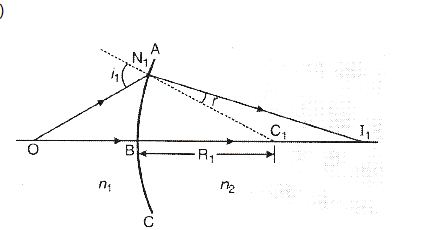
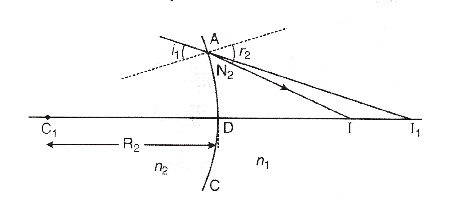
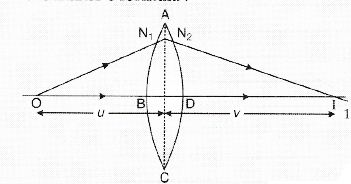
The first refracting ABC forms the image I1 of the object O. The image I1 acts as virtual object for the second refracting surface ADC, which forms the real image I as shown in the diagram
For refraction at ABC
\(\frac { { n }_{ 2 } }{ { v }_{ 1 } } -\frac { { n }_{ 1 } }{ u } =\frac { { n }_{ 2 }-{ n }_{ 1 } }{ { R }_{ 1 } } \)
For refraction at ADC
\(\frac { { n }_{ 1 } }{ v } -\frac { { n }_{ 2 } }{ { v }_{ 1 } } =\frac { { n }_{ 1 }-{ n }_{ 2 } }{ { R }_{ 2 } } \)
Adding equation (i) and equation (ii)
\(\frac { { n }_{ 1 } }{ v } -\frac { { n }_{ 2 } }{ u } =\left( { n }_{ 2 }-{ n }_{ 1 } \right) \left( \frac { 1 }{ { R }_{ 1 } } -\frac { 1 }{ { R }_{ 2 } } \right) \)
\(\frac { 1 }{ v } -\frac { 1 }{ u } =\left( \frac { { n }_{ 2 } }{ { n }_{ 1 } } -1 \right) \left( \frac { 1 }{ { R }_{ 1 } } -\frac { 1 }{ { R }_{ 2 } } \right) \)
We know, If \(u=\infty ,v=f\)
\(\frac { 1 }{ v } -\frac { 1 }{ u } =\frac { 1 }{ f } \)
\(\frac { 1 }{ f } =\left( \frac { { n }_{ 2 } }{ { n }_{ 1 } } -1 \right) \frac { 1 }{ { R }_{ 1 } } -\frac { 1 }{ { R }_{ 2 } } \)
\(\frac { 1 }{ f } =\left( { \mu }_{ 21 }-1 \right) \left( \frac { 1 }{ { R }_{ 1 } } -\frac { 1 }{ { R }_{ 2 } } \right) \)
\(\frac { 1 }{ f } =\left( { \mu }_{ 21 }-1 \right) \left( \frac { 1 }{ { R }_{ 1 } } -\frac { 1 }{ { R }_{ 2 } } \right) \)
\(\frac { 1 }{ f } =\left( 1.55-1 \right) \left( \frac { 1 }{ R } -\frac { 1 }{ -R } \right) \)
\(=0.55\times \frac { 2 }{ R } \)
\(R=0.55\times 2\times 20=22 \ cm\)
2.
\(Here,\quad \frac { \Delta \lambda }{ \lambda } =\frac { 0.032 }{ 100 } ,v=?\)
Since the wavelength of light from a star is shifting towards longer wavelength side, therefore \(\Delta \lambda \)is positive, hence star is moving away from the earth i.e., v is negative.
\(v=\frac { \Delta \lambda }{ \lambda } c=-\frac { 0.032 }{ 100 } \times 3\times { 10 }^{ 8 }\)
\( =-9.6\times { 10 }^{ 4 }m{ s }^{ -1 }\)
3.
\(Here, \ v=8.1\times { 10 }^{ 9 }Hz\)
\( \Delta v=2.7\times { 10 }^{ 3 }Hz\)
\(Velocity \ of \ aeroplane, \ v=\frac { 1 }{ 2 } \frac { \Delta v }{ v } \times c\)
\(=\frac { 1 }{ 2 } \times \frac { 2.7\times { 10 }^{ 3 } }{ 8.1\times { 10 }^{ 9 } } \times 3\times { 10 }^{ 8 }=50m/s\)
4.
\(Here,\ D=60 \ cm=0.6 \ m\)
\({ f }_{ 0 }=2.0m,\ { f }_{ e }=1.0cm\)
Distance between stars \(={ 10 }^{ 4 }light \ years\)
\( ={ 10 }^{ 4 }\times (9.46\times { 10 }^{ 15 }m)=9.46\times { 10 }^{ 19 }m\)
Transverse separation of stars \(={ 10 }^{ 10 }m\)
Angle subtended by transverse separation of stars
\(=\frac { { 10 }^{ 10 } }{ 9.46\times { 10 }^{ 19 } } \approx { 10 }^{ -10 }radian\)
Smallest angular separation between two objects that can be resolved by the telescope=limit of resolution of telescope,
\(d\theta =\frac { 1.22\lambda }{ D } =\frac { 1.22\times (6\times { 10 }^{ -7 }) }{ 0.6 } \)
\( =1.22\times { 10 }^{ -6 }rad\)
As the angle subtended by transverse separation of stars is much too small compared to the limit of resolution of the telescope, therefore, the two stars of the binary cannot be resolved by the telescope.
5.
(i) When light travels from water to air,
\(^{ a }{ \mu }_{ w }=\frac { 1 }{ sin\quad C } \)
\(sin\quad C=\frac { 1 }{ ^{ a }{ \mu }_{ w } } =\frac { 1 }{ 1.33 } =0.7518\)
\(\therefore \) \(C=sin^{ -1 }(0.7518)=48° \ 44'\)
(ii) When light travels from glass into water
\(^{ w }{ \mu }_{ g }=\frac { 1 }{ sin \ C' } , \ i.e., \ \frac { ^{ a }{ \mu }_{ g } }{ ^{ a }{ \mu }_{ w } } =\frac { 1 }{ sin \ C' } \)
or \(\frac { 1.5 }{ 1.33 } =\frac { 1 }{ sin\quad C' } \)
or \(sin\quad C'=\frac { 1.33 }{ 1.5 } =0.8866\)
\(\therefore \) \(C'=sin^{ -1 }\quad (0.8866)\)
\(=62° \ 27'\)
6.
\(Here,\quad { \lambda }_{ r }=660nm;\lambda '=?\)
\(For \ diffraction \ minima,\)
\(a \ sin\theta =n\lambda , \ sin\theta =\frac { n\lambda }{ a } \)
\( For \ first \ minima \ of \ red \ light, \ sin\theta =\frac { 1{ \lambda }_{ r } }{ a } \)
\(For \ diffraction \ maxima,\ asin\theta =(2n+1)\frac { \lambda }{ 2 }\)
\(for \ first \ maxima \ of \ \lambda ',\)
\(a \ sin\theta '=\frac { 3\lambda ' }{ 2 } ; \ sin\theta '=\frac { 3\lambda ' }{ 2a } ;\)
\(As \ the \ two \ coincide, \ therefore, \ sin\theta '=sin\theta \)
\(\\ \frac { 3\lambda ' }{ 2a } =\frac { { \lambda }_{ r } }{ a } or\lambda '=\frac { 2 }{ 3 } { \lambda }_{ r }\)
\(or \ \lambda '=\frac { 2 }{ 3 } (660)=440nm\)
7.
Here, \(i_{ 1 }=45°, \ t=10 \ cm=0.1 \ m\)
\(\mu =1.5,\) lateral shift=?
As \(\mu =\frac { sin \ i_{ 1 } }{ sin \ r_{ 1 } } \)
\(\therefore \) \(sin \ r_{ 1 }=\frac { sin \ i_{ 1 } }{ \mu } =\frac { sin \ 45° }{ 1.5 } =\frac { 0.707 }{ 1.5 } =0.4713\)
\(r_{ 1 }=sin^{ -1 }(0.4713)=28.14°\)
lateral shift\(=\frac { t \ sin(i_{ 1 }-r_{ 1 }) }{ cos \ r_{ 1 } } \)
\(=\frac { 0.1 \ sin \ (45°-28.14°) }{ cos \ 28.14° } \)
\(=\frac { 0.1 \ sin \ 16.86° }{ cos\quad 28.14° } =\frac { 0.1\times 0.2900 }{ 0.8818 } =0.033 \ m\)
8.
Here,
\(h_{ 1 }=5 \ cm, \ u=-10 \ cm\)
\(f=40 \ cm\)
From
\(\frac { 1 }{ \upsilon } =\frac { 1 }{ f } -\frac { 1 }{ u } =\frac { 1 }{ 40 } -\frac { 1 }{ -10 } =\frac { 5 }{ 40 } =\frac { 1 }{ 8 }\)
\(\upsilon =8\ cm\)
Image is virtual, erect and is formed 8 cm behind the mirror.
Magnification,
\(m=\frac { h_{ 2 } }{ h_{ 1 } } =\frac { -\upsilon }{ u } =\frac { -8 }{ -10 } =\frac { 4 }{ 5 } \)
\(h_{ 2 }=\frac { 4 }{ 5 } h_{ 1 }=\frac { 4 }{ 5 } \times 5=4\ cm\)
As needle is moved farther away from the mirror, image shifts towards the focus and its size goes on decreasing.
9.
Here, \(\lambda =5000\quad \overset { \circ }{ A } =5\times 10^{ -7 }m\)
\(v=\frac { c }{ \lambda } =\frac { 3\times 10^{ 8 } }{ 5\times 10^{ -7 } } =6\times 10^{ 14 }\) hertz
On reflection, there is no change in wavelength or frequency. Therefore,
\(\lambda '=\lambda =5000\quad \overset { \circ }{ A } \quad ;\quad v'=v=6\times 10^{ 14 }Hz.\)
For reflected ray to be normal to incident ray,
\(i+r=90°\) or \(i+i=90°\) \((\because r=i)\)
\(\therefore \) \(i=90/2=45°\)
10.
A = 600 , \(\delta \)m = 300
i = e = ¾ A = 450
as A + \(\delta \) = i + e
60 + \(\delta \) = 45 +45
or \(\delta \) = 300
Refractive index,
\(\mu \) = sin a + \(\delta \)m /2/sin A/2 = sin 600+300/2/sin 600/2
= sin 450/sin300 = 1\(\surd 2\) 1/2 = \(\surd 2\) = 1.414
11.
(i) As the lens forms a real iamge, it must be a convex lens.
(ii) From the graph, when u = 20 cm , we have v = 20 cm.
For the convex lens forming a real iamge, u is negative and v and f are positive.
U = -20 cm v = +20cm
Using this lens formula,
1/f = 1/v – 1/u = 1/20 – 1/-20 = 1/10 or f = + 10 cm
12.
Clearly , the fish can see the outside view of the cone with semi vertical angle
But \(\mu \) = 1.sin ic
or 1/3 = 1/ sin ic
or sin ic = 3/4 = 0.75
\(\theta\)/2 =ic = sin-1 (0.75 ) = 48.60

12th Standard CBSE Syllabus & Materials
12th Standard CBSE
CBSE 12th Computer Science Python Revision Tour I - New Previous year Question Papers Study Material - QB365 Set A
NEW12th Standard CBSE
CBSE 12th Business Studies Planning Important Questions And Answers Study Material - QB365 Set A
NEW12th Standard CBSE
CBSE 12th Business Studies Business Environment Important Questions And Answers Study Material - QB365 Set A
NEW12th Standard CBSE
CBSE 12th Business Studies Principles of Management Important Questions And Answers Study Material - QB365 Set A



CBSE 12th Standard CBSE Subjects
CBSE Standards










