
 100% FREE ACCESS
12th Standard CBSE Syllabus & Materials
12th Standard CBSE
CBSE 12th Economics Government Budget and the Economy Previous year Question Papers Study Material - QB365 Set A
NEW12th Standard CBSE
CBSE 12th Computer Science Interface Python with MySQL - New Previous year Question Papers Study Material - QB365 Set A
NEW12th Standard CBSE
CBSE 12th Computer Science Database Concept - New Previous year Question Papers Study Material - QB365 Set A
NEW12th Standard CBSE
CBSE 12th Computer Science Data Communication - New Previous year Question Papers Study Material - QB365 Set A
NEW12th Standard CBSE
CBSE 12th Computer Science Data Structures - New Previous year Question Papers Study Material - QB365 Set A
NEW12th Standard CBSE
CBSE 12th Computer Science Functions - New Previous year Question Papers Study Material - QB365 Set A

Published on: 21/05/2021
QB365 Provides the updated CASE Study Questions for Class 12 Biology, and also provide the detail solution for each and every case study questions . Case study questions are latest updated question pattern from NCERT, QB365 will helps to get more marks in Exams
Download CBSE Class 12th Standard CBSE Biology question papers, sample papers, important questions, and previous year solved papers in PDF format. Get free study materials, NCERT solutions, and exam preparation resources for Class 12th Standard CBSE Biology
Questions + Answers key
Take MCQ Biology Test
1.
Faced with conflict between development and conservation, many nations find it unrealistic and economically not feasible to conserve all their biological wealth. On a global basis, eminent conservationists have identified certain regions as 'Biodiversity hotspots' for maximum protection.
(a) Mention two criteria for a region to be called a 'biodiversity hotspot'.
(b) Name two biodiversity hotspots in India.
(c) Hotspots occupy less than 2 per cent of the earth's land area. Yet, they are given priority for conservation of biodiversity. Give two reasons.
2.
It is learnt from the study of the history of life on earth through fossil records that there were large scale losses of species. Since the orgin and diversification of life forms on the earth, there were five episodes of mass extinction. The 'Sixth Extinction' is presently in progress.
(a) Give two points as to how this sixth episode is different from the earlier episodes.
(b) What do the ecologists warn about the current trend?
(c) Mention the three effects of loss of biodiversity in a region.
3.
When a graph showing species-area relationship on a logarithmic scale, the relationship is a straight line. Ecologists have discovered that the value of z-line lies in the range of 0.1 and 0.2 irrespective of the taxonomic group or the region.
(a) When will the stope become much steeper with higher Z-values? Give an example.
(b) What do steeper slopes mean in this context?
4.
The following graph shows the species area relationship.
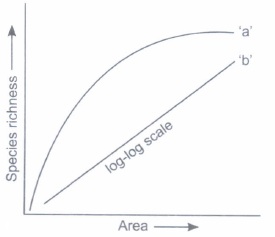
Answer the following questions as asked.
(i) Write the equations for the curves a and b.
(ii) Name the naturalist who showed this kind of relationship.
(iii) Name the region he explored.
5.
The global animal diversity is shown in the pie charts (A-Invertebrates and B-vertebrates) drawn below.
Answer the questions that follow.
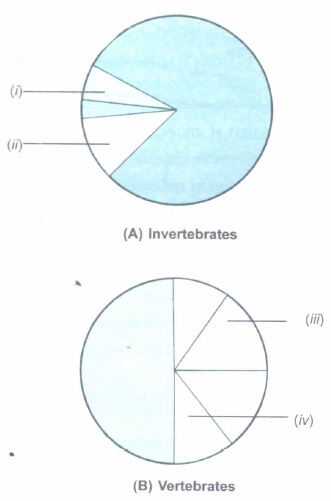
(a) Name the animal groups that are represented by the areas shaded black in A and B, respectively. Also, mention the kind of habitat, where you would find these groups of animals.
(b) Identify the following groups of animals in the pie diagrams: Crustaceans and Amphibians.
1.
(a) Criteria for hotspot.
(i) Very high levels of species richness.
(ii) High degree of endemism.
(b) (i) Western Ghats
(ii) Himalaya
(c) (i) The number of species (species richness) they collectively harbour is extremely high.
(ii) Strict protection of these hotspots could reduce the ongoing mass extinctions by nearly 30 per cent.
2.
(a) The two differences are:
(i) The current rate of extinction of species is100-1000 times faster than the previous episodes.
(ii) The human activities are responsible for this faster rate.
(b) The ecologists warn that if the present trend continues, nearly half of all the species on earth might be wiped out within the next 100 years.
(c) Loss of biodiversity in a region would lead to:
(i) Decline in plant productivity.
(ii) Lowered resistance to environmental perturbations.
(iii) Increased variability in certain ecosystem processes.
3.
(a) When the species-area relationship is analysed for very large area like the entire continent, the slope of the line becomes steeper with values ranging between 0.6 and 1.2.
e.g. the slope is found to be 1.15 for the frugivorous birds of trophical forests of different continents.
(b) Steeper slopes mean higher species richness.
4.
(i) a. S = CA2
b. Log S = Log C + Z Log A, where
S = Species richness
C = Y intercept
A = Area explored
Z = Slope of the line (Regression coefficient)
(ii) Alexander van Humboldt
(iii) South American Jungles.
5.
(a) A - Insects; they are present in soil, water, on the plants and animals.
B - Fishes; they are aquatic, both marine and freshwater.
(b) (ii) Crustaceans (iv) Amphibians.

12th Standard CBSE Syllabus & Materials
12th Standard CBSE
CBSE 12th Computer Science Python Revision Tour I - New Previous year Question Papers Study Material - QB365 Set A
NEW12th Standard CBSE
CBSE 12th Business Studies Planning Important Questions And Answers Study Material - QB365 Set A
NEW12th Standard CBSE
CBSE 12th Business Studies Business Environment Important Questions And Answers Study Material - QB365 Set A
NEW12th Standard CBSE
CBSE 12th Business Studies Principles of Management Important Questions And Answers Study Material - QB365 Set A



NCERT Books

Syllabus

Exam Pattern

Sample Question Papers

Previous year Question Papers

Important Notes

MCQ Practice test

NCERT Exemplers

Case study Questions

Image Based Questions

Passage based Questions

HOT Questions

Value Based Questions

Model Questions Papers
NCERT ( Book Back ) Questions

Assertion and Reason
Important Questions And Answers

CBSE 12th Standard CBSE Subjects
CBSE Standards








