
 100% FREE ACCESS
12th Standard CBSE Syllabus & Materials
12th Standard CBSE
CBSE 12th Economics Government Budget and the Economy Previous year Question Papers Study Material - QB365 Set A
NEW12th Standard CBSE
CBSE 12th Computer Science Interface Python with MySQL - New Previous year Question Papers Study Material - QB365 Set A
NEW12th Standard CBSE
CBSE 12th Computer Science Database Concept - New Previous year Question Papers Study Material - QB365 Set A
NEW12th Standard CBSE
CBSE 12th Computer Science Data Communication - New Previous year Question Papers Study Material - QB365 Set A
NEW12th Standard CBSE
CBSE 12th Computer Science Data Structures - New Previous year Question Papers Study Material - QB365 Set A
NEW12th Standard CBSE
CBSE 12th Computer Science Functions - New Previous year Question Papers Study Material - QB365 Set A

Published on: 29/05/2021
QB365 Provides the HOT Question Papers for Class 12 Biology, and also provide the detail solution for each and every HOT Questions. HOT Questions will help to get more idea about question pattern in every exams and also will help to get more marks in Exams
Download CBSE Class 12th Standard CBSE Biology question papers, sample papers, important questions, and previous year solved papers in PDF format. Get free study materials, NCERT solutions, and exam preparation resources for Class 12th Standard CBSE Biology
Questions + Answers key
Take MCQ Biology Test1.
Study-1. A forest that is rich in biodiversity seems to decline in animal population. The government declared it as a biodiversity hotspot and the forest regained its species richness in few years. Study-2. A lake that is rich in marine fishes seems to decline in its species population due to overexploitation. A wise man in the area decided to worship the lake. The species population f the lake again became normal.
(a) Which values are been promoted in the above studies.
(b) Suggest some ways by which you can contribute to this concern.
(c) What would be the effect if the forest was not declared hotspot?
2.
Alien species are threat to native species. Justify
3.
Loss of key species that drive major ecosystem functions is the most serious threat to species diversity found in any ecosystem. How is it explained by Paul Ehalich through the "rivet popper hypothesis" analogy.
4.
Conservation of bio-diversity is a collective responsibility of all nations. Mention the steps taken by various countries in this direction.
5.
Categorize the followings statement into narrowly utilitarian, broadly utilitarian and ethical reason:-
i) Every species in biodiversity has an intrinsic value even if it not of value to us.
ii) Human beings device a number of economic benefits like food, fiber etc from biodiversity.
iii) Biodiversity provides ecosystem services which can not be given price tag. Justify your categorization also.
6.
Ecologists believe that communities with more species tend to be more stable than those with less species. What attributes are taken into account while defining a stable community. Mention the observation of David Tilman ecological experiments using outdoor plots.
7.
On a log scale, species area relationship becomes linear and can be represented by equation logS = logC + z logA. What is represented by S, z,a & c in this equation. What is the average value of Z-line irrespective of the taxonomic group or the region? The z value for frugivorous birds and mammals in the tropical forests of different continents is found to be 1.15. Why is it so?
8.
What is EI Nino effect? Explain how it accounts for biodiversity loss.
9.
Write a critical note on the following:
(i) Hotspots of biodiversity.
(ii) Ex-situ conservation.
(iii) India's effort in biodiversity
10.
The species diversity of plants (22 per cent) is much less than that of animals (72 per cent). What could be the explanations to how animals achieved greater diversification?
1.
(i) Biodiversity conservation, Ecosystem protection.
(iii) Educate people not to harm biodiversity.
(iii) Forest would be destroyed, many species of plants and animals lost.
2.
Alien species are species that have been introduced from another geographic region to an area outside its natural range. For example; Parthenium, Lantana and Eicchornia are invaded the native species of India and causes environmental damage. Introduction of African catfish Clarias gariepinus in India for aquaculture purpose is posing threat to many indigenous catfish.
3.
Details of rivet popper hypothesis emphasizing the loss of rivets on the wings of an aeroplane, less of key species that drive major ecosystem function is a serious threat.
4.
Earth Summit held at Rio de Janerio and World Summit on sustainable development held in 2002 in Johannesburg South Africa where 190 countries pledged their commitment to achieve by 2010, a significant reduction in the current rate of biodiversity loss at global, regional and local levels.
5.
i) Ethical
ii) Narrowly utilitarian
iii) Broadly utilitarian
6.
Less variation in productivity from years to years, resilient to occasional disturbances, resistant to invasions by alien species. Tilman found that plots with more species showed less year to year variations in total biomass & increased diversity contributed to higher productivity.
7.
S – species, A – area, Z – slope of the line (regression coefficient), C – Y intercept. Z value is 0.1 to 0.2 Value 1.15 indicates larger suitable areas for species diversity.
8.
(a) EI Nino. It is an abnormal warming of surface ocean waters in the eastern tropical Pacific. It is called the Southern Oscillation. The Southern Oscillation is the see-saw pattern of reversing surface air pressure between the eastern and western tropical Pacific; When the surface pressure is high in the eastern tropical Pacific it is low in the western tropical Pacific, and vice-versa. Because the ocean warming and pressure reversals are, for the most part, simultaneous, scientists call this phenomenon the EI Nino/Southern Oscillation or ENSO for short.
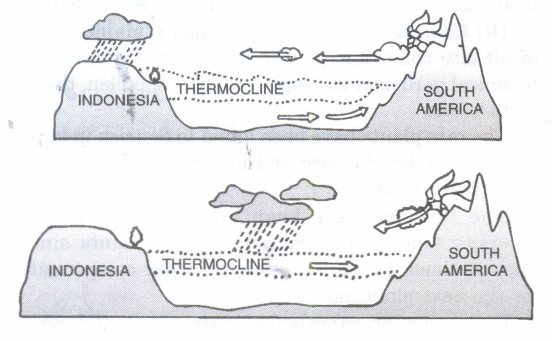
Unfortunately not all EI Nino's are the same nor does the atmosphere always react in the same way from one EI Nino to another. This is why NASA's Earth scientists continue to take part in international efforts to understand EI Nino events. Hopefully one day scientists will be able to provide sufficient warning so that we can be better prepared to deal with the damages and changes that EI Nino causes in the weather.
9.
(i) Hot spots of biodiversity. The concept of 'Hot-spots' was developed by Norman Myres (1988) to designate specific areas for in-situ conservation. The conservation the hot spots are the richest and most threatened reservoirs of plants and animal life on earth.
The criteria for determining hot spots are:
1. Number of endemic species.
2. Degree of threat which is measured in terms of habitat loss.
There are 25 hot spots in the world out of which two are in India. They are Western Ghats and eastern Himalayas.
Hot spot of Eastern Himalayas are active centres of evolution and rich in diversity of flowering angiosperms. Western Ghats have semi evergreen forests. Western Ghats include two main centres of biodiversity i.e. Agastyamalai hills and Silent valley.
(ii) Ex-situ conservation. It means maintenance of off site collections either in gardens by farmers, botanical garden for storing seeds, genes, pollen, tissue culture etc.
The rare plants have been found to flourish in large numbers under the care and protection of gardeners and nature lovers.
The farmers have been maintaining genetic diversity (enormous varieties) of crop plants since ancient times by saving seeds or other components for the next plantings.
Collection of samples of cultivated and wild varieties of plants and storing them in botanical gardens is another method of conservation of germplasm.
In seeds, the living meterial remains in metabolically suspened state. When the seeds are to be stores for longer periods, it is necessary to avoid conditions which favour respiration and enzymatic actions.
(iii) India's effort in biodiversity conservation. India has greatly contributed to conservation of biodiversity owing to its great utility and need for conservation. The following measures have been taken for this purpose:
1. Setting up bodies like Indian Board for Wildlife, Bombay Natural History etc.
2. observation of first week of October as national wildlife week.
3. Introduction of Wildlife Protection Act in 1972.
4. Setting up of sanctuaries, national parks and biosphere reserves.
10.
Since plants cannot move away from their predators (herbivores) and harsh environmental conditions, many of them have become extinct. But animals can move away from the harmful/unfavourable environments or their predators and evolution of favourable characters has thus taken place in them.

12th Standard CBSE Syllabus & Materials
12th Standard CBSE
CBSE 12th Computer Science Python Revision Tour I - New Previous year Question Papers Study Material - QB365 Set A
NEW12th Standard CBSE
CBSE 12th Business Studies Planning Important Questions And Answers Study Material - QB365 Set A
NEW12th Standard CBSE
CBSE 12th Business Studies Business Environment Important Questions And Answers Study Material - QB365 Set A
NEW12th Standard CBSE
CBSE 12th Business Studies Principles of Management Important Questions And Answers Study Material - QB365 Set A



NCERT Books

Syllabus

Exam Pattern

Sample Question Papers

Previous year Question Papers

Important Notes

MCQ Practice test

NCERT Exemplers

Case study Questions

Image Based Questions

Passage based Questions

HOT Questions

Value Based Questions

Model Questions Papers
NCERT ( Book Back ) Questions

Assertion and Reason
Important Questions And Answers

CBSE 12th Standard CBSE Subjects
CBSE Standards









