
 100% FREE ACCESS
12th Standard CBSE Syllabus & Materials
12th Standard CBSE
CBSE 12th Economics Government Budget and the Economy Previous year Question Papers Study Material - QB365 Set A
NEW12th Standard CBSE
CBSE 12th Computer Science Interface Python with MySQL - New Previous year Question Papers Study Material - QB365 Set A
NEW12th Standard CBSE
CBSE 12th Computer Science Database Concept - New Previous year Question Papers Study Material - QB365 Set A
NEW12th Standard CBSE
CBSE 12th Computer Science Data Communication - New Previous year Question Papers Study Material - QB365 Set A
NEW12th Standard CBSE
CBSE 12th Computer Science Data Structures - New Previous year Question Papers Study Material - QB365 Set A
NEW12th Standard CBSE
CBSE 12th Computer Science Functions - New Previous year Question Papers Study Material - QB365 Set A

Published on: 21/05/2021
QB365 Provides the updated CASE Study Questions for Class 12 Biology, and also provide the detail solution for each and every case study questions . Case study questions are latest updated question pattern from NCERT, QB365 will helps to get more marks in Exams
Download CBSE Class 12th Standard CBSE Biology question papers, sample papers, important questions, and previous year solved papers in PDF format. Get free study materials, NCERT solutions, and exam preparation resources for Class 12th Standard CBSE Biology
Questions + Answers key
Take MCQ Biology Test
1.
Read the following and answer any four questions from (i) to(v) given below:
In recombinant DNA technology, the fragments of DNA generated after cutting the DNA by restriction enzymes are separated according to their size or length by gel electrophoresis. Gel electrophoresis is performed in a gel matrix so that molecules of similar electric charges can be separated on the basis of size. Most commonly used matrix in gel electrophoresis is agarose. The fragments are separated under the influence of electric field. The separated DNA fragments can be seen only after staining the DNA with compound known as ethidium bromide (EtBr) followed by exposure to UV radiation as bright orange band.
(i) Gel electrophoresis is used for the separation of
| (a) DNA only | (b) DNA and RNA only |
| (c) DNA and proteins only | (d) DNA, RNA and proteins. |
(ii) Most commonly used matrix is (i) which is a (ii) extracted from (iii).
| (a) (i) agarose (ii) polysaccharide (iii) sea weed | (b) (i) agarose (ii) protein (iii) sea weed |
| (c) (i) EtBr (ii) polysaccharide (iii) sea weed | (d) (i) EtBr (ii) protein (iii) bacteria |
(iii) A DNA molecule was treated with a restriction endonuclease and three fragments of size (i) 426 kb, (ii) 129 kb and (iii) 46 kb were obtained. Identify the order in which these bands will arrange themselves in the gel plate after gel electrophoresis is completed. (Assuming that negative part of electrode is towards the well)
| (a) (iii) ➝ (ii) ➝ (i) | (b) (i) ➝ (ii) ➝(iii) | (c) (i) ➝ (iii) ➝ (ii) | (d) (iii) ➝ (i) ➝ (ii) |
(iv) Which of the following statements regarding gel electrophoresis is incorrect?
| (a) Separated DNA fragments can be seen only after staining DNA with EtBr. | (b) DNA fragments are separated according to their size. |
| (c) Under the influence of electric field, positively charged molecules move towards the anode and negatively charged molecules move towards the cathode. | (d) None of these |
(v) The factor that will not affect the rate of DNA migration in gel electrophoresis is
| (a) size of DNA molecule | (b) concentration of DNA | (c) voltage supplied | (d) concentration of the gel |
2.
Read the following and answer any four questions from (i) to (v) given below:
The foundations of recombinant DNA (rDNA) were laid by the discovery of restriction enzymes. These enzymes are present in many bacterias where they function as a part of their defense mechanism called the Restriction Modification system (RM system). Molecular basis of this system was explained first by Werner Arber in 1962. The Restriction t-'l0dification system consists of two components:
1. A restriction enzyme (called restriction endonuclease) identifies the introduced foreign DNA and cuts it into pieces.
2.The second component is a modification enzyme (methylase) that adds a methyl group to DNA at specific site to protect it from the restriction enzyme cleavage.
(i) Restriction endonucleases are enzymes present in (i) where they function as a part of (ii) mechanism.
| (a) (i) bacteria (ii) digestive | (b) (i) protists (ii) transcription | (c) (i) plant cells (ii) replication | (d) (i) prokaryotes (ii) defence |
(ii) Which of the following statements regarding modification enzyme is correct?
| (a) It adds methyl group to one or two bases usually within the host DNA sequence to protect it from the restriction enzyme. |
| (b) It adds ethyl group to one or two bases usually within the sequence recognised by the restriction enzymes. |
| (c) It adds methyl group to only one of bases within the foreign DNA sequence that is recognised by the restriction enzymes. |
| (d) None of these |
(iii) Which of the following is a type II restriction enzyme?
| (a) Alu I | (b) EcoR I | (c) BamH I | (d) All of these |
(iv) Which of the following is the first discovered restriction endonuclease?
| (a) Sal I | (b) EcoR I | (c) Hind II | (d) EcoR II |
(v) Components of Restriction Modification System include
| (a) restriction enzyme | (b) modification enzyme | (c) lysing enzyme | (d) both (a) and (b). |
3.
Read the following and answer any four questions from (i) to (v) given below:
Gene manipulation is a fast emerging science. It started with development of recombinant DNA molecule. It is named variously as DNA manipulation biotechnology, recombinant DNA technology and genetic engineering. This technology, that mostly involves cutting and pasting of desired DNA fragments, is based on two important discoveries in bacteria, i.e., presence of plasmid in bacteria and restriction endonucleases. Paul Berg was able to introduce a gene of SV-40 into a bacterium. The science of recombinant DNA technology took birth when Cohen and Boyer (1973) were able to introduce a piece of gene containing foreign DNA into plasmid of E.coli.
(i) Biotechnology is also known as
| (a) DNA manipulation biotechnology | (b) recombinant DNA technology |
| (c) genetic engineering | (d) all of these. |
(ii) A bacterial plasmid is a/an
| (a) extra chromosomal material that do not replicate | (b) extra chromosomal material that undergo replication with or without chromosomal DNA |
| (c) tubular structures that help in conjugation | (d) bristle like solid structure that help in adhesion. |
(iii) Father of genetic engineering is
| (a) Paul Berg | (b) Arber | (c) Nathan | (d) Smith. |
(iv) Which of the following is used by Paul Berg to introduce a gene of SV-40 in a bacterium?
| (a) E. coli | (b) cos-plasmids | (c) Lambda phage | (d) None of these |
(v) Read the given statements and select the correct option.
Assertion : Biotechnology started with the development of recombinant DNA molecule.
Reason : Biotechnology mostly involves cutting and pasting of desired DNA fragments.
| (a) Both assertion and reason are true and reason is the correct explanation of assertion. |
| (b) Both assertion and reason are true but reason is not the correct explanation of assertion. |
| (c) Assertion is true but reason is false. |
| (d) Both assertion and reason are false. |
4.
A schematic representation of the steps in Polymerase Chain Reaction (PCR) is shown below. Answer the questions that follow:
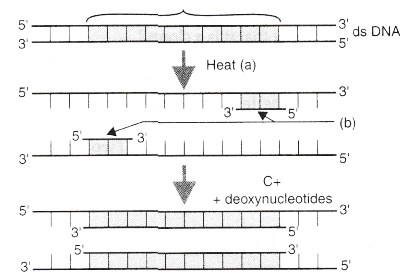
(a) Name the steps A and D in the PCR.
(b) Identify B. What are they chemically?
(c) What is C? Name its source organism.
1.
(i) (d) : Gel electrophoresis is a technique used to separate fragments of molecules, i.e., DNA, RNA and protein.
(ii) (a)
(iii) (b)
(iv) (c) : Under the influence of electric field positively charged molecules move towards the cathode and negatively charged molecules move towards the anode.
(v) (b) : Concentration of DNA will not affect the migration of DNA molecule in a gel electrophoresis. As in gel electrophoresis, molecules separate according to their size therefore DNA size will affect migration. Increased voltage supply will increase rate of migration and the more concentrated gel will reduce rate of migration.
2.
(i) (d)
(ii) (a)
(iii) (d) : Different examples of Type II restriction endonuclease are Alu I, EcoR I, BamH I, etc.
(iv) (c)
(v) (d) : The restriction modification system consists of two components
(i) A restriction enzyme called restriction endonucleases which identifies the introduced foreign DNA and cuts it into pieces and
(ii) A modification enzyme (methylase) that adds a methyl group to DNA at a specific site to protect the site from restriction endonuclease cleavage.
3.
(i) (d)
(ii) (b) : Plasmid in a bacterial cell is an extra chromosomal material that undergo replication with or without chromosomal DNA.
(iii) (a)
(iv) (c) : In 1972, Paul Berg was able to introduce a gene of SV-40 virus into a bacterium with the help of lambda phage.
(v) (b)
4.
(a) A - Denaturation; D - Extension.
(b) B - Primers; they are oligonucleotides.
(c) C - Taq polymerase; its source organism is Thermus aquaticus.

12th Standard CBSE Syllabus & Materials
12th Standard CBSE
CBSE 12th Computer Science Python Revision Tour I - New Previous year Question Papers Study Material - QB365 Set A
NEW12th Standard CBSE
CBSE 12th Business Studies Planning Important Questions And Answers Study Material - QB365 Set A
NEW12th Standard CBSE
CBSE 12th Business Studies Business Environment Important Questions And Answers Study Material - QB365 Set A
NEW12th Standard CBSE
CBSE 12th Business Studies Principles of Management Important Questions And Answers Study Material - QB365 Set A



NCERT Books

Syllabus

Exam Pattern

Sample Question Papers

Previous year Question Papers

Important Notes

MCQ Practice test

NCERT Exemplers

Case study Questions

Image Based Questions

Passage based Questions

HOT Questions

Value Based Questions

Model Questions Papers
NCERT ( Book Back ) Questions

Assertion and Reason
Important Questions And Answers

CBSE 12th Standard CBSE Subjects
CBSE Standards








