
 100% FREE ACCESS
12th Standard CBSE Syllabus & Materials
12th Standard CBSE
CBSE 12th Economics Government Budget and the Economy Previous year Question Papers Study Material - QB365 Set A
NEW12th Standard CBSE
CBSE 12th Computer Science Interface Python with MySQL - New Previous year Question Papers Study Material - QB365 Set A
NEW12th Standard CBSE
CBSE 12th Computer Science Database Concept - New Previous year Question Papers Study Material - QB365 Set A
NEW12th Standard CBSE
CBSE 12th Computer Science Data Communication - New Previous year Question Papers Study Material - QB365 Set A
NEW12th Standard CBSE
CBSE 12th Computer Science Data Structures - New Previous year Question Papers Study Material - QB365 Set A
NEW12th Standard CBSE
CBSE 12th Computer Science Functions - New Previous year Question Papers Study Material - QB365 Set A

Published on: 21/05/2021
QB365 Provides the updated CASE Study Questions for Class 12 Biology, and also provide the detail solution for each and every case study questions . Case study questions are latest updated question pattern from NCERT, QB365 will helps to get more marks in Exams
Download CBSE Class 12th Standard CBSE Biology question papers, sample papers, important questions, and previous year solved papers in PDF format. Get free study materials, NCERT solutions, and exam preparation resources for Class 12th Standard CBSE Biology
Questions + Answers key
Take MCQ Biology Test
1.
Read the following and answer any four questions from (i) to (v) given below:
Crown gall is a neoplastic disease of most dicotyledonous plants and is caused by the soil bacterium Agrobacterium tumefaciens. A large extra chromosomal plasmid in these bacteria was found to be responsible for this disease. The plasmid is known as Ti plasmid. Bacteria free crown gall cells can be cultured in the absence of phytohormones. Ti plasmid is widely used in genetic engineering to deliver the desirable genes. The part of Ti plasmid transferred into plant cell DNA is called T-DNA. T-DNA with desired DNA segment is inserted into the chromosome of the host plant where it produces copies of itself.
(i) Which of the following is the full form of T-DNA?
| (a) Transfer DNA | (b) Tumour inducing DNA | (c) Transgenic DNA | (d) None of these |
(ii) Ti plasmid cannot infect and develop crown gall in
| (a) tomato | (b) maize | (c) soybean | (d) sunflower. |
(iii) While making transgenic plant, T-DNA is inserted into the host cell, it is then
| (a) integrated into the target host genome |
| (b) lie independent of the host genome |
| (c) rupture the host cell wall |
| (d) produce oncogenic factors in the host |
(iv) Agrobacterium mediated gene transfer in plants
| (a) allows relatively large segment of DNA |
| (b) transfer of DNA with defined ends and minimal rearrangement |
| (c) high quality and fertility in transgenic plants |
| (d) all of these |
(v) Assertion : In Agrobacterium mediated gene transfer in plants, transgenic plants do not develop tumors.
Reason : In T-DNA tumor producing genes are deleted during the process of gene transfer.
| (a) Both assertion and reason are true and reason is the correct explanation of assertion |
| (b) Both assertion and reason are true but reason is not the correct explanation of assertion. |
| (c) Assertion is true but reason is false. |
| (d) Both assertion and reason are false |
2.
Read the following and answer any four questions from (i) to (v) given below:
Bioreactors are considered as vessels in which raw materials are biologically converted into specific products by microbes, plant and animal cells or their enzymes. They are used for large scale production as they provide optimum growth conditions such as temperature, pH, substrate, vitamins, oxygen and salts for obtaining desired product. Most commonly used bioreactors are of stirring type which include simple stirred tank bioreactor and sparged stirred-tank bioreactor.
(i) Bioreactor are useful in
| (a) amplifying a gene | (b) isolation of genetic material |
| (c) processing large volume of culture | (d) infecting DNA in a cell. |
(ii) Which of the following is essential to obtain desired product in a bioreactor?
| (a) Size of the bioreactor | (b) Sterile condition |
| (c) Quantity of the raw material | (d) All of these |
(iii) Assertion : The stirred-tank is well suited for large scale production of microorganisms under aseptic conditions.
Reason: In sparged stirred tank bioreactor, surface area for oxygen transfer is increased.
| (a) Both assertion and reason are true and reason is the correct explanation of assertion. |
| (b) Both assertion and reason are true but reason is not the correct explanation of assertion. |
| (c) Assertion is true but reason is false. |
| (d) Both assertion and reason are false. |
(iv) Growth condition that could affect the quality of obtained product in a bioreactor are
| (a) temperature and pH only | (b) pH and oxygen supply only |
| (c) temperature and oxygen supply only | (d) temperature, pH and oxygen supply. |
(v) Vessels in which raw materials are biologically converted into specific products are
| (a) bioreactors | (b) fermentors | (c) gene guns | (d) both (a) and (b). |
3.
Read the following and answer any four questions from (i) to (v) given below:
Saurin, a M.Sc student, get an assignment on sewage treatment plant (STP) to study the microbial load. After visiting such plant in his locality, he makes a Simplified diagram of the STP for his project. Study the diagram given below and answer the following questions.
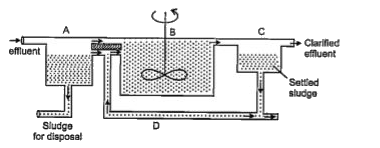
(i) In the diagram A denotes
| (a) aeration tank | (b) primary settling tank | (c) secondary settling tank | (d) sludge digester. |
(ii) Which of the following is incorrect regarding the sludge released from A?
| (a) It is formed after primary treatment. | (b) It does not require aeration. | (c) It possesses floes of decomposer microbes. | (d) It is used in landfills. |
ii) A large number of aerobic heterotrophic microbes grow in
| (a) A | (b) B | (c) C | (d) both (a) and (b). |
(iv) What is denoted by 'D' in the given diagram?
| (a) Primary sludge | (b) Primary effluent | (c) Activated sludge | (d) Secondary effluent |
(v) Assertion: The colloided and finely suspended matter of sewage form aggregates which are called floes.
Reason: Floes contain masses of bacteria, slime and fungal filaments.
(a) Both assertion and reason are true and reason is the correct explanation of assertion.
(b) Both assertion and reason are true but reason is not the correct explanation of assertion.
(c) Assertion is true but reason is false.
(d) Both assertion and reason are false.
4.
Read the following and answer any four questions from (i) to (v) given below:
The vectors are DNA molecules that can carry a foreign DNA segment and replicate inside the host cell. Vectors may be plasmids, bacteriophages (viruses that attack bacteria), cosmids, yeast artificial chromosomes (YACs), Bacterial artificial chromosomes (BACs) and viruses. The most widely used, versatile, easily manipulated vector pBR 322 is an ideal plasmid vector. Features that are required to facilitate cloning into a vector includes origin of replication (Ori) which is a specific sequence of DNA bases responsible for initiating replication, selectable marker genes and cloning sites.
(i) P in pBR 322 denotes that it is a
| (a) plasmid | (b) prokaryote | (c) protist | (d) plant cell. |
(ii) Ori is a specific DNA sequence that help in
| (a) attachment of primers | (b) initiation of replication | (c) extension of DNA base | (d) initiation of denaturation. |
(iii) A and B shown in the figure respectively indicates
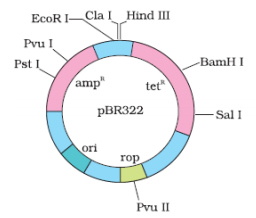
| (a) Pvu II and Cla I | (b) ROP and Sal I | (c) ampR and tetR | (d) tetR and ampR |
(iv) Selectable markers in vector
| (a) are responsible for replication | (b) help in selecting transformants from non-transformants |
| (c) code for proteins involved in the replicating plasmids | (d) contain unique recognition sites. |
(v) Plasmid vectors are
| (a) dsDNA molecule | (b) extra-chromosomal | (c) present in bacteria and yeast | (d) all of these |
5.
Read the following and answer any four questions from (i) to(v) given below:
In recombinant DNA technology, the fragments of DNA generated after cutting the DNA by restriction enzymes are separated according to their size or length by gel electrophoresis. Gel electrophoresis is performed in a gel matrix so that molecules of similar electric charges can be separated on the basis of size. Most commonly used matrix in gel electrophoresis is agarose. The fragments are separated under the influence of electric field. The separated DNA fragments can be seen only after staining the DNA with compound known as ethidium bromide (EtBr) followed by exposure to UV radiation as bright orange band.
(i) Gel electrophoresis is used for the separation of
| (a) DNA only | (b) DNA and RNA only |
| (c) DNA and proteins only | (d) DNA, RNA and proteins. |
(ii) Most commonly used matrix is (i) which is a (ii) extracted from (iii).
| (a) (i) agarose (ii) polysaccharide (iii) sea weed | (b) (i) agarose (ii) protein (iii) sea weed |
| (c) (i) EtBr (ii) polysaccharide (iii) sea weed | (d) (i) EtBr (ii) protein (iii) bacteria |
(iii) A DNA molecule was treated with a restriction endonuclease and three fragments of size (i) 426 kb, (ii) 129 kb and (iii) 46 kb were obtained. Identify the order in which these bands will arrange themselves in the gel plate after gel electrophoresis is completed. (Assuming that negative part of electrode is towards the well)
| (a) (iii) ➝ (ii) ➝ (i) | (b) (i) ➝ (ii) ➝(iii) | (c) (i) ➝ (iii) ➝ (ii) | (d) (iii) ➝ (i) ➝ (ii) |
(iv) Which of the following statements regarding gel electrophoresis is incorrect?
| (a) Separated DNA fragments can be seen only after staining DNA with EtBr. | (b) DNA fragments are separated according to their size. |
| (c) Under the influence of electric field, positively charged molecules move towards the anode and negatively charged molecules move towards the cathode. | (d) None of these |
(v) The factor that will not affect the rate of DNA migration in gel electrophoresis is
| (a) size of DNA molecule | (b) concentration of DNA | (c) voltage supplied | (d) concentration of the gel |
6.
Read the following and answer any four questions from (i) to (v) given below:
Tools used in the formation of recombinant DNA are of three types. These are enzymes, cloning vectors and competent host. Lysing enzymes are used to extract DNA for experimental purpose from the cells. Cleaving enzymes break the DNA molecules. They are of three types : exonucleases, endonucleases and restriction endonucleases. A competent host is required for transformation with recombinant DNA and cloning vectors help to propagate DNA.
(i) Which of the following is an example of natural lysing activity in a human body?
| (a) Lysozyme present in tears dissolve the bacterial cell wall. |
| (b) Conversion of starch to maltose in the buccal cavity |
| (c) Absorption of digested food into the intestinal cells. |
| (d) Conversion of protein molecules into amino acids in the stomach. |
(ii) The enzyme which has polymerizing activity in 5'→3' direction but exonuclease activity in 3'→ 5' direction only is
| (a) RNA polymerase III | (b) DNA polymerase II |
| (c) DNA polymerase I | (d) All of these |
(iii) Cloning vectors are the DNA molecules that
| (a) carry foreign DNA segment but do not replicate inside the host cell |
| (b) carry foreign DNA segment and replicate inside the host cell |
| (c) transfer nuclear DNA form nucleus to the cytoplasm of the same cells |
| (d) help in sealing gaps in DNA segments. |
(iv) Transfer of DNA into a eucaryotic cell is called
| (a) transformation | (b) transduction | (c) transfection | (d) electroporation. |
(v) Assertion: Type I restriction enzymes are not used in rDNA technology.
Reason: Type I restriction endonucleases consist of two different subunits and require ATP for restriction activity.
| (a) Both assertion and reason are true and reason is the correct explanation of assertion. |
| (b) Both assertion and reason are true but reason is not the correct explanation of assertion. |
| (c) Assertion is true but reason is false. |
| (d) Both assertion and reason are false. |
7.
Read the following and answer any four questions from (i) to (v) given below:
Villagers in a place near Chambur started planning to make power supply for agricultural purposes from cow dung. They have started a biogas plant for the purpose. Study the flow chart for biogas production given below and answer the following questions.

(I) Biogas is composed of majorly
| (a) methane, CO2 and O2 | (b) CO2, H2S and H | (c) methane, CO2 | (d) H2S, Hand O2. |
(ii) In the given flow chart, 'A' .denotes
| (a) aerobic bacteria | (b) methanogenic bacteria | (c) cellulose degrading bacteria | (d) yeast and protozoa. |
(iii) What is represented by 'B' in the flow chart?
| (a) Carbohydrates | (b) Protein polymers | (c) Organic acids | (d) Fat globules |
(iv) 'C' in the given flow chart causes
| (a) aerobic breakdown of complex organic compounds | (b) anaerobic digestion of complex organic compounds | (c) fermentation of organic compounds | (d) fermentation of monomers. |
(v) If 'A' is not added in the procedure
| (a) methane will not be formed | (b) CO2 will not be formed | (c) organic compounds will not be converted to H2S | (d) O2 will not be formed. |
8.
Read the following and answer any four questions from (i) to (v) given below:
Alcohols are important industrial solvents. Ethanol, methanol, propanol and butanol are produced commercially by fermentation activity of some fungi, majorly yeasts. During fermentation, yeast cells convert cereal derived sugars into ethanol and CO2. At the same time hundreds of secondary metabolites that influence the aroma and taste of alcohol are produced. Sugar concentration affects the rate of fermentation reactions. Yeast cannot grow in very strong sugar solution. In case of complex carbohydrate containing nutrient media, 1% malt or Rhizopus is used along with yeasts. Hydrolysis of starch is carried out at high temperature for 30 mins. The crushed food mixed with hot water for obtaining malt in called mash. The nutrient medium prior to fermentation in called wort. Wort is cooled down to appropriate temperature and inoculated with strain of yeast.
(i) The rate of alcohol production is measured on the basis of
| (a) amount of sugar present in the medium | (b) amount of CO2 produced per unit time | (c) amount of yeast added in the medium | (d) all of these |
(ii) A number of chemicals are produced at the time of alcoholic fermentation with the change of nutrient media, pH and aeration. Select such by-product from the following.
| (a) Phenylethanol | (b) Amyl alcohol | (c) Glycerol | (d) All of these |
(iii) During alcoholic fermentation of cereals and potato, the crushed food mixed with hot water for obtaining malt is called
| (a) juice | (b) mash | (c) wort | (d) none of these |
(iv) Distilled alcohol with 95% ethanol content is called
| (a) absolute alcohol | (b) rectified spirit | (c) gin | (d) brandy. |
(v) Assertion: Rhizopus or 1% malt is used in the nutrient medium when it contains complex carbohydrates.
Reason: Yeast does not possess sufficient diastase or amylase.
(a) Both assertion and reason are true and reason is the correct explanation of assertion.
(b) Both assertion and reason are true but reason is not the correct explanation of assertion.
(c) Assertion is true but reason is false.
(d) Both assertion and reason are false.
9.
Read the following and answer any four questions from (i) to (v) given below:
Gene manipulation is a fast emerging science. It started with development of recombinant DNA molecule. It is named variously as DNA manipulation biotechnology, recombinant DNA technology and genetic engineering. This technology, that mostly involves cutting and pasting of desired DNA fragments, is based on two important discoveries in bacteria, i.e., presence of plasmid in bacteria and restriction endonucleases. Paul Berg was able to introduce a gene of SV-40 into a bacterium. The science of recombinant DNA technology took birth when Cohen and Boyer (1973) were able to introduce a piece of gene containing foreign DNA into plasmid of E.coli.
(i) Biotechnology is also known as
| (a) DNA manipulation biotechnology | (b) recombinant DNA technology |
| (c) genetic engineering | (d) all of these. |
(ii) A bacterial plasmid is a/an
| (a) extra chromosomal material that do not replicate | (b) extra chromosomal material that undergo replication with or without chromosomal DNA |
| (c) tubular structures that help in conjugation | (d) bristle like solid structure that help in adhesion. |
(iii) Father of genetic engineering is
| (a) Paul Berg | (b) Arber | (c) Nathan | (d) Smith. |
(iv) Which of the following is used by Paul Berg to introduce a gene of SV-40 in a bacterium?
| (a) E. coli | (b) cos-plasmids | (c) Lambda phage | (d) None of these |
(v) Read the given statements and select the correct option.
Assertion : Biotechnology started with the development of recombinant DNA molecule.
Reason : Biotechnology mostly involves cutting and pasting of desired DNA fragments.
| (a) Both assertion and reason are true and reason is the correct explanation of assertion. |
| (b) Both assertion and reason are true but reason is not the correct explanation of assertion. |
| (c) Assertion is true but reason is false. |
| (d) Both assertion and reason are false. |
10.
Read the following and answer any four questions from (i) to (v) given below:
Microorganisms include bacteria, viruses, fungi and protozoa. In our mind, we presume, most of the time, that microbes are always harmful. Microbes are, of course, the causal agents of many infections diseases of plants and animals including humans but they also have lots of beneficial role. Lactic acid bacteria (LAB) are one of this kind of useful group. These are Gram positive, non-sporulating, either rod shaped or spherical bacteria. They produce lactic acid in milk products as major metabolic end product of carbohydrate fermentation. LAB are considered as natural fermentors. Lactobacillus is a common LAB which converts lactose sugar of milk into lactic acid, that causes coagulation and partial digestion of milk protein casein. Milk is then changed into curd, yoghurt and cheese. Lactobacillus is also used in probiotics which have potentially beneficial effect on gut ecosystem of humans. Some other pro biotic strain used belong to the Genus Bifidobacterium.
(i) Which of the following is not considered as microorganisms?
| (a) Bacteriophage | (b) Streptococcus | (c) Porphyra | (d) Staphylococcus |
(ii) Select the incorrect option regarding the characteristics oflactic acid bacteria.
| (a) They are rod-shaped or spherical | (b) They are Gram positive | (c) They take part in carbohydrate fermentation. | (d) They are acid intolerant |
(iii) Which of the following is not a lactic acid producing bacteria?
| (a) Streptococcus | (b) Lactococcus | (c) Saccharomyces | (d) Enterococcus |
(iv) Probiotics are
| (a) gut friendly live bacteria | (b) acid balancing alternated bacteria | (c) beneficial amount of dead bacteria | (d) Gram negative attenuated bacteria |
(v) Assertion: Lactobacillus bacteria do not retain crystal violet stain while staining.
Reason: Lactobacillus have a very thin layer of peptidoglycan layer in their cell wall.
(a) Both assertion and reason are true and reason is the correct explanation of assertion.
(b) Both assertion and reason are true but reason is not the correct explanation of assertion.
(c) Assertion is true but reason is false.
(d) Both assertion and reason are false.
11.
Read the following and answer any four questions from (i) to (v) given below:
Biosphere reserves are multipurpose protected areas which are meant for preserving genetic diversity in representative ecosystems of various natural biomes and unique biological communities by protecting wild populations, traditional life style of tribals and domesticated plant/animal genetic resources. Each biosphere reserve has three zones-core, buffer and transition zone.
(i) Which of the following is similar to biosphere reserve in terms of conservation?
| (a) Gene banks | (b) Offsite collection | (c) Orchards | (d) Hotspots |
(ii) Refer to the given figure representing different zones of a biosphere reserve and select the correct option regarding it.
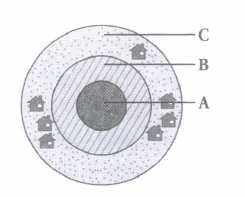
| (a) A-Limited human activity is allowed such as for research and education. |
| (b) B-An active co-operation occurs between reserve management and local people for activities like cropping, settlements, etc. |
| (c) C-No human activity is allowed. |
| (d) None of these |
(iii) Refer to the given diagrammatic representation of a biosphere reserve. Select the incorrect statement regarding X, Y and Z.
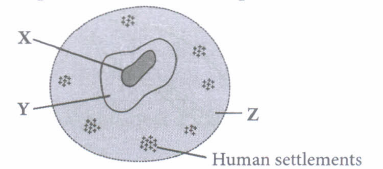
(i) X is devoted to strict protection of wildlife and no human activity is allowed in this zone.
(ii) In Y, only limited human activity (compatible with conservation) is allowed.
(iii) In Z, commercial exploitation of natural resources is allowed.
(iv) Tourism is allowed in Z zone only.
(v) Zone Y helps to maintain the lifestyle of the tribal people living in the area.
| (a) (iii), (iv) and (v) only | (b) (ii), (iii) and (v) only | (c) (i), (iii) and (iv) only | (d) (ii), (iii) and (iv) only |
(iv) Biosphere reserves differ from national parks and wildlife sanctuaries because in the former.
| (a) human beings are not allowed to enter |
| (b) people are an integral part of the system |
| (c) plants are paid greater attention than the animals |
| (d) living organisms are brought from all over the world and preserved for posterity. |
(v) MAB Programme means
| (a) Man and biosphere programme |
| (b) Man and biodiversity conservation programme |
| (c) Manually aided biosphere conservation programme |
| (d) none of these. |
12.
Read the following and answer any four questions from (i) to (v) given below:
Ecosystem diversity is the variety of forms in the ecosystem due to diversity of niches, trophic levels and ecological processes like nutrient recycling, food webs, energy flow, etc. Study the given figure.
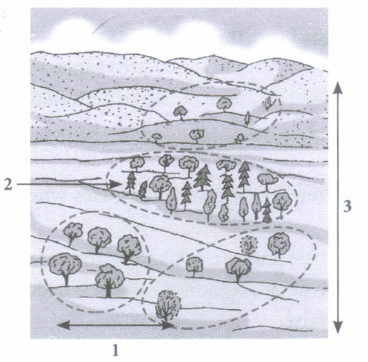
(i) Identify different types of diversity denoted by 1, 2 and 3 in the given figure.
| 1 | 2 | 3 | |
| (a) | Alpha diversity | Beta diversity | Gamma diversity |
| (b) | Gamma diversity | Alpha diversity | Beta diversity |
| (c) | Gamma diversity | Beta diversity | Alpha diversity |
| (d) | Beta diversity | Alpha diversity | Gamma diversity |
(ii) Alpha diversity is biodiversity present
| (a) within community | (b) between communities | (c) in ranges of communities | (d) none of these. |
(iii) Diversity represented by diversity of habitats over a total landscape area is
| (a) α - diversity | (b) γ-diversity | (c) β -diversity | (d) δ - diversity |
(iv) Concept of three types of ecological diversity was given by
| (a) Elton | (b) Odum | (c) Edward Wilson | (d) Whittaker. |
(v) The diversity of organisms sharing the same habitat or community is termed as
| (a) alpha diversity | (b) beta diversity | (c) gamma diversity | (d) delta diversity. |
13.
Read the following and answer any four questions from (i) to (v) given below:
Golden rice was engineered from normal rice by Potrykus and Beyer in the 1990s. The typical golden colour is due to the production of \(\beta\) carotene a precursor of vitamin - A. Golden rice differs from its parental strain by the addition of three \(\beta\) carotene genes. These included two genes from daffodil plant and third from a bacterium. The incorporation of these genes allows the rice plant to modify certain metabolic pathways in its cells to produce \(\beta\)-carotene.
(i) Due to genetic modification golden rice plants produce and store \(\beta\) - carotene in
| (a) stem | (b) seed | (c) leaves | (d) all of these |
(ii) Transfer of genes to produce golden rice is achieved by
| (a) Agrobacterium | (b) pBR322 | (c) \(\lambda \text { -phage }\) | (d) gene gun |
(iii) In golden rice two genes were taken from
| (a) Narcissus sp. | (b) Erwinia | (c) Coryza sativa | (d) none of these |
(iv) Golden rice is helpful to fight against disease caused by the deficiency of
| (a) Vitamin Bl2 | (b) Vitamin C | (c) Vitamin A | (d) Vitamin D. |
(v) Golden rice was genetically engineered by
| (a) Fire and Mello | (b) Potrykus and Beyer | (c) Banting and Best | (d) Kohler and Milstein |
14.
Read the following and answer any four questions from (i) to (v) given below:
Non-native or alien species are often introduced in advertently for their economic and other uses. They often become invasive and drive away-the local species. Exotic species have proved harmful to both aquatic and terrestrial ecosystems. For example, water hyacinth (Eichhornia crassipes) was introduced in Indian waters to reduce pollution. It was clogged water bodies including wetlands at many places resulting in death of several aquatic plants and animals.
(i) Island water ecosystem are the most vulnerable due to
| (a) small size | (b) small number of species | (c) increases reproductive capacity | (d) both (a) and (b). |
(ii) Which of the following is not an alien species?
| (a) Lantana camara | (b) Periplaneta americana | (c) Nile Perch | (d) Yucca moth |
(iii) Second major cause of species extinction is
| (a) habitat loss and fragmentation | (b) over exploitation | (c) alien species invasion | (d) co-extinction. |
(iv) Assertion: Eichhornia crassipes drains off oxygen from water and can be seen growing in standing water.
Reason: Eichhornia crassipes is an indigenous species of India.
| (a) Both assertion and reason are true and reason is the correct explanation of assertion. |
| (b) Both assertion and reason are true but reason is not the correct explanation of assertion. |
| (c) Assertion is true but reason is false. |
| (d) Both assertion and reason are false. |
(v) The population of species P in a certain community was constant until a population species Q from a distant land was subsequently introduced into that community. The interaction between the two populations is reflected in the graph below.
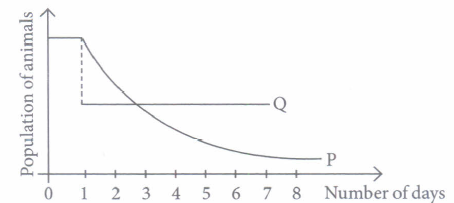
What could be the possible reason for the decrease in the population of species P over a number of days?
| (a) Species Q is a predator of species P. |
| (b) Species Q.is a prey species which wiped out the population of species P. |
| (c) Species P and Q compete for space but feeds on different food. |
| (d) None of these |
1.
(i) (a) : Transfer DNA (T-DNA) is the transferred DNA of Ti plasmid of some species of bacteria.
(ii) (b) : Agrobacterium infects all broad-leaved agricultural crops. It does not infect cereals.
(iii) (a) : Part of Ti plasmid transferred into the plant cell DNA, is called T-DNA. This T-DNA with desired DNA spliced into it, is inserted into the chromosomes of the host plant where it produces copies of itself, by migrating from one chromosomal position to another at random. But it no longer produces tumors.
(iv) (d)
(v) (a) : Transfer DNA (T-DNA) is the transferred DNA of Ti plasmid of some species of bacteria.
2.
(i) (c) : Bioreactors are considered as vessels in which raw molecules are biologically converted into specific products.
(ii) (b) : In a bioreactor, all operations must be carried under sterile conditions to avoid contamination.
(iii) (b)
(iv) (d) : A bioreactor provides the optimal growth conditions such as temperature, pH, substrate, vitamins, oxygen and salts for obtaining the desired product.
(v) (d)
3.
(i) (b): In the given diagram, A-primary settling tank, B-aeration tank, C-secondary settling tank
(ii) (c): Primary sludge does not possess floes of decomposer microbes. These are formed during secondary treatment.
(iii) (b) : A large number of aerobic heterotrophic microbes grow in the aeration tank (B).
(iv) (c)
(v) (b)
4.
(i) (a) : In pBR322 plasmid, P - denotes that it is a plasmid; BR - stands for Boliver and Rodriguez, who constructed this plasmid; 322 - is a number given to distinguish this plasmid from others developed in the same laboratory.
(ii) (b)
(iii) (c)
(iv) (b) : Plasmid pBR322 has two resistance gene, i.e., ampicillin resistance (ampR) and tetracyclin resistance (tetR) which are considered useful for selectable markers.
(v) (d)
5.
(i) (d) : Gel electrophoresis is a technique used to separate fragments of molecules, i.e., DNA, RNA and protein.
(ii) (a)
(iii) (b)
(iv) (c) : Under the influence of electric field positively charged molecules move towards the cathode and negatively charged molecules move towards the anode.
(v) (b) : Concentration of DNA will not affect the migration of DNA molecule in a gel electrophoresis. As in gel electrophoresis, molecules separate according to their size therefore DNA size will affect migration. Increased voltage supply will increase rate of migration and the more concentrated gel will reduce rate of migration.
6.
(i) (a) : Conversion of starch into maltose and protein into amino acids is due to hydrolysis.
(ii) (c) : DNA polymerase I
(iii) (b)
(iv) (c)
(v) (c): Type I restriction endonuclease consist of three different subunits and requires ATP, Mg2+, S-adenosyl methionine for restriction.
7.
(I) (c) : Biogas is composed of methane (50-70%), carbon dioxide (30-40%) with traces of nitrogen, hydrogen sulphide and hydrogen.
(ii) (b)
(iii) (c) : In the second stage ofbiogas production, the simple soluble compounds or monomers are acted upon by fermentation causing microbes and converted into organic acids especially acetic acid.
(iv) (b)
(v) (a)
8.
(i) (b) : The fermentation rate of the yeast can be calculated by measuring the volume of CO2 and dividing it by the amount of time it took for that volume to form.
(ii) (d)
(iii) (b) : The crushed food mixed with hot water for obtaining malt is called mash. The nutrient medium prior to fermentation is called wort. Wort is added into the bioreactor tank, sterilised and then inoculated with yeast.
(iv) (b) : Alcoholic content in gin is 40%, brandy in 60-70%. These are hard liquors. Rectified spirit contains 95% alcohol and absolute alcohol is 100% alcohol. Rectified spirit and absolute alcohol are extensively used in laboratory works.
(v) (a)
9.
(i) (d)
(ii) (b) : Plasmid in a bacterial cell is an extra chromosomal material that undergo replication with or without chromosomal DNA.
(iii) (a)
(iv) (c) : In 1972, Paul Berg was able to introduce a gene of SV-40 virus into a bacterium with the help of lambda phage.
(v) (b)
10.
(i) (c) : Porphyra is a coldwater seaweed belongs to red algae.
(ii) (d) : LAB are acid tolerant bacteria.
(iii) (c): Sadharomyces cerevisiae, also known as Brewer's yeast, is used in alcoholic fermentation.
(iv) (a) : Probiotics are live bacteria which are beneficial for digestive system.
(v) (d) : Lactobacillus is a Gram positive bacteria. Gram positive bacteria have a very thick cell wall layer comprising of peptidoglycan. They retain crystal violet stain during Gram staining and appear violet in colour under microscope.
11.
(i) (d) : Biosphere reserves and hotspots are in-situ methods of conservation
(ii) (d)
(iii) (a) : In the given figure, X, Y and Z represent core zone, buffer zone and transition zone of biosphere reserve respectively. No commercial exploitation of natural resources is allowed in core zone. Tourism is allowed up to buffer zone of biosphere reserve. Transition .zone helps to maintain the lifestyle of the tribal people living in the area.
(iv) (b) : Biosphere reserves have a transition zone where participation of local people for activities like settlements, cropping, recreation, forestry, etc. take place.
(v) (a)
12.
(i) (d) : Ecological diversity is of three types: (i) Alpha diversity (Within community diversity) (ii) Beta diversity (Between community diversity) (iii) Gamma diversity is diversity of habitats/ ecosystems over a total landscape or geographical area.
(ii) (a)
(iii) (b) : γ-diversity is ,diversity present in ranges of communities as represented by diversity of habitats over total landscape.
(iv) (d)
(v) (a)
13.
(i) (b) : Golden rice is a transgenic variety of rice (Oryza sativa) which contains good quantities of\(\beta\)-carotene (provitamin A - inactive state of vitamin A).\(\beta\)-carotene is a principal source of vitamin A. Since the grains (seeds) of the rice are yellow in colour due to \(\beta\)-carotene, the rice is commonly called golden rice.
(ii) (a) : Foreign genes were inserted into the genome of a tempera,te rice variety by using Agrobacterium tumefaciens as the vector.
(iii) (a) : In golden rice, two genes for \(\beta\)-carotene were taken from daffodil (Narcissus sp.) and one gene from a bacterium Erwinia.
(iv) (c) : Golden rice is rich in\(\beta\)-carotene which is a precursor of vitamin A.
(v) (b) : Prof. Ingo Potrykus and Peter Beyer produced genetically engineered rice by introducing three gene associated with synthesis of carotene. The grains (seeds) of transgenic rice are rich in provitamin.
14.
(i) (d)
(ii) (d) : Pronuba yuccasella shows obligatory mutualistic relationships with Yucca.
(iii) (c) : Alien species invasion is considered to be second major cause of extinction of species.
(iv) (c): Eichhornia crassipes is an aquatic plant, native to Amazon basin. This plant was introduced into India for its beautiful flowers and shape of leaves.
(v) (a)

12th Standard CBSE Syllabus & Materials
12th Standard CBSE
CBSE 12th Computer Science Python Revision Tour I - New Previous year Question Papers Study Material - QB365 Set A
NEW12th Standard CBSE
CBSE 12th Business Studies Planning Important Questions And Answers Study Material - QB365 Set A
NEW12th Standard CBSE
CBSE 12th Business Studies Business Environment Important Questions And Answers Study Material - QB365 Set A
NEW12th Standard CBSE
CBSE 12th Business Studies Principles of Management Important Questions And Answers Study Material - QB365 Set A



NCERT Books

Syllabus

Exam Pattern

Sample Question Papers

Previous year Question Papers

Important Notes

MCQ Practice test

NCERT Exemplers

Case study Questions

Image Based Questions

Passage based Questions

HOT Questions

Value Based Questions

Model Questions Papers
NCERT ( Book Back ) Questions

Assertion and Reason
Important Questions And Answers

CBSE 12th Standard CBSE Subjects
CBSE Standards








