
 100% FREE ACCESS
12th Standard CBSE Syllabus & Materials
12th Standard CBSE
CBSE 12th Economics Government Budget and the Economy Previous year Question Papers Study Material - QB365 Set A
NEW12th Standard CBSE
CBSE 12th Computer Science Interface Python with MySQL - New Previous year Question Papers Study Material - QB365 Set A
NEW12th Standard CBSE
CBSE 12th Computer Science Database Concept - New Previous year Question Papers Study Material - QB365 Set A
NEW12th Standard CBSE
CBSE 12th Computer Science Data Communication - New Previous year Question Papers Study Material - QB365 Set A
NEW12th Standard CBSE
CBSE 12th Computer Science Data Structures - New Previous year Question Papers Study Material - QB365 Set A
NEW12th Standard CBSE
CBSE 12th Computer Science Functions - New Previous year Question Papers Study Material - QB365 Set A

Published on: 21/05/2021
QB365 Provides the updated CASE Study Questions for Class 12 Biology, and also provide the detail solution for each and every case study questions . Case study questions are latest updated question pattern from NCERT, QB365 will helps to get more marks in Exams
Download CBSE Class 12th Standard CBSE Biology question papers, sample papers, important questions, and previous year solved papers in PDF format. Get free study materials, NCERT solutions, and exam preparation resources for Class 12th Standard CBSE Biology
Questions + Answers key
Take MCQ Biology Test
1.
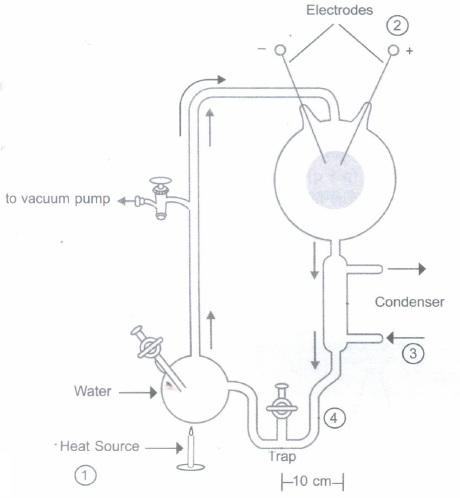
(a) State the hypothesis which S.L. Miller tried to prove in the laboratory with the help of the set up given above.
(b) Name the organic compound observed by him in the liquid water after running the above experiment.
(c) A scientist simulated a similar set up and added CH4, NH3 and water vapour at 800°C.
Which important component is missing in his experiment?
2.
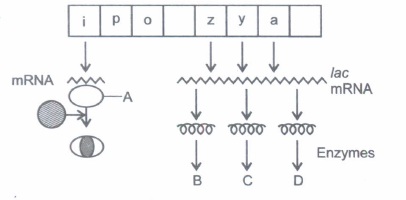
Lac operon in the 'switched on' position is shown above.
(a) Identify the molecule A and the enzymes B, C and D in the diagram.
(b) When will this operon get 'switched off'?
3.
Haemophilia is a sex-linked recessive disorder in humans. The pedigree chart given below shows the inheritance pattern of haemophilia in a family. Study the inheritance pattern and answer the questions that follow:
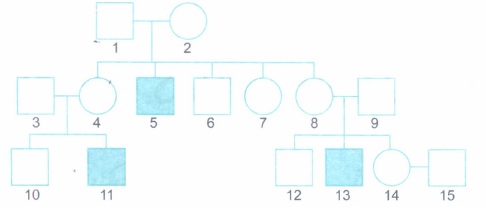
(a) Give the possible genotypes of the members 4 and 5 in the above chart.
(b) A blood test shows that the member 14 is a carrier of haemophilia. The member 15 has recently married the member 14. What is the probability of their first child being haemophilic? Show it with the help of a Punnett square.
4.
Study the pedigree chart showing the pattern of inheritance of blood group character in a family.
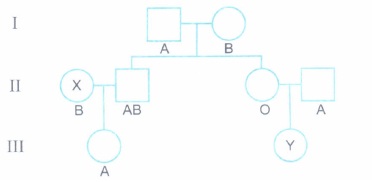
(a) Give the genotypes of the parents in generation I.
(b) State the possible genotypes of the individuals.
(i) X in generation II.
(ii) Y in generation III.
(c) How does the inheritance of this blood group explain codominance?
5.
ABO blood group character in human population exhibits four possible phenotypes and six different genotypes. Explain the different mechanisms of inheritance involved in exhibiting the possibility of four phenotypes and six genotypes.
6.
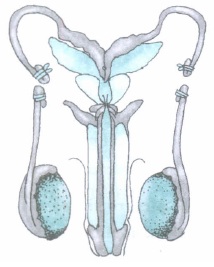
Shown above is the surgical method of contraception in human males.
Answer the following questions:
(a) Give the technical term for the process shown above.
(b) What is the principle behind it as a contraceptive method?
(c) How is the process carried out?
7.
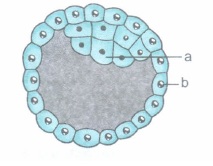
(a) Name the human embryonic stage shown above.
(b) Identify 'a' and 'b' in it.
(c) Where are stem cells located in it?
(d) Mention the role of 'b'.
8.
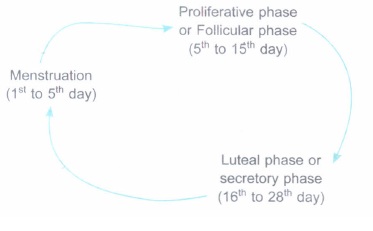
The events in a menstrual cycle are represented above. Answer the following questions based on that.
(a) Why is the phase between 5th and 15th day of menstrual cycle, called
(i) proliferative phase?
(ii) follicular phase?
(b) Mention the ovarian events during the luteal phase.
9.
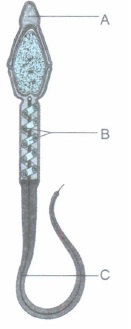
A Human Spermatozoan
A diagrammatic sketch of a human sperm is given. Identify the parts labelled A, Band C and mention their respective functions.
10.
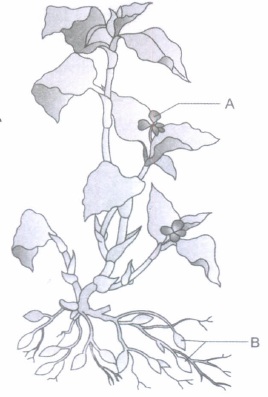
Identify the types of flowers A and B on the Commelina plant shown above.
(b) Mention the type(s) of pollination that can occur in each of them.
11.
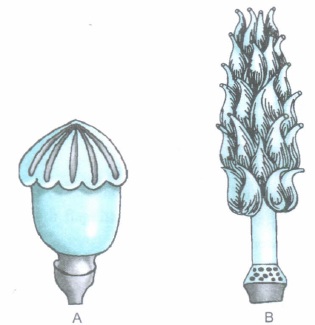
These pictures show the gynoecium of A. Papaver and B. Michelia.
(a) Write one similarity and one difference between the two.
(b) Name the three parts of a pistil.
12.
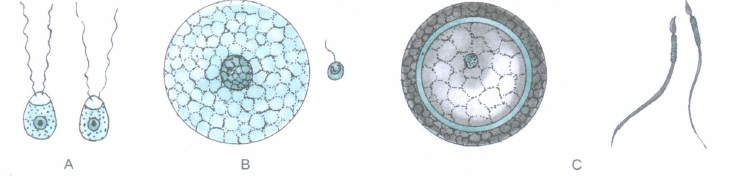
Identify the types of gametes and give an example for each of A, Band C shown in tbe diagram, given below.
13.
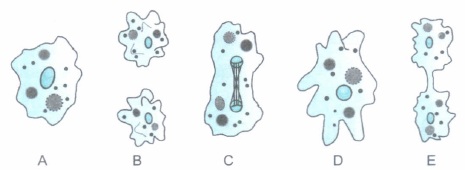
The stages in the binary fission of Amoeba are shown above.
(a) Arrange the stages in their proper natural sequence in binary fission.
(b) How does this differ from the process of sporulation employed by Amoeba?
1.
(a) S.L. Miller tried to prove the hypothesis of Oparin and Haldane; it is as follows:
(i) The first from oflife could have come from the pre-existing non-living organic molecules like RNA, proteins, etc.
(ii) Formation oflife was preceded by chemical evolution that resulted in the formation of diverse organic molecules from inorganic constituents.
(b) Amino acids.
(c) Hydrogen is missing.
2.
(a) A -Repressor
B -galactosidase
C-Permease
D -Transacetylase.
(b) It will get 'switched off' when
(i) the substrate/inducer lactose is not available
(ii) the energy source, glucose is available to the cells.
3.
(a) Genotype of 4 - XXh
Genotype of 5 - xhv.
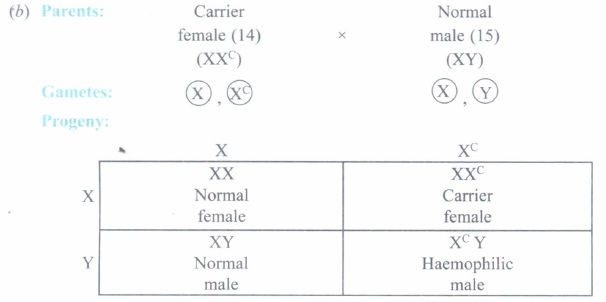
T4e probability of their first child being haemophilic is 25 per cent.
4.
(a) Father - IAi, Mother IBi
(b) (i) -IBi
(ii) IAi or ii
(C) (i) The alleles IAand IBofthe blood group character are equally dominant and both of them express themselves when present together, resulting in blood group AB.
5.
Mechanisms of Inheritance.
(i) Multiple allelism.
(a) The gene I controlling blood group character exists in three allelic forms, lA, IB and i.
(ii) Dominance.
(a) The allele IA is dominant over the allele i and the allele IB is also dominant over the allele, i.
(iii) Codominance.
(a) The alleles IA and IB are equally dominant and both of them express themselves, when they are present together; blood group AB results.
6.
(a) Vasectomy.
(b) The surgical intervention blocks the transport of gametes and thereby prevent fertilisation and conception.
(c) In this method, a small part of the vas deferens is either removed or tied up through a small incision on the scrotum.
7.
(a) It is a blastocyst.
(b) 'a' is inner cell mass.
'b' is trophoblast.
(c) Stem cells are present in the inner cell mass.
(d) Role of Trophoblast.
(i) It becomes attached to the endometrium for implantation.
(ii) The chorionic villi appearing on it form the foetal part of placenta.
8.
(a) (i) It is called proliferative phase because the endometrium of the uterus is regenerated through prol iferation of its cells.
(ii) It is called follicular phase as the primary follicle in the ovary grows to become a fully mature Graafian follicle under the influence of follicle-stimulating hormone.
(b) (i) Corpus luteum is formed from the remaining parts of the ruptured Graafian follicle.
(ii) Corpus luteum secretes large amounts of progesterone.
9.
A. Acrosome
(i) The secretions.enzymes of acrosome dissolve the egg envelopes and help the sperm enter the cytoplasm of the ovum.
B. Mitochondria
(i) The mitochondria in the middle piece provide energy for the sperm motility in the female reproductive tract towards ovum.
C. Tail
(i) It facilitates the movement of sperm towards the ovum for fertilisation.
10.
(a) A - Chasmogamous flower
B - Cleistogamous flower
(b) A - Autogamy, geitonogamy and xenogamy
B - Autogamy only.
11.
(a) Similarity
(i) Both are multicarpellary.
Difference
(i) A. Papaver is syncarpous - all the carpels have fused together.
(ii) B. Michelia is apocarpous - the carpels are free.
(b) Ovary, style and stigma are the three parts of a pistil.
12.
A - Isogametes; e.g. Cladophora, an alga
B - Heterogametes, e.g. Fueus, an alga
C - Heterogametes, e.g. Homo sapiens, (Human beings)
13.
(a) D\(\rightarrow\)A\(\rightarrow\)C\(\rightarrow\)E\(\rightarrow\)B
(b) Differences
| Binary Fission | Sporulation |
| (i) It occurs during favourable conditions. | (i) It occurs during unfavourable seasons |
| (ii) No cyst is formed | (ii) A cyst is formed. |
| (iii) By binary fission, only two daughter cells are formed. | (iii) By multiple fission, a number of daughter cells are formed |

12th Standard CBSE Syllabus & Materials
12th Standard CBSE
CBSE 12th Computer Science Python Revision Tour I - New Previous year Question Papers Study Material - QB365 Set A
NEW12th Standard CBSE
CBSE 12th Business Studies Planning Important Questions And Answers Study Material - QB365 Set A
NEW12th Standard CBSE
CBSE 12th Business Studies Business Environment Important Questions And Answers Study Material - QB365 Set A
NEW12th Standard CBSE
CBSE 12th Business Studies Principles of Management Important Questions And Answers Study Material - QB365 Set A



NCERT Books

Syllabus

Exam Pattern

Sample Question Papers

Previous year Question Papers

Important Notes

MCQ Practice test

NCERT Exemplers

Case study Questions

Image Based Questions

Passage based Questions

HOT Questions

Value Based Questions

Model Questions Papers
NCERT ( Book Back ) Questions

Assertion and Reason
Important Questions And Answers

CBSE 12th Standard CBSE Subjects
CBSE Standards








