
 100% FREE ACCESS
12th Standard CBSE Syllabus & Materials
12th Standard CBSE
CBSE 12th Economics Government Budget and the Economy Previous year Question Papers Study Material - QB365 Set A
NEW12th Standard CBSE
CBSE 12th Computer Science Interface Python with MySQL - New Previous year Question Papers Study Material - QB365 Set A
NEW12th Standard CBSE
CBSE 12th Computer Science Database Concept - New Previous year Question Papers Study Material - QB365 Set A
NEW12th Standard CBSE
CBSE 12th Computer Science Data Communication - New Previous year Question Papers Study Material - QB365 Set A
NEW12th Standard CBSE
CBSE 12th Computer Science Data Structures - New Previous year Question Papers Study Material - QB365 Set A
NEW12th Standard CBSE
CBSE 12th Computer Science Functions - New Previous year Question Papers Study Material - QB365 Set A

Published on: 21/05/2021
QB365 Provides the updated CASE Study Questions for Class 12 Biology, and also provide the detail solution for each and every case study questions . Case study questions are latest updated question pattern from NCERT, QB365 will helps to get more marks in Exams
Download CBSE Class 12th Standard CBSE Biology question papers, sample papers, important questions, and previous year solved papers in PDF format. Get free study materials, NCERT solutions, and exam preparation resources for Class 12th Standard CBSE Biology
Questions + Answers key
Take MCQ Biology Test
1.
Over the years, it has been observed that some of the lakes are disappearing due to urbanisation. In the absence of human interference, depict through a flow chart, how the successional series progresses from hydric to mesic condition.
2.
Organisms occupy a specific place in their natural surroundings or in a community according to their feeding relationship with the other organisms. Based on the source of nutrition of food organisms occupy a particular place, called trophic level, in a food chain.
(a) What technical term is given to the organisms occupying the first, second and third trophic levels in a food chain?
(b) Choose an example for each of the above trophic levels, from the following list of organisms: Rabbit, Wolf, phytoplanktons, frog, snail, Hydrilla, jackal.
3.
The fallen parts of plants such as leaves, flowers, etc., faecal matter of animals, dead remains of animals, etc. are ultimately broken down into simpler inorganic nutrients, carbon dioxide and water.
1. Fragmentation, 2. Leaching, 3. Catabolism are some important steps in the process; they occur simultaneously.
(a) What term is given to the group of organisms that carry out the steps 1 and 3, respectively and give an example for each.
(b) Name the other two steps involved in the process.
4.
A pond is a shallow water body, which is fairly a self-sustainable unit that explains the complex interactions in an aquatic ecosystem. The water with all the dissolved inorganic and organic nutrients is the major abiotic component.
Name the three groups of biotic components in the pond and give an example for each.
5.
An ecosystem can be visualised as a functional unit in nature, where living organisms interact among themselves and with the surrounding physical environment also. The interaction of the biotic and abiotic components results in a physical structure that is characteristic of an ecosystem.
(a) Name the two features that define the structural aspect of an ecosystem.
(b) Mention the four common functional aspects of an ecosystem.
1.
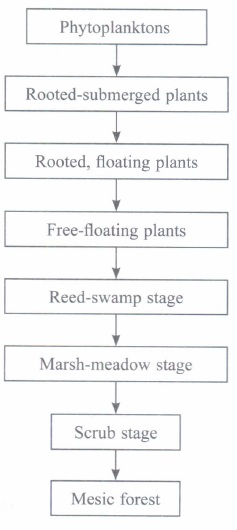
2.
(a) First trophic level - Producers
Second trophic level - Herbivores/Primary consumers
Third trophic level - Secondary consumers/Primary carnivores.
(b) First trophic level - Phytoplanktons, Hydrilla. Second trophic level - Rabbit, snail Third trophic level - Wolf, frog, jackal.
3.
(a) Step 1: Detritivores, e.g. earthworm
Step 3: Decomposers, e.g. some fungi and bacteria
(b) Humification and mineralisation are the other two steps.
4.
The three groups of biotic components
(i) Producers - e.g. Phytoplanktons, some algae, submerged and floating plants.
(ii) Consumers - e.g. zooplanktons, sanils, fish.
(iii) Decomposers - e.g. some bacteria, fungi, flagellates.
5.
(a) Structural aspects
(i) Species composition
(ii) Stratification
(b) Functional aspects
(i) Productivity
(ii) Decomposition
(iii) Energy flow
(iv) Nutrient cycling.

12th Standard CBSE Syllabus & Materials
12th Standard CBSE
CBSE 12th Computer Science Python Revision Tour I - New Previous year Question Papers Study Material - QB365 Set A
NEW12th Standard CBSE
CBSE 12th Business Studies Planning Important Questions And Answers Study Material - QB365 Set A
NEW12th Standard CBSE
CBSE 12th Business Studies Business Environment Important Questions And Answers Study Material - QB365 Set A
NEW12th Standard CBSE
CBSE 12th Business Studies Principles of Management Important Questions And Answers Study Material - QB365 Set A



NCERT Books

Syllabus

Exam Pattern

Sample Question Papers

Previous year Question Papers

Important Notes

MCQ Practice test

NCERT Exemplers

Case study Questions

Image Based Questions

Passage based Questions

HOT Questions

Value Based Questions

Model Questions Papers
NCERT ( Book Back ) Questions

Assertion and Reason
Important Questions And Answers

CBSE 12th Standard CBSE Subjects
CBSE Standards








