
 100% FREE ACCESS
12th Standard CBSE Syllabus & Materials
12th Standard CBSE
CBSE 12th Economics Government Budget and the Economy Previous year Question Papers Study Material - QB365 Set A
NEW12th Standard CBSE
CBSE 12th Computer Science Interface Python with MySQL - New Previous year Question Papers Study Material - QB365 Set A
NEW12th Standard CBSE
CBSE 12th Computer Science Database Concept - New Previous year Question Papers Study Material - QB365 Set A
NEW12th Standard CBSE
CBSE 12th Computer Science Data Communication - New Previous year Question Papers Study Material - QB365 Set A
NEW12th Standard CBSE
CBSE 12th Computer Science Data Structures - New Previous year Question Papers Study Material - QB365 Set A
NEW12th Standard CBSE
CBSE 12th Computer Science Functions - New Previous year Question Papers Study Material - QB365 Set A

Published on: 28/05/2021
QB365 Provides the HOT Question Papers for Class 12 Biology, and also provide the detail solution for each and every HOT Questions. HOT Questions will help to get more idea about question pattern in every exams and also will help to get more marks in Exams
Download CBSE Class 12th Standard CBSE Biology question papers, sample papers, important questions, and previous year solved papers in PDF format. Get free study materials, NCERT solutions, and exam preparation resources for Class 12th Standard CBSE Biology
Questions + Answers key
Take MCQ Biology Test1.
What kind of evolution has brought similarity in the following:
(i) Placental cat and a marsupial cat
(ii) Fishes and whales
(iii) Darwin's finches
2.
Name the specific term being used for the following statements:
(a) The chance elimination of the genes of certain traits when a section of population migrates or dies of natural calamity is referred to as ____________.
(b) Change in the morphology and number of chromosomes at times is referred to as____________.
(c) A small group of human being leave their homes to find a new settlement. This results in the formation of a different genotype in the settlement. It is called____________.
3.
How do closely related species of alligators, at present, occur only in South-eastern United States and Eastern China? Explain.
4.
Australia has egg-laying and pouched mammals that occur nowhere else. How can it be explained by evolutionists?
5.
State in what ways Stanely Miller simulated the conditions of:
(i) primitive atmosphere on earth.
(ii) energy source at the time of origin of life, and
(iii) formation of organic molecules of life to prove the theory of chemical evolution?
6.
How did Louis Paster successfully demolish the popular theory of spontaneous generation?
7.
Study the given figures (a) and (b) and answer the questions given below:
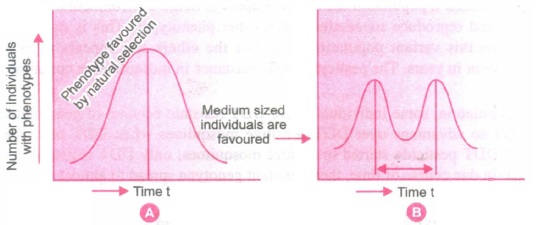
(i) Under the influence of which type of natural selection would graph (a) becomes like graph (b)?
(ii) What could be the likely reasons of new variations arising in the population?
(iii) Who suggested natural selection as a mechanism of evolution?
8.
The study of
(i) fossils of dinosaurs
(ii) forelimbs of Cheeta, bat and human
(ii) thorns of Bougainvillea and tendril of Cucurbita shows that evolution of life forms has indeed taken place on earth. Explain.
9.
Anthropogenic action can hasten evolution. Explain with the help of a suitable example.
1.
(i) Parallel evolution.
(ii) Convergent evolution.
(ii) Divergent evolution.
2.
(a) Genetic drift
(b) Chromosomal aberrations
(c) Founder effect.
3.
Descendants of a common ancestor in some cases inhabit different continents and also differ from each other. This is called discontinuous distribution. Common example is of alligators which at present occur only in South-eastern United States and Eastern China. Such a discontinuous distribution can be explained as follows:
The North American Continent was connected with Eastern Asia in early Cenozoic by a land bridge in the Bering Strait Region. The climate of the whole region was much warmer than at present, and the alligators (as revealed by fossil evidence) were distributed over the entire region. South-eastern United States and Eastern China remained unaffected by glaciations, and here the alligators survived. The alligators of these regions have been separated for a long time, and have developed different random mutations. As a result, they have become slightly different, but closely related species of the same genus.
4.
Egg-laying mammals and pouched mammals only occur in Australia. This restricted distribution can be explained as follow:
Australia continent separated from the mainland of Asia during the Mesozoic era, before placental mammals evolved. placental mammals, being mor4e adapted, eliminated the egg laying mammals and majority of pouched mammals in other part of the world. The primitive mammals of Australia survived as placental mammals could not reach Australia due to lack of land route. These primitive mammals have flourished and evolved along different lines through divergent evolution in Australia.
5.
(i) Stanley Miller designed a glass apparatus (Fig. 7.11) comprising a gas flask, a condenser, and a liquid flask interconnected with tubes and fitted with sources of energy. This apparatus simulated the conditions on the primitive earth, including a reducing atmosphere and an ocean.
(ii) He provided energy, for the interaction of gases present as mixture in the apparatus, in the form of electric sparks of 75,000 volts from electrodes in the gas flask.
(iii) Miller circulated, in this apparatus, a mixture of methane, ammonia and hydrogen gases in the ratio of 2 : 2 : 1 and water vapour at 800\(^{o}\)C. After electric spark, the gas were condensed in a narrow tube and passed through a liquid flask. Here, energy was provided as heat with an electric heater. This resulted in mixture of small organic molecules in the gas flask (atmosphere) and were carried by condensation (rain) to the liquid flask (ocean).
6.
Louis Paster experimentally demonstrated that life can arise only from pre-existing life in the present environment. He proved that no life arose from the heat-killed microorganisms kept in a pre-sterilized flask kept closed while new life arose from the heat-killed microorganisms that were kept in flask left open in the air.
7.
(i) Disruptive selection.
(ii) Here, the extreme have more adaptable phenotypes the average ones. Consequently, the original population is disrupted into two or more separate groups that later evolve into new species.
(iii) Charles Darwin.
8.
(i) Fossils of dinosaurs provide palaeontological evidences for evolution.
They represent extinct organisms.
A study of fossils indicates the geological time period in which these organisms existed and that life forms varied over time.
(ii) Forelimbs of cheetah, bat, whale and humans provide evidences of evolution from comparative anatomy and morphology.
The similarity in the anatomy of these organs indicates that the same structure has developed along different directions as adaptations to different needs; homology indicates common ancestry.
(iii) Thorns of Bougainvillea and tendril of Cucurbita also provide evidences from comparative anatomy and morphology.
They represent homology (both are stem modifications) and homology represents common ancestry and divergent evolution.
9.
1.Anthropogenic actions, i.e. human activities have been found to enhance evolution.
e,g. 1.Use of DDT has resulted in evolution of DDT-resistant mosquitoes.
2.Evolution of antibiotic or drug-resistant microbes.
3. When DDT was used fo the first time, many mosquitoes died, but a few survived.
4. These few mosquitoes showed resistance to DDT and reproduced in the presence of DDT.
5. Most of the offspring were also resistant to DDT.
6. Hence, the mosquito populations of today consist mainly of DDT-resistant mosquitoes and hence, DDT is not effective.
7. In the absence of DDT, these DDT-resistant mosquitoes had no advantage over those mosquitoes, which were sensitive to DDT.
8. This is an example of evolution due to anthropogenic activities.

12th Standard CBSE Syllabus & Materials
12th Standard CBSE
CBSE 12th Computer Science Python Revision Tour I - New Previous year Question Papers Study Material - QB365 Set A
NEW12th Standard CBSE
CBSE 12th Business Studies Planning Important Questions And Answers Study Material - QB365 Set A
NEW12th Standard CBSE
CBSE 12th Business Studies Business Environment Important Questions And Answers Study Material - QB365 Set A
NEW12th Standard CBSE
CBSE 12th Business Studies Principles of Management Important Questions And Answers Study Material - QB365 Set A



NCERT Books

Syllabus

Exam Pattern

Sample Question Papers

Previous year Question Papers

Important Notes

MCQ Practice test

NCERT Exemplers

Case study Questions

Image Based Questions

Passage based Questions

HOT Questions

Value Based Questions

Model Questions Papers
NCERT ( Book Back ) Questions

Assertion and Reason
Important Questions And Answers

CBSE 12th Standard CBSE Subjects
CBSE Standards









