
 100% FREE ACCESS
12th Standard CBSE Syllabus & Materials
12th Standard CBSE
CBSE 12th Economics Government Budget and the Economy Previous year Question Papers Study Material - QB365 Set A
NEW12th Standard CBSE
CBSE 12th Computer Science Interface Python with MySQL - New Previous year Question Papers Study Material - QB365 Set A
NEW12th Standard CBSE
CBSE 12th Computer Science Database Concept - New Previous year Question Papers Study Material - QB365 Set A
NEW12th Standard CBSE
CBSE 12th Computer Science Data Communication - New Previous year Question Papers Study Material - QB365 Set A
NEW12th Standard CBSE
CBSE 12th Computer Science Data Structures - New Previous year Question Papers Study Material - QB365 Set A
NEW12th Standard CBSE
CBSE 12th Computer Science Functions - New Previous year Question Papers Study Material - QB365 Set A

Published on: 28/05/2021
QB365 Provides the HOT Question Papers for Class 12 Biology, and also provide the detail solution for each and every HOT Questions. HOT Questions will help to get more idea about question pattern in every exams and also will help to get more marks in Exams
Download CBSE Class 12th Standard CBSE Biology question papers, sample papers, important questions, and previous year solved papers in PDF format. Get free study materials, NCERT solutions, and exam preparation resources for Class 12th Standard CBSE Biology
Questions + Answers key
Take MCQ Biology Test1.
Algae and fungi shiftto sexual method ofreproduction just before the onset of adverse conditions. Find out how sexual reproduction enables these organisms to survive during unfavourable conditions. Why is sexual reproduction favoured under such conditions?
2.
If one can induce parthenocarpy through the application of growth substances, which fruits would you select to induce parthenocarpy and why?
3.
An orchid plant is growing on the branch of mango tree. How do you describe this interaction between the orchid and the mango tree?
4.
Crystals of Bt toxin produced by some bacteria do not kill the bacteria themselves. What is the reason behind it?
5.
What is the number of chromosomes in the following cells of a human male?
(i) Spermatogonial cells
(ii) Spermatids
(iii) Primary spermatocytes
(iv) Sertoli cells
6.
You have created a recombinant DNA molecule by ligating a gene to a plasmid vector. By mistake, your friend adds exonuclease enzyme to the tube containing the recombinant DNA. How will your experiment get affected as you plan to go transformation now?
7.
The species diversity of plants (22 per cent) is much less than that of animals (72 per cent). What could be the explanations to how animals achieved greater diversification?
8.
Explain giving reaons why an alien piece of DNA needs to be integrated to a specific sequence of host DNA for its cloning.
9.
Many microbial pathogens enter the gut of humans along with food.What are the preventive barriers to protect the body from such pathogens?What type of immunity do you observe in this case?
10.
(a) Explain the property that prevents normal cells from becoming cancerous.
(b) All normal cells have inherent characteristic of becoming cancerous.Explain.
11.
Why are the tumour cells dangerous?
12.
Evolution is not a direct process, but a stochastive process, based on chance event(s) in nature. Justify.
13.
Why are the wings of butterfly and birds said to be analogous organs? Name the type of evolution, the analogous organs are a result of.
14.
Regulation of lac operon can be visualised as regulation of enzyme synthesis by its substrate. Explain the statement.
15.
Why does a doctor administer tetanus antitoxoid and not a tetanus vaccine to a child injured in a roadside accident with a bleeding wound?Explain.
16.
Recall the experiment of Frederick Griffith.If RNA instead of DNA was the genetic material would the heat-killed S-strain of the bacteria have transformed the R-strain into S-strain? Explain your answer
17.
Not all characters show true dominance what are the two other possible types of dominance? Give an example of each type.
18.
In a cross between two tall pea plants, some of the offspring produced were dwarf. Show with the help of a Punnet square, how this is possible.
19.
Reptiles and frogs are oviparous animals; yet they differ in certain aspects of reproduction. Bring out the differences and mention which of the two animals has more advantage in survival.
20.
A haploid organism produces gametes by mitosis. Does it mean that meiosis never occurs in such organisms? Justify your answer.
21.
Why should a breeder need to emasculate a bisexual flower? Mention a condition in a flower, where emasculation is not necessary?
22.
The cell division involved in gamete formation is not of the same type in different organisms. Justify.
23.
If you squeeze a seed of orange, you might observe many embryos of different sizes. How is it possible? Explain.
24.
Explain how geitonogamy is functionally similar to cross-pollination and genetically similar to autogamy.
25.
A and B are two different cloning vectors in two different bacterial colonies cultured in chromogenic substrate Bacterial colonies with cloning vector A were colourless, whereas those with B were blue coloured. Explain by giving reasons the cause of difference in colour that appeared.
1.
In algae and fungi, the zygote formed as a result of sexual reproduction, develops a thick wall that protects the zygote from desiccation and mechanical injuries; hence the zygote is able to remain dormant during the unfavourable conditions and germinate at the return of favourable conditions. Since sexual reproduction brings in variation(s), at least some variants will be able to survive, in case of an adverse change in the environmental conditions. Because of the survival advantages (mentioned above), sexual reproduction is favoured under such conditions.
2.
The fruits selected to induce parthenocarpy can be watermelon, papaya, etc. It is because these fleshy fruits have a large number of seeds, which interfere with the preparation of jams, jellies, etc.
3.
Orchid is an epiphytic plant that grows on a mango tree branch and they together show commensalism. In this interaction, orchid is benefitted and the mango tree is neither harmed nor benefitted at all.
4.
Cry protein of bt toxin in Bacillus thuringiensis is produced in an inactive state. (pro-toxin). It remains inactive until subjected to alkaline pH.
5.
(i) 46
(ii) 23
(iii) 46
(iv) 46
6.
The experiment will not likely to be affected as recombinant DNA molecule is circular closed, with no free ends. Hence, it will not be a substrate for exonuclease enzyme which removes nucleotides from the free ends of DNA.
7.
Since plants cannot move away from their predators (herbivores) and harsh environmental conditions, many of them have become extinct. But animals can move away from the harmful/unfavourable environments or their predators and evolution of favourable characters has thus taken place in them.
8.
1. The specific DNA sequence where the replication of DNA is initiated is called origin of replication(Ori)
2. For the multiplication of the alien DNA in the host it has to be integrated to the origin of replication(Ori)
9.
(i) The mucus coating of the gut epithelium is a barrier that traps microbes.
(ii) The hydrochloric acid secreted by gastric glands retards the growth of microbes.
This type of immunity is called innate immunity, which occurs right from birth.
10.
(a) Contact inhibition is the property shown by normal cells,by the virtue of which contact with other cells inhibits their uncontrolled proliferation and growth.
(b) All normal cells have cellular oncogenes (c-onc) or proto-oncogenes;when activated under certain conditions,such genes could lead to oncogenic transformation of cells,i.e.they become cancerous.
11.
(i) Cancer cells grow rapidly,invade and damage the surrounding normal cells.
(ii) They starve the normal cells by competing for vital nutrients.
(iii) Some cells get sloughed off and reach distant sites through body fluids and start a new (secondary) tumour there,i.e. metastasis.
12.
1. Evolution is not a direct process in terms of determinism
2. As the environment changes, due to meteorological, biological and other physical activities, the organisms which are better adapted to the changed environment are selected by nature in a much lesser time scale.
3. It is also true for natural selection and evolution of antibiotic-resistant strains of bacteria in a time scale of months.
4. So, evolution is a stochastic process based on chance events in nature and chance mutation in the organism.
13.
1. convergent evolution is the evolutionary process, where anatomically different structures in different groups of organisms evolve towards the same function, in similar habitats.
2. Such structures in different groups of organisms which perform similar function, but are anatomically different, are called analogous organs.
3. The wings of a butterfly and those of bird are anatomically different, but perform the same function (flying); hence they are said to be analogous organs.
14.
1. Lactose is the inducer for lac operon. The active form of lactose binds to the repressor protein and brings about a conformational change in the repressor.
2. As a result, the repressor is inactive, i.e. it cannot bind to the operator.
3. This provides access of the RNA polymerase to structural genes and transcription and production of enzymes continue and metabolism of lactose takes place.
4. In its absence, the repressor is active and binds to the operator, thereby switching off the process.
15.
1. Tetanus antitoxin,i.e. preformed antibodies for tetanus are injected,as the child infected with deadly microbe (tetanus bacteria) to which quick immunisation response is required.
2. If tetanus vaccine is injected,it will take some time for the body to develop antibodies and this can lead to a fatal end.
16.
1.The presence of 2'OH-group of ribose makes RNA more labile and prone to degradation.
2.In the heat-killed S-strain,it would not have remained functional and hence would not have transformed the R-cells into S-cells.
17.
The other possible types of dominance are:
(i) Incomplete dominace.
e.g. Flower colour in snapdragon.
(ii) Codominance.
e.g. Blood group AB.
18.
Since dwarfness (recessive trait) has appeared in the progeny, the tall pea plant must be heterozygous for tallness, i.e. its genotype is Tt
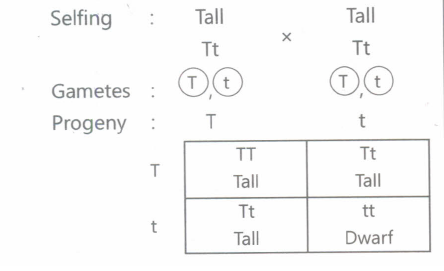
The phenotypic ratio is 3 Tall : 1 dwarf.
Since tallness is dominant over dwarfness, the homozygotes (TT) as well as the heterozygotes (Tt) are tall.
The recessive trait is expressed only under homozygous condition (tt) and hence appears only in one-fourth of the progeny.
19.
| Reptiles | Frogs |
|
In reptiles, fertilisation is internal |
In frogs, fertilisation is external. |
| They lay fertillised eggs in safe places. | Both male and female gametes are laid in water |
| Eggs have a calcareous shell for protection. | Eggs have no calcareous shell, but have mucilaginous covering. |
20.
1. In haploid organisms, meiosis occurs during development of zygote.
2. It is the only diploid stage (formed by the fusion of two haploid gametes) in the life-cycle that can undergo meiosis.
21.
1. Emasculation is necessary to prevent the self-pollen grains falling on the stigma.
2. Emasculation is not needed when the female parent chosen bears unisexual, i.e. female flowers.
22.
1. In haploid organisms, showing haplontic life cycle, gamete formation involves only mitosis; the diploid zygote formed by the fusion of two haploid gametes, undergoes meiosis (zygotic meiosis).
2. In diploid organisms, showing diplontic or haplodiplontic life cycle, gamete formation involues meiosis (gametic meiosis) and haploid gametes are formedl; the diploid zygote undergoes mitosis to form diploid individuals.
23.
1. It is a case of polyembryony, the phenomenon of occurrence of more than one embryo in a seed.
2. It is possible in the following ways:
(i) Some of the nucellar cells surrounding the embryo sac start dividing, protrude into the embryos.
(ii) Synergids of the embryo sac divide and form embryos.
24.
1. Since geitonogamy involves two different flowers of the same plant, it is genetically similar to autogamy; both autogamy and geitonogamy do not result in genetic variation in the progeny.
2. Geitonogamy and cross-pollination involve different flowers and a pollinating agent.
25.
On the basis of colour production in the presence of chromogenic substrate, the recombinants and non-recombinants can be differentiated. In this, a recombinant DNA is inserted within coding sequence of an enzyme \(\beta\)-galactosidase, which results in inactivation of enzyme.
In plate A. the bacterial colonies having inserted plasmid, shows no colouration. While in plate B. insertion of plasmid does not occur, therefore it shows blue colour.

12th Standard CBSE Syllabus & Materials
12th Standard CBSE
CBSE 12th Computer Science Python Revision Tour I - New Previous year Question Papers Study Material - QB365 Set A
NEW12th Standard CBSE
CBSE 12th Business Studies Planning Important Questions And Answers Study Material - QB365 Set A
NEW12th Standard CBSE
CBSE 12th Business Studies Business Environment Important Questions And Answers Study Material - QB365 Set A
NEW12th Standard CBSE
CBSE 12th Business Studies Principles of Management Important Questions And Answers Study Material - QB365 Set A



NCERT Books

Syllabus

Exam Pattern

Sample Question Papers

Previous year Question Papers

Important Notes

MCQ Practice test

NCERT Exemplers

Case study Questions

Image Based Questions

Passage based Questions

HOT Questions

Value Based Questions

Model Questions Papers
NCERT ( Book Back ) Questions

Assertion and Reason
Important Questions And Answers

CBSE 12th Standard CBSE Subjects
CBSE Standards









