
 100% FREE ACCESS
12th Standard CBSE Syllabus & Materials
12th Standard CBSE
CBSE 12th Economics Government Budget and the Economy Previous year Question Papers Study Material - QB365 Set A
NEW12th Standard CBSE
CBSE 12th Computer Science Interface Python with MySQL - New Previous year Question Papers Study Material - QB365 Set A
NEW12th Standard CBSE
CBSE 12th Computer Science Database Concept - New Previous year Question Papers Study Material - QB365 Set A
NEW12th Standard CBSE
CBSE 12th Computer Science Data Communication - New Previous year Question Papers Study Material - QB365 Set A
NEW12th Standard CBSE
CBSE 12th Computer Science Data Structures - New Previous year Question Papers Study Material - QB365 Set A
NEW12th Standard CBSE
CBSE 12th Computer Science Functions - New Previous year Question Papers Study Material - QB365 Set A

Published on: 28/05/2021
QB365 Provides the HOT Question Papers for Class 12 Biology, and also provide the detail solution for each and every HOT Questions. HOT Questions will help to get more idea about question pattern in every exams and also will help to get more marks in Exams
Download CBSE Class 12th Standard CBSE Biology question papers, sample papers, important questions, and previous year solved papers in PDF format. Get free study materials, NCERT solutions, and exam preparation resources for Class 12th Standard CBSE Biology
Questions + Answers key
Take MCQ Biology Test1.
You have learnt about vegetative reproduction in plants. What do you think, is vegetative reproduction also a type of asexual reproduction? Why do you say so? Is the term clone applicable to the individuals formed by vegetative reproduction?
2.
Why do we say there is no natural death in single-celled organisms?
3.
If one can induce parthenocarpy through the application of growth substances, which fruits would you select to induce parthenocarpy and why?
4.
Study the figure given below and answer the question that follow:
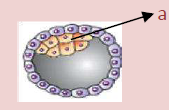
a) Identify 'a' in the figure and mention its function.
b) Mention the stage of human embryo it follows.
c) Where are the stem cells located in this embryo?
d) Which part of this stage of human embryo gets attached to endometrium to establish pregnancy?
5.
Which strategy of Bioconversation is being taken care of if the endangered species are removed from the unsafe or threatened habitat and placed under the care of humans? How is this strategy different from the other strategy of bio-conservation?
6.
By chance you have been caught by the neighboring country & you have been put with cattle. You have not only given human food to eat, but plentiful straw and green forage was there. As an intellectual student of biology, what thoughts would have come to your mind if you had eaten Straw?
7.
Write a critical note on the following:
(i) Hotspots of biodiversity.
(ii) Ex-situ conservation.
(iii) India's effort in biodiversity
8.
How was penicillin discovered?
9.
Why do prokaryotes(bacteria) have restriction enzymes but not eukaryotes?
10.
(a)Explain how to find whether an E.Coli bacterium has transformed or not when a recombinant DNA bearing ampicillin-resistant gene is transferred into it.
(b)What does the ampicillin-resistant gene act as, in the above case?
11.
Many microbial pathogens enter the gut of humans along with food.What are the preventive barriers to protect the body from such pathogens?What type of immunity do you observe in this case?
12.
(a) Explain the property that prevents normal cells from becoming cancerous.
(b) All normal cells have inherent characteristic of becoming cancerous.Explain.
13.
Regulation of lac operon can be visualised as regulation of enzyme synthesis by its substrate. Explain the statement.
14.
ATGGAGTACTTCGTGTGA is the coding strand of DNA in a transcription unit.
(i)Write the mRNA transcribed from this DNA segment.
(ii)How many amino acids does it code for?Why?
15.
Why is it that transcription and translation can be coupled in prokaryotic cells but not in eukaryotic cells?
16.
Recall the experiment of Frederick Griffith.If RNA instead of DNA was the genetic material would the heat-killed S-strain of the bacteria have transformed the R-strain into S-strain? Explain your answer
17.
Why does the son of a carrier mother and a normal father suffer from haemophilia, whereas the son of a haemophilic father and a normal mother would not?
18.
Not all characters show true dominance what are the two other possible types of dominance? Give an example of each type.
19.
Even though each pollen grain has two male gametes, why are at least 10 pollen grains and not 5 pollen grains required to fertilise 10 ovules present in a particular carpel?
20.
Why is it considered that the presence or absence of hymen is not an indication of virginity?
21.
A haploid organism produces gametes by mitosis. Does it mean that meiosis never occurs in such organisms? Justify your answer.
22.
The cell division involved in gamete formation is not of the same type in different organisms. Justify.
23.
If you squeeze a seed of orange, you might observe many embryos of different sizes. How is it possible? Explain.
24.
Explain how geitonogamy is functionally similar to cross-pollination and genetically similar to autogamy.
25.
Geitonogamous flowering plants are genetically autogamous, but functionally cross-pollinated. Justify.
1.
Vegetative reproduction is also a type of asexual reproduction; it is because it involves a single parent and there is no formation or fusion of gametes. The term clone is applicable to the individuals formed by vegetative reproduction, because they are genetically and morphologically identical among themselves and to the parent.
2.
Since single-celled organisms reproduce by cell division (into two new individuals), there is no natural death for them.
3.
The fruits selected to induce parthenocarpy can be watermelon, papaya, etc. It is because these fleshy fruits have a large number of seeds, which interfere with the preparation of jams, jellies, etc.
4.
a) Inner cell mass. It forms the tissues of future embryo
b) Morula
c) In the inner cell mass.
d) The pole of the blastocyst that contains the inner cell mass
5.
Ex-situ. Any two differences between ex-situ and in-situ conservation of biodiversity.
6.
If I had been cow , I would have rumen , I would be able to eat straw which is a cellulosic material and digest it with the help of Methanogens ( Methane generating bacteria)
7.
(i) Hot spots of biodiversity. The concept of 'Hot-spots' was developed by Norman Myres (1988) to designate specific areas for in-situ conservation. The conservation the hot spots are the richest and most threatened reservoirs of plants and animal life on earth.
The criteria for determining hot spots are:
1. Number of endemic species.
2. Degree of threat which is measured in terms of habitat loss.
There are 25 hot spots in the world out of which two are in India. They are Western Ghats and eastern Himalayas.
Hot spot of Eastern Himalayas are active centres of evolution and rich in diversity of flowering angiosperms. Western Ghats have semi evergreen forests. Western Ghats include two main centres of biodiversity i.e. Agastyamalai hills and Silent valley.
(ii) Ex-situ conservation. It means maintenance of off site collections either in gardens by farmers, botanical garden for storing seeds, genes, pollen, tissue culture etc.
The rare plants have been found to flourish in large numbers under the care and protection of gardeners and nature lovers.
The farmers have been maintaining genetic diversity (enormous varieties) of crop plants since ancient times by saving seeds or other components for the next plantings.
Collection of samples of cultivated and wild varieties of plants and storing them in botanical gardens is another method of conservation of germplasm.
In seeds, the living meterial remains in metabolically suspened state. When the seeds are to be stores for longer periods, it is necessary to avoid conditions which favour respiration and enzymatic actions.
(iii) India's effort in biodiversity conservation. India has greatly contributed to conservation of biodiversity owing to its great utility and need for conservation. The following measures have been taken for this purpose:
1. Setting up bodies like Indian Board for Wildlife, Bombay Natural History etc.
2. observation of first week of October as national wildlife week.
3. Introduction of Wildlife Protection Act in 1972.
4. Setting up of sanctuaries, national parks and biosphere reserves.
8.
1. Alexander Fleming, while working on Staphylococci bacteria, observed a mould growing in one of the unwashed culture plates, around the mould the bacterium could not grow.
2. He found that it was due to a chemical produced by the mould Penicillium notatum and named the chemical as Penicillin.
3. Its full potential as an antibiotic was established later by Ernst Chain and Howard Florey.
9.
1. The prokaryotes / bacteria have restriction enzyme to restrict the growth of bacteriophage.
2. They do so by cutting the DNA of the phage with restriction enzyme.
10.
(a) The recombinant/transformant can be selected out from the non-recombinants/non-transformants by plating the transformants on ampicillin containing medium.
1. The transformants will grow in it, while the non-transformants will not grow.
(b) It acts as a selectable marker.
11.
(i) The mucus coating of the gut epithelium is a barrier that traps microbes.
(ii) The hydrochloric acid secreted by gastric glands retards the growth of microbes.
This type of immunity is called innate immunity, which occurs right from birth.
12.
(a) Contact inhibition is the property shown by normal cells,by the virtue of which contact with other cells inhibits their uncontrolled proliferation and growth.
(b) All normal cells have cellular oncogenes (c-onc) or proto-oncogenes;when activated under certain conditions,such genes could lead to oncogenic transformation of cells,i.e.they become cancerous.
13.
1. Lactose is the inducer for lac operon. The active form of lactose binds to the repressor protein and brings about a conformational change in the repressor.
2. As a result, the repressor is inactive, i.e. it cannot bind to the operator.
3. This provides access of the RNA polymerase to structural genes and transcription and production of enzymes continue and metabolism of lactose takes place.
4. In its absence, the repressor is active and binds to the operator, thereby switching off the process.
14.
(i) AUG GAG UAC UUC GUG UGA
(ii) It will code for five amino acids
The last codon UGA is a termination codon that does not code for any amino acid.
15.
1. In prokaryotes, the mRNA does not require any processing to become active.
2. Transcription and translation occur in the same compartment-cytosol, as there is no well-defined nucleus. So coupling of transcription and translation is possible.
3. The mRNA has to be processed before becoming active (splicing is necessary).
4. Since nucleus and cytoplasm are well separated, in eukaryotes the RNA has to be transported to the cytoplasm for translation.
5. So coupling of transcription and translation is not possible.
16.
1.The presence of 2'OH-group of ribose makes RNA more labile and prone to degradation.
2.In the heat-killed S-strain,it would not have remained functional and hence would not have transformed the R-cells into S-cells.
17.
1.The gene for haemophilia is present in the X-chromosome.
2.The son receives the X-chromosome from his mother; so a carrier-mother passeson the disease to 50% of her sons.
3. When the mother is normal, the sons .have no chance of getting the disease, even if the father is haemophilic, because father passes on the Y-chromosome to his sons.
18.
The other possible types of dominance are:
(i) Incomplete dominace.
e.g. Flower colour in snapdragon.
(ii) Codominance.
e.g. Blood group AB.
19.
The two male gametes produced by a pollen grain are used in the fertilisation of one ovule.
One male gamete fuses with the female gamete to form the zygote, i.e. syngamy.
The second male gametes fuses with the secondary nucleus, to form the triploid primary endosperm nucleus (PEN), i.e. triple fusion.
As double fertilisation (two fusions) occurs in the ovules of angiosperms, ten pollen grains are necessary to fertilise ten ovules.
20.
1.Hymen is the membrane that partially covers the vaginal opening.
2.The hymen gets torn during the first coitus.
3. But it can also be torn by active participation in sports like horse-riding,cycling,or by a sudden fall or jolt and insertion of vaginal tampon;so its presence or absence cannot indicate virginity.
21.
1. In haploid organisms, meiosis occurs during development of zygote.
2. It is the only diploid stage (formed by the fusion of two haploid gametes) in the life-cycle that can undergo meiosis.
22.
1. In haploid organisms, showing haplontic life cycle, gamete formation involves only mitosis; the diploid zygote formed by the fusion of two haploid gametes, undergoes meiosis (zygotic meiosis).
2. In diploid organisms, showing diplontic or haplodiplontic life cycle, gamete formation involues meiosis (gametic meiosis) and haploid gametes are formedl; the diploid zygote undergoes mitosis to form diploid individuals.
23.
1. It is a case of polyembryony, the phenomenon of occurrence of more than one embryo in a seed.
2. It is possible in the following ways:
(i) Some of the nucellar cells surrounding the embryo sac start dividing, protrude into the embryos.
(ii) Synergids of the embryo sac divide and form embryos.
24.
1. Since geitonogamy involves two different flowers of the same plant, it is genetically similar to autogamy; both autogamy and geitonogamy do not result in genetic variation in the progeny.
2. Geitonogamy and cross-pollination involve different flowers and a pollinating agent.
25.
1. Since geitonogamy involves two different flowers of the same plant, it is genetically similar to autogamy; both autogamy and geitonogamy do not result in genetic variation in the progeny.
2. Geitonogamy and cross-pollination involve different flowers and a pollinating agent.

12th Standard CBSE Syllabus & Materials
12th Standard CBSE
CBSE 12th Computer Science Python Revision Tour I - New Previous year Question Papers Study Material - QB365 Set A
NEW12th Standard CBSE
CBSE 12th Business Studies Planning Important Questions And Answers Study Material - QB365 Set A
NEW12th Standard CBSE
CBSE 12th Business Studies Business Environment Important Questions And Answers Study Material - QB365 Set A
NEW12th Standard CBSE
CBSE 12th Business Studies Principles of Management Important Questions And Answers Study Material - QB365 Set A



NCERT Books

Syllabus

Exam Pattern

Sample Question Papers

Previous year Question Papers

Important Notes

MCQ Practice test

NCERT Exemplers

Case study Questions

Image Based Questions

Passage based Questions

HOT Questions

Value Based Questions

Model Questions Papers
NCERT ( Book Back ) Questions

Assertion and Reason
Important Questions And Answers

CBSE 12th Standard CBSE Subjects
CBSE Standards









