
 100% FREE ACCESS
12th Standard CBSE Syllabus & Materials
12th Standard CBSE
CBSE 12th Economics Government Budget and the Economy Previous year Question Papers Study Material - QB365 Set A
NEW12th Standard CBSE
CBSE 12th Computer Science Interface Python with MySQL - New Previous year Question Papers Study Material - QB365 Set A
NEW12th Standard CBSE
CBSE 12th Computer Science Database Concept - New Previous year Question Papers Study Material - QB365 Set A
NEW12th Standard CBSE
CBSE 12th Computer Science Data Communication - New Previous year Question Papers Study Material - QB365 Set A
NEW12th Standard CBSE
CBSE 12th Computer Science Data Structures - New Previous year Question Papers Study Material - QB365 Set A
NEW12th Standard CBSE
CBSE 12th Computer Science Functions - New Previous year Question Papers Study Material - QB365 Set A

Published on: 28/05/2021
QB365 Provides the HOT Question Papers for Class 12 Biology, and also provide the detail solution for each and every HOT Questions. HOT Questions will help to get more idea about question pattern in every exams and also will help to get more marks in Exams
Download CBSE Class 12th Standard CBSE Biology question papers, sample papers, important questions, and previous year solved papers in PDF format. Get free study materials, NCERT solutions, and exam preparation resources for Class 12th Standard CBSE Biology
Questions + Answers key
Take MCQ Biology Test1.
Algae and fungi shiftto sexual method ofreproduction just before the onset of adverse conditions. Find out how sexual reproduction enables these organisms to survive during unfavourable conditions. Why is sexual reproduction favoured under such conditions?
2.
You have learnt about vegetative reproduction in plants. What do you think, is vegetative reproduction also a type of asexual reproduction? Why do you say so? Is the term clone applicable to the individuals formed by vegetative reproduction?
3.
Why do we say there is no natural death in single-celled organisms?
4.
Each restriction enzyme cuts DNA at a specific base sequence. For example, EcoRI always cuts DNA at GAATTC
3’—GTAAGAATTCTTTAGAATTCCGCCATTATCGAATTCAGGATCTTAC—5’
5’—CATTCTTAAGAAATCTTAAGGCGGTAATAGCTTAAGTCCTAGAATG—3’
a. How many times EcoRI cuts this long strand?
b. How many small DNA pieces are formed from this long strand?
c. These fragments show overhangs of single stranded DNA. What are they known as? Why are they called so?
d. Which enzyme is used to seal these fragments together?
5.
Water samples, three in number namely river water; sewage water and secondary effluent from STP were subjected to BOD test. They were labeled A B & C but the laboratory technician did not note which was which. The BOD values of three samples A, B & C were recorded as 30mg/l, 8mg/l and 500mg/l respectively. Which sample of water is most polluted? Can you assign the correct label to each assuming the river water relatively clear?
6.
Although AIDS is a fluid transmitted disease, it is considered as an STD. Give a reason for it.
7.
Name the types of barrier of innate immune system, which involves
(i) HCI of stomach
(ii) macrophages.
8.
What is EI Nino effect? Explain how it accounts for biodiversity loss.
9.
Write a critical note on the following:
(i) Hotspots of biodiversity.
(ii) Ex-situ conservation.
(iii) India's effort in biodiversity
10.
How was penicillin discovered?
11.
A plasmid DNA and a linear DNA (both of the same size) have one site for a restriction endonuclease. When cut and separated on agarose gel electrophoresis, plasmid shows one DNA band, while the linear DNA shows two fragments. Explain.
12.
The species diversity of plants (22 per cent) is much less than that of animals (72 per cent). What could be the explanations to how animals achieved greater diversification?
13.
(a) Explain the property that prevents normal cells from becoming cancerous.
(b) All normal cells have inherent characteristic of becoming cancerous.Explain.
14.
Discuss, is evolution a process or the end result of a process.
15.
Why are the wings of butterfly and birds said to be analogous organs? Name the type of evolution, the analogous organs are a result of.
16.
Name and explain the type of immunity that is provided by injecting microbes deliberately during immunisation into the human body.
17.
Why does the son of a carrier mother and a normal father suffer from haemophilia, whereas the son of a haemophilic father and a normal mother would not?
18.
Not all characters show true dominance what are the two other possible types of dominance? Give an example of each type.
19.
Inheritance is particulate in nature. Justify.
20.
Reptiles and frogs are oviparous animals; yet they differ in certain aspects of reproduction. Bring out the differences and mention which of the two animals has more advantage in survival.
21.
A haploid organism produces gametes by mitosis. Does it mean that meiosis never occurs in such organisms? Justify your answer.
22.
Why should a breeder need to emasculate a bisexual flower? Mention a condition in a flower, where emasculation is not necessary?
23.
The cell division involved in gamete formation is not of the same type in different organisms. Justify.
24.
Geitonogamous flowering plants are genetically autogamous, but functionally cross-pollinated. Justify.
25.
A and B are two different cloning vectors in two different bacterial colonies cultured in chromogenic substrate Bacterial colonies with cloning vector A were colourless, whereas those with B were blue coloured. Explain by giving reasons the cause of difference in colour that appeared.
1.
In algae and fungi, the zygote formed as a result of sexual reproduction, develops a thick wall that protects the zygote from desiccation and mechanical injuries; hence the zygote is able to remain dormant during the unfavourable conditions and germinate at the return of favourable conditions. Since sexual reproduction brings in variation(s), at least some variants will be able to survive, in case of an adverse change in the environmental conditions. Because of the survival advantages (mentioned above), sexual reproduction is favoured under such conditions.
2.
Vegetative reproduction is also a type of asexual reproduction; it is because it involves a single parent and there is no formation or fusion of gametes. The term clone is applicable to the individuals formed by vegetative reproduction, because they are genetically and morphologically identical among themselves and to the parent.
3.
Since single-celled organisms reproduce by cell division (into two new individuals), there is no natural death for them.
4.
a. Three cuts.
b. Four strands.
c. Sticky ends, since they have complementary bases, they can rejoin fragments with complementary sticky ends to form rDNA (gene from vector and the gene to be cloned is inserted)
d. DNA ligase
5.
BOD value - 30mg/L - Secondary effluent from STP
BOD value - 8mg/L – River Water
BOD value - 500mg/L – Sewage Water
(Fact – The greater the BOD of water, the more is its pollution potential.)
6.
AIDS is a fluid transmitted disease and is considered as an STD because the probability of fluid transmission is maximum during sexual intercourse.
7.
(i) HCI of stomach belongs to the physiological barrier.
(ii) Macrophages come under cellular barrier.
8.
(a) EI Nino. It is an abnormal warming of surface ocean waters in the eastern tropical Pacific. It is called the Southern Oscillation. The Southern Oscillation is the see-saw pattern of reversing surface air pressure between the eastern and western tropical Pacific; When the surface pressure is high in the eastern tropical Pacific it is low in the western tropical Pacific, and vice-versa. Because the ocean warming and pressure reversals are, for the most part, simultaneous, scientists call this phenomenon the EI Nino/Southern Oscillation or ENSO for short.
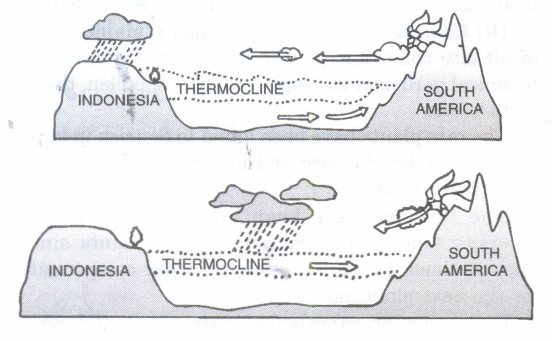
Unfortunately not all EI Nino's are the same nor does the atmosphere always react in the same way from one EI Nino to another. This is why NASA's Earth scientists continue to take part in international efforts to understand EI Nino events. Hopefully one day scientists will be able to provide sufficient warning so that we can be better prepared to deal with the damages and changes that EI Nino causes in the weather.
9.
(i) Hot spots of biodiversity. The concept of 'Hot-spots' was developed by Norman Myres (1988) to designate specific areas for in-situ conservation. The conservation the hot spots are the richest and most threatened reservoirs of plants and animal life on earth.
The criteria for determining hot spots are:
1. Number of endemic species.
2. Degree of threat which is measured in terms of habitat loss.
There are 25 hot spots in the world out of which two are in India. They are Western Ghats and eastern Himalayas.
Hot spot of Eastern Himalayas are active centres of evolution and rich in diversity of flowering angiosperms. Western Ghats have semi evergreen forests. Western Ghats include two main centres of biodiversity i.e. Agastyamalai hills and Silent valley.
(ii) Ex-situ conservation. It means maintenance of off site collections either in gardens by farmers, botanical garden for storing seeds, genes, pollen, tissue culture etc.
The rare plants have been found to flourish in large numbers under the care and protection of gardeners and nature lovers.
The farmers have been maintaining genetic diversity (enormous varieties) of crop plants since ancient times by saving seeds or other components for the next plantings.
Collection of samples of cultivated and wild varieties of plants and storing them in botanical gardens is another method of conservation of germplasm.
In seeds, the living meterial remains in metabolically suspened state. When the seeds are to be stores for longer periods, it is necessary to avoid conditions which favour respiration and enzymatic actions.
(iii) India's effort in biodiversity conservation. India has greatly contributed to conservation of biodiversity owing to its great utility and need for conservation. The following measures have been taken for this purpose:
1. Setting up bodies like Indian Board for Wildlife, Bombay Natural History etc.
2. observation of first week of October as national wildlife week.
3. Introduction of Wildlife Protection Act in 1972.
4. Setting up of sanctuaries, national parks and biosphere reserves.
10.
1. Alexander Fleming, while working on Staphylococci bacteria, observed a mould growing in one of the unwashed culture plates, around the mould the bacterium could not grow.
2. He found that it was due to a chemical produced by the mould Penicillium notatum and named the chemical as Penicillin.
3. Its full potential as an antibiotic was established later by Ernst Chain and Howard Florey.
11.
This is because plasmid is a circular DNA molecule. When cut with enzyme, it becomes linear, but does not get fragmented.
Whereas, a linear DNA molecule gets cut into two fragments. Hence, a single DNA band is observed for plasmid while, two DNA bands are observed for linear DNA in agarose gel.
12.
Since plants cannot move away from their predators (herbivores) and harsh environmental conditions, many of them have become extinct. But animals can move away from the harmful/unfavourable environments or their predators and evolution of favourable characters has thus taken place in them.
13.
(a) Contact inhibition is the property shown by normal cells,by the virtue of which contact with other cells inhibits their uncontrolled proliferation and growth.
(b) All normal cells have cellular oncogenes (c-onc) or proto-oncogenes;when activated under certain conditions,such genes could lead to oncogenic transformation of cells,i.e.they become cancerous.
14.
1. The biodiversity we see today is the story of evolution, i.e. evolution is considered as a process, that has resulted in various life forms.
2. If we talk about the life on earth, evolution is considered as a consequence of the process, called natural selection.
3. It is difficult to decide, whether evolution and natural selection are processes or results of some unknown processes.
15.
1. convergent evolution is the evolutionary process, where anatomically different structures in different groups of organisms evolve towards the same function, in similar habitats.
2. Such structures in different groups of organisms which perform similar function, but are anatomically different, are called analogous organs.
3. The wings of a butterfly and those of bird are anatomically different, but perform the same function (flying); hence they are said to be analogous organs.
16.
1. Active immunity is produced by injecting the microbes deliberately during immunisation.
2. Antibodies are produced by the B-cells of our body in response to the antigens;they neutralise the pathogenic agents during actual infection.
3. The vaccines also generate memory B-cells and T-cells,which recognise the same pathogen on subsequent exposure and destroy them by a massive production of antibodies.
17.
1.The gene for haemophilia is present in the X-chromosome.
2.The son receives the X-chromosome from his mother; so a carrier-mother passeson the disease to 50% of her sons.
3. When the mother is normal, the sons .have no chance of getting the disease, even if the father is haemophilic, because father passes on the Y-chromosome to his sons.
18.
The other possible types of dominance are:
(i) Incomplete dominace.
e.g. Flower colour in snapdragon.
(ii) Codominance.
e.g. Blood group AB.
19.
1. The characters are controlled by 'Factors' which are stably passed down without any change from the parents to the offspring, through the gametes.
2. The allels do not show any blending.
20.
| Reptiles | Frogs |
|
In reptiles, fertilisation is internal |
In frogs, fertilisation is external. |
| They lay fertillised eggs in safe places. | Both male and female gametes are laid in water |
| Eggs have a calcareous shell for protection. | Eggs have no calcareous shell, but have mucilaginous covering. |
21.
1. In haploid organisms, meiosis occurs during development of zygote.
2. It is the only diploid stage (formed by the fusion of two haploid gametes) in the life-cycle that can undergo meiosis.
22.
1. Emasculation is necessary to prevent the self-pollen grains falling on the stigma.
2. Emasculation is not needed when the female parent chosen bears unisexual, i.e. female flowers.
23.
1. In haploid organisms, showing haplontic life cycle, gamete formation involves only mitosis; the diploid zygote formed by the fusion of two haploid gametes, undergoes meiosis (zygotic meiosis).
2. In diploid organisms, showing diplontic or haplodiplontic life cycle, gamete formation involues meiosis (gametic meiosis) and haploid gametes are formedl; the diploid zygote undergoes mitosis to form diploid individuals.
24.
1. Since geitonogamy involves two different flowers of the same plant, it is genetically similar to autogamy; both autogamy and geitonogamy do not result in genetic variation in the progeny.
2. Geitonogamy and cross-pollination involve different flowers and a pollinating agent.
25.
On the basis of colour production in the presence of chromogenic substrate, the recombinants and non-recombinants can be differentiated. In this, a recombinant DNA is inserted within coding sequence of an enzyme \(\beta\)-galactosidase, which results in inactivation of enzyme.
In plate A. the bacterial colonies having inserted plasmid, shows no colouration. While in plate B. insertion of plasmid does not occur, therefore it shows blue colour.

12th Standard CBSE Syllabus & Materials
12th Standard CBSE
CBSE 12th Computer Science Python Revision Tour I - New Previous year Question Papers Study Material - QB365 Set A
NEW12th Standard CBSE
CBSE 12th Business Studies Planning Important Questions And Answers Study Material - QB365 Set A
NEW12th Standard CBSE
CBSE 12th Business Studies Business Environment Important Questions And Answers Study Material - QB365 Set A
NEW12th Standard CBSE
CBSE 12th Business Studies Principles of Management Important Questions And Answers Study Material - QB365 Set A



NCERT Books

Syllabus

Exam Pattern

Sample Question Papers

Previous year Question Papers

Important Notes

MCQ Practice test

NCERT Exemplers

Case study Questions

Image Based Questions

Passage based Questions

HOT Questions

Value Based Questions

Model Questions Papers
NCERT ( Book Back ) Questions

Assertion and Reason
Important Questions And Answers

CBSE 12th Standard CBSE Subjects
CBSE Standards









