
 100% FREE ACCESS
12th Standard CBSE Syllabus & Materials
12th Standard CBSE
CBSE 12th Economics Government Budget and the Economy Previous year Question Papers Study Material - QB365 Set A
NEW12th Standard CBSE
CBSE 12th Computer Science Interface Python with MySQL - New Previous year Question Papers Study Material - QB365 Set A
NEW12th Standard CBSE
CBSE 12th Computer Science Database Concept - New Previous year Question Papers Study Material - QB365 Set A
NEW12th Standard CBSE
CBSE 12th Computer Science Data Communication - New Previous year Question Papers Study Material - QB365 Set A
NEW12th Standard CBSE
CBSE 12th Computer Science Data Structures - New Previous year Question Papers Study Material - QB365 Set A
NEW12th Standard CBSE
CBSE 12th Computer Science Functions - New Previous year Question Papers Study Material - QB365 Set A

Published on: 28/05/2021
QB365 Provides the HOT Question Papers for Class 12 Biology, and also provide the detail solution for each and every HOT Questions. HOT Questions will help to get more idea about question pattern in every exams and also will help to get more marks in Exams
Download CBSE Class 12th Standard CBSE Biology question papers, sample papers, important questions, and previous year solved papers in PDF format. Get free study materials, NCERT solutions, and exam preparation resources for Class 12th Standard CBSE Biology
Questions + Answers key
Take MCQ Biology Test1.
Why are nutrient cyclesin nature called biogeochemical cycles?
2.
If the meiocyte of a maize plant contains 20 chromosomes, write the number of chromosomes in the endosperm and embryo of the maize grain and give reasons in support of your answer.
3.
How are somaclones cultured from explants in in-vitro? Why are somaclones so called?
4.
Since the origin of life on earth and evolution there have been 5 episodes of mass extinction, but the current rate of extinction is 100-1000 times. What are the main causes of high extinction rate and how is it going to harm human beings?
5.
When and where did Neanderthal man live? What was his brain capacity? Mention the advancements he showed over Homo erectus?
6.
Why does deforestation lead to global warming?
7.
The use of incinerators is crucial for the disposal of hospital waste justify.
8.
Why is the strand of DNA with 3'-5' polarity transcribed and not the other strand with 5'--> 3' polarity?
9.
Do you think that the alternate splicing of exons may enable a structural gene to code for several isoproteins from one and the same gene ?If yes.how?If not, why so?
10.
Why do the toxic insecticide proteins secreted by Bacillus thuringiensis kill insects?
11.
(i) Construct a complete transcription unit with promoter and terminator on the basis of hypothetical template strand given below.

(ii) Write the RNA strand transcribed from the above transcription unit along with its polarity.
12.
Explain with an example, where a gene, which carries a major disadvantage in homozygous condition.
13.
Create an aquatic food chain in a water body into which effluents flow from a pesticide factory. Diagrammatically represent and answer the following questions:
What is the phenomenon called?
14.
We sometimes find the existence of following structures in human beings:
(i) Occurrence of short tail in some babies.
(ii) Presence of additional mammae in two rows down the front of the body of some persons
(iii) Power of moving pinna, or
(iv) Presence of very long and dense hair on the body.
Why does this happen in such persons? Also, name the phenomenon involved.
15.
Give reasons for the following statements:
(a) Placental wolf and Tasmanian wolf exist sharing the same habitat.
(b) Special kind of evolution has brought the similarity as seen in fins of fishes and flippers of dolphins Name the kind of evolution also.
(c) Study of fossils provide us direct and most reliable evidences of evolution.
16.
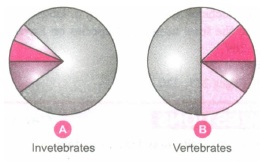
In the pie charts (A) and (B) drawn below to show the global animal diversity, which groups of animals would you name and write on the area shaded black in (A) and (B). In which kind of habitat would you find these groups of animals?
17.
Why are reducers or decomposers considered crucial and essential components of an ecosystem? Explain.
18.
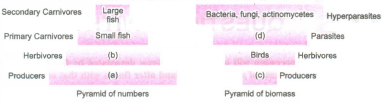
Given below are two figures depicting pyramid of numbers and pyramid of biomass in aquatic ecosystem and parasitic food chain.Observe the figures carefully and fill in the blanks (a), (b), (c) and (d).
19.
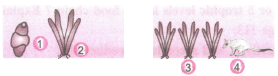
In the pictures provided, what is the relationship between (1) and (2) and (3) and (4) with respect to trophic levels.
20.
(a)Name a genetic RNA and a non-genetic RNA
(b)Differntiate between prokaryotic mRNA and eukaryotic mRNA on the basis of any one character.
21.
What will you do to get your cow crossed artificially by an exotic bull?
22.
Name 'A' and 'B' in the following equations:
Sugary juice \(\underrightarrow { 'A' } \) Ethanol + H2 O ; Ethanol \(\underrightarrow { Acetobacter\quad aceti } \) B
23.
Which one is advance- external fertilization or internal fertilization? Give reasons in support of your answer.
24.
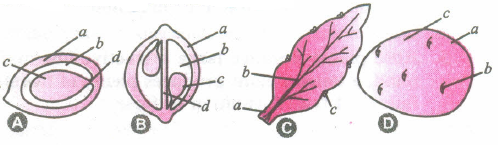
In the following figures label the parts responsible for production of new plants
25.
(i)Why does DNA replication occur in small replication forks and not in its entire length?
(ii)Why is DNA replication countinuous and discountinuous in a replication fork?
(iii)Explain the importance of 'origin of replication' in a replication fork.
1.
The nutrients (chemicals) are cycled through living organisms (bio) and the components of earth (geo : air, water, soil/rock); hence the nutrient cycles, are called biogeochemical cycles.
2.
1. The endosperm will have 30 chromosomes and the embryo will have 20 chromosomes.
2. The meiocyte is a diploid cell (with 20 chromosomes) and it undergoes meiosis; hence, the haploid cells of maize will have 10 chromosomes.
3. The endosperm develops from the primary endosperm cell, where the primary endosperm nucleus (PEN) is formed by triple fusion, i.e., fusion of three haploid nuclei-two polar nuclei (fuse to form a diploid secondary nucleus) and a haploid male gamete.
4. So the endosperm cells are triploid with 30 chromosomes.
5. The embryo develops from the zygote, which is formed by the fusion of a female gamete with a male gamete; so it is diploid with 20 chromosomes.
3.
1. The explant is grown in a test tube or petridish under sterile conditions in a special nutrient medium.
2. The nutrient medium must provide a carbon source like sucrose, inorganic salts, vitamins, amino acids and growth regulators like auxins and cytokinins, etc.
3. The plantlets are then shifted to the soil in the field (Micropropagation).
4. The plants are genetically identical among themselves and also to the plant from which they have been produced; hence they are called somaclones.
4.
Human activities are the basic cause for it.
Causes – 4 major causes (The evil Quartet along with suitable examples of each:
i) Habitat loss and fragmentation-decline in covered forest area from 14% to 6%.
ii) Overexploitation- extinction of steller’s sea cow
iii) Alien species invasion-Nile perch introduction into Lake Victoria resulted in extinction of 200 species cichlid fish.
iv) Co-extinction-coevolved plant pollinator mutualism.
Harms: (a) Decline in plant production
b) Lowered resistance to Env. Perturbations like drought.
c) Increased variability in certain ecosystem processes such as plant productivity, water use etc.
5.
1. Near east and central Asia between 1, 00,000 - 40,000 years back.
2. Brain capacity is around 1400 cc.
3.buried their dead & used hides to protect their body.
6.
The forest plants fix a lot of CO2 and thus have a lot of carbon in their biomass. The deforestation therefore results in the increased concentration of CO2 in the atmosphere which may result in the global warming.
7.
Many harmful chemicals, disinfectants and pathogenic microbes are present in the waste generated in the hospitals. Such waste require disposal, requiring incinerators.
8.
The DNAstrand with 3'-5' polarity only is trancribed and not the other because the RNA-polymerase can polymerize RNA only in 5'-3' direction.
9.
1. Functional mRNA of structural genes need not always include all of its exons.This alternate splicing of exons is sex-specific , issue-specific and even development stage-specific.
2. By such alternate splicing of exons, a single gene may encode for several ios proteins and/ or proteins of similar class.In absence of such a kind od splicing, there should have been new genes for every protein/isoprotein.Such an extravagance has been avoided in natural phenomena by alternative splicing.
10.
It is because spores of Bacillus thuringiensis produce the insecticidal Cry proteins that are toxic when ingested by certain insects.
11.
(i) Transcription unit

(ii) RNA transcribed

12.
An example for this condition is sickle-anaemia. The person with homozygous condition (Hbs Hbs ) for sickle-cell anaemia does not survive beyond the age of 20 years.
The individual with normal gene (HbHb) does not have sickle-cell anaemia but they are sensitive towards malaria.
The person with heterozygous condition (HbHbs) for sickle-cell anaemia does not develop both sickle-cell anaemia and malaria.
Due to abnormal haemoglobin, the malarial parasite will not harm the person.
Hence, in this case, the heterozygous condition has more survival chances, an advantage with respect to the homozygous individuals.
13.
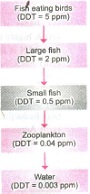
Biomagnification or biological magnification.
14.
The appearance of above characters in some persons can be explained on the assumption that there is a tendency among the animals including human being to develop structures that were present in their remote ancestors.
The phenomenon involved is called atavism (i.e., the reappearance of certain ancestral, not parental, structure(s) which has/have either completely disappeared or greatly reduced).
15.
(a) Placental wolf and Tasmanian wolf exist sharing the same habitat in different continents (former in Asia and the latter in Australia) because these species show parallel evolution. These have shown independent development of similar characters in two animal groups of common ancestory living in similar habitats of different continents.
(b) Convergent evolution has brought the similarity in the fins of fishes and flippers of dolphins because these are analogous structures. These are quite different in fundamental structure and embryonic origin but have been modified to perform same function in aquatic habitats.
(c) Study of fossils (palaeontology) deals with the actual organisms or their parts that lived in the past. Therefore, it provides us direct and most reliable evidence of evolution.
16.
(A) (1) Shaded area = Insects (Habitat-Aerial; terrestrial, aquatic).
(B) Shaded area = fishes (Habitat-Aquatic).
17.
Sun is the endless source of energy, but the chemical materials of the environment are exhaustible.The producers fix solar energy into the chemical energy of organic compounds by utilizing inorganic substance (i.e., CO2 and water). This stored energy is passed to consumers by repeated eating and being eaten.Decomposers act on dead decaying organic matter and return the locked inorganic substance back to the environment for their reuse by producers.Without this, all life will ultimately cease to exist and earth will be full of dead organisms and waste organic substances.
18.
(a) Phytoplanktons
(b) Zooplanktons
(c) Oak tree
(d) lice and bugs
19.
(1) is a mollusc (a herbivore or primary consumer in aquatic habitat)
(2) is an aquatic plant or producer (producer level.)
(3) crop plants are producers in cropland ecosystem.
(4) is a rat (primary concumer).
20.
(a) Genetic RNA-Double stranded RNA of mammalian reovirus
Non-genetic RNA-Ribosomal RNA, messenger RNA or transfer RNA
(b)Prolaryotic mRNA is short lived and hardly undergoes processing(capping, methylation and polyadenylation)to from comparatively stable mRNA.
21.
There are insemination centres throughout the country which collect the semen of superior bulls of exotic or indigenous breeds and store in the frozen form to be used at a later date. We should take our cows to these centres for artificial insemination.
22.
'A' = Saccharomyces cerevisiae ; 'B' = Acetic acid
23.
External fertilization is primitive and internal fertilization is advance. External fertilization is not advanced because it occurs outside the body of the organisms, mostly in water in most aquatic organisms so that a large number of gametes are wasted. Moreover, the offsprings are not protected from predators and their survival threatened.
24.
(A) c is a seed that produces new plant.
(B) c is a seed that produces new plant.
(C) c is an adventitious bud that produces a new plant.
(D) b is an eye that has a bud.
25.
(i) Replication of DNA occurs in small replication forks, because DNA is such a long molecule that the separation of the two strands along its entire length requires a very high amount of energy.
(ii) DNA polymerase can catalyse the polymerisation of nucleotides only in \({ 5 }^{ ' }\rightarrow { 3 }^{ ' }\) direction.So on the template strand with \({ 3 }^{ ' }\rightarrow { 5 }^{ ' }\) polarity, DNA replication is continuous.On the template strand with \({ 5 }^{ ' }\rightarrow { 3 }^{ ' }\) polarity, DNA synthesis occurs in short stretches as the opening of replication fork continues; later these short stretches are joined by the action of DNA ligases
(iii) Replication of DNA does not initiate randomly, and DNA polymerases on their own cannot initiate replication.So, there is a specific sequence on DNA, called origin of replication; DNA polymerase binds to it and continues the process.

12th Standard CBSE Syllabus & Materials
12th Standard CBSE
CBSE 12th Computer Science Python Revision Tour I - New Previous year Question Papers Study Material - QB365 Set A
NEW12th Standard CBSE
CBSE 12th Business Studies Planning Important Questions And Answers Study Material - QB365 Set A
NEW12th Standard CBSE
CBSE 12th Business Studies Business Environment Important Questions And Answers Study Material - QB365 Set A
NEW12th Standard CBSE
CBSE 12th Business Studies Principles of Management Important Questions And Answers Study Material - QB365 Set A



NCERT Books

Syllabus

Exam Pattern

Sample Question Papers

Previous year Question Papers

Important Notes

MCQ Practice test

NCERT Exemplers

Case study Questions

Image Based Questions

Passage based Questions

HOT Questions

Value Based Questions

Model Questions Papers
NCERT ( Book Back ) Questions

Assertion and Reason
Important Questions And Answers

CBSE 12th Standard CBSE Subjects
CBSE Standards









