
 100% FREE ACCESS
12th Standard CBSE Syllabus & Materials
12th Standard CBSE
CBSE 12th Economics Government Budget and the Economy Previous year Question Papers Study Material - QB365 Set A
NEW12th Standard CBSE
CBSE 12th Computer Science Interface Python with MySQL - New Previous year Question Papers Study Material - QB365 Set A
NEW12th Standard CBSE
CBSE 12th Computer Science Database Concept - New Previous year Question Papers Study Material - QB365 Set A
NEW12th Standard CBSE
CBSE 12th Computer Science Data Communication - New Previous year Question Papers Study Material - QB365 Set A
NEW12th Standard CBSE
CBSE 12th Computer Science Data Structures - New Previous year Question Papers Study Material - QB365 Set A
NEW12th Standard CBSE
CBSE 12th Computer Science Functions - New Previous year Question Papers Study Material - QB365 Set A

Published on: 28/05/2021
QB365 Provides the HOT Question Papers for Class 12 Biology, and also provide the detail solution for each and every HOT Questions. HOT Questions will help to get more idea about question pattern in every exams and also will help to get more marks in Exams
Download CBSE Class 12th Standard CBSE Biology question papers, sample papers, important questions, and previous year solved papers in PDF format. Get free study materials, NCERT solutions, and exam preparation resources for Class 12th Standard CBSE Biology
Questions + Answers key
Take MCQ Biology Test1.
Honeybees produce their young ones only by sexual reproduction. Inspite of this, we find both haploid
and diploid individuals in the colony. Analyse the reasons behind their formation.
2.
Give reasons why:
(i) most zygotes in angiosperms divide only after certain amount of endosperm is formed.
(ii) groundnut seeds are exalbuminous and castor seeds 'are albuminous.
(iii) micropyle remains as a small pore in the seed coat of a seed.
(iv) integuments of an ovule harden and the water content is highly reduced, as the seed matures.
(v) apple and cashew are not called true fruits.
3.
Though the conflict between humans and wildlife started with the evolution of man, the intensity of conflict has increased due to the activities of modern man. Justify your answer with suitable examples.
4.
(i) Indiscriminate human activities such as alien species invasion, fragmentation and habitat loss have accelerated the loss of biodiversity. Justify by taking one example for each.
(ii) State the importance of (a) IUCN Red Data list and (b) Hotspots in conservation of biodiversity.
5.
During a biology lecture in class the teacher called apple seeds as seeds but maize seeds as grains. On hearing this Amit got confused and asks her teacher the reason behind this. The teacher appreciated Amit and cleared all his doubts.
(i) What is the difference between seed and grain?
(ii) How are maize grains formed?
(iii) Explain along with a labelled diagram of the vertical section of a maize grain.
(iv) What values are shown by Amit.
6.
Ram saw a farmer spraying some chemicals on flowers. On asking farmer, he came to know that this act will lead to the formation of fruits without fertilisation. Ram thought that fruits developed in this way are not good to eat as chemicals are sprayed on it.
Next day, he asked his biology teacher about it, who explained him everything.
(i) What chemicals were sprayed by the farmer?
(ii) Give difference between such a spray and usual pesticide spray?
(iii) What is parthenocarpy? Give its types.
(iv) What values are shown by Ram?
7.
In case of polyembryony, if one embryo develops from the synergid and another from the nucellus, which one is haploid and which is diploid? Describe polyembryony and also mention how can it be commercially exploited.
8.
Embryo sacs of some apomictic species appear normal, but contain diploid cells. Suggest a suitable explanation for the condition.
9.
Double fertilisation is immediately followed by development of endosperm. Explain the link between the two processes.
10.
Give one word
(i) Supply of alternative resources to industries In the form of starches fuels & pharmaceuticals.
(ii) New strategy adopted to protect the tobacco Plant infestation by Meloidogyne incognitia.
(iii) Technique based on the principle of antigen antibody interaction
(iv) Uses of bioresources by multinational companies /other organization Without proper authorization from the concerned parties.
(v) Decision making organization regardingvalidity of G.M. resources & the safety of introducing G.M. crops
11.
Give a flow chart to show the different divisions of geological time scale.
12.
Fitness is the end result of the ability to adapt and get selected by Nature. Explain with suitable example.
13.
A population od Paramecium caudatum was grown in a culture medium. After 5 days the culture medium became overcrowded with Paramecium and had depleted nutrients.
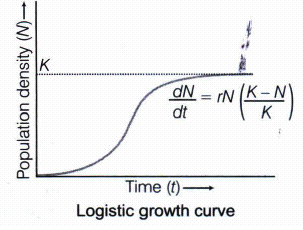
What will happen to the population and what type of growth curve will the population attain?Draw the growth curve.
14.
Do all the gametes formed from a parent organism have the same genetic composition (identical DNA copies of the parental genome)? Analyze the situation with the background of gametogenesis and provide or give a suitable explanation.
15.
With reference for events starting from menstrued cycle till the events of parturition give the name of the hormones involved at each stage and explain their role.
16.
Mukta visits a dairy farm near her locality to buy milk for her household. While, waiting there for her turn, she noticed that one of the member of the farm was injecting something into the cow before milking. She was very curious and discussed her queries with her friend (a biology expert)
(i) What did the injection contain?
(ii) Why is this injection administered to the cow?
(iii) State any two methods of herd improvements.
(iv) What values are shown by Mukta?
17.
Answer the following questions related to Down's syndrome.
(i) When was Down's syndrome first described?
(ii) What is its frequency in human and does it also occur in other animals?
(iii) How does Down's syndrome arise?
(iv) Related it with chromosome dysfunctions.
18.
Why is aerobic degradation more important than anaerobic degradation for the treatment of large volumes of waste water in organic matter. Discuss.
19.
(a) A garden pea plant bearing terminal, violet flowers, when crossed with another pea plant bearing axial, violet flowers produced axial, violet flowers in the ratio of 3 : 1.
Work out the cross showing the genotypes of the parent pea plants and their progeny.
(b) Name and state the law that can be derived from this cross and not from a mohohybrid cross.
20.
(a) Draw a labelled diagram of L.S. of an embryo of grass (any six labels).
(b) Give reason for each of the following:
(i) Anthers of angiosperm flowers are described as dithecous.
(ii) Hybrid seeds have to be produced year after year.
1.
1.Honeybees reproduce sexually and form gametes.
2. Those female gametes which develop without fertilisation (parthenogenesis), develop into males/ drones; they are haploid.
3. When fertilisation occurs, the zygote develops into female; it is diploid.
4. Hence, both diploid and haploid individuals are found in a colony of honeybees.
2.
(i) The zygote starts dividing only after a certain amount of endosperm is formed as an adaptation to provide assured nutrition to the developing embryo; hence we can say it remains dormant for sometime.
(ii) In groundnut, the developing embryo utilises the endosperm completely; there is no residual endosperm in the seed and so the seed is exalbuminous.
In castor, the endosperm is not completely used up by the developing embryo; there is some amount of endosperm left in the seeds and hence the seeds are albuminous.
(iii) The integuments encircle the nucellus except at the tip, leaving a small opening, called micropyle.
a. As the integuments harden as the seed coat the micropyle remains as a small opening or pore in the seed coat.
b. The micropyle facilitates the entry of water and oxygen into the seed during germination.
(iv) The integuments harden as seed coat to protect the embryo. The moisture content is reduced and the seed become dry (with only 10-15% of moisture by mass), so that the general metabolic activity of the seed decreases and the seed can enter a state of inactivity, called dormancy, to tide over the unfavourable conditions.
(v) Since, the thalamus (a part other than the ovary) also contributes to fruit formation, these fruits are not true fruits; they are cal\ed false fruits.
3.
The humans first evolved around 2.5million years ago and agriculture began about 11 thousand years ago. It is since then that humans have started to exploit the forest land for agriculture. Development in medical technology has increased the lifespan of humans, decreased the mortality rate of mother and child, further aggrevating the problem of human population.
Along with this, the industrial revolution caused enormous consumption of earth's resources and giving back a lot of air pollution. The enormous amount of waste being generated every day is destroying the natural habitat of other species, be it aquatic or terrestrial, endangering and later causing extinction thereof. This is how human activities have led to the increase in conflict between humans and wildlife.
4.
(a) Alien species invasions : When alien species are introduced unintentionally or deliberatelt for whatever purpose, some of them turn invasive, and cause decline or extinction of indigenous species E.g. The recent illegal introduction of African catfish claries gariepinus for aqua culture purposes is posing a threat to the indigenous catfishes in our rivers.
Habit loss and fragmentation : The most important cause driving animals and plants to extinction. When large habitals are broken up into fragments due to various human activities, badly affected, leading to population declines.
For example , The Amazon rain forest harbouring probably millions of species is being cut and cleared for cultivating soya beans or for conversion to grasslands for raising beef cattle.
(b) The IUCN Red list is set upon precies criteria to evaluta the extinction risk of the thousands of species and sub-species. The role of IUCN (1996) Red data list are :
(i) to provide scientifically based information on status of species and subspecies at a global level,
(ii) todraw attention to the magnitude and importance of threatened biodiversity.
(iii) to conserve biological diversity.
Hot spot has been developed in 1988. Thses include the proteced areas rich in species which are under a constant threat of being ober exploited. There are 25 hot spots in the whole world and two are in India. These are ''The Eastern Himalays'' and ''The Western Ghats''.
5.
(i) A seed is defined as an embryonic plant covered in a seed coat containing some food.On the other hand, a grain is a small edible fruit, usually hard on the outside, harvested from grassy crops.
(ii) Maize grains are formed from female flowers after the fertilisation.
(iii)VS of maize grain
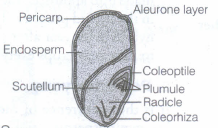
(iv) Amit is attentive, inquisitive and wants to gain knowledge.
6.
(i) The farmer was spraying auxins or gibberellins in low concentration which have been found to induce parthenocarpy in several plants, e.g. tomato, cucurbits, strawberry, fig, etc.
(ii) This is called chemicallyinduced parthenocarpy, which is not harmful for the consumers. However, pesticide sprays are harmful for our health.
(iii) In parthenocarpy, fruit formation occurs without fertilisation. It can be of three types, i.e. genetical, environmental and chemically induced (as done by the farmer).
(iv) Ram is an intelligent, observant, inquisitive boy who is concerned about the day-to-day activities that happen around him.
7.
1.Embryo developed from the synergid is haploid as the ploidy level of the synergid is haploid.
2.Embryo developed from the nucellus is diploid as the ploidy of the nucellus is diploid.
3.Presence of more than one embryo in a seed is called polyembryony, e.g. lemon, groundnut, etc.
4.Polyembryony plays an important role in plant breeding and horticulture. The plantlets obtained from these embryos are virus-free and have more vigour. Hybrid varieties of several food and vegetable crops are being extensively cultivated and these hybrid cultivars possess high productivity.
8.
Replacement of the normal sexual reproduction by asexual reproduction without fertilisation is called apomixis, e.g. replacement of the flower by bulbils and replacement of the seed by a plant. Apomictically produced offsprings are genetically identical to the parent plant. In flowering plants, apomixis is used in a restricted sense to mean angiosperm, i.e. asexual reproduction through seeds. In some plant species, it is common, e.g. Asteraceae and Poaceae. In some species, the diploid egg cell is formed without reduction division and develops into embryo without fertilisation. It is an asexual reproduction in the absence of pollinators such as in extreme environments.
In some species like Citrus, some of the nucellar cells surrounding the embryo sac start dividing and develop into embryo. It occurs in the megaspore mother cell and does not undergo meiosis, thus produces diploid embryo sac through mitotic divisions. Thus, it explains that, embryo sacs of some apomictic species appear normal but produce diploid cells.
9.
1.As the name suggests; double fertilisation involves two types of fertilisation-syngamy and triple fusion. The release of two male gametes into the cytoplasm of one of the synergids causes its degeneration.
2.One male gamete fuses with the egg cell to form a diploid zygote (which later forms embryo). This process is called syngamy or generative fertilisation. The other male gamete fuses with the two polar nuclei in the central cell by a process called triple fusion, which results in the formation of a triploid.
3.Primary Endosperm Nucleus (PEN) and the central cell becomes the Primary Endosperm Cell (PEe). This PEC divides repeatedly to form triploid endosperm tissue which further undergoes successive free nuclear divisions to give rise to free nuclear endosperm (free-nuclei).
4.This stage is followed by the wall formation around the cellular endosperm. Thus, the events of double fertilisation are immediately followed by post-fertilisation events involving development of endosperm.
10.
| i | Supply of alternative resources to industries in the form of starches fuels & pharmaceuticals | i | Tailor-made plants |
| ii | New strategy adopted to protect the tobacco plant infestation by Meloidogyne incognitia | ii | RNA interference |
| iii | Technique based on the principle of antigen antibody interaction | iii | ELISA |
| iv | Uses of bioresources by multinational companies /other organization whitout proper authorization from the concerned parties | iv | Biopiracy |
| v | Decision making organization regardingvalidity of G.M. resources & the safety of introducing G.M. crops | v | GEAC |
11.
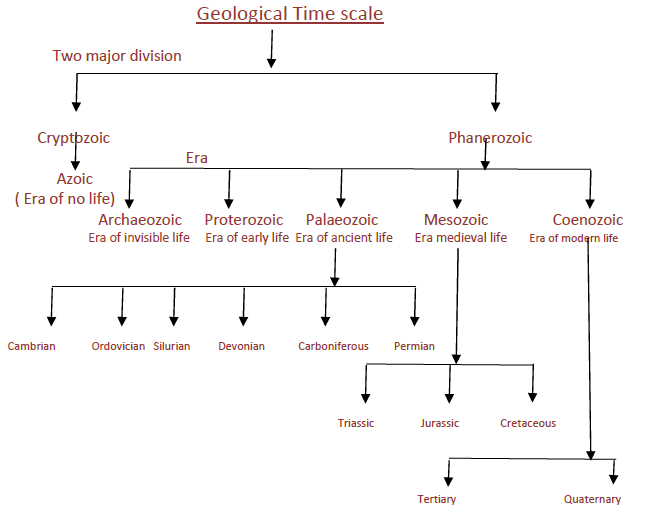
Note-Coenozoic era is divided in to two periods which are Tertiary and Quaternary and these are
further divided into seven Epochs-1.Recent(Holozoic )1-0.6mya
2.Pleistocene 0.6-2.0mya
3.Pliocene 2-13mya
4.Miocene 13-26mya
5.Eocene 38-54mya
6.Palaeocene 54-65mya
12.
1. Industrial Melanism : Before industrialisation started in England it was observed, there were more white -winged peppered moth, on trees than dark winged moth, but after industrialisation, there were more dark - winged moths in the same area,
2. predators spot a moth against a contrasting background, post industrialisation the tree trunks became dark due to industrial smoke and soot, Under this condition the white- winged moth did not survive, due to predators, but the dark-winged moth managed to survive. II or any other example explained under the following heads in the text book - fitness, selection and adaptation.
13.
Initially, after a lag phase, the population will grow in an exponential manner as the nutrients and space will be abundant. When the food sources get depleted, the population density starts decreasing and ends in an asymptote phase, then the population density reaches the carrying capacity (maximum number of given environment can sustain indefinitely).
The population shows a pattern of logistic growth giving an S-shaped curve. where, K-carrying capacity, N=population density at time 't', r = Intrinsic rate of natural increase
14.
No, all the gametes formed from a parent organism do not have the same genetic composition.
It can be better understood with the help of the explanation given below: sexual reproduction in organisms involves the fusion of gametes from two different individuals.these gametes are formed by the process of gametogenesis.In the heterogametic species, gametes are of two types, i.e. male and female. Gametes are always haploid though the parent body from which they arise may be either haploid or diploid.
i)A haploid parent like Monera, fungi, algae and bryophytes produce gametes by mitotic division.The number of chromosomes,i.e. the genetic composition remain same after such type of division.
ii)The diploid parent like pteridophytes, gymnosperms, angiosperms and most of the animals including human beings produces gametes by meiosis.In such organisms (Diploid), specialized cells undergo meiosis.At the end of meiosis, only one set of chromosomes gets incorporated into each gamete.It means the gametes formed to contain a haploid number of chromosomes in contrast to the number of chromosomes in mother cells.
15.
(i) Rapid release of Luteinising Hormone (LH) ruptures Graafian follicle and release ovum (ovulation).
(ii) Corpus luteum secretes large amount of progesterone hormone that is essential for the maintenance of the endometrium required for implantation of blastocyst leading to pregnancy.
(iii) Placenta produces several hormones like human Chorionic Gonadotropin (hCG), human Placental Lactogen (hPL). Relaxin is also produced during later phase of pregnancy. Levels of other hormones like oestrogen, progestogen, cortisol, prolactin and thyroxine also increase, which is essential for supporting foetal growth, metabolic changes in mother and maintenance of pregnancy.
(iv) Parturition signals originate from the fully developed foetus and the placenta that induce mild uterine contractions which triggers the release of oxytocin from pituitary. Oxytocin acts on the uterine muscle causing stronger uterine contractions.
16.
(i) The injection contained stilbestrol.
(ii) Stilbestrol is administered to sterile cows for inducing lactation.
(iii) Two methods of held improvement are:
(a) Artificial insemination
(b) Multiple Ovulation Embryo Transfer Technique
(iv) Mukta is highly vigilant, inquisitive, a good observer and has love towards animals.
17.
(i) It was first described in 1866 by J Langdon Down, so it is called Down's syndrome.
(ii) About 1 in every 750 children exhibits Down's syndrome throughout the world. It is also seen in chimpanzees and other related primates.
(iii) In humans, it comes as a result of non-disjunction of chromosome 21 during egg formation. The cause of this primary non-disjunction is not known.
(iii) The defect is associated with a particular small portion of chromosome 21. When this particular chromosome segment is present due to translation in three copies, instead of two, Down's syndrome occur.
18.
During aerobic condition, the decomposing bacteria multiply very rapidly and associate with fungal filaments to form flocs. The aerobic bacteria decompose large amount of organic wastes of wastewater in the presence of oxygen produced by algae. But during anaerobic degradation, some toxic gases are produced which kill the bacteria and fungi.
19.
(a) Dihybrid cross:
1.Since white flowers have appeared in the progeny, both the parents must be heterozygous for flower colour, i.e. Vv.
2.Since all plants in the progeny have axial flowers, the parent with axialm flowers, must be homozygous for the trait, i.e. AA.
3. Genotypes of the parents are as follows: Terminal, violet flowers : aaVv
Axial, violet flowers: AAVv
Parents : Terminal Violet flowers X Axial Violet flowers
aaVv AAVv
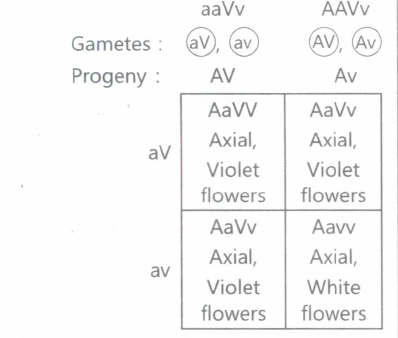
4. The phenotypic ratio:
3 Axial, violet flower 1 axial, white flowers is justified
(b) Law of independent assortment It states that when two pairs of traits are combined in a hybrid, segregation of one pair of traits is independent of the other pair of trait.
20.
(b) (i) Since the anthers of angiosperm flowers are bilobed with two thecae (sporangia) in each lobe, they are called dithecous.
(ii) The plants grown from the hybrid seeds show segregation of traits and do not maintain the hybrid characters; so hybrid seeds have to be produced every year.

12th Standard CBSE Syllabus & Materials
12th Standard CBSE
CBSE 12th Computer Science Python Revision Tour I - New Previous year Question Papers Study Material - QB365 Set A
NEW12th Standard CBSE
CBSE 12th Business Studies Planning Important Questions And Answers Study Material - QB365 Set A
NEW12th Standard CBSE
CBSE 12th Business Studies Business Environment Important Questions And Answers Study Material - QB365 Set A
NEW12th Standard CBSE
CBSE 12th Business Studies Principles of Management Important Questions And Answers Study Material - QB365 Set A



NCERT Books

Syllabus

Exam Pattern

Sample Question Papers

Previous year Question Papers

Important Notes

MCQ Practice test

NCERT Exemplers

Case study Questions

Image Based Questions

Passage based Questions

HOT Questions

Value Based Questions

Model Questions Papers
NCERT ( Book Back ) Questions

Assertion and Reason
Important Questions And Answers

CBSE 12th Standard CBSE Subjects
CBSE Standards









