
 100% FREE ACCESS
12th Standard CBSE Syllabus & Materials
12th Standard CBSE
CBSE 12th Economics Government Budget and the Economy Previous year Question Papers Study Material - QB365 Set A
NEW12th Standard CBSE
CBSE 12th Computer Science Interface Python with MySQL - New Previous year Question Papers Study Material - QB365 Set A
NEW12th Standard CBSE
CBSE 12th Computer Science Database Concept - New Previous year Question Papers Study Material - QB365 Set A
NEW12th Standard CBSE
CBSE 12th Computer Science Data Communication - New Previous year Question Papers Study Material - QB365 Set A
NEW12th Standard CBSE
CBSE 12th Computer Science Data Structures - New Previous year Question Papers Study Material - QB365 Set A
NEW12th Standard CBSE
CBSE 12th Computer Science Functions - New Previous year Question Papers Study Material - QB365 Set A

Published on: 21/05/2021
QB365 Provides the updated CASE Study Questions for Class 12 Biology, and also provide the detail solution for each and every case study questions . Case study questions are latest updated question pattern from NCERT, QB365 will helps to get more marks in Exams
Download CBSE Class 12th Standard CBSE Biology question papers, sample papers, important questions, and previous year solved papers in PDF format. Get free study materials, NCERT solutions, and exam preparation resources for Class 12th Standard CBSE Biology
Questions + Answers key
Take MCQ Biology Test
1.
Read the following and answer any four questions from (i) to (v) given below:
Priya was 4 years old when she contracted chicken pox. It took her around 15 days to recover completely. Now Priya is 5 years old so her mother got her vaccinated few days back for DPT (5th dose) as per immunisation program. Recently she was playing with her friend in the park when her friend accidently fell on iron pipe and badly bruised her knee. She was taken to the hospital where doctor gave her ATS injection and painkillers. Based on the above information, answer the following questions.
(i) Select the correct statement.
| (a) Priya has developed natural active immunity against chicken pox. | (b) Priya has developed artificial active immunity against DPT. |
| (c) Priyas friend has developed artificial passive immunity against tetanus. | (d) All of these |
(ii) Which of the following do you think is an example of natural passive immunity?
| (a) Administration of AGS (anti gas gangrene serum) in a person | (b) Transfer of IgA antibodies from mother to baby through mother's milk |
| (c) A person recovered from viral infection | (d) A child vaccinated for polio |
(iii) Which of the following is true for active immunity?
| (a) It provides immediate relief. | (b) It is temporary, not long lasting. |
| (c) It has no side effects | (d) None of these |
(iv) Select the incorrect match.
| (a) Passive immunity - IgG antibodies crossing placental barrier to reach fetus | (b) Active immunity - Vaccination against corona virus |
| (c) Active immunity - Administration of antidiphtheria serum in patient | (d) Passive immunity - Fetus having mother's milk |
(v) Assertion: A person recovered from measles develops an active immunity against this infection.
Reason: In active immunity, person's own cells develop antibodies in response to infection.
| (a) Both assertion and reason are true and reason is the correct explanation of assertion. | (b) Both assertion and reason are true but reason is not the correct explanation of assertion. |
| (c) Assertion is true but reason is false. | (d) Both assertion and reason are false. |
2.
Read the following and answer any four questions from (i) to (v) given below :
X and Yare communicable diseases whereas Wand Z are non-communicable diseases. X is transmitted through vectors whereas Y is transmitted through droplet infection. W is caused due to a hormone deficiency whereas Z is a degenerative disease.
Based on the above information, answer the following questions.
(i) Identify W, X, Y and Z.
| W | X | Y | Z | |
| (a) | Coronary artery disease . | Cholera | Chikungunya | Hypertension |
| (b) | Diabetes | Malaria | Rhinitis | Alzheimer's disease |
| (c) | Arthritis | AIDS | Shigella | Plague |
| (d) | Gonorrhea | Diphtheria | Pertussis | Anthrax |
(ii) Select the correct statement.
| (a) If X is sleeping sickness then its vector is Leishmania |
| (b) If Y is diphtheria then it is caused by Bacillus anthracis |
| (c) If W is hypothyroidism then it is caused by deficiency of thyroxine hormone. |
| (d) If Z is myocardial infarction then patient develops acute rheumatic fever, joint pain and throat infection |
(iii) If X and Y both are usual diseases then which of the following holds true?
| (a) X could be dengue caused by flavivirus and Y could be AIDS caused by HIV. |
| (b) X could be.chikungunya whereas Y could be rhinitis. |
| (c) X could be hepatitis whereas Y could be rabies. |
| (d) X could be chicken pox caused by Varicella zoster virus whereas Y could be yellow fever caused by flavivirus. |
(iv) If X and Y both are bacterial diseases then select the correct match from the following.
| (a) X- Bubonic plague - Yersinia pestis | (b) Y - Leprosy - Mycobacterium leprae |
| (c) X - Whooping cough - Bordetella pertussis | (d) Y - Botulism - Clostridium botulinum |
(v) Assertion: Communicable diseases could be contagious or non-contagious.
Reason: Diseases that spread through vectors are non-contagious disease.
| (a) Both assertion and reason are true and reason is the correct explanation of assertion. | (b) Both assertion and reason are true but reason is not the correct explanation of assertion. |
| (c) Assertion is true but reason is false. | (d) Both assertion and reason are false. |
3.
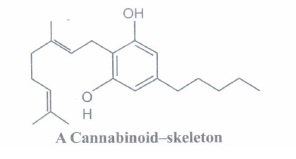
The skeletal structure of a cannabinoid molecule is given above. Answer the following questions.
(a) What are the modes of its consumption by humans?
(b) Name the four different forms in which cannabinoids are produced.
4.
Study the diagram showing the entry of HIV into the human body and the processes that are followed:
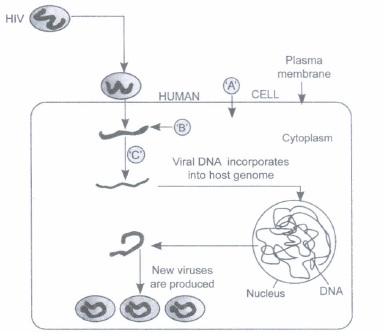
(a) Name the human cell 'A' HIV enters into.
(b) Mention the genetic material 'B' HIV releases into the cell.
(c) Identify enzyme 'C'
5.
Your classmate complains of cough and headache to the doctor. The doctor confirms that he is suffering from pneumonia and not just common cold.
(a) How did the doctor arrive at this conclusion?
(b) Write the binomials of the causative organisms of pneumonia.
(c) What is common about the transmission of the two diseases, common cold and pneumonia?
1.
(i) (d) : In active immunity, person's own cells produce antibodies in response to infection or vaccination. A person who has recovered from an infection develops natural active immunity whereas artificial active immunity is the resistance induced by vaccines. When ready-made antibodies are directly injected into a person to protect the body against foreign agents, it is called passive immunity.
(ii) (b)
(iii) (c) : Active immunity provides relief only after long period. It is long lasting.
(iv) (c) : Administration of antidiphtheric serum in a patient provides artificial passive immunity.
(v) (a)
2.
(i) (b) : X is a communicable disease that is transmitted through vectors. It could be malaria, chikungunya, etc. Y is communicable disease that is transmitted through droplet infection. It could be rhinitis, diphtheria, pertussis, etc.
W is a non-communicable disease like diabetes that is caused by deficiency of insulin hormone. Z is a non-communicable degenerative disease like Alzheimer's disease.
(ii) (c) : Sleeping sickness is caused by Trypanosoma. Diphtheria is caused by Corynebacterium diphtheriae. In myocardial infarction a large portion of heart muscle is deprived of blood due to coronary thrombosis and patient develops heart attack.
(iii) (b)
(iv) (a) : Leprosy is a bacterial infection that spreads through prolonged contact with the infected person. Whooping cough spreads through droplet infection. Botulism spreads through faecal oral route.
(v) (b)
3.
(a) It is consumed by
(i) inhalation and
(ii) oral ingestion.
(b) Marijuana, Hashish, Ganja, Charas.
4.
(a) Macrophage.
(b) RNA (Ribonucleic acid).
(c) Reverse transcriptase.
5.
(a) In pneumonia, the lung alveoli become filled with a fluid leading to severe problems in breathing, whereas in common cold, only the nose and respiratory passage are affected, but not the lungs.
(b) Pneumonia is caused by
(i) Streptococcus pneumoniae
(ii) Haemophilus influenzae.
(c) Both common cold and pneumonia spread by the droplets/aerosols released by the infected person during coughing and sneezing.

12th Standard CBSE Syllabus & Materials
12th Standard CBSE
CBSE 12th Computer Science Python Revision Tour I - New Previous year Question Papers Study Material - QB365 Set A
NEW12th Standard CBSE
CBSE 12th Business Studies Planning Important Questions And Answers Study Material - QB365 Set A
NEW12th Standard CBSE
CBSE 12th Business Studies Business Environment Important Questions And Answers Study Material - QB365 Set A
NEW12th Standard CBSE
CBSE 12th Business Studies Principles of Management Important Questions And Answers Study Material - QB365 Set A



NCERT Books

Syllabus

Exam Pattern

Sample Question Papers

Previous year Question Papers

Important Notes

MCQ Practice test

NCERT Exemplers

Case study Questions

Image Based Questions

Passage based Questions

HOT Questions

Value Based Questions

Model Questions Papers
NCERT ( Book Back ) Questions

Assertion and Reason
Important Questions And Answers

CBSE 12th Standard CBSE Subjects
CBSE Standards








