
 100% FREE ACCESS
12th Standard CBSE Syllabus & Materials
12th Standard CBSE
CBSE 12th Economics Government Budget and the Economy Previous year Question Papers Study Material - QB365 Set A
NEW12th Standard CBSE
CBSE 12th Computer Science Interface Python with MySQL - New Previous year Question Papers Study Material - QB365 Set A
NEW12th Standard CBSE
CBSE 12th Computer Science Database Concept - New Previous year Question Papers Study Material - QB365 Set A
NEW12th Standard CBSE
CBSE 12th Computer Science Data Communication - New Previous year Question Papers Study Material - QB365 Set A
NEW12th Standard CBSE
CBSE 12th Computer Science Data Structures - New Previous year Question Papers Study Material - QB365 Set A
NEW12th Standard CBSE
CBSE 12th Computer Science Functions - New Previous year Question Papers Study Material - QB365 Set A

Published on: 21/05/2021
QB365 Provides the updated CASE Study Questions for Class 12 Biology, and also provide the detail solution for each and every case study questions . Case study questions are latest updated question pattern from NCERT, QB365 will helps to get more marks in Exams
Download CBSE Class 12th Standard CBSE Biology question papers, sample papers, important questions, and previous year solved papers in PDF format. Get free study materials, NCERT solutions, and exam preparation resources for Class 12th Standard CBSE Biology
Questions + Answers key
Take MCQ Biology Test
1.
Read the following and answer any four questions from (i) to (v) given below:
The first menstruation is called menarche, that usually occurs between 12 and 15 years. In human females, menstruation is repeated at an average interval of about 28129 days and is called menstrual cycle. It is regulated by certain hormones, as pituitary gland is stimulated by releasing factors produced in the hypothalamus. The hormones produced by pituitary gland influence the ovaries. The hormones secreted by the ovaries affect the walls of the uterus.
(i) The breakdown of endometrium is characteristic of
| (a) proliferative phase | (b) luteal phase | (c) ovulatory phase | (d) menstrual phase |
(ii) Which days of the menstrual cycle marks the proliferative phase?
| (a) 1-5 | (b) 15-28 | (c) 6-13 | (d) 10-14 |
(iii) Which of the following occurs during secretory phase?
| (a) Empty Graafian follicle changes into corpus luteum. | (b) Primary follicle changes' into Graafian follicle. | (c) Endometrium rebuilds and estrogen secretion increases | (d) LH surge inducing release of an ovum. |
(iv) Identify the hormones that attain peak level during ovulatory phase
| (a) FSH | (b) Progesterone | (c) LH | (d) Both (a) and (c) |
(v) Withdrawal of which hormone causes degeneration of corpus luteum?
| (a) FSH | (b) LH | (c) Progesterone | (d) Estrogen |
2.
Read the following and answer any four questions from (i) to (v) given below:
Human male reproductive system comprises of a pair of testes, primary sex organs associated with formation of gametes and production of sex hormone. Study the given figure of human male reproductive system and answer the following questions.
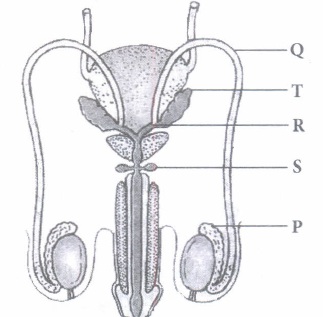
(i) Which of the following is correct for labelled part P?
| (a) P is rete testis which transports sperms to outside. | (b) P is epididymis which secretes fluid that nourish the sperms | (c) P is epididymis that carry sperms and secretion of seminal vesicles | (d) P is rete testis which lies along inner side of each testis and stores the sperms |
(ii) Identify the correctly matched pair.
| (a) Q - Vasa efferentia | (b) R - Ejaculatory duct | (c) S - Seminal vesicle | (d) T - Cowper's gland |
(iii) Which statement is incorrect for Q?
| (a) It carries spermatozoa from epididymis to ejaculatory duct | (b) Q are only 2 in number. | (c) It arises from rete testis. | (d) It constitutes male sex accessory duct |
(iv) Which structure passes through the prostate gland and carries sperms and secretion of seminal vesicle?
| (a) P | (b) T | (c) S | (d) R |
(v) Assertion: Mucus present in secretion of bulbourethral gland decreases the number of sperms damaged during ejaculation
Reason: Mucus lubricates the end of penis and lining of the urethra.
(a) Both assertion and reason are true and reason is the correct explanation of assertion.
(b) Both assertion and reason are true but reason is not the correct explanation of assertion.
(c) Assertion is true but reason is false.
(d) Both assertion and reason are false .
3.
Study the flow chart given below and answer the questions that follow:
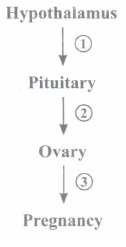
(a) Name the hormone(s) (in full form) involved in each of the stages, 
(b) Specify the structure in the ovary that is the source of the hormone at stage 
4.
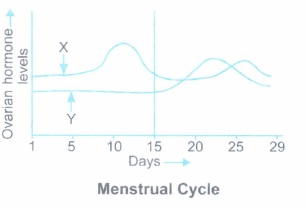
Read the graph given above and answer the following questions:
(a) Identify the ovarian hormones X and Y and name their respective sources in the ovary.
(b) Why does the hormone X peak before the hormone Y?
5.
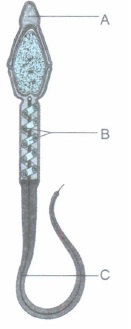
A Human Spermatozoan
A diagrammatic sketch of a human sperm is given. Identify the parts labelled A, Band C and mention their respective functions.
1.
(i) (d): During menstrual phase, the endometrium breaks down and menstruation begins.
(ii) (c) : Proliferative phase extends for about 10-12 days usually from day 6th to 13th in a 28 day cycle
(iii) (a)
(iv) (d) : During ovulatory phase, both LH and FSH attain a peak level
(v) (b)
2.
(i) (b) : P is an epididymis that stores the sperms and secretes a fluid which is considered to nourish the sperms
(ii) (b) : Q - Vas deferens, R - Ejaculatory duct S - Bulbourethral gland, T - Seminal vesicle
(iii) (c) :Q (vas deferens) arises from cauda epididymis
(iv) (d)
(v) (a)
3.
(i) 1. Gonadotropin-releasing hormone (GnRH)
2. Follicle-stimulating hormone (FSH) and Luteinising hormone (LH)
3. Progesterone.
(b) Corpus luteum secretes progesterone.
4.
(a) X is hormone estrogen.
(i) It is secreted by the cells of the developing follicle.
Y is hormone progesterone.
(ii) It is secreted by corpus luteum.
(b) (i) X is secreted by the cells of the follicle during follicular phase before ovulation; after the rupture of Graafian follicle, there is no secretion of estrogen.
(ii) Y is secreted by corpus luteum that is formed after ovulation in the luteal phase; hence X peaks before Y.
5.
A. Acrosome
(i) The secretions.enzymes of acrosome dissolve the egg envelopes and help the sperm enter the cytoplasm of the ovum.
B. Mitochondria
(i) The mitochondria in the middle piece provide energy for the sperm motility in the female reproductive tract towards ovum.
C. Tail
(i) It facilitates the movement of sperm towards the ovum for fertilisation.

12th Standard CBSE Syllabus & Materials
12th Standard CBSE
CBSE 12th Computer Science Python Revision Tour I - New Previous year Question Papers Study Material - QB365 Set A
NEW12th Standard CBSE
CBSE 12th Business Studies Planning Important Questions And Answers Study Material - QB365 Set A
NEW12th Standard CBSE
CBSE 12th Business Studies Business Environment Important Questions And Answers Study Material - QB365 Set A
NEW12th Standard CBSE
CBSE 12th Business Studies Principles of Management Important Questions And Answers Study Material - QB365 Set A



NCERT Books

Syllabus

Exam Pattern

Sample Question Papers

Previous year Question Papers

Important Notes

MCQ Practice test

NCERT Exemplers

Case study Questions

Image Based Questions

Passage based Questions

HOT Questions

Value Based Questions

Model Questions Papers
NCERT ( Book Back ) Questions

Assertion and Reason
Important Questions And Answers

CBSE 12th Standard CBSE Subjects
CBSE Standards








