
 100% FREE ACCESS
12th Standard CBSE Syllabus & Materials
12th Standard CBSE
CBSE 12th Economics Government Budget and the Economy Previous year Question Papers Study Material - QB365 Set A
NEW12th Standard CBSE
CBSE 12th Computer Science Interface Python with MySQL - New Previous year Question Papers Study Material - QB365 Set A
NEW12th Standard CBSE
CBSE 12th Computer Science Database Concept - New Previous year Question Papers Study Material - QB365 Set A
NEW12th Standard CBSE
CBSE 12th Computer Science Data Communication - New Previous year Question Papers Study Material - QB365 Set A
NEW12th Standard CBSE
CBSE 12th Computer Science Data Structures - New Previous year Question Papers Study Material - QB365 Set A
NEW12th Standard CBSE
CBSE 12th Computer Science Functions - New Previous year Question Papers Study Material - QB365 Set A

Published on: 24/05/2021
QB365 Provides the updated NCERT Examplar Questions for Class 12 Biology, and also provide the detail solution for each and every ncert examplar questions , QB365 will give all kind of study materials will help to get more marks
Download CBSE Class 12th Standard CBSE Biology question papers, sample papers, important questions, and previous year solved papers in PDF format. Get free study materials, NCERT solutions, and exam preparation resources for Class 12th Standard CBSE Biology
Questions + Answers key
Take MCQ Biology Test1.
A human female ovary releases how many eggs in a month?If the mother gave birth to identical twins, how many eggs do you think would have been released?Would your answer change if twins born were fraternal?
2.
The diagram shows the arrangement of blood vessels in the uterus wall and placenta of a pregnant woman.If the women has high blood pressure, would it affect the developing foetus?

3.
The given diagram shows the cross-section of an umbilical cord.

(i)Label the part A and B (both are blood vessels.)
(ii)Which would contain higher amount of urea?
4.
The middle piece of a mature sperm is characterised by the presence of mitochondria arranged in a spiral.These help in the movement of sperm tail.
With reference to the statement given above,answer the questions that follow.
(i)What do you understand by the term chondriosome?
(ii)State the major function of mitochondria
(iii)'Mitochondria is a site of presence of the major enzymes of cell.'Comment on the statement.
5.
Differentiate between vasa efferentia and vasa deferentia.
6.
When and where does spermatogenesis occur in a human male?
7.
Mark the wrong items in each series...
(i) Scrotum rete testis, fallopian tube, vas deferens.
(ii) Ovary, uterus, vagina, ejaculatory duct.
(iii) Acrosome, Graafian follicle, corpus luteum, cervix.
(iv) Fission, budding, fragmentation, Gametogenesis.
(v) Prostate, testis, seminal vesicles, Cowper's gland.
8.
Fill in the blanks:
(i) Primary sex organ are called______.and secondary sex organ include______. and reproductive glands.
(ii) Seminiferous tubules produce______.while interstitial (Leydig's) cells produce ______.
(iii) Vas efferentia carry spermatozoa from ______. to______.
(iv) Vasa deferentia carry spermatozoa from______. to ______.
(v) In females, urethra is small and conducts ______.while in males it conducts urine and ______.
(vi) Penis is an external intromittent organ which contains 3 columns of spongy tissue: two column of ______. on the front side and one column of ______. around the urethra.
(vii) The process of formation of spermatozoa from spermatogonia is called ______. and the process of maturation of spermatids into spermatozoa is called______.
9.
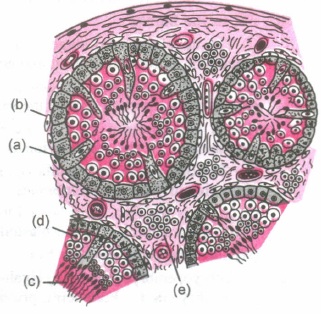
Study the given figure carefully and answer the following question:
(i) Label the parts marked as (a), (b), (c), (d) and (e).
(ii) Give one major function of each part.
10.
Meiotic division during oogenesis is different from that in spermatogenesis. Explain how and why?
1.
(i)A pair ovaries are present human female and an egg is released alternately from each ovary every month,i.e. an ovary release one egg after an interval of 56 days
(ii)Identical twins are monozygotic twins and are genetically limiar.A single egg after fertilization, undergoes cleavage, develops the two cells separate and develop into a new individual.Therefore the mother released only one egg.
(ii)Fraternal twins are dizygotic,i.e they are produced by the fertilisation of two different eggs by two separate sperms.There is a possibility that either an ovary has released two ova or the two ova come from each of the two ovaries.
2.
Yes, if a pregnant woman has high blood pressure, the woman develops preeclampsia, which can threaten the lives of both the mother and the foetus.It can cause low birth weight and early delivery of foetus,sometimes the child,born very early also may die.
High blood pressure can harm the mother's kidneys and other organs and also lower the number of platelets.
3.
(i)The part labelled A is a vein and B is an artery, as media of artery is thicker than that of a vein and the elastic components of vein is small when compared to that of an attery
(ii)The umbilical artery contains higher amount of urea.The veins carry oxygenated, nutrient rich blood to foetus and arteries carry deoxygenated, nutrient depleted blood away from the foetus.
4.
(i)The mitochondrion present in a cell are collectively referred to as chondriosome
(ii)Mitochondria are associated with cellular respiration (ie.oxidation of cellular nutrients) and energey generation of cell.Thus,it is also referred to as power house the cell.
(iii)Out of the total enzyme present in a cell,mitochondria alone contribute to 70%.The enzymes of Krebs, cycle are present in matrix of mitochondrial membrance) while that of Electron Transport System(ETS) and oxidative phosphorylation are situate in cristae
5.
Difference between vasa efferentia and vasa deferentia are as follows
| Vasa Efferentia | Vasa Deferentia |
| They arises from the rete testes. | They arises from the epididymis. |
| Fine and convoluted ductules. Vary from 15-20 in number. | Thick and coiled ductules, only 2 in number. |
| Carry spermatozoa from rete testes to epididymis. | Carry spermatozoa from epididymis to ejaculatory ducts |
6.
Spermatogenesis occurs at the age of puberty in testes.
7.
(i) Fallopian tube
(ii) Ejaculatory duct
(iii) Acrosome
(iv) Gametogenesis
(v) Testis
8.
(i) Gonada, reproductive ducts
(ii) Spermatozoa, androgens (testosterone)
(iii) Retia testes, caput epididymis
(iv) Cauda epididymis, ejaculatory ducts
(v) Urine, seminal fluid
(vi) Corpora cavernosa, corpus spongiosum
(vii) Spermatogenesis, spermiogenesis.
9.
(i) (a) Sertoli cells
(b) Seminiferous tubule
(c) Spermatozoa
(d) Spermatogonia
(e) Interstitial cells.
(ii) Function of parts:
(a) Sertoli cells provide nutrition to developing spermatozoa.
(b) Spermatozoa are formed in the seminiferous tubules from spermatogonia that arise from germinal epithelial cells.
(c) These are male gametes which fertilize the ovum.
(d) The spermatogenic cells of germinal epithelium lining the seminiferous tubules by mitotic divisions produce spermatogonia. The latter undergo meiotic division to form spermatozoa.
(e) Interstitial cells secrete male sex hormones (Testosterone).
10.
Meiotic division during oogenesis is different from that of spermatogenesis in the following ways
|
Meiotic division in spermatogenesis |
Meiotic division in Oogenesis |
|
Many million sperms generated at a time. |
Only one mature ovum is generated at a time, every month. |
|
After two complete meiotic divisions, four equal sized cells are produced. |
Meiosis-l gers arrested at prophase-I and when it is complered at later stage, one big cell with almost all the cytoplasm and three very small-sized cells are produced. |
|
They mature into flagellated and motile cell. |
Mature ovum is non-flagellated and non-motile. |
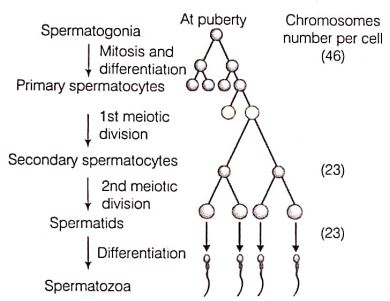
(i) Unequal cell division makes the ovum much larger than the other three polar bodies. As, ovum has more
cyloplasm and more organelles, it has a better chance of survival.
(ii) The male makes millions of tiny sperms, while the female makes only one egg per month that also arrested for second meiotic division, until just before fertilisation. This is a way of conserving energy.
(iüi) Sperm is smaller and motile as it has to move out of male system to female reproductive system. Larger egg has abundant reserve food, so thal embryo starts developing right after fertilisation.

12th Standard CBSE Syllabus & Materials
12th Standard CBSE
CBSE 12th Computer Science Python Revision Tour I - New Previous year Question Papers Study Material - QB365 Set A
NEW12th Standard CBSE
CBSE 12th Business Studies Planning Important Questions And Answers Study Material - QB365 Set A
NEW12th Standard CBSE
CBSE 12th Business Studies Business Environment Important Questions And Answers Study Material - QB365 Set A
NEW12th Standard CBSE
CBSE 12th Business Studies Principles of Management Important Questions And Answers Study Material - QB365 Set A



NCERT Books

Syllabus

Exam Pattern

Sample Question Papers

Previous year Question Papers

Important Notes

MCQ Practice test

NCERT Exemplers

Case study Questions

Image Based Questions

Passage based Questions

HOT Questions

Value Based Questions

Model Questions Papers
NCERT ( Book Back ) Questions

Assertion and Reason
Important Questions And Answers

CBSE 12th Standard CBSE Subjects
CBSE Standards









