
 100% FREE ACCESS
12th Standard CBSE Syllabus & Materials
12th Standard CBSE
CBSE 12th Economics Government Budget and the Economy Previous year Question Papers Study Material - QB365 Set A
NEW12th Standard CBSE
CBSE 12th Computer Science Interface Python with MySQL - New Previous year Question Papers Study Material - QB365 Set A
NEW12th Standard CBSE
CBSE 12th Computer Science Database Concept - New Previous year Question Papers Study Material - QB365 Set A
NEW12th Standard CBSE
CBSE 12th Computer Science Data Communication - New Previous year Question Papers Study Material - QB365 Set A
NEW12th Standard CBSE
CBSE 12th Computer Science Data Structures - New Previous year Question Papers Study Material - QB365 Set A
NEW12th Standard CBSE
CBSE 12th Computer Science Functions - New Previous year Question Papers Study Material - QB365 Set A

Published on: 24/05/2021
QB365 Provides the updated NCERT Examplar Questions for Class 12 Biology, and also provide the detail solution for each and every ncert examplar questions , QB365 will give all kind of study materials will help to get more marks
Download CBSE Class 12th Standard CBSE Biology question papers, sample papers, important questions, and previous year solved papers in PDF format. Get free study materials, NCERT solutions, and exam preparation resources for Class 12th Standard CBSE Biology
Questions + Answers key
Take MCQ Biology Test1.
Vaibhav, 12th class student watched the movie 'Vickey donar'. He was very curious to know the structure and details of sperm. He wondered, why the donation of sperm is considered a taboo irrespective of the fact that it helps childless couples to have children. He discussed this whole thing with his elder brother, who is a biology professor in a university. His brother smiled and explained all his queries.
(i) Name the main parts of a sperm.
(ii) Which part of the human sperm is responsible for facilitating sperm motility? Explain.
(iii) What are the values shown by Vaibhav?
2.
During the biology class, teacher was explaining the human reproductive system. Ankita was busy doing work of some other subject and so missed on the topic. When the teacher asked questions Ankita was unable to answer them. She, however, realised her mistake and requested the teacher to explain the topic once again. The teacher happily repeated.
(i) What is the primary sex organ in male?
(ii) What is tunica albuginea?
(iii) Name the three layers of tissue of uterus.
(iv) Identify the values shown by the teacher.
3.
With reference for events starting from menstrued cycle till the events of parturition give the name of the hormones involved at each stage and explain their role.
4.
The zygote passes through several development stages till implantation.Describe each stage briefly with suitable diagrams.
5.
What roles does pituitary gonadotrophins play during follicular and ovulatory phases of menstrual cycle? Explain the shifts in steroidal secretions.
1.
(i) A sperm consists of a head, neck, middle piece and a tail.
(ii) Middle piece It is cylindrical and known as the power house of the sperm. It possesses many mitochondria to produce energy for the movement of the tail that facilitates sperm motility essential for fertilisation.
(iii) He is curious, intelligent, inquisitive and has scientific attitude.
2.
(i) Tests are the primary sex organs in males. It is the site where male gametes or sperms are made.
(ii) The outermost covering of the tests is formed of a dense fibrous membrane called tunica albuginea.
(iii) Uterus has a thick wall composed of three layers of tissues as follows:
(a) Outer perimetrium
(b) Middle myometrium
(c) Inner endometrium
(iv) The teacher is patient, understanding, has scientific knowledge and is dutiful.
3.
(i) Rapid release of Luteinising Hormone (LH) ruptures Graafian follicle and release ovum (ovulation).
(ii) Corpus luteum secretes large amount of progesterone hormone that is essential for the maintenance of the endometrium required for implantation of blastocyst leading to pregnancy.
(iii) Placenta produces several hormones like human Chorionic Gonadotropin (hCG), human Placental Lactogen (hPL). Relaxin is also produced during later phase of pregnancy. Levels of other hormones like oestrogen, progestogen, cortisol, prolactin and thyroxine also increase, which is essential for supporting foetal growth, metabolic changes in mother and maintenance of pregnancy.
(iv) Parturition signals originate from the fully developed foetus and the placenta that induce mild uterine contractions which triggers the release of oxytocin from pituitary. Oxytocin acts on the uterine muscle causing stronger uterine contractions.
4.
Cleavage is holoblastic type but there is tendency to show size differences of the blastomeres from the very start. Cleavage occurs during its passage through fallopian tube to uterus.
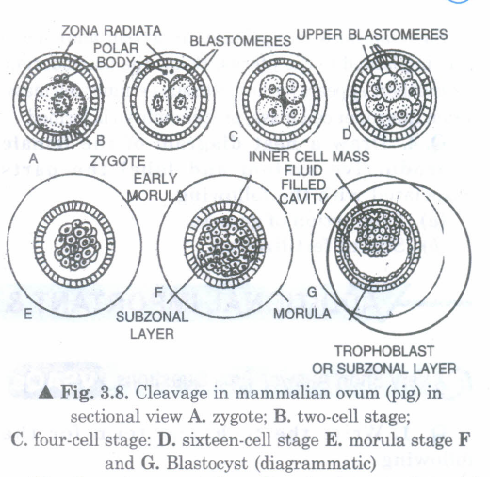
The first cleavage takes place in the cytoplasm of ovum on an imaginary axis (Animal pole to vegetal pole). The first division results into two blastomeres. One blastomere is slightly larger than the other. The larger cell divides first and thus forms the three blastomeres. Then the smaller blastomere divides and thus four blastomeres are formed. It is 4 celled stage.
2nd cleavage is at right angle to the 1st cleavage. One member of the large blastomeres of 4-cell stage divides forming 5-cell condition followed 6-7 stage ultimately 8 celled stage. Successive cleavage divisions result in the formation of solid mass of cells. Thus solid ball-like stage is called morula stage.
Conversion of morula into blastula is initiated by dynamic rearrangement of small blastomeres. A central fluid filled cavity called blastocoel (segmentation cavity) appears. Externally placed blastomeres lose their rounded form and become flat. This trophoblast along with lining of uterus forms extra-embryonic membranes. This provides protection and nourishment to the developing embryo.
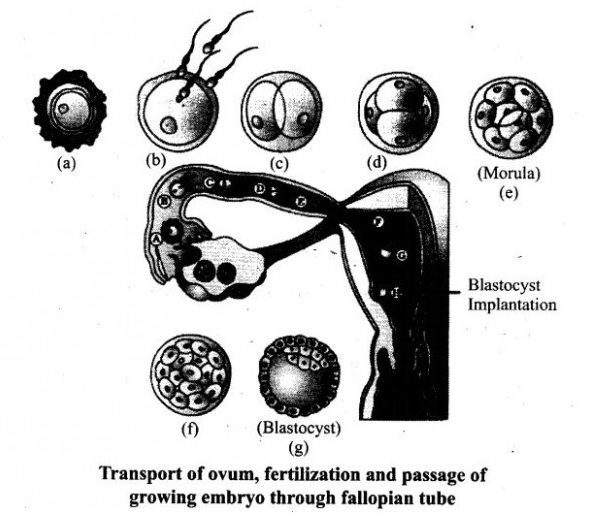
Simultaneouslyzonapellucidadisappears and embryo gets implanted to the uterus. Below the blastodermic vehicle there appears formative tissue i.e. inner cellmass. From this inner cell mass, proper embryo is formed.
5.
Hormonal Control of Menstrual Cycle.
Gonadotropin-releasing hormone (GnRH) also called Gonadotropin-releasing Factor (GnRF), is secreted by the hypothalamus of the brain, which stimulates the release of follicle-stimulating hormone (FSH) and luteinizing hormone (LH).FSH stimulates the ovarian follicles to produce oestrogens during proliferative phase.LH stimulates the corpus luteum of the ovary to secrete progesterone.
1.Menstrual phase is caused by the reduction of progesterone and oestrogens.
2.Proliferative phase is caused by the increased production of oestrogens.
3.LH causes ovulation.
LH also causes transformation of empty Graafian follicle into corpus luteum by luteinisation inside the ovary. LH also stimulates corpus luteum to secrete progesterone hormone to help in implantation, placentation and maintenance of pregnancy.
4.Secretary phase is caused by increased production of progesterone.

12th Standard CBSE Syllabus & Materials
12th Standard CBSE
CBSE 12th Computer Science Python Revision Tour I - New Previous year Question Papers Study Material - QB365 Set A
NEW12th Standard CBSE
CBSE 12th Business Studies Planning Important Questions And Answers Study Material - QB365 Set A
NEW12th Standard CBSE
CBSE 12th Business Studies Business Environment Important Questions And Answers Study Material - QB365 Set A
NEW12th Standard CBSE
CBSE 12th Business Studies Principles of Management Important Questions And Answers Study Material - QB365 Set A



NCERT Books

Syllabus

Exam Pattern

Sample Question Papers

Previous year Question Papers

Important Notes

MCQ Practice test

NCERT Exemplers

Case study Questions

Image Based Questions

Passage based Questions

HOT Questions

Value Based Questions

Model Questions Papers
NCERT ( Book Back ) Questions

Assertion and Reason
Important Questions And Answers

CBSE 12th Standard CBSE Subjects
CBSE Standards









