
 100% FREE ACCESS
12th Standard CBSE Syllabus & Materials
12th Standard CBSE
CBSE 12th Economics Government Budget and the Economy Previous year Question Papers Study Material - QB365 Set A
NEW12th Standard CBSE
CBSE 12th Computer Science Interface Python with MySQL - New Previous year Question Papers Study Material - QB365 Set A
NEW12th Standard CBSE
CBSE 12th Computer Science Database Concept - New Previous year Question Papers Study Material - QB365 Set A
NEW12th Standard CBSE
CBSE 12th Computer Science Data Communication - New Previous year Question Papers Study Material - QB365 Set A
NEW12th Standard CBSE
CBSE 12th Computer Science Data Structures - New Previous year Question Papers Study Material - QB365 Set A
NEW12th Standard CBSE
CBSE 12th Computer Science Functions - New Previous year Question Papers Study Material - QB365 Set A

Published on: 21/05/2021
QB365 Provides the updated CASE Study Questions for Class 12 Biology, and also provide the detail solution for each and every case study questions . Case study questions are latest updated question pattern from NCERT, QB365 will helps to get more marks in Exams
Download CBSE Class 12th Standard CBSE Biology question papers, sample papers, important questions, and previous year solved papers in PDF format. Get free study materials, NCERT solutions, and exam preparation resources for Class 12th Standard CBSE Biology
Questions + Answers key
Take MCQ Biology Test
1.
Read the following and answer any four questions from (i) to (v) given below:
Discovery of penicillin by Alexander Fleming in 1928 marked the beginning of the remarkable era in medical field. Penicillin was the first antibiotic extracted from Penicillium notatum. Antibiotics are used to treat bacterial diseases. These can be broad spectrum which can kill diverse group of disease causing bacteria and narrow spectrum which is effective only against one group of pathogenic strain. Antibiotics can act as bactericides or bacteriostatic. Bactericidal antibiotics kill bacteria by - disruption of cell wall synthesis (e.g., penicillin, cephalosporin, etc.), inhibition of 50S ribosome function (e.g., erythromycin), inhibition of 30S ribosome function (e.g., streptomycin, neomycin), inhibition of amino acid-tRNA binding to ribosome (e.g., tetracyline), etc. Bacteriostatic antibiotics do not kill the bacteria rather they restrict the growth of bacteria. Penicillin belongs to B-Iactum group of antibiotics and it inhibits bacterial cell wall synthesis by binding and inactivating protein. It inhibits transpeptidation of reaction and blocks cross-linking of the cell wall. It is used to treat tonsilitis, sore throat, gonorrhoea, rheumatic fever and some pneumonia types.
(i) The first antibiotic was extracted from a
| (a) lichen | (b) fungus | (c) eubacteria | (d) actinomycetes |
(ii) Which of the following kills bacteria by interfering 50S ribosome function?
| (a) Cephalosporin | (b) Erythromycin | (c) Streptomycin | (d) Neomycin |
(iii) \(\beta \)-Iactum group of antibiotics kill the bacterial pathogen by
| (a) disruption of plasma membrane | (b) inhibition of translation of mRNA | (c) disruption of cell wall | (d) inhibition of transcription of mRNA. |
(iv) Penicillin is not used to treat
| (a) pneumonia | (b) tonsilitis | (c) rheumatic fever | (d) candidiasis |
(v) Assertion :Cephalosporins act by disruption of bacterial cell wall synthesis mechanism.
Reason: Cephalosporins are bacteriostatic antibiotics.
(a) Both assertion and reason are true and reason is the correct explanation of assertion.
(b) Both assertion and reason are true but reason is not the correct explanation of assertion.
(c) Assertion is true but reason is false.
(d) Both assertion and reason are false.
2.
In agriculture, there is a method of controlling pests that relies on natural predation rather than on chemicals. An organic farmer believes that the more biodiversity a landscape has, the more sustainable it is.
(a) Mention two disadvantages of using chemical methods to control pests.
(b) Give an example of a bacterium and a fungus that are used as biocontrol agents.
(c) An organic farmer does not eradicate the 'pests'. Give two reasons.
3.
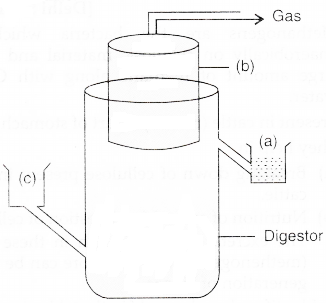
The diagram above is that of a typical biogas plant. Explain the sequence of events occurring in a biogas plant. Identify a, b and c.
4.
Large quantities of sewage is generated everyday in cities and towns, which is treated in Sewage Treatment Plants (STPs) to make it less polluted. Given below is the flow diagram of one of the stages of STP. Observe the given flow diagram and answer the questions accordingly.
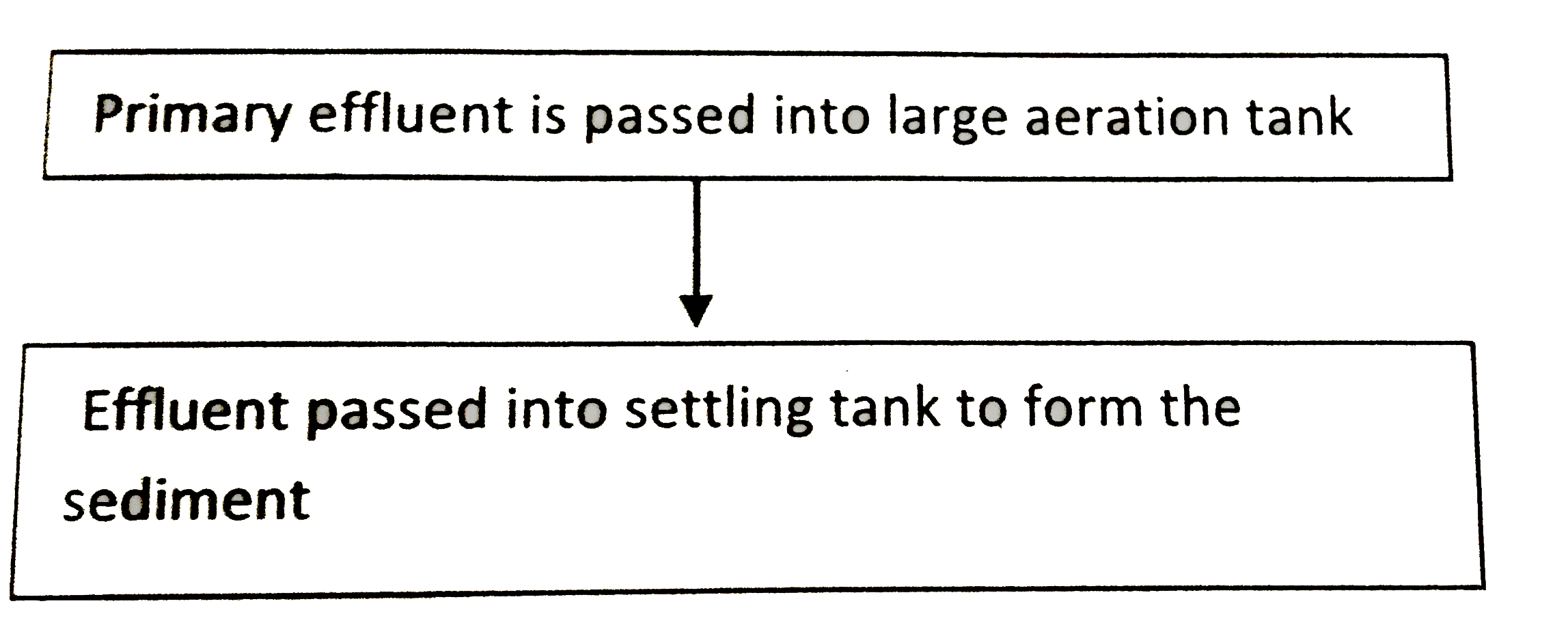
(a) Why is the primary effluent passed into large aeration tanks?
(b) Write the technical term used for the sediment formed. Mention its significance.
(c) Explain the final step that results in the formation of biogas in the large tank before the treated effluent is released into water bodies.
5.
Antibiotics produced by microbes are regarded as one of the most significant discoveries of the twentieth century. Antibiotics are the chemical substances which are produced by some microbes and can kill or retard the growth of other (diseasecausing) microbes.
(a) Name the scientist who discovered the first antibiotic and the organism he was working on.
(b) Name the first antibiotic and its source organism.
(c) Name the scientists who established the potential of the above as an effective antibiotic.
1.
(i) (b) : The first antibiotic was extracted from a fungus Penicillium notatum.
(ii) (b)
(iii) (c)
(iv) (d) : Penicillin is given to patients with an infection caused by bacteria including pneumonia, sore throat, gonorrhoea, etc. Candidiasis is a fungal disease.
(v) (c): Cephalosporins are bactericidal in nature. They kill the bacteria by disruption of cell wall synthesis.
2.
(a) Disadvantages of chemical methods.
(i) The chemicals kill both the beneficial and harmful organisms indiscriminately.
(ii) The chemicals are toxic and extremely harmful to humans and other animals.
(b) Bacterium - Bacillus thuringiensis
Fungus - Trichoderma sps.
(c) (i) According to an organic farmer, eradication of pests is impossible.
(ii) Some ofthe beneficial organisms that depend on the pests as food would not be able to survive.
3.
Bio Wastes are collected and a slurry of dungs is fed, a floating cover having gas outlet is placed over slurry which keeps on rising as the gas is produced in the tank, the spent slurry is removed through another outlet and may be used as fertilizer.
(a) sludge loader
(b) gas holder / CH4 and CO2
(c) dung and water.
4.
(a) It is to facilitate the vigorous growth of the useful aerobic microbes to form floes, which consume a large part of the organic matter.
(b) (i) Activated sludge
(ii) A small part of it is transferred to aeration tank as inoculum; it is used for production of biogas also.
(c) (i) The anaerobic microbes digest the floes in the anaerobic sludge digester and produce gases like carbon dioxide, methane and hydrogen sulphide that form biogas.
5.
(a) (i) Alexander Fleming
(ii) He was working on Staphylococcus bacterium.
(b) (i) Penicillin is the first antibiotic.
(ii) It is obtained from Penicillium notatum.
(c) Ernst Chain and Howard Florey established its full potential as an antibiotic.

12th Standard CBSE Syllabus & Materials
12th Standard CBSE
CBSE 12th Computer Science Python Revision Tour I - New Previous year Question Papers Study Material - QB365 Set A
NEW12th Standard CBSE
CBSE 12th Business Studies Planning Important Questions And Answers Study Material - QB365 Set A
NEW12th Standard CBSE
CBSE 12th Business Studies Business Environment Important Questions And Answers Study Material - QB365 Set A
NEW12th Standard CBSE
CBSE 12th Business Studies Principles of Management Important Questions And Answers Study Material - QB365 Set A



NCERT Books

Syllabus

Exam Pattern

Sample Question Papers

Previous year Question Papers

Important Notes

MCQ Practice test

NCERT Exemplers

Case study Questions

Image Based Questions

Passage based Questions

HOT Questions

Value Based Questions

Model Questions Papers
NCERT ( Book Back ) Questions

Assertion and Reason
Important Questions And Answers

CBSE 12th Standard CBSE Subjects
CBSE Standards








