
 100% FREE ACCESS
12th Standard CBSE Syllabus & Materials
12th Standard CBSE
CBSE 12th Economics Government Budget and the Economy Previous year Question Papers Study Material - QB365 Set A
NEW12th Standard CBSE
CBSE 12th Computer Science Interface Python with MySQL - New Previous year Question Papers Study Material - QB365 Set A
NEW12th Standard CBSE
CBSE 12th Computer Science Database Concept - New Previous year Question Papers Study Material - QB365 Set A
NEW12th Standard CBSE
CBSE 12th Computer Science Data Communication - New Previous year Question Papers Study Material - QB365 Set A
NEW12th Standard CBSE
CBSE 12th Computer Science Data Structures - New Previous year Question Papers Study Material - QB365 Set A
NEW12th Standard CBSE
CBSE 12th Computer Science Functions - New Previous year Question Papers Study Material - QB365 Set A

Published on: 21/05/2021
QB365 Provides the updated CASE Study Questions for Class 12 Biology, and also provide the detail solution for each and every case study questions . Case study questions are latest updated question pattern from NCERT, QB365 will helps to get more marks in Exams
Download CBSE Class 12th Standard CBSE Biology question papers, sample papers, important questions, and previous year solved papers in PDF format. Get free study materials, NCERT solutions, and exam preparation resources for Class 12th Standard CBSE Biology
Questions + Answers key
Take MCQ Biology Test
1.
Read the following and answer any four questions from (i) to (v) given below :
Translation is the process of polymerisation of amino acids to form a polypeptide. The order and sequence of amino acids are defined by the sequence bases in the mRNA. The amino acids are joined by a bond called peptide bond. Ribosome is the site of protein synthesis.
(i) Which ion is essential for association of both units of ribosome at the time of protein formation ?
| (a) Mg2+ | (b) Mn2+ | (c) Cl- | (d) Ca2+ |
(ii) During translation, how many initiation factors are required in eukaryotes for initiation reactions?
| (a) 3 | (b) 6 | (c) 7 | (d) 9 |
(iii) Which part of mRNA contains untranslated regions (UTR)?
| (a) 3' end | (b) 5' end | (c) Either 3' or 5' end | (d) Both 5' end and 3' end |
(iv) Name the enzyme that helps in combining amino acid to its particular tRNA.
| (a) Activating enzyme | (b) Amino-acyl tRNA-synthetase | (c) Peptidyl transferase | (d) Both (a) and (b) |
(v) From the given list, select the translation machinery.
1. mRNA
2. Ribosomes
3. Amino acids
4. tRNAs
5. Peptidyl transferase
6. Amino acyl tRNA synthetase
7. Pyrophosphatase
| (a) (1), (2), (3), (4) and (6) | (b) (1), (2), (3), (4) and (5) | (c) (1), (2), (3), (4), (5) and (6) | (d) (1), (2), (3), (4), (5), (6) and (7) |
2.
Read the following and answer any four questions from (i) to (v) given below:
In prokaryotes, DNA is circular and present in the cytoplasm but in eukaryotes, DNA is linear and mainly confined to the nucleus. DNA or deoxyribonucleic acid is a long polymer of nucleotides. In 1953, the first correct double helical structure of DNA was worked out by Watson and Crick. Based on the X-ray diffraction data produced by Maurice Wilkins and Rosalind Franklin. It is composed of three components, i.e., A phosphate group, a deoxyribose sugar and a nitrogenous base. Different forms of DNA are B-DNA, Z-DNA, A-DNA, C-DNA and D-DNA.
(i) Name the linkage present between the nitrogen base and pentose sugar in DNA.
| (a) Phosphodiester bond | (b) Glycosidic bond | (c) Hydrogen bond | (d) None of these |
(ii) The double helix structure of DNA was proposed by
| (a) James Watson and Francis Crick | (b) Earwin Chargaff | (c) Federick Griffith | (d) Hershey and Chase |
(iii) The double chain of B-DNA is coiled in a helical fashion. The spiral twisting of B-DNA duplex produces
| (a) right and left part | (b) major and minor grooves | (c) upper and lower sides | (d) linear and circular part. |
(iv) Assertion: The two strands of DNA helix have uniform distance between them.
Reason: A large sized purine always paired opposite to a small sized pyrimidine.
| (a) Both assertion and reason are true and reason is the correct explanation of assertion. |
(b) Both assertion and reason are true but reason is not the correct explanation of assertion. |
| (c) Assertion is true but reason is false. | (d) Both assertion and reason are false. |
(v) Which of the following describes the structure of B-DNA?
| Polynucleotide chains | Number of base pairs per complete turn of helix |
| (a) Parallel | 5 |
| (b) Anti-parallel | 10 |
| (c) Parallel | 15 |
| (d) Anti-parallel | 20 |
3.
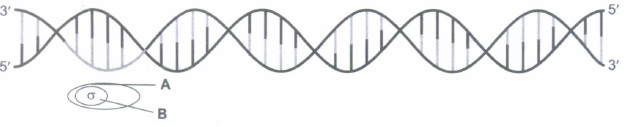
A stage in the process of transcription in a prokaryote is shown above.
(a) Name the stage in transcription.
(b) Identify A and B in the diagram.
(c) Can this process be coupled to translation ? Justify your answer.
4.
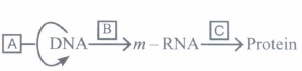
The Central dogma of molecular biology is shown above.
(a) Who proposed this?
(b) Identify the processes A, Band C in the above representation.
(c) Why is it not applicable to certain viruses?
5.
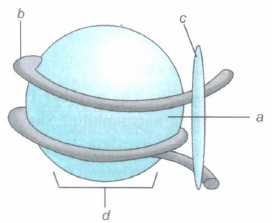
The diagram of a nucleosome is shown above.
(i) Identify the parts labeUed a, b, c and d in it.
(ii) Name the positively-charged and negatively charged components in it.
1.
(i) (a) :The two subunits of ribosomes come together at the time of protein formation. This phenomenon is called association. Mg2+ is essential for it.
(ii) (d): Eukaryotes have nine initiation factors- elf2, elf3, elfl, elf4A, elf4B, elf4C, elf4D, elf5,elf6.
(iii) (d): An mRNA molecule has some additional sequences that are not translated and are called untranslated regions (UTR). The UTRs are present at both 5' end (before start codon) and at 3'-end (after stop codon). They are required for efficient translation process.
(iv) (d): Amino-acyl tRNA-synthetase is also called aa-activating enzyme.
(v) (a): Enzyme peptidyl transferase is component of larger subunit of ribosome. It catalyses two principal chemical reaction - peptide bond formation and peptide release. Enzyme pyrophosphatase hydrolyses pyrophosphate and provides energy for driving the initial reaction of activating amino acids.
2.
(i) (b): In DNA the nitrogenous base and a pentose sugar joins to form nucleoside with the help of bond called glycosidic bond or N-glycosidic linkage.
(ii) (a): The correct structure of DNA was first worked out by James Watson and Francis Crick in 1953. Their double-helix model of DNA structure was based on two major investigations, i.e., Chargaff's rules of base i'airing and study of X-ray diffraction pattern of DNA produced by Maurice Wilkins and Rosalind Franklin which helped Watson and Crick to design the 3-dimensional structure of DNA.
(iii) (b): Due to spiral twisting, the B-DNA duplex comes to have two types of alternate grooves, i.e., majo: (length 22 Â) and minor (length 12 Â).
(iv) (a)
(v) (b): The double helical chains of B-DNA are bound to each other via hydrogen bonds in an antiparallel fashion, i.e., 5'-3' in one and 3'-5' in other. The pitch of helix per turn is 3.4 nm with 10 base pairs in each turn.
3.
(a) Initiation step in transcription.
(b) A - RNA polymerase.
B - Sigma (\(\sigma \)) factor.
(c) Yes, this process can be coupled to translation because
(i) the RNA synthesised does not require any processing to become active.
(ii) both transcription and translation occur in the cytosol, as there is no distinct nucleus and cytosol in prokaryotes.
4.
(a) Francis Crick proposed this.
(b) A - Replication (of D A)
B - Transcription
C - Translation
(c) In some viruses (retroviruses), the flow of information is in reverse direction, i.e., from RNA to DNA catalysed by enzyme, reverse transcriptase; hence, it is not applicable to these viruses.
5.
(i) a - Histone octamer
b - DNA
c - H1 histone
d - Core of histone molecules.
(ii) (a) Positively-charged component-Histone.
(b) Negatively-charged component-DNA.

12th Standard CBSE Syllabus & Materials
12th Standard CBSE
CBSE 12th Computer Science Python Revision Tour I - New Previous year Question Papers Study Material - QB365 Set A
NEW12th Standard CBSE
CBSE 12th Business Studies Planning Important Questions And Answers Study Material - QB365 Set A
NEW12th Standard CBSE
CBSE 12th Business Studies Business Environment Important Questions And Answers Study Material - QB365 Set A
NEW12th Standard CBSE
CBSE 12th Business Studies Principles of Management Important Questions And Answers Study Material - QB365 Set A



NCERT Books

Syllabus

Exam Pattern

Sample Question Papers

Previous year Question Papers

Important Notes

MCQ Practice test

NCERT Exemplers

Case study Questions

Image Based Questions

Passage based Questions

HOT Questions

Value Based Questions

Model Questions Papers
NCERT ( Book Back ) Questions

Assertion and Reason
Important Questions And Answers

CBSE 12th Standard CBSE Subjects
CBSE Standards








