
 100% FREE ACCESS
12th Standard CBSE Syllabus & Materials
12th Standard CBSE
CBSE 12th Economics Government Budget and the Economy Previous year Question Papers Study Material - QB365 Set A
NEW12th Standard CBSE
CBSE 12th Computer Science Interface Python with MySQL - New Previous year Question Papers Study Material - QB365 Set A
NEW12th Standard CBSE
CBSE 12th Computer Science Database Concept - New Previous year Question Papers Study Material - QB365 Set A
NEW12th Standard CBSE
CBSE 12th Computer Science Data Communication - New Previous year Question Papers Study Material - QB365 Set A
NEW12th Standard CBSE
CBSE 12th Computer Science Data Structures - New Previous year Question Papers Study Material - QB365 Set A
NEW12th Standard CBSE
CBSE 12th Computer Science Functions - New Previous year Question Papers Study Material - QB365 Set A

Published on: 24/05/2021
QB365 Provides the updated NCERT Examplar Questions for Class 12 Biology, and also provide the detail solution for each and every ncert examplar questions , QB365 will give all kind of study materials will help to get more marks
Download CBSE Class 12th Standard CBSE Biology question papers, sample papers, important questions, and previous year solved papers in PDF format. Get free study materials, NCERT solutions, and exam preparation resources for Class 12th Standard CBSE Biology
Questions + Answers key
Take MCQ Biology Test1.
Refer to the diagram given below and answer the questions that follow.
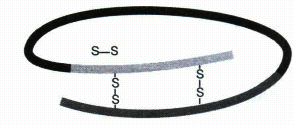
(i) The diagram shown above is insulin or proinsulin, Justify.
(ii) How is mature insulin syntheised?
2.
Secondary producers are
(i) herbivores
(ii) producers
(iii) carnivores
(iv) None of these
3.
Name a set of principles that may be used to regulate human activities in relation to the biological world. Why they are important?
4.
Some plants have a mechanism of shedding of pollen before maturation of stigma. Why?
5.
How is the child affected, if it has grown from the zygote formed by an XX-egg fertilised by a Y-carrying sperm? What do you call this abnormality?
6.
Name the organic materials of which exine and intine of angiosperm pollen grains are made up of. Explain the role of exine.
7.
Mention the three strata (zones) of a lake.
8.
Name the edaphic factors of an ecosystem.
9.
Match the organism given in column 'A' with the Vegetative propagules given in column 'B'.
| Column A | Column B |
| Bryophyllum | offset |
| Agave | Eyes |
| Potato | Leaf buds |
| Water hyacinth | Bulbils |
10.
There is greater biodiversity in tropical/subtropical regions than in temperate region.Explain.
11.
Define the term 'stress' for plants, Discuss briefly the two types of stress encountered by plants.
12.
Is there any relationship between dedifferentiation and the higher degree of success achieved in plant tissue culture experiments?
13.
In a developing embryo, analyse the consequences if cell divisions are not followed by cell differentiation
14.
All reproductive tract infections RTIs, are STDs, but all STDs are not RTIs. Justify with example.
15.
Comment on the essential features required for an ideal contraceptive.
16.
What are possible types of pollination in chasmogamous flowers. Give reasons.
17.
The generative cell of a two-celled pollen divides in the pollen tube but not in three celled pollen. Give reasons.
18.
Why does the zygote begin only after the division of primary endosperm cell (PEC)?
19.
Vivipary automatically limits the number of offspring in a litter. Why?
20.
A part from plants and animals,microbes form a permanent biotic component in an ecosystem.While plants have been referred to as autorophs and animals a sheterotrophs,How do microbes fulfil their energy requirements?
21.
What could be the reason for the fast rate of decomposition in the tropics?
22.
Give reasons as to why cell division cannot be a type of reproduction in multicellular organisms.
23.
Is there a relation between the size of an organism and its life span? Give two examples in support of your answer.
1.
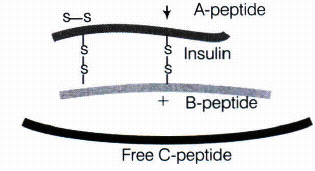
(i) The diagram is proinsulin as it contains C-peptide.
(ii) Mature insulin is synthesised by removal of extra stretch called C-peptide.
2.
None of these - Plants are autotrophic and are called primary producers because they are self-sufficient to synthesise their own food. Also, there is nothing like secondary producers.
3.
A set of principles that may be used to regulate human activities in relation to the biological world are called bioethics.
These are important because the genetic modification of an organism can have unpredictable results when such organisms are introduced into the ecosystem.
4.
The strategy of shedding of pollen before maturation of stigma is to prevent self-fertilisation and reduce inbreeding depression. Such mechanisms facilitate cross-pollination and produce genetically better yielding crops.
5.
(i) The zygote will be XXY. It means the zygote is male with feminine characters.
(ii) This abnormality is called Klinefelter's syndrome.
6.
The exine layer is made up of sporopollenin and intine is made up of cellulose and pectin material.
Exine layer protects the pollen from adverse environmental condition.
7.
Littoral zone, limnetic zone and profundal zone.
8.
Edaphic factore are related to soil and substratum, and include topography, background, minerals, pH, etc.
9.
(c), (d), (b), (a).
10.
India has high ecological diversity due to variety of topography, soil types, climates, rainfall zones, sea coasts.islands, etc. Ten well demarcated biogeographical zones with different biota occur in India.
11.
'Stress' for plants refers to unfavourable environment condition that reduces growth and yield of plants. Plants encounter two types of stress.
(a) Drought, water-logging, snowing, high-temperature, salinity (Abiotic Stress Factors). Stomata get closed which leads to reduction in photosynthesis and plant yield.
(b) Animals and Man (Biotic Stress).
12.
Yes. Dedifferentiation is key to development of cell division and growth of plant mass callus. Callus can be subdivided at regular intervals and the subcultures allowed differentiate and form plantlets.
13.
Cell differentiation is a must for formation of tissues and organs. In the absence of cell differentiation, the developing embryo will become a mass of similar cells. There would not be any plumule, radicle, cotyledons or embryo axis. A new plant will not be formed from such an embryo.
14.
Among the common STDs, hepatitis-B and AIDS are not infections of the reproductive organs though their mode
of transmission could be through sexual contact also.All other diseases like gonorrhoea, syphilis, genital herpes, hepatitis-B are transmitted through sexual contact and are also infections of the reproductíive tract,so these are STDs as well as RTIs, whereas, AIDS and hepatitis, STDs, but not RTIs.
15.
(i) User-friendly, i.e., comfortable and easy to use.
(ii) Without any side effect.
(iii) Reversible.
(iv) Completely effective against pregnancy.
16.
Self-pollination and cross-pollination both can occur in chasmogamous flower. For details,refer Basics and Basis.
17.
In a 3-celled pollen, there is one vegetative or tube cell and two male gametes. in two-celled pollen, there is one vegetative cell and a generative cell. Here the generative cell divides in the pollen tube to form two male gametes which are already present in 3-celled pollen. Therefore, there is no need for further division in 3-celled pollen.
18.
Primary endosperm cell (PEC) is to form the food laden endosperm for nourishment of developing embryo. Therefore, division of PEC for production of endosperm is a pre-requisite for division of zygote in the formation of embryo.
19.
Vivipary is nourishment and growth of embryo inside the body of the female till it becomes fully formed and delivered. Vivipary provides protection and assured nourishment to the young ones. As the female has a limited space and nourishment, the number of youngones always kept low, e.g., one in humans and cattle, 6-12 in Rabbit and Rat.
20.
1. The microbes are also heterotrophs.
2. Those microbes which meet their energy requirement by degrading the dead and decaying organic matter,are called decomposers.
3. Those microbes which depend on living organisms for their food as well as shelter, are called parasites.
21.
1. The rate of decomposition is regulated by temperature and soil moisture, as they influence the activities of decomposers.
2. The trophic have a warm/hot and humid condition; such a condition is favourable for the decomposers and hence they speed up the process of decomposition.
22.
(i) In mullticellular organisms, cells/ tissues are specialised for various functions; the function of reproduction is performed by one group of speciallised cells.
(ii) Not all cells of a multicellular organism retains the power of division at maturity; the cells which retain the power of division are localised and they alone can help in reproduction.
23.
No, there is no relationship between the size of an organisms and its lifespan, e.g.
1. The size of crows and parrots is almost same, but the lifespan of crows is 15 years while that of parrots is 140 years.
2. A mango tree has a much shorter lifespan, compared to a peepal tree, though they both are of similar size.

12th Standard CBSE Syllabus & Materials
12th Standard CBSE
CBSE 12th Computer Science Python Revision Tour I - New Previous year Question Papers Study Material - QB365 Set A
NEW12th Standard CBSE
CBSE 12th Business Studies Planning Important Questions And Answers Study Material - QB365 Set A
NEW12th Standard CBSE
CBSE 12th Business Studies Business Environment Important Questions And Answers Study Material - QB365 Set A
NEW12th Standard CBSE
CBSE 12th Business Studies Principles of Management Important Questions And Answers Study Material - QB365 Set A



NCERT Books

Syllabus

Exam Pattern

Sample Question Papers

Previous year Question Papers

Important Notes

MCQ Practice test

NCERT Exemplers

Case study Questions

Image Based Questions

Passage based Questions

HOT Questions

Value Based Questions

Model Questions Papers
NCERT ( Book Back ) Questions

Assertion and Reason
Important Questions And Answers

CBSE 12th Standard CBSE Subjects
CBSE Standards









