
 100% FREE ACCESS
12th Standard CBSE Syllabus & Materials
12th Standard CBSE
CBSE 12th Economics Government Budget and the Economy Previous year Question Papers Study Material - QB365 Set A
NEW12th Standard CBSE
CBSE 12th Computer Science Interface Python with MySQL - New Previous year Question Papers Study Material - QB365 Set A
NEW12th Standard CBSE
CBSE 12th Computer Science Database Concept - New Previous year Question Papers Study Material - QB365 Set A
NEW12th Standard CBSE
CBSE 12th Computer Science Data Communication - New Previous year Question Papers Study Material - QB365 Set A
NEW12th Standard CBSE
CBSE 12th Computer Science Data Structures - New Previous year Question Papers Study Material - QB365 Set A
NEW12th Standard CBSE
CBSE 12th Computer Science Functions - New Previous year Question Papers Study Material - QB365 Set A

Published on: 24/05/2021
QB365 Provides the updated NCERT Examplar Questions for Class 12 Biology, and also provide the detail solution for each and every ncert examplar questions , QB365 will give all kind of study materials will help to get more marks
Download CBSE Class 12th Standard CBSE Biology question papers, sample papers, important questions, and previous year solved papers in PDF format. Get free study materials, NCERT solutions, and exam preparation resources for Class 12th Standard CBSE Biology
Questions + Answers key
Take MCQ Biology Test1.
At what stages does Plasmodium gain entry in to human body? Write the different stages of its life cycle in the human body.
2.
Classify the following contraceptive measures into different methods of birth control.
(i) Saheli
(ii) Tubectomy
(iii) Vasectomy
(iv) Condoms
(v) Diaphragms
(vi) Cervical caps
3.
What are methanogens? How do they help to generate biogas?
4.
Identify the type of inheritance shown in the following pedigree diagram.
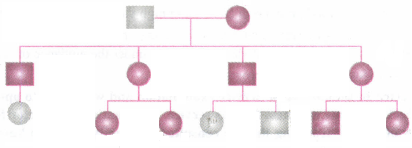
5.
(a)Name a genetic RNA and a non-genetic RNA
(b)Differntiate between prokaryotic mRNA and eukaryotic mRNA on the basis of any one character.
6.
What is the role of microbes in sewage treatment plant?
7.
In a medical case, It was detected that a child is suffering from a genetic disorder due to the deletion of the gene. What remedial measure do you suggest for the treatment of such disorder.
8.
List the condition found on the primitive earth.
9.
A _______ is the development of seeds from unfertilised female gamete.
B. Parthenocarpy is the development of______in an unfertilised flower, resulting in a_______
C. Polyembryony is the presence of more than one_______ in the_______
D. There are usually three germ pores in _______and one in _______
E. The anther wall is composed of_______to_______layers.
F. The flowers producing _______ and _______ with bright _______ attract the insects.
G. Plants with reduced power of _______ reproduction, _______ dormant period of seed or _______ viability are propagated through vegetative reproduction.
H. The integuments of ovule surround the_______all around expect at the apex, leaving a narrow passage, called the _______.
I. The wind-pollinated flowers are generally _______sexual.
J. In many dicots, the reserves in the _______ and consumed by the developing embryo.
10.
(a) What is the contribution of Avery, MacCleod and McCarty?
(b) How did the transformation experiments of Griffith differ from those of Avery and MacCleod?
(c) What was the significance of each?
11.
Why was it believed earlier that proteins could be genetic material?
12.
Recall the experiment done by frederick Griffith, Avery, MacLeod and McCarty, where DNA was speculated to be the genatic material. If RNA, Instead of DNA was the genetic material, would the heat killed strain of Pneumococcus have tranformed the R-strain into virulent strain? Explain
13.
Retroviruses do no follow central dogma comment
14.
During DNA replication, why is it that the entire molecule does not open in one go? Explain replication fork. what is the two function that the monomers (dNTPs) play?
15.
How does species diversity differ from ecological diversity?
16.
How do you express the meaning of worlds like race, breed cultivars or variety?
17.
Gene flow occurs through generations. Gene flow can occur across language barriers in humans. If we have a technique of measuring specific allele frequencies in different population of the world, can we not predict human migratory patterns in pre-history and history? Do you agree or disagree? Provide explanation to your answer.
18.
Comment on the statement that "evolution and natural selection are end result of consequences of some other processes but themselves are not processes.
19.
The evolutionary story of moths in England during industrialization reveals, that "evolution is apparently reversible". Clarify this statement.
20.
Give one example for each of the following:
(a) Migratory animal
(b) Predator animal
(c) Phytophagous animals
(d) Camouflaged animal
(e) Chemical defense agent.
21.
Differentiate between diagnostics and therapeutics. Give one example for each category.
22.
How was it conclused that genes are located on chromosome?
23.
With help of an example, differentiate between incomplete dominance and codominance.
24.
In peas, tallness is dominant over dwarfness and red colour of flowers is dominant over the white colour. When a tall plant bearing red flowers was pollinated with a dwarf plant bearing white flowers, the different phenotypic groups were obtained in the progeny in human mentioned against them:
Tall, Red = 138
Tall, White = 132
Dwarf, Red = 136
Dwarf, White = 128
Mention the genotypes of the two parents and of the four offspring types.
25.
Meiotic division during oogenesis is different from that in spermatogenesis. Explain how and why?
1.
The part of life cycle of Plasmodium spent in human body includes following stages:
(i) Sporozoites enter the human body through the bite of infected female Anopheles mosquito (vector)
(ii) From the blood, they enter liver cells and multiply within the liver cells.
(iii) Infected liver cells burst and release the parasites again in the blood.
(iv) They attack RBCs repeatedly, multiply and cause their rupture.
(v) Ruptured RBCs release a toxin called haemozoin which is responsible for high recurring fever and resultant chill/shivering.
(vi) When a female Anopheles mosquito bites an infected person, these parasites enter the mosquito body and undergo further development
2.
(i) Oral pills
(ii) Surgical method
(iii) Surgical method
(iv) Barrier method
(v) Barrier method
(vi) Barrier method
3.
1. Certain bacteria which grow anaerobically on cellulosic material, produce large amounts of methane along with CO2 and H2. These bacteria are called methanogens (one of the common bacterium is Methanobacterium).
2. Methanogens are commonly found in the anaerobic sludge during sewage treatment and are also present in the rumen (a part of stomach) of cattle.
3. In rumen, methanogens help in the breakdown of cellulose and their excreta called gobar, is rich in these bacteria. Therefore, dung can be used to produce biogas commonly called as gobar gas.
4.
The type of inheritance is cytoplasmic or mitochondrial inheritance because the character in the given pedigree analysis is inherited only through female.
5.
(a) Genetic RNA-Double stranded RNA of mammalian reovirus
Non-genetic RNA-Ribosomal RNA, messenger RNA or transfer RNA
(b)Prolaryotic mRNA is short lived and hardly undergoes processing(capping, methylation and polyadenylation)to from comparatively stable mRNA.
6.
A sewage treatments plants is regarded as a giant microbial culture breading facility where the microbes are persuaded to work for our benefit.They metabolize the solid waste that passes through the treatment plant.The microbes oxidize the nutrients and during this process, they release energy in the form of heat and chemicals (phosphates, nitrates and sulphates) Gaseous by-product is also produced in the form of carbon dioxide.
7.
The best possible remedial measure is gene therapy in which a defective gene is manipulated by introduction of normal healthy and functional gene/s.
8.
The earth originally had a strongly reducing atmosphere. There was no oxygen in molecular form in the primitive atmosphere.
9.
A. Parthengenesis
B. fruit, seedless
C. embryo, seed
D. dicots, monocots
E. 4 to 5
F. nectar fragrance, colours
G. sexual, long, poor
H. nucellus, micropyle
I. uni
J. endosperm.
10.
(a) Avery, MacCleod and McCarty gave the proof that "Transforming agent" is DNA
Avery, MacCleod and McCarty experiment:
1) Oswald Avery, colin MacCleod and McCarty in 1933-34 revealed the chemical nature of the transforming substance to be DNA
2) They purified DNA, RNA, Protein from heat-killed S-strain to see which of them could transform R-cells \(\rightarrow \)S-cells.
3) They also observed that protein digesting enzyme (protease) and RNA digesting enzyme (RNAase) have no effect on transformation whereas digestion of DNA with DNAase would not cause transformation
4) This finding established that transforming genetic material is DNA
Result of experiment
| Mixture | Result |
| 1) R-type bacteria + carbohydrates of S-type bacteria 2) R-type + protein of S-type 3) R-type + DNA of S-type 4) R-type + DNA of S-type + Deoxyribonuclease |
R-type R-type S-type R-type |
(b) Griffith's in vitro experiments demonstrated the occurrence of transformation in Pneumococcus. They provide no indication as to the molecular basis of the transformation phenomenon. Avery and MacCleod carried their experiments in vitro employing biochemical analysis to demonstrate that transformation was mediated by DNA
(c) Griffith showed that a transforming substance existed. Avery et.al. defined it as DNA
11.
Living organisms are composed of various biomolecules and there are two main macromolecules, i.e., DNA and proteins which can have structural specificity as diverse as the basic requirement of genetic material
It was believed that proteins could be the ideal candidates for genetic material because:
(1) Proteins are made up of twenty amino acids thus the diversity can be generated on the basis of the number of residues of each amino acid in a given protein and sequence of amino acid would be enormous.
(2) They are macromolecules and universally present.
12.
RNA is more liable and prone to degradation (owing to the presence of 2'OH group in its ribose) Hence, heat-killed S-strain may not have retained its ability to transform the R-strain into virulent form if RNA was its genetic material.
13.
Retroviruses do no follow central dogma of (DNA->RNA->Protein) because their genetic material is not DNA. Instead they have RNA that is converted to DNA by the enzyme reverse transcriptase. It is termed reverse transcription. It was proposed by Temin
14.
(i) While replicating, the entire DNA molecule to keep the whole molecule stabilised does not open in one go because it would be highly expense energetically. Actually un unwidinsg creates tension in the molecule as uncoiled parts.
Actually, unwinding creates tension in the molecule as uncoiled parts starts forming super coils due to the interaction of exposed nucleotides.
(ii) Replication fork: Instead helicase enzyme, acts on the double strand at or site (origin of replication and a small stretch is unzipped. Immediately. It is held and stabilised by single strand binding protein.
Slowly with the help of enzymes, exposed strands are copied as a point of unwinding moves and ahead in both direction
It gives an appearence of Y-shaped structure which is called replication fork.
The two functions that the monorner units of NTPs play are:
1. They pair up with exposed nucleotides of the template strand and make phosphodiester linkages and release a pyrophosphate.
2. Hydrolysis of his pyrophosphate by enzyme pyrophosphate release energy that will facilitate making hydrogen bonds between free nucleotides and bases of the template strand
15.
Species diversity is the occurrence of variety and abundance of species in community while ecological diversity is the occurrence of different ecosystem and communities in a geographical area.
16.
The meaning of the given words are as given below
Race. It is a classification system used to categorise humans into large and distinct populations or groups
by anatomical, cultural, linguistic, geographical, historical and for religious relationship.
Breed. It is a specificgroup ofdomestic animals or plants having homogenous appearance and behaviour
and other characteristics that distinguish it from other animals or plants of the same species. They were formed through selective breeding.
Cultivar. It is a plant or grouping of plants selected for desirable characteristics that can be maintained by propagation. 'Cultivar' stands for 'cultivated variety'.
Variety. A variety arises naturally in the plant kingdom and plant grown from its seeds will typically come true to type.
17.
Yes, we agree. As the gene flow occurs through geographical barriers over generations, by studying specific allelic frequencies in various populations of the world, we can predict the human migratory patterns in pre-historic and historic era.
There have been projects undertaken such as human genographics project. Which uses data from studies on specific genes/chromosomes/mitochondrial DNA to trade the evolutionary history and migratory patterns of humans.
18.
1. We are still not clear whether evolution and natural selection are processes or results of some unknown processes.
2. On one hand, when we describe the world as we see today, we describe evolution a process.
3. On the other hand, when we describe life on earth, we treat evolution as a consequences of the process of natural selection.
19.
With the industrial growth in 1920, the white-winged grey-coloured Biston betularia was rapidly replaced by a dark-coloured melanic Biston carbonaria as the later had more chances of survival and favoured by Natural selection. But after 1956, the coal was rapidly replaced by oil and electricity as energy source in the industries which reduced soot deposition. So the light coloured moth is again replacing the dark-coloured moth by reverse evolution.
20.
(a) Arctic tern
(b) Tiger/Lion
(c) Aphid
(d) Chameleon
(e) Glycosides (in Calotropis).
21.
A diagnostic technique helps to identify or confirm a disorder.
e.g., ELISA is used to diagnose HIV infection.
A therapeutic agent is used to help in the treatment of a disease.
e.q., \(\alpha \)-1 antitrypsin is used to treat emphysema.
22.
Sutton and Boveri noted that the behaviour of chromosomes was parallel to that of genes.
(i) Both genes and chromosomes occur in pairs.
(ii) They segregate during gamete formation and only one member of a pair enters one gamete.
(iii) One pair of genes 'or chromosomes segregates independently of the other pairs.
(iv) Since the number of chromosomes is far less than the number of genes or traits an organism possesses, it is proposed that a number of genes are located on every chromosome.
23.
Incomplete dominance.
It is the phenomenon in which neither of the two alleles of a gene is completely dominant over the other and the \(F_{ 1 }\) hybrid is intermediate between the two parents.
The parental traits appear without blending \(F_{ 2 }\) in the generation.
The phenotypic and genotypic ratios of \(F_{ 2 }\) are same, i.e. 1: 2: 1.
e.g. Inheritance of flower colour in snapdragon.
Codominance:
It is a phenomenon in which two alleles of a gene are equally dominant and the hybrid resembles both the parents.
e.g., The blood group AB is the phenotype of the genotype the alleles IA and IB express themselves and hence both glycoproteins A and B are present in such an individual and the blood group is AB.
24.
The phenotypes obtained in the progeny fall i'1to a ratio of 1 : 1 : 1 : 1, which is Mendelian dihybrid test cross ratio.
It is a cross between a dihybrid (heterozygous for both traits) and a double recessive plant.
The cross is as follows:
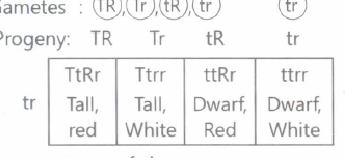
The genotypes of the parents:
TtRr and ttrr
The genotypes of the offspring:
TtRr, Ttrr, ttRr, and ttrr
25.
Meiotic division during oogenesis is different from that of spermatogenesis in the following ways
|
Meiotic division in spermatogenesis |
Meiotic division in Oogenesis |
|
Many million sperms generated at a time. |
Only one mature ovum is generated at a time, every month. |
|
After two complete meiotic divisions, four equal sized cells are produced. |
Meiosis-l gers arrested at prophase-I and when it is complered at later stage, one big cell with almost all the cytoplasm and three very small-sized cells are produced. |
|
They mature into flagellated and motile cell. |
Mature ovum is non-flagellated and non-motile. |
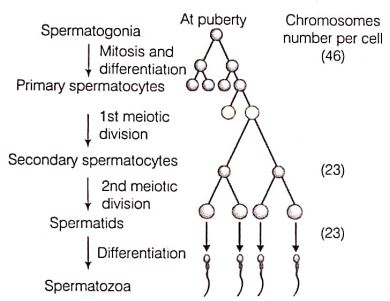
(i) Unequal cell division makes the ovum much larger than the other three polar bodies. As, ovum has more
cyloplasm and more organelles, it has a better chance of survival.
(ii) The male makes millions of tiny sperms, while the female makes only one egg per month that also arrested for second meiotic division, until just before fertilisation. This is a way of conserving energy.
(iüi) Sperm is smaller and motile as it has to move out of male system to female reproductive system. Larger egg has abundant reserve food, so thal embryo starts developing right after fertilisation.

12th Standard CBSE Syllabus & Materials
12th Standard CBSE
CBSE 12th Computer Science Python Revision Tour I - New Previous year Question Papers Study Material - QB365 Set A
NEW12th Standard CBSE
CBSE 12th Business Studies Planning Important Questions And Answers Study Material - QB365 Set A
NEW12th Standard CBSE
CBSE 12th Business Studies Business Environment Important Questions And Answers Study Material - QB365 Set A
NEW12th Standard CBSE
CBSE 12th Business Studies Principles of Management Important Questions And Answers Study Material - QB365 Set A



NCERT Books

Syllabus

Exam Pattern

Sample Question Papers

Previous year Question Papers

Important Notes

MCQ Practice test

NCERT Exemplers

Case study Questions

Image Based Questions

Passage based Questions

HOT Questions

Value Based Questions

Model Questions Papers
NCERT ( Book Back ) Questions

Assertion and Reason
Important Questions And Answers

CBSE 12th Standard CBSE Subjects
CBSE Standards









