
 100% FREE ACCESS
12th Standard CBSE Syllabus & Materials
12th Standard CBSE
CBSE 12th Economics Government Budget and the Economy Previous year Question Papers Study Material - QB365 Set A
NEW12th Standard CBSE
CBSE 12th Computer Science Interface Python with MySQL - New Previous year Question Papers Study Material - QB365 Set A
NEW12th Standard CBSE
CBSE 12th Computer Science Database Concept - New Previous year Question Papers Study Material - QB365 Set A
NEW12th Standard CBSE
CBSE 12th Computer Science Data Communication - New Previous year Question Papers Study Material - QB365 Set A
NEW12th Standard CBSE
CBSE 12th Computer Science Data Structures - New Previous year Question Papers Study Material - QB365 Set A
NEW12th Standard CBSE
CBSE 12th Computer Science Functions - New Previous year Question Papers Study Material - QB365 Set A

Published on: 24/05/2021
QB365 Provides the updated NCERT Examplar Questions for Class 12 Biology, and also provide the detail solution for each and every ncert examplar questions , QB365 will give all kind of study materials will help to get more marks
Download CBSE Class 12th Standard CBSE Biology question papers, sample papers, important questions, and previous year solved papers in PDF format. Get free study materials, NCERT solutions, and exam preparation resources for Class 12th Standard CBSE Biology
Questions + Answers key
Take MCQ Biology Test1.
The following diagrams are the age pyramids of different populations. Comment on the status of these populations.

2.
Since October 02, 2014 'Swachh Bharat Abhiyan' has been launched in our country.
(i) Write your views on this initiative giving justification.
(ii) As a biologist name two problems that you may face while implementing the programme in your locality.
(iii) Suggest two remedial methods to overcome three problems
3.
Differentiate between
i) estrous and menstrual cycle
ii) oviparity and vivipary.Give an example of each type.
4.
Differentiate between the following
(a) Repetitive DNA and Satellite DNA
(b) mRNA and tRNA
(c) Template strand and Coding strand
5.
Himani while watching a TV programme based on life in polar region observed that all animals in polar regions possess larger size. Also, smaller animals are not found in that region. She asked about this surprising fact to her teacher.
(i) why smaller animals (e.g. humming birds) are rarely found in polar regions?
(ii) What are the adaptations shown by polar animals?
(iii) What are the chief characteristics of polar region animals?
(iv) What values are shown by Himani?
6.
Arun visited his grandfather's farm and noticed that one of the workers was introducing earthworms in the soil. He quickly rushed to his grandfather and asked him the reason. His grandfather explained him the advantages of earthworm in soil improvement.
(i) Why are earthworms also known as detritivores?
(ii) Explain fragmentation.
(iii) Name the steps in the process ofdecomposition.
(iv) What values are shown by Arun?
7.
Mrs. Sharma was eager to know the sex of the foetus, which her daughter-in-law was carrying. She was so anxious that she could pay any amount for that. The doctor refused to disclose the result of the test.
(i) How can one know the sex of the foetus?
(ii) How is it done?
(iii) Why is disclosing the sex of the foetus banned in our country?
(iv) What value do you learn from the doctor's act?
8.
Following figure shows one of the artificial plasmids constructed to act as a vector.
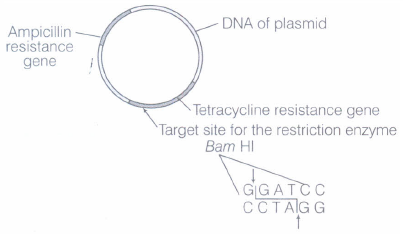
(i) With reference to above figure explain the importance of the plasmids having a single target site for a particular restriction enzyme, such as Bam HI.
(ii) The genes for ampicillin resistance and tetracycline resistance on the plasmid allow the genetic engineer to distinguish between bacteria that have taken up different circuits of DNA.
Complete the table to shoe whether bacteria which have taken up each of the different circuits of DNA are resistance to ampicillin, to tetracycline or to both. Show presence of resistance with a tick (\(\surd \)) and absence of resistance with a cross(\(\times \)).
(iii) (a) Explain why genes for antibiotic resistance are now rarely used as markers in gene technology.
(b) Describe the use of one alternative marker gene that can be used instead of an antibiotic resistance gene..
9.
Grandfather told his grandson Arun that many years ago in Uttrakhand, villagers started a movement to save trees of Himalayas by hugging the trees whenever contractors came to cut trees. This movement was effective in saving our forest wealth.
Read the above passage and answer the following questions:
(i) What is the name given to this movement?
(ii) How are trees imported for maintaining ecosystem?
(iii) What value was displayed by villagers?
10.
Which of the following ecosystem will be more productive in term of primary productivity? Justify your answer.
11.
Justify the following statement in terms of ecosystem dynamics."Nature tends to increase the gross primary productivity, while man tends to increase the gross primary productivity, while man tends to increase the net primary-productivity".
12.
Define transgenic animals. Explain any four areas where they can be utilised.
13.
Give an account of method used in sequencing the human genome
14.
Give an account of post-transcriptional modification of a eukaryotic mRNA.
15.
Explain briefly the 'rivet popper hypothesis' of Paul Ehrlich.
16.
Species diversity decrease as we move away from the equator towards the poles. what could be the possible reasons?
17.
We are told that evolution is a continuing phenomenon for all living things. Are humans also evolving? Justify your answer.
18.
Two organisms occupying particular geographical area show similar adaptive strategies. Taking examples, describe the phenomenon.
19.
"Modern methods of breeding animals and plants can alleviate the global food shortage". Comment on the statement and give suitable examples.
20.
(a) The shift from grain to meat diets creates more demands for cereals. Why?
(b) A 250 kg cow produces 200 g of protein per day but 250 g of Methylophillus methylotrophus can produce 25 tonnes of protein. Name this emerging area of research. Explain its benefits.
21.
Rose plants produce large, attractive bisexual flowers but they seldom produce fruits. On the other hand Lady's finger produces plenty of fruits. Analyse the reasons for failure of fruit formation in rose.
22.
Do you justify the statutory ban on amniocentesis in our country? Give reasons.
23.
Discuss the mode of action and advantages/disadvantages of hormonal contraceptives.
24.
The zygote passes through several development stages till implantation.Describe each stage briefly with suitable diagrams.
25.
What roles does pituitary gonadotrophins play during follicular and ovulatory phases of menstrual cycle? Explain the shifts in steroidal secretions.
1.
Figure A It is a 'pyramid' shaped age pyramid. In this figure, the base,i.e. pre-reproductive stage is very large as compared with the reproductive and post-productive stages of the population.
This type of age structure indicates that the population would increase rapidly.
Figure B It is an 'inverted bell' shaped pyramid. In this figure, the pre-reproductive and reproductive stages are same. This type of age structure indicates that the population is stable.
Figure C It is an urn-shaped pyramid. In the figure, the pre-reproductive and reproductive stages are less than the post-reproductive stages of this population. In this population more older people are present. This type of age structure indicates that the population definitely is declining.
2.
(i) 'Swachh Bharat Abhiyan' is a cleanliness drive launched by Shri Narendra Modi, Prime Minister of India on 2 October 2014. I totally support this campaign.This initiative is needed to solve the sanitation problem and waste management in India. Following this drive by all citizens will ensure hygiene across the country. It will spread awareness among people on the importance of clean surroundings. An unclean environment leads to various diseases, different types of pollution and creates a feeling of disgust in the minds of viewer. As a responsible Indian citizen, we all should join this drive with enthusiasm.
(ii) Two major problems can be:
(a) Lack of adequate sanitation
(b) Separation of biodegradable and non-biodegradable substances so that they can be treated property.
(iii) Two remedial measures to overcome problems are:
(a) Large number of toilets need to be constructed and people should be made aware about the importance of proper sanitation.
(b) Separate bins have to be installed for biodegradable and non-biodegradable substances.
3.
| estrous cycle | menstrual cycle |
| the cyclic change in the activities of ovaries and accessory ducts as well as hormones during the reproductive phase of non-primate mammals is called oestrus cyclic |
The cyclic changes in the activities of ovaries and accessory ducts as well as hormones during the reproductive the phase of primate mammals is called menstrual cycle. |
| Female show strong irresistible sexual urge. |
Female do not show irresistible sexual urge. |
| There is heat production at the time of ovulation and copulation occurs only at that period. |
There is no heat period and population can occur during any time of the cycle. |
| The shedding of endometrium and bleeding does not occur e.g. cows, sheep, rats, deer, dogs, tigers, etc |
The shedding of endometrium and bleeding occur. e.g. monkeys, apes, humans, etc. |
ii) Difference between i) oviparity and ii) vivipary are as follows:
| oviparity | vivipary |
| In oviparity, female animals lay eggs. |
In vivipary, female animals give birth to young ones |
| The development of zygote takes place outside the female's body. |
The development of zygote takes place inside the female's body. |
| Female lay eggs in a safe place in the environment, but the chance of survival are less. e.g. all birds, most of the reptiles and egg laying mammals. |
Female deliver young ones and the chance of survival are more. e.g. mammals except monotremes (egg-laying mammals) |
4.
(a) Difference between repetitive DNA and satellite DNA.
| Repetitive DNA | Satellite DNA |
| It is the non-coding DNA with multiple copies of identical sequences, which may lie in tandem or interspersed. | Refers to non-coding tandem repeat sequences. |
| These can be few base pairs to hundreds or thousands of base pairs long. |
These are generally short sequence repeats(upto 60 base pairs long) |
| In CsCI density gradient analysis, They appear as light bands. |
These appear as small dark bands. |
(b) Difference between mRNA and tRNA
| mRNA | tRNA |
| It is called messenger RNA and carries the codes for amino acid sequence. |
It is called transfer RNA as it carries amino acids to the site of protein synthesis. |
| It is a long chain of bases with large molecular weight(25-200000 Dalton). |
It is a clover-leaf like structure, with small molecular weight(25000 Dalton). |
| It is synthesised by RNA polymerase II | It is synthesised by RNA polymerase III. |
(c) Difference between Template strand and Coding strand
| Coding strand | Template strand |
| The coding strand determines the correct nucleotide sequence of mRNA. | The template strand acts as a base for mRNA transcription. |
| It is also known as sense strand (plus strand) or coding strand. | It is the antisense strand (minus strand) or a non-coding strand. |
| They do not take part in the transcription process. | Here, they take part in the transcription. They help in the formation of mRNA. |
| The coding strand is directed in the 3’ to 5’ direction. | The template strand is directed in the 5’ to 3’ direction. |
| The coding strand has a complementary nucleotide sequence. | The template strand does not have any complementary sequence. |
5.
(i)Smaller animals are rarely found in polar regions because such animals have surface area relative to their volume and they tend to loose heat very fast when it is cold outside. This is they are rarely found in polar regions
(ii) Animals that live in polar regions are adaptable to polar environments by features like the presence of thick skin coat, tendency to change colour or camouflage to white in snow and high metabolic rate. These features allow animals to adapt in colder environments.
(iii) Chief characteristics of polar region animals are:
(a) large sizes
(b) hairy skin
(c) lipid layer beneath the skin
(iv) Himani showed curiosity and eagerness for learning new things
6.
(i) Earthworms are known as detritivores as they breakdown detritus(dead remains of plants and animals) into smaller particles. Earthworms are often called farmer's friend.
(ii) Fragmentation is the first step in the process of decomposition. It is the process by which detritivores (e.g. earthworm) breakdown detritus in smaller particles.
(iii) The steps involved in decomposition are fragmentation, leaching, catabolism, humification and mineralisation.
(iv) Arun is very alert, curious and had scientific attitude.
7.
(i) One can know the sex of the foetus by amniocentesis.
(ii) During the process of amniocentesis, a sterile needle is inserted through the abdominal wall into the amniotic sac. Then, a small amount of amniotic fluid is withdrawn through the needle.
The fluid contains cells, which are separated from the amniotic fluid. Tests are then performed on cultured cells by chemical analysis, DNA analysis, and chromosomal analysis.
(iii) Disclosing the sex of the foetus is banned in our country because, in the past, there have been numerous cases, where the female foetud has been aborted. this discrimination for the girl child is considered a crime. the number of females to males ration is thereby reduced.
(iv) the doctor is devoted to his duties and has professional and moral ethics.
8.
(i) Single target site is present for particular restriction enzyme. If more than one site is present, then more cuts would fragment the plasmid.
(ii)
| Circle of DNA taken up by Bacteria | Bacteria Resistant to Ampicillin | Bacteria Resistance to Tetracycline |
| Unaltered plasmids | \(\surd \) | \(\surd \) |
| Recombinant plasmids that have taken up the wanted gene | \(\surd \) | \(\times \) |
(iii) (a) Now a days antibiotic resistance gene as markers are not used as they create more risk of plasmids to resistant gene to other bacteria.
It may spread the antibiotic resistance in many bacteria.
(b) Reporter genes are used now a days instead of antibiotic resistance genes. These genes have an ability to produce color in the presence of chromogenic substrate.
9.
(i) Chipko movement.
(ii) Trees are important component of forest ecosystem as they are producers, play important role in water cycle, and also prevent soil erosion etc.
(iii) Villagers wanted to protect the overall environment by checking natural calamities such as flood and drought, and maintaining harmony between different components of ecosystem.
10.
Primary productivity can be defined as the rate at which primary producers (e.g. green plants) traps and store solar radiation in the form of biomass. This is measured in terms of weight (gm) and in terms of energy (kcal m²) per year in a given time.
So, primary productivity varies from ecosystem to ecosystem. The ecosystem which possesses more producers will be more productive in terms of primary productivity. The young forest is still developing it may contain fewer trees compared to the old forests. The young forests therefore will not quench the solar radiation as much as old forests. Hence, old forest is more productive as compared to foung one. The shallow polluted lake will be less productive because of less number of producers and high amount of dead organic matter.
11.
In terms of ecosystem dynamics, flow of energy takes place from one trophic level to the next trophic level in unidirectional way. About 50% of solar energy incident over earth is present in Photosynthetic Active Radiation (PAR) and 2-10% of this PAR is utilised by green plants to form chemical energy(Gross Primary Productivity) (GPP). Out of 90% of gross primary productivity is lost maximum during respiration and other vital activities. Gross Primary Productivity of an ecosystem is the rate of production of organic matter during photosynthesis. So nature tend to increase gross primary productivity through supporting the large number of plant (producers) in an ecosystem. Net Primary Productivity is the available biomass for the consumption to heterotrophs (human and animals) man tries to increase net primary productivity by cultivating food and other crops which the depend on to fulfil their needs.
12.
Transgenic animals Transgenic animals are produced for the following purposes:
(i) Transgenic animals are designed to allow the study of how genes are regulated and how they affect the normal functions of the body and its developments e.g. Information is obtained as to how insulin has a role as growth factor.
(ii) Transgenic animals are designed to increase our understanding as to how genes control the development of diseases; they serve as models for human di eases.
(iii) Transgenic animals that produce useful biological compounds lure created by introducing a portion of the DNA that codes for that product, e.g.
\(\alpha \) -I antitrypsin is produced for curing emphysema.
(iv) Transgenic mice are being developed to test the safety of vaccines. e.g., polio vaccine has been tested on mice.
13.
A methodology of HGP includes following steps:
1) Mapping: The physical and genetic maps of the human genome are prepared by using molecule markers, microsatellite simple sequence repeats or sequence tagged sites and PCR amplification of particular microsatellite.
2) Sequencing: The two basic approaches are sequencing
(i) Expressed sequences tags ( ESTs). It is focussed on identifying all the genes that are expressed as RNAs.
(ii) Sequence annotation. It involves simply sequence the whole set of genome, that included all the coding and non-coding sequences and then assigning functions to different regions in the sequence
HGP followed the second technique,
The HGP strategy
Genome DNA
\(\downarrow \)
DNA is digested into fragments. These are inserted into BAC
\(\downarrow \)
(Baterial artificial chromosome)
\(\downarrow \)
Fragments are identified and mapped
\(\downarrow \)
BAC to be sequenced is fragmented. These fragments are sequenced at random
\(\downarrow \)
Sequence overlapping reveal final sequence
\(\downarrow \)
Final sequence is prepared
14.
After the completion of transcription in eukaryotes mainly, the hnRNA (heteronuclear RNA) undergoes following additional modification These processes are:
1) Modification of 5' -end by capping: It occurs rapidly after the start of transcription. The guanosine methylated at 7th position is added at 5' with the help of enzyme guanyl transferase. It is essential for the formation of an mRNA- ribosome complex. Translation is not possible if a cap is lacking because a cap is identified by 18 S rRNA of ribosome unit.
2) Polyadenylation at 3' -end (Tailing). Poly A tail is added to 3'-end of newly formed hnRNA with the help of enzyme poly A polymerase. It adds about 200-300 adenylate residues
3) Splicing of hnRNA. In eukaryotes, the coding sequences of RNA (exons) are interrupted by non-coding sequences (introns), Which are to be removed, Small nuclear RNA (snRNA) + protein complex called small nuclear Ribo-Nucleoproteins or snRNPs or snurps play important role in this process. As a result of splicing, alCL the introns are removed and exons come in one plane. Thus, a mature mRNA is produced.
15.
Ecologist Paul Ehrlich gave 'rivet popper hypothesis' to understand the contribution of the species richness. He compared each species with rivet in the body of an airplane.
(i) This hypothesis explain that ecosystem to be an airplane and the species to be the rivets joining all parts together.
(ii) If every passenger traveling in the airplane start taking rivets home(causing a species to become extinct), initially it may not affect flight safety (proper functioning of ecosystem), but over a period of time the plane become weak and dangerous (Species become endangered and then extinct).
16.
Species diversity decrease as we move towards the poles, because
(i) Temperature decrease and conditions become harsh.
(ii) Both the amount and intensity of solar radiation decrease.
(iii) Less resources available to support species.
Speciation is generally a function of time and environmental stability, so if condition are too harsh, it is difficult for the species to survive and adapt. this results in decrease in biodiversity towards the poles.
17.
New research suggests that despite modern technology and industrialisation, 'humans continue to evolve'. In the last 10,000 years or so, the pace of our evolution has speeded up 100 times creating more mutations in our genes and hence, greater natural selection.
Some clues that show humans are evolving are
(i) Lactose Tolerance: Historically the gene that regulated human's ability to digets lactose was shut down as infants are weaned off of their mother's breast milk. However, adult human in regions of Africa and Northern Europe developed the ability to tolerate lactose in their diets as recent as 5,000 or 6,000 years ago due to mutations.
(ii) Wisdom Teeth: Our ancestors had much bigger jaws than we do to lactose their eating habits. Today our jaws are much smaller and wisdom teeth are often impact estimates say that they will disappear in the coming population.
18.
This phenomenon indicated in the questions is convergent evolution where by organisms, not closely related, evolve similar environment e.g.,
(i) Streamlined shape of sharks and dolphins. The former is a fish, while dolphin is a mammal, but both of them depend on swift movement through the water so a streamlined shape is essential. Thus, it is the similar habitat that resulted in selection of similar adaptive features in different groups of organisms, but toward the same funcion.
(ii) Spines and thorns, both look similar and provide protection to the plant, but the plants to which they belong are distantly related.
19.
(A) Role of modern methods of breeding animals:
(i) By continued inbreeding, superior genes can be accumulated and less desirable genes can be eliminated by selection. It is also used to produce pure line.
(ii) By cross-breeding, good characters of different breeds can be combined to produce high yielding hybrid animals Examples 1.Karan Swiss breed of Switzerland and Sahiwal of India and gives about 3,500 litres of milk during its lactation period of 300 days.
2. High yielding layers of fowls e.g. IBL-80; B-77 and HH-260 are also cross-breeds out of which IBL-80 and B-77 breeds produce 200 eggs while HH-260 produces 260 eggs in a year.
3. Hissardale is a high wool and meat-yielding cross breed of sheep, while mules are more sturdier and stronger interspecific hybrids produced by a cross between male donkey and female horse (mare).
(iii) Multiple Ovulation-Embryo Transfer (MOET):
(iv) Artificial Insemination
(B)Role of modern methods of plant breeding:
1. Green revolution.
2. Genetically modified crops.
20.
(a) For forming 1 kg of meat about 3-10 kg of cereal is consumed. Thus if one shifts from grain to meat, consumption of cereals will be increased.
(b) Use of SCP microbes, no doubt is emerging area of research. SCP microbes are rich in proteins.
21.
Fruit formation fails in rose is due to following reasons:
(i) Rose plants may not produce viable pollen.
(ii) Rose plants may not have functional egg.
(iii) Rose plants may bear abortive ovules.
(iv) Being hybrids, the meiotic process may be abnormal, which leads to formation of non-viable gametes.
(v) There may be self-incompatibility.
(vi) Ther may be internal hinderances for pollen tubes growth and fertilisation.
22.
Amniocentesis is a foetal sex determination test based upon the chromosomal pattern in the amniotic fluid surrounding the developing embryo. It should be legally banned throughout the country as such a ban shall check increasing female foeticide cases and maintain a normal sex rJtio in the country.
23.
(i) Mode of Action. Oestrogen inhibits ovulation by preventing FSH production.
(ii) Advantages. Hormonal contraceptives are super devices to prevent conception.
(iii) Disadvantages. They disturb the menstrual cycles.
24.
Cleavage is holoblastic type but there is tendency to show size differences of the blastomeres from the very start. Cleavage occurs during its passage through fallopian tube to uterus.
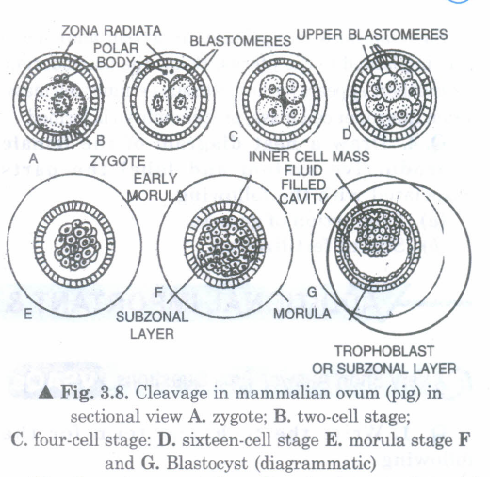
The first cleavage takes place in the cytoplasm of ovum on an imaginary axis (Animal pole to vegetal pole). The first division results into two blastomeres. One blastomere is slightly larger than the other. The larger cell divides first and thus forms the three blastomeres. Then the smaller blastomere divides and thus four blastomeres are formed. It is 4 celled stage.
2nd cleavage is at right angle to the 1st cleavage. One member of the large blastomeres of 4-cell stage divides forming 5-cell condition followed 6-7 stage ultimately 8 celled stage. Successive cleavage divisions result in the formation of solid mass of cells. Thus solid ball-like stage is called morula stage.
Conversion of morula into blastula is initiated by dynamic rearrangement of small blastomeres. A central fluid filled cavity called blastocoel (segmentation cavity) appears. Externally placed blastomeres lose their rounded form and become flat. This trophoblast along with lining of uterus forms extra-embryonic membranes. This provides protection and nourishment to the developing embryo.
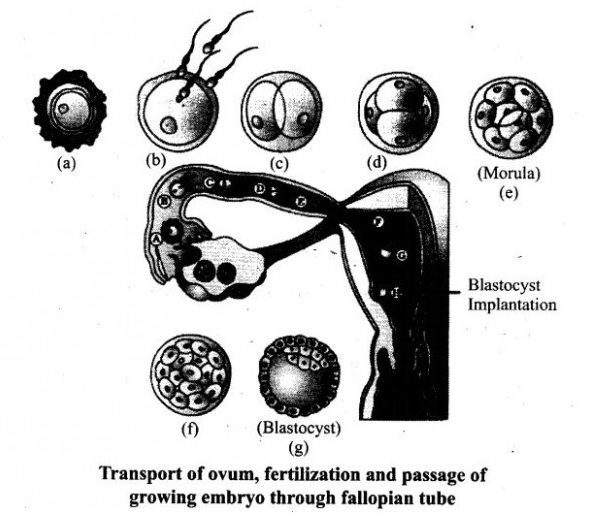
Simultaneouslyzonapellucidadisappears and embryo gets implanted to the uterus. Below the blastodermic vehicle there appears formative tissue i.e. inner cellmass. From this inner cell mass, proper embryo is formed.
25.
Hormonal Control of Menstrual Cycle.
Gonadotropin-releasing hormone (GnRH) also called Gonadotropin-releasing Factor (GnRF), is secreted by the hypothalamus of the brain, which stimulates the release of follicle-stimulating hormone (FSH) and luteinizing hormone (LH).FSH stimulates the ovarian follicles to produce oestrogens during proliferative phase.LH stimulates the corpus luteum of the ovary to secrete progesterone.
1.Menstrual phase is caused by the reduction of progesterone and oestrogens.
2.Proliferative phase is caused by the increased production of oestrogens.
3.LH causes ovulation.
LH also causes transformation of empty Graafian follicle into corpus luteum by luteinisation inside the ovary. LH also stimulates corpus luteum to secrete progesterone hormone to help in implantation, placentation and maintenance of pregnancy.
4.Secretary phase is caused by increased production of progesterone.

12th Standard CBSE Syllabus & Materials
12th Standard CBSE
CBSE 12th Computer Science Python Revision Tour I - New Previous year Question Papers Study Material - QB365 Set A
NEW12th Standard CBSE
CBSE 12th Business Studies Planning Important Questions And Answers Study Material - QB365 Set A
NEW12th Standard CBSE
CBSE 12th Business Studies Business Environment Important Questions And Answers Study Material - QB365 Set A
NEW12th Standard CBSE
CBSE 12th Business Studies Principles of Management Important Questions And Answers Study Material - QB365 Set A



NCERT Books

Syllabus

Exam Pattern

Sample Question Papers

Previous year Question Papers

Important Notes

MCQ Practice test

NCERT Exemplers

Case study Questions

Image Based Questions

Passage based Questions

HOT Questions

Value Based Questions

Model Questions Papers
NCERT ( Book Back ) Questions

Assertion and Reason
Important Questions And Answers

CBSE 12th Standard CBSE Subjects
CBSE Standards









