
 100% FREE ACCESS
12th Standard CBSE Syllabus & Materials
12th Standard CBSE
CBSE 12th Economics Government Budget and the Economy Previous year Question Papers Study Material - QB365 Set A
NEW12th Standard CBSE
CBSE 12th Computer Science Interface Python with MySQL - New Previous year Question Papers Study Material - QB365 Set A
NEW12th Standard CBSE
CBSE 12th Computer Science Database Concept - New Previous year Question Papers Study Material - QB365 Set A
NEW12th Standard CBSE
CBSE 12th Computer Science Data Communication - New Previous year Question Papers Study Material - QB365 Set A
NEW12th Standard CBSE
CBSE 12th Computer Science Data Structures - New Previous year Question Papers Study Material - QB365 Set A
NEW12th Standard CBSE
CBSE 12th Computer Science Functions - New Previous year Question Papers Study Material - QB365 Set A

Published on: 24/05/2021
QB365 Provides the updated NCERT Examplar Questions for Class 12 Biology, and also provide the detail solution for each and every ncert examplar questions , QB365 will give all kind of study materials will help to get more marks
Download CBSE Class 12th Standard CBSE Biology question papers, sample papers, important questions, and previous year solved papers in PDF format. Get free study materials, NCERT solutions, and exam preparation resources for Class 12th Standard CBSE Biology
Questions + Answers key
Take MCQ Biology Test1.
Differentiate between the following
(a) Repetitive DNA and Satellite DNA
(b) mRNA and tRNA
(c) Template strand and Coding strand
2.
Arun visited his grandfather's farm and noticed that one of the workers was introducing earthworms in the soil. He quickly rushed to his grandfather and asked him the reason. His grandfather explained him the advantages of earthworm in soil improvement.
(i) Why are earthworms also known as detritivores?
(ii) Explain fragmentation.
(iii) Name the steps in the process ofdecomposition.
(iv) What values are shown by Arun?
3.
Describe the specific action of FSH, LH, oestrogen and progesterone in the menstrual cycle.
4.
Does light factor affect the distribution of organisms? Write a brief note giving suitable examples of either plants or animals.
5.
What is genetic engineering? List the steps involved in rDNA technology.
6.
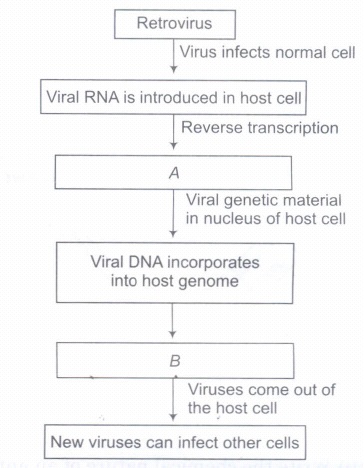
In the given flow diagram, the replication of retrovirus in a host is shown. Observe and answer the following questions.
(a) fill in (A) and (B)
b) Why is the virus called retrovirus?
(c) Can the infected cell survive, while viruses are being replicated and released?
7.
On world population day, Rohit and his friends arranged an awareness campaign on population explosion programme in their locality. Some elderly people tried to stop the children and asked them not to talk about such things in public.
The children convinced the elders about the need for the programme and on understanding their point of view, the elders also joined the campaign.
(i) Why is such awareness programme necessary?
(ii) What role has the government played in controlling population explosion?
(iii) When were reproductive health programmes initiated in India?
(iv) What values did Rohit and his friends show on the occasion?
8.
Discuss briefly the technology that made us self-sufficient in food production.
9.
(i) State the objective of animal breeding.
(ii) List the importance and limitations of inbreeding. How can the limitations be overcome?
(iii) Give an example of a new breed each of cattle nd poultry.
10.
How is 'oogenesis' markedly different from spermatogenesis with respect to the growth till puberty in the humans?
11.
Comment on the following figures 1,2 and 3 : A,B,C,D,G,P,Q,R,S are species
12.
Anil's grandfather read in the newspaper about golden rice. Being a farmer, he asked Anil to get more information from his teacher about this rice.Teacher explained to him that it is a new variety of rice which in precursor of vitamin A and his will be useful for rice eating poor population.
Read the above passage and answer the following questions:
(i) What is golden rice?
(ii) Why is it beneficial for rice eating poor population?
(iii) What values is displayed by Anil's grandfather?
13.
Hari was a grower. He used to grow tomatoes on his fertile land and got very good yields. Science the vegetable market was far from his village and also he had no transport facility, most of his harvest was rotten due to delay. He consulted his friend in a agriculture university for solution to this problem who suggested him to grow transgenic tomatoes with delayed ripening genes.
Read the above passage and answer the following questions:
(i) What are transgenics?
(ii) How are transgenic tomato produced?
What value was displayed by Hari's friend?
14.
What will happen to an ecosystem if
(a) All producers are removed.
(b) All organisms of herbivore level are eliminated and
(c) All top carnivore population is removed.
15.
"The energy flow in the ecosystem follows the second law of thermodynamics". Explain.
16.
Write a short note on pyramid of numbers and pyramid of biomass.
17.
What are three types of ecological pyramids? What information is conveyed by each pyramid with regard to structure, function and energy in the ecosystem?
18.
Which of the following ecosystem will be more productive in term of primary productivity? Justify your answer.
19.
Justify the following statement in terms of ecosystem dynamics."Nature tends to increase the gross primary productivity, while man tends to increase the gross primary productivity, while man tends to increase the net primary-productivity".
20.
Species diversity decrease as we move away from the equator towards the poles. what could be the possible reasons?
21.
Can you think of a scientific explanation, besides analogy used by paul Ehrlich, for the direct relationship between diversity and stability of an ecosystem?
22.
"Modern methods of breeding animals and plants can alleviate the global food shortage". Comment on the statement and give suitable examples.
23.
(a) The shift from grain to meat diets creates more demands for cereals. Why?
(b) A 250 kg cow produces 200 g of protein per day but 250 g of Methylophillus methylotrophus can produce 25 tonnes of protein. Name this emerging area of research. Explain its benefits.
24.
Do you justify the statutory ban on amniocentesis in our country? Give reasons.
25.
What roles does pituitary gonadotrophins play during follicular and ovulatory phases of menstrual cycle? Explain the shifts in steroidal secretions.
1.
(a) Difference between repetitive DNA and satellite DNA.
| Repetitive DNA | Satellite DNA |
| It is the non-coding DNA with multiple copies of identical sequences, which may lie in tandem or interspersed. | Refers to non-coding tandem repeat sequences. |
| These can be few base pairs to hundreds or thousands of base pairs long. |
These are generally short sequence repeats(upto 60 base pairs long) |
| In CsCI density gradient analysis, They appear as light bands. |
These appear as small dark bands. |
(b) Difference between mRNA and tRNA
| mRNA | tRNA |
| It is called messenger RNA and carries the codes for amino acid sequence. |
It is called transfer RNA as it carries amino acids to the site of protein synthesis. |
| It is a long chain of bases with large molecular weight(25-200000 Dalton). |
It is a clover-leaf like structure, with small molecular weight(25000 Dalton). |
| It is synthesised by RNA polymerase II | It is synthesised by RNA polymerase III. |
(c) Difference between Template strand and Coding strand
| Coding strand | Template strand |
| The coding strand determines the correct nucleotide sequence of mRNA. | The template strand acts as a base for mRNA transcription. |
| It is also known as sense strand (plus strand) or coding strand. | It is the antisense strand (minus strand) or a non-coding strand. |
| They do not take part in the transcription process. | Here, they take part in the transcription. They help in the formation of mRNA. |
| The coding strand is directed in the 3’ to 5’ direction. | The template strand is directed in the 5’ to 3’ direction. |
| The coding strand has a complementary nucleotide sequence. | The template strand does not have any complementary sequence. |
2.
(i) Earthworms are known as detritivores as they breakdown detritus(dead remains of plants and animals) into smaller particles. Earthworms are often called farmer's friend.
(ii) Fragmentation is the first step in the process of decomposition. It is the process by which detritivores (e.g. earthworm) breakdown detritus in smaller particles.
(iii) The steps involved in decomposition are fragmentation, leaching, catabolism, humification and mineralisation.
(iv) Arun is very alert, curious and had scientific attitude.
3.
The menstrual cycle is controlled by rhythmic synthesis and release of ovarian hormones under feedback control from the hormones of anterior pituitary. These are discussed below:
(i) Pituitary hormones The gonadotroph cells, of anterior pituitary secrete FSH and LH in females. Their role in menstrual cycle are:
(a) Follicle Stimulating Hormone (FSH) It is secreted during the follicular phase of the cycle and is responsible for follicular development on induction of LH receptors on granulosa cells of the ovary.
(b) Luteinising Hormone (LH) Its primary function is to stimulate the formation of corpus luteum and secretion of estradiol and progesterone from ovary.
(ii) Ovarian hormones Ovary secretes the following hormones under the effect of FSH and LH.
(a) Oestrogen It influences proliferation of the uterine endometrium to prepare for implantation of the fertilised oocyte.
(b) Progesterone secreted from corpus luteum under LH influence, maintains endometrium for implantation It rising level inhibits LH.
4.
Plants require sunlight for photosynthesis. Therefore, light is an important factor that affects the distribution of plants, e.g.,
(i) Many species of small plants (herbs and shrubs) growing in forests are adapted to photosynthesis optimally under very low light conditions so they are seen distributed in shady areas under tall, canopied trees.
(ii) Many plants in the shade will grow vertically to gain access to light. These plants will appear to have maller4 leafs than others of the same species of the same age found in conditions with better sunlight.
(iii) Large sized trees will be present in areas that get abundant sunlight.
(iv) Plants dependent on sunlight to meet their photoperiodic requirements of flowering, will try to be distributed in area where this requirement is being met for their reproductive success.
5.
Genetic engineering is a manipulation of genetic material in vitro. It involves the techniques to alter the chemistry of genetic material (DNA and RNA), to introduce the host organisms and thereby change the phenotype of the host organism.
Steps of rDNA technology are:
(i) Isolation of DNA.
(ii) Fragmentation of DNA by restriction endonucleases.
(iii) Isolation of the desired DNA fragments.
(iv) Amplification of the gene of interest.
(v) Ligation of the DNA fragment into the victor using DNA ligase.
(vi) Transfer of the recombinant DNA into the host.
(vii) Culturing the host cell on a suitable medium on a large scale.
(viii) Extraction of the desired product.
(ix) Downstream processing of the products as finished products.
6.
(a)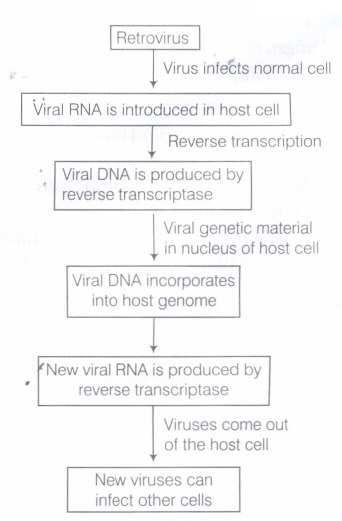
(b) The virus is called retro virus because its genetic material is RNA that is transcribed to DNA using enzyme reverse transciptase.
(c) Yes, the infected cell can survive, while viruses are being replicated and released.
7.
(i) To understand the problem faced by the family and the nation due to increasing population and the benefits of having a small family.
(ii) Role of Government in controlling population explosion are:
(a) Creating public awareness through mass media.
(b) Education at all Levels.
(c) Family planning.
(d) Increasing marriageable age (18 for girls and 21 for boys)
(iii) In India, these programmes called 'family planning' were initiated in 1951.
(iv) Rohit and his friends showed understanding about the problem of population explosion, teamwork, and motivational capacity.
8.
Plant breeding technology used in the green revolution has made us self-sufficient in food production. This has helped in the development of high yielding and disease resistant varieties in wheat, rice, maize, etc.
9.
(i) Animal breeding is a branch of animals husbandry that aims to increase the animal yield and improvement of desirable qualities of animal product.
(iii) New breed of cattle and poultry are Jersey and Leghorn respectively.
10.
Difference between spermatogenesis and oogenesis are as follows
| Spermatogenesis | Oogenesis |
| It begins and gets completed in the testis only. | It begins in the ovary and is completed in the female reproductive tract. |
| It is not a cyclic process, it occurs continuously. | It is a cyclic process, completed every 28/29 days |
| Spermatogonia change to primary spermatocytes. | Oogonia change to primary oocytes. |
| A primary spermatocyte divides to form two secondary spermatocytes. | A primary oocyte divides to form the secondary oocyte and one polar body. |
| The secondary spermatocyte divides to form two spermatids. | A secondary oocyte divides to form one ootid and one polar body. |
| A spermatogonium forms spermatozoa. | An oogonium forms one ovum. |
11.
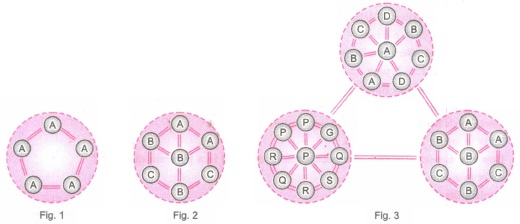
Fig 1. represents interaction between individuals of a single population.
Fig 2. represents interaction between individuals of 3species (A,B,C) in a community.
Fig 3. represents a biome having 3 communities at different stages of development
12.
(i) Golden rice is variety of rice in which rice grain has a coating of beta carotene, a precursor of vitamin A.
(ii) It is very useful for poor rice eating human population which generally suffers from vitamin A deficiency.
(iii) Being a farmer, Anil's grandfather was concerned about the latest development in agriculture and wanted to grow such varieties which provide better nutrition contents to human beings.
13.
(i) These are the organisms which contain functional foreign genes.
(ii) These are produced by experimentally introduced gene into their genome by genetic engineering from another species.
(iii) Hari's friend helped him by advising him transgenic crop having delayed ripening property.
14.
(a) Removal of all producer reduce primary production in the ecosystem. Hence, no biomass will be available to the successive/higher trophic level or heterotrophic organisms.
(b) Elimination of all organisms of herbivore level results into an increase in primary productivity and biomass of producer and the carnivorous animal will not survive due to inavailability of food due to the elimination of herbivores.
(c) Removal of top carnivores also disturbs the ecosystem as it will result in huge increase in a number of herbivores which will finish plants creating desertification.
15.
According to second law of thermodynamics every activity involving energy transformation is accomplished by dissipation of energy as heat and only a part of it is used in building up tissues in an organisms. If left to itself it will undergo randomness.
This trapped energy as biomass is transferred to next trophic level. According to Lindman law only 10% of the stored energy is passed from one trophic level to successive trophic level.
16.
(a) Removal of all producer reduce primary production in the ecosystem. Hence, no biomass will be available to the successive/higher trophic level or heterotrophic organisms.
(b) Elimination of all organisms of herbivore level results into an increase in primary productivity and biomass of producer and carnivorous animal will not survive due to availability of food due to elimination of herbivores.
(c) Removal of top carnivores also disturb the ecosystem as it will result in huge increase in number of herbivores which will finish plants (producers) creating desertification.
17.
(a) Removal of all producer reduce primary production in the ecosystem. Hence, no biomass will be available to the successive/higher trophic level or heterotrophic organisms.
(b) Elimination of all organisms of herbivore level results into an increase in primary productivity and biomass of producer and carnivorous animal will not survive due to availability of food due to elimination of herbivores.
(c) Removal of top carnivores also disturb the ecosystem as it will result in huge increase in number of herbivores which will finish plants (producers) creating desertification.
18.
Primary productivity can be defined as the rate at which primary producers (e.g. green plants) traps and store solar radiation in the form of biomass. This is measured in terms of weight (gm) and in terms of energy (kcal m²) per year in a given time.
So, primary productivity varies from ecosystem to ecosystem. The ecosystem which possesses more producers will be more productive in terms of primary productivity. The young forest is still developing it may contain fewer trees compared to the old forests. The young forests therefore will not quench the solar radiation as much as old forests. Hence, old forest is more productive as compared to foung one. The shallow polluted lake will be less productive because of less number of producers and high amount of dead organic matter.
19.
In terms of ecosystem dynamics, flow of energy takes place from one trophic level to the next trophic level in unidirectional way. About 50% of solar energy incident over earth is present in Photosynthetic Active Radiation (PAR) and 2-10% of this PAR is utilised by green plants to form chemical energy(Gross Primary Productivity) (GPP). Out of 90% of gross primary productivity is lost maximum during respiration and other vital activities. Gross Primary Productivity of an ecosystem is the rate of production of organic matter during photosynthesis. So nature tend to increase gross primary productivity through supporting the large number of plant (producers) in an ecosystem. Net Primary Productivity is the available biomass for the consumption to heterotrophs (human and animals) man tries to increase net primary productivity by cultivating food and other crops which the depend on to fulfil their needs.
20.
Species diversity decrease as we move towards the poles, because
(i) Temperature decrease and conditions become harsh.
(ii) Both the amount and intensity of solar radiation decrease.
(iii) Less resources available to support species.
Speciation is generally a function of time and environmental stability, so if condition are too harsh, it is difficult for the species to survive and adapt. this results in decrease in biodiversity towards the poles.
21.
Scientific explanation for the direct relationship between diversity and stability of an ecosystem could be as follows
If a specific plant species dies, the related insect population will be affected that would lead to unavailability of food for the birds.
In addition, if the plant species was a nitrogen fixer, the death of these plants would mean no replenishment of soil with nitrogen. This will obviously affect the other plants as well. So, if the cycle continues, the whole habitat/ecosystem will be negatively affected.
22.
(A) Role of modern methods of breeding animals:
(i) By continued inbreeding, superior genes can be accumulated and less desirable genes can be eliminated by selection. It is also used to produce pure line.
(ii) By cross-breeding, good characters of different breeds can be combined to produce high yielding hybrid animals Examples 1.Karan Swiss breed of Switzerland and Sahiwal of India and gives about 3,500 litres of milk during its lactation period of 300 days.
2. High yielding layers of fowls e.g. IBL-80; B-77 and HH-260 are also cross-breeds out of which IBL-80 and B-77 breeds produce 200 eggs while HH-260 produces 260 eggs in a year.
3. Hissardale is a high wool and meat-yielding cross breed of sheep, while mules are more sturdier and stronger interspecific hybrids produced by a cross between male donkey and female horse (mare).
(iii) Multiple Ovulation-Embryo Transfer (MOET):
(iv) Artificial Insemination
(B)Role of modern methods of plant breeding:
1. Green revolution.
2. Genetically modified crops.
23.
(a) For forming 1 kg of meat about 3-10 kg of cereal is consumed. Thus if one shifts from grain to meat, consumption of cereals will be increased.
(b) Use of SCP microbes, no doubt is emerging area of research. SCP microbes are rich in proteins.
24.
Amniocentesis is a foetal sex determination test based upon the chromosomal pattern in the amniotic fluid surrounding the developing embryo. It should be legally banned throughout the country as such a ban shall check increasing female foeticide cases and maintain a normal sex rJtio in the country.
25.
Hormonal Control of Menstrual Cycle.
Gonadotropin-releasing hormone (GnRH) also called Gonadotropin-releasing Factor (GnRF), is secreted by the hypothalamus of the brain, which stimulates the release of follicle-stimulating hormone (FSH) and luteinizing hormone (LH).FSH stimulates the ovarian follicles to produce oestrogens during proliferative phase.LH stimulates the corpus luteum of the ovary to secrete progesterone.
1.Menstrual phase is caused by the reduction of progesterone and oestrogens.
2.Proliferative phase is caused by the increased production of oestrogens.
3.LH causes ovulation.
LH also causes transformation of empty Graafian follicle into corpus luteum by luteinisation inside the ovary. LH also stimulates corpus luteum to secrete progesterone hormone to help in implantation, placentation and maintenance of pregnancy.
4.Secretary phase is caused by increased production of progesterone.

12th Standard CBSE Syllabus & Materials
12th Standard CBSE
CBSE 12th Computer Science Python Revision Tour I - New Previous year Question Papers Study Material - QB365 Set A
NEW12th Standard CBSE
CBSE 12th Business Studies Planning Important Questions And Answers Study Material - QB365 Set A
NEW12th Standard CBSE
CBSE 12th Business Studies Business Environment Important Questions And Answers Study Material - QB365 Set A
NEW12th Standard CBSE
CBSE 12th Business Studies Principles of Management Important Questions And Answers Study Material - QB365 Set A



NCERT Books

Syllabus

Exam Pattern

Sample Question Papers

Previous year Question Papers

Important Notes

MCQ Practice test

NCERT Exemplers

Case study Questions

Image Based Questions

Passage based Questions

HOT Questions

Value Based Questions

Model Questions Papers
NCERT ( Book Back ) Questions

Assertion and Reason
Important Questions And Answers

CBSE 12th Standard CBSE Subjects
CBSE Standards









