
 100% FREE ACCESS
12th Standard CBSE Syllabus & Materials
12th Standard CBSE
CBSE 12th Economics Government Budget and the Economy Previous year Question Papers Study Material - QB365 Set A
NEW12th Standard CBSE
CBSE 12th Computer Science Interface Python with MySQL - New Previous year Question Papers Study Material - QB365 Set A
NEW12th Standard CBSE
CBSE 12th Computer Science Database Concept - New Previous year Question Papers Study Material - QB365 Set A
NEW12th Standard CBSE
CBSE 12th Computer Science Data Communication - New Previous year Question Papers Study Material - QB365 Set A
NEW12th Standard CBSE
CBSE 12th Computer Science Data Structures - New Previous year Question Papers Study Material - QB365 Set A
NEW12th Standard CBSE
CBSE 12th Computer Science Functions - New Previous year Question Papers Study Material - QB365 Set A

Published on: 24/05/2021
QB365 Provides the updated NCERT Examplar Questions for Class 12 Biology, and also provide the detail solution for each and every ncert examplar questions , QB365 will give all kind of study materials will help to get more marks
Download CBSE Class 12th Standard CBSE Biology question papers, sample papers, important questions, and previous year solved papers in PDF format. Get free study materials, NCERT solutions, and exam preparation resources for Class 12th Standard CBSE Biology
Questions + Answers key
Take MCQ Biology Test1.
Describe the individuals having the following chromosomal abnormalities.
(i) Trisomy of 21st chromosome
(ii) XXX
(iii) XO
2.
Embryo sacs of some apomictic species appear normal, but contain diploid cells. Suggest a suitable explanation for the condition.
3.
Differentiate between
i) estrous and menstrual cycle
ii) oviparity and vivipary.Give an example of each type.
4.
It is often said that the pyramid of energy is always upright. On the other hand, the pyramid of biomass can be both upright and inverted. 'Explain with the help of examples and sketches.
5.
Differentiate between the following
(a) Repetitive DNA and Satellite DNA
(b) mRNA and tRNA
(c) Template strand and Coding strand
6.
Study the schematic representation of the genes involved in the lac operon given below and answer the question that follows.
| p | i | po | z | y | a |
i) Identify and name the regulatory gene in this operon .Explain its role in 'switching off' the operon.
(ii) Why is lac operon's regulation referred to as negative regulation?
(iii) Names the inducer molecule and the products of the genes 'z' and 'y' of the operon.Write the function of these gene products
(iii) Names the inducer molecule and the products of the genes 'z' and 'y' of the operon.Write the function of these gene products.
7.
Pragyan takes fruits, vegetables, bread and egg curry in a day's menu.While his teacher was giving a lecture on trophic level, he got fascinated and asked following questions from his teacher.
(i) How many trophic levels does he occupy in different food chains?
(ii) Represent atleast three food chains.
(iii) Which among them gives him the maximum amount of energy? Give reason.
(iv) What values are shown by Pragyan?
8.
(i) Describe the various steps of Griffith's experiment that led to the conclusion of the 'transforming principle'.
(ii) How did the chemical nature of the 'transforming principle'get established?
9.
Does light factor affect the distribution of organisms? Write a brief note giving suitable examples of either plants or animals.
10.
What is genetic engineering? List the steps involved in rDNA technology.
11.
Following figure shows one of the artificial plasmids constructed to act as a vector.
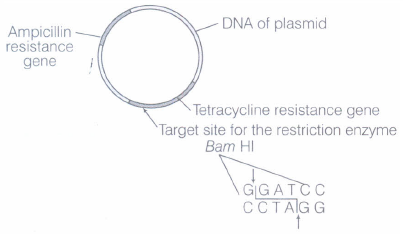
(i) With reference to above figure explain the importance of the plasmids having a single target site for a particular restriction enzyme, such as Bam HI.
(ii) The genes for ampicillin resistance and tetracycline resistance on the plasmid allow the genetic engineer to distinguish between bacteria that have taken up different circuits of DNA.
Complete the table to shoe whether bacteria which have taken up each of the different circuits of DNA are resistance to ampicillin, to tetracycline or to both. Show presence of resistance with a tick (\(\surd \)) and absence of resistance with a cross(\(\times \)).
(iii) (a) Explain why genes for antibiotic resistance are now rarely used as markers in gene technology.
(b) Describe the use of one alternative marker gene that can be used instead of an antibiotic resistance gene..
12.
Your school has been selected by the Department of Education to organize and host an interschool seminar on 'Reproductive Health problems and Practices', However, many parents are reluctant to permit their wards to attend it. Their argument is that the topic is 'too embar raddling'. Put forth four arguments with appropriate reasons and explanations to justify the topic to be very essential and timely.
13.
Comment on the following figures 1,2 and 3 : A,B,C,D,G,P,Q,R,S are species
14.
Fill in the blanks:
(i) A drug relieves pain is called_______.
(ii) Any drink which has caffeine causes_______.
(iii) ...is derived from the unripe capsules of white poppy_______.
(iv) Marijuana is obtained from_______.
(v) The intake of_______.after a normal doze of barbiturates may cause death.
(vi) L.S.D stands for_______.
(vii) The chemical named_______.present in Lophophora is hallucinogenic.
(viii) antibiotics are not effective against_______.
(ix) The first antibiotic discovered was_______.
(x) _______.is a source of sex hormones.
15.
The biodiversity increases when one moves from the pioneer to the climax stage. what could be the explanation?
16.
Give two examples of artificial or man-made ecosystems. List the salient features by which they differ from natural ecosystems.
17.
A farmer harvests his crop and expresses his harvest in three different ways:
(a) I have harvested 10 quintals of wheat.
(b) I have harvested 10 quintals of wheat today in one acre land.
(c) I have harvested 10 quintals of wheat in one acre of land, 6 months after sowing.
Do the above statements mean one and the same thing. If your answer is "Yes", give reasons. And if your answer is "No", explain the meaning of each expression.
18.
Comment on the growth curve given below.
19.
Two organisms occupying particular geographical area show similar adaptive strategies. Taking examples, describe the phenomenon.
20.
You have studied the story of Pepper moths in England. Had the industries been removed, what impact would it have on the moth population? Discuss.
21.
Do you justify the statutory ban on amniocentesis in our country? Give reasons.
22.
Discuss the mode of action and advantages/disadvantages of hormonal contraceptives.
1.
Aneuploidy is the condition used to describe a chromosomal aberration or alteration that is caused by an addition or deletion of one or a few chromosomes. It results in genetic disorders. It differs from polyploidy which is the addition of one or more complete sets of chromosome in the genome. Individuals having following chromosomal abnormalities are defmed as
(i) Trisomy of 21st chromosome It is also known as Down's syndrome. In this, a person is born with three chromosomesat 21st position rather than normal pair.
(ii) XXX It is also known as triple X-syndrome or Klinefelter's syndrome. This condition can occur only in females where they have three X-chromosomes instead of two.
(iii) XO It is also known as Turner's syndrome. It always affects the females in which one of the two chromosomes are defective or completely absent. The individuals with this syndrome are born with 45 chromosomes in each cell rather than 46.
2.
Replacement of the normal sexual reproduction by asexual reproduction without fertilisation is called apomixis, e.g. replacement of the flower by bulbils and replacement of the seed by a plant. Apomictically produced offsprings are genetically identical to the parent plant. In flowering plants, apomixis is used in a restricted sense to mean angiosperm, i.e. asexual reproduction through seeds. In some plant species, it is common, e.g. Asteraceae and Poaceae. In some species, the diploid egg cell is formed without reduction division and develops into embryo without fertilisation. It is an asexual reproduction in the absence of pollinators such as in extreme environments.
In some species like Citrus, some of the nucellar cells surrounding the embryo sac start dividing and develop into embryo. It occurs in the megaspore mother cell and does not undergo meiosis, thus produces diploid embryo sac through mitotic divisions. Thus, it explains that, embryo sacs of some apomictic species appear normal but produce diploid cells.
3.
| estrous cycle | menstrual cycle |
| the cyclic change in the activities of ovaries and accessory ducts as well as hormones during the reproductive phase of non-primate mammals is called oestrus cyclic |
The cyclic changes in the activities of ovaries and accessory ducts as well as hormones during the reproductive the phase of primate mammals is called menstrual cycle. |
| Female show strong irresistible sexual urge. |
Female do not show irresistible sexual urge. |
| There is heat production at the time of ovulation and copulation occurs only at that period. |
There is no heat period and population can occur during any time of the cycle. |
| The shedding of endometrium and bleeding does not occur e.g. cows, sheep, rats, deer, dogs, tigers, etc |
The shedding of endometrium and bleeding occur. e.g. monkeys, apes, humans, etc. |
ii) Difference between i) oviparity and ii) vivipary are as follows:
| oviparity | vivipary |
| In oviparity, female animals lay eggs. |
In vivipary, female animals give birth to young ones |
| The development of zygote takes place outside the female's body. |
The development of zygote takes place inside the female's body. |
| Female lay eggs in a safe place in the environment, but the chance of survival are less. e.g. all birds, most of the reptiles and egg laying mammals. |
Female deliver young ones and the chance of survival are more. e.g. mammals except monotremes (egg-laying mammals) |
4.
Ecological pyramids are diagrammatic illustrations of connection between different trophic levels in terms of energy, biomass and number of organisms.
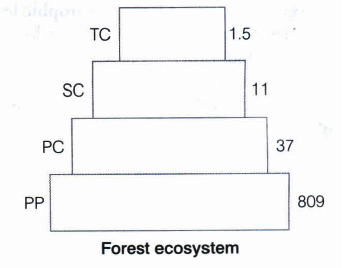
Pyramids of biomass can be both upright and inverted. This can be understood from the examples given below:
(i) The pyramid of biomass in a pond ecosystem is inverted. Because, the sum total of the weight of phytoplankton (produce) is far less than a few fishes feeding on them, at higher tropic levels.
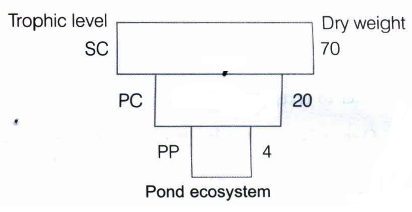
(ii) Pyramid of biomass in a forest ecosystem is upright because producers are more in biomass than primary consumers.Primary consumers are more than secondary consumers and secondary consumers are more than tertiary consumers (top). Pyramid of energy is never inverted, (i.e. it is always upright).Because, when energy flows from a particular trophic level to the next trophic level, some energy is always lost as heat at each step. Each bar in the energy pyramid indicates the amount of energy present at each trophic level in a given time.
5.
(a) Difference between repetitive DNA and satellite DNA.
| Repetitive DNA | Satellite DNA |
| It is the non-coding DNA with multiple copies of identical sequences, which may lie in tandem or interspersed. | Refers to non-coding tandem repeat sequences. |
| These can be few base pairs to hundreds or thousands of base pairs long. |
These are generally short sequence repeats(upto 60 base pairs long) |
| In CsCI density gradient analysis, They appear as light bands. |
These appear as small dark bands. |
(b) Difference between mRNA and tRNA
| mRNA | tRNA |
| It is called messenger RNA and carries the codes for amino acid sequence. |
It is called transfer RNA as it carries amino acids to the site of protein synthesis. |
| It is a long chain of bases with large molecular weight(25-200000 Dalton). |
It is a clover-leaf like structure, with small molecular weight(25000 Dalton). |
| It is synthesised by RNA polymerase II | It is synthesised by RNA polymerase III. |
(c) Difference between Template strand and Coding strand
| Coding strand | Template strand |
| The coding strand determines the correct nucleotide sequence of mRNA. | The template strand acts as a base for mRNA transcription. |
| It is also known as sense strand (plus strand) or coding strand. | It is the antisense strand (minus strand) or a non-coding strand. |
| They do not take part in the transcription process. | Here, they take part in the transcription. They help in the formation of mRNA. |
| The coding strand is directed in the 3’ to 5’ direction. | The template strand is directed in the 5’ to 3’ direction. |
| The coding strand has a complementary nucleotide sequence. | The template strand does not have any complementary sequence. |
6.
(i) Regulatory gene in this operon is as follows:
Role of regulatory gene in switching off operon is as follows:
(a) It codes for the repressor protein of the operon, which is synthesised constitutively.
(b) The repressor has affinity for the operator gene.It binds to operator and prevents the RNA polymerase from transcribing the structural genes.
(ii) When repressor binds to the operator, the operon is switched off and transcription is stopped.So it is called a negative regulation.
(iii) Lactose is an inducer molecule.
gene 'z' codes for \(\beta \)-galactosidase, which is responsible for the hydrolysis of lactose galactose and glucose.'y' gene codes for permease.It increase the permeability of the cell to lactose.
7.
(i) He occupies three trophic levels in three different food chains.
(ii) (a)Plants(vegetables) ->Pragyan
(b)Plants->Insects->Hen->Egg->Pragyan
(c)Plants->Hen->Egg->Pragyan.
(iii) Food chain (a) gives him maximum energy. This is because plants are autotrophs, i.e. they produce food through the process of photosynthesis and according to 10% law only 10% energy is passed on to next trophic level.
(iv) Pragyan is a sincere child, who possess scientific attitude towards his daily life.
8.
(ii) Griffith was not able to find the chemical nature of transforming agent.It was finally Hershey and Chase who proved that DNA is the genetic material.They proved it by using radio labelled elements, such as 35S and 32P. Radioactivity was detected in the cell which was due to the presence of 32P in DNA.
9.
Plants require sunlight for photosynthesis. Therefore, light is an important factor that affects the distribution of plants, e.g.,
(i) Many species of small plants (herbs and shrubs) growing in forests are adapted to photosynthesis optimally under very low light conditions so they are seen distributed in shady areas under tall, canopied trees.
(ii) Many plants in the shade will grow vertically to gain access to light. These plants will appear to have maller4 leafs than others of the same species of the same age found in conditions with better sunlight.
(iii) Large sized trees will be present in areas that get abundant sunlight.
(iv) Plants dependent on sunlight to meet their photoperiodic requirements of flowering, will try to be distributed in area where this requirement is being met for their reproductive success.
10.
Genetic engineering is a manipulation of genetic material in vitro. It involves the techniques to alter the chemistry of genetic material (DNA and RNA), to introduce the host organisms and thereby change the phenotype of the host organism.
Steps of rDNA technology are:
(i) Isolation of DNA.
(ii) Fragmentation of DNA by restriction endonucleases.
(iii) Isolation of the desired DNA fragments.
(iv) Amplification of the gene of interest.
(v) Ligation of the DNA fragment into the victor using DNA ligase.
(vi) Transfer of the recombinant DNA into the host.
(vii) Culturing the host cell on a suitable medium on a large scale.
(viii) Extraction of the desired product.
(ix) Downstream processing of the products as finished products.
11.
(i) Single target site is present for particular restriction enzyme. If more than one site is present, then more cuts would fragment the plasmid.
(ii)
| Circle of DNA taken up by Bacteria | Bacteria Resistant to Ampicillin | Bacteria Resistance to Tetracycline |
| Unaltered plasmids | \(\surd \) | \(\surd \) |
| Recombinant plasmids that have taken up the wanted gene | \(\surd \) | \(\times \) |
(iii) (a) Now a days antibiotic resistance gene as markers are not used as they create more risk of plasmids to resistant gene to other bacteria.
It may spread the antibiotic resistance in many bacteria.
(b) Reporter genes are used now a days instead of antibiotic resistance genes. These genes have an ability to produce color in the presence of chromogenic substrate.
12.
The arguments that can be put forward to justify the topic are:
(i) Reduce misconceptions and increase accurate knowledge Students have various wrong and inaccurate information about sex-related and pubertal issues. Accurate knowledge will help them cope up with their bodily changes and hormonal effects easily.
(ii) Clarify and strengthen positive values and attitude It is only through healthy discussions that students can realize that women are not the weaker sex because of their body structure. Such discussions will inculcate a feeling of equality amongst both sexes.
(iii) Increase communication with parents or other trusted elders These seminars open up students to consult their elders in case of confusion and doubt. It will make them understand that reproduction is a normal phenomenon and there is nothing inappropriate in discussing it with elders.
(iv) Increase the skills and thinking needed to make informed decisions and act upon them Out of curiosity, students are often seen getting involved in drug use, unhygienic and unsafe sexual activities, etc. increasing the risk of STDs and other diseases. making them well informed through such seminars well help them to take correct decisions.
13.
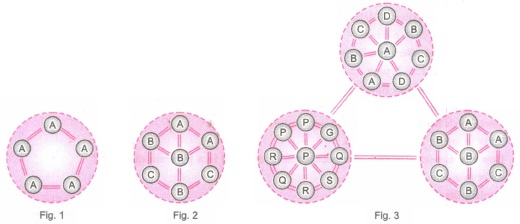
Fig 1. represents interaction between individuals of a single population.
Fig 2. represents interaction between individuals of 3species (A,B,C) in a community.
Fig 3. represents a biome having 3 communities at different stages of development
14.
(i) Analgesic;
(ii) Stimulation;
(iii) Opium
(iv) Cannabis sativa;
(v) Alcohol;
(vi) Lysergic acid diethylamide;
(vii) Mescaline;
(viiii) Viruses;
(ix) Penicillin;
(x) Chlesterol.
15.
In an ecological succession, there is a tendency towards an increase in biodiversity (i.e. species diversity) from pioneer to climax stage due to following reasons:
(i) Environmental conditions become more and less hostile.
(ii) More and more ecological niches become available.
(iii) There is a change in types of plant and animal species towards a state of stability.
(iv) There is an increase in organic matter and biomass supported by available energy.
16.
(a) Two examples of man-made ecosystems are: Gardens and parks, crop fields and fishery tanks.
(b) Salient features of man-made ecosystems:
(i) These are simple and highly efficient.
(ii) These are generally monoculture (e.g. field crops) with low biodiversity.
(iii) These are generally unstable
(iv) These are more vulnerable to sudden changes because of low biodiversity, stability and self-regulation.
17.
Three above statements do not mean one and the same thing because:
(i) Statement (a) indicates total productivity of wheat but does not indicate the extent of area.
(ii) Statement (b) indicates productivity of wheat/acre on a specific day.
(iii) Statement (c) indicates productivity of wheat/acre/specific period.
18.
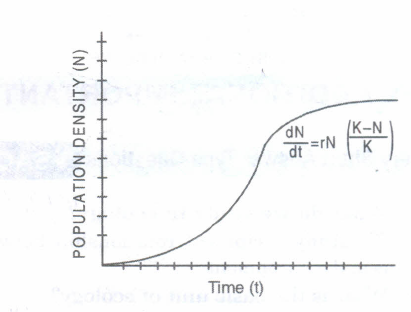
The growth curve shown aboveis logistic growth curve or S-shaped curve.
Logistic growth curve is considered more realistic because unlimited resources are not available in an ecosystem or in a habital, where
K-stands for carrying capacity.
N-indicates population density, which is the number of species of a population per unit area. r-is for intrinsic rate of natural increase.
19.
This phenomenon indicated in the questions is convergent evolution where by organisms, not closely related, evolve similar environment e.g.,
(i) Streamlined shape of sharks and dolphins. The former is a fish, while dolphin is a mammal, but both of them depend on swift movement through the water so a streamlined shape is essential. Thus, it is the similar habitat that resulted in selection of similar adaptive features in different groups of organisms, but toward the same funcion.
(ii) Spines and thorns, both look similar and provide protection to the plant, but the plants to which they belong are distantly related.
20.
In the population of pepper moth two variants exist the dark and the light coloured. Before industrialisation, the light coloured moths were covered bark of the trees.
The predators were unable to spot them and hence, their population were more in number. With industrialisation, the barks got covered with soot. The growth of lichens reduced, the light coloured moths were thus, spotted by the predators and their number decreased.
However, the black variants were camouflased better on soot covered barks and their number increased drastically.
If the industries were removed, the population of black moths would have declined because as stated before, they would not be able to camouflage against a light background. Also the growth of lichens would increase. Therefore, the dark variants would be spotted better bu predators and be eaten more frequently.
21.
Amniocentesis is a foetal sex determination test based upon the chromosomal pattern in the amniotic fluid surrounding the developing embryo. It should be legally banned throughout the country as such a ban shall check increasing female foeticide cases and maintain a normal sex rJtio in the country.
22.
(i) Mode of Action. Oestrogen inhibits ovulation by preventing FSH production.
(ii) Advantages. Hormonal contraceptives are super devices to prevent conception.
(iii) Disadvantages. They disturb the menstrual cycles.

12th Standard CBSE Syllabus & Materials
12th Standard CBSE
CBSE 12th Computer Science Python Revision Tour I - New Previous year Question Papers Study Material - QB365 Set A
NEW12th Standard CBSE
CBSE 12th Business Studies Planning Important Questions And Answers Study Material - QB365 Set A
NEW12th Standard CBSE
CBSE 12th Business Studies Business Environment Important Questions And Answers Study Material - QB365 Set A
NEW12th Standard CBSE
CBSE 12th Business Studies Principles of Management Important Questions And Answers Study Material - QB365 Set A



NCERT Books

Syllabus

Exam Pattern

Sample Question Papers

Previous year Question Papers

Important Notes

MCQ Practice test

NCERT Exemplers

Case study Questions

Image Based Questions

Passage based Questions

HOT Questions

Value Based Questions

Model Questions Papers
NCERT ( Book Back ) Questions

Assertion and Reason
Important Questions And Answers

CBSE 12th Standard CBSE Subjects
CBSE Standards









