
 100% FREE ACCESS
12th Standard CBSE Syllabus & Materials
12th Standard CBSE
CBSE 12th Economics Government Budget and the Economy Previous year Question Papers Study Material - QB365 Set A
NEW12th Standard CBSE
CBSE 12th Computer Science Interface Python with MySQL - New Previous year Question Papers Study Material - QB365 Set A
NEW12th Standard CBSE
CBSE 12th Computer Science Database Concept - New Previous year Question Papers Study Material - QB365 Set A
NEW12th Standard CBSE
CBSE 12th Computer Science Data Communication - New Previous year Question Papers Study Material - QB365 Set A
NEW12th Standard CBSE
CBSE 12th Computer Science Data Structures - New Previous year Question Papers Study Material - QB365 Set A
NEW12th Standard CBSE
CBSE 12th Computer Science Functions - New Previous year Question Papers Study Material - QB365 Set A

Published on: 25/05/2021
QB365 Provides the updated NCERT Examplar Questions for Class 12 Biology, and also provide the detail solution for each and every ncert examplar questions , QB365 will give all kind of study materials will help to get more marks
Download CBSE Class 12th Standard CBSE Biology question papers, sample papers, important questions, and previous year solved papers in PDF format. Get free study materials, NCERT solutions, and exam preparation resources for Class 12th Standard CBSE Biology
Questions + Answers key
Take MCQ Biology Test1.
What is 'predation'? Explain with the help of suitable examples why is it required in a community with rich biodiversity.
2.
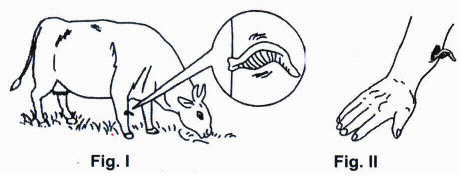
In nature, leeches attach themselves to the cow grazing in the field (shown in figure I). In some medical treatments, doctors attach leeches onto accumulation of blood (shown in figure II).
(i) State the type of interaction in figure I and II.
(ii) Under what conditions the doctors advice leech therapy?
(iii) Why are leeches used for treating patients?
3.
Why do all the fresh water organisms have contractile vacuoles whereas majority of marine organisms lack them?
4.
Why are coral reefs not found in the regions from West Bengal to Andhra Pradesh but are found in Tamil Nadu and on the East coast of India?
5.
Explain the S-shaped pattern of population growth. How is J-shaped pattern different from it and why?
6.
Study the population growth curve in the graph given below and answer the following questions.
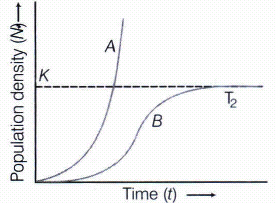
(i) Identify the growth curves 'A' and 'B'.
(ii) Which one of them is considered a more realistic one and why?
(iii) If \(\frac { dN }{ dt } =rN(\frac { K-N }{ K } )\) is the equation of the curve B, what does K stand for?
(iv) What is symbolised by N?
7.
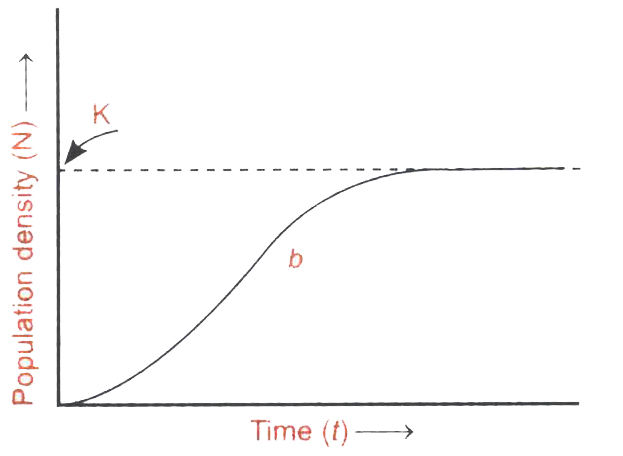
A population of paramoecium caudatum was grown in a culture medium. After 5 days, the culture medium became over-crowed wth paramoecium and had depleted nutrients. What will happen to the population and what type of growth curve will the population attain? Draw the growth curve.
8.
An individual and a population has certain characteristics. Name these attributes with definitions.
9.
Give one example for each of the following:
(a) Migratory animal
(b) Predator animal
(c) Phytophagous animals
(d) Camouflaged animal
(e) Chemical defense agent.
1.
Predation is an interaction where one organism (predator) kills and eats the other weaker organisms called prey. Predation is a natural way of transferring the energy fixed by plants, to higher trophic levels.
Examples of predation include snake eating a frog, tiger killing and eating a deer, Predators keep prey population under control which otherwise could achieve very high population densities and cause instability in ecosystem.
They also help in maintaining a species diversity in a community by reducing the intensity of competition among competing prey species.
2.
(i) The interaction in figure I parasitism (one organism is benefitted and other is harmed) and in figure II, the interaction is mutualism (both organisms are benefitted).
(ii) The doctors often use leech therapy after a microsurgery (attaching tissues and connecting thin arteries and veins). If the veins are not connected properly, excess blood can pool-blocking the entry of oxygenated blood and eventually leading to death of reattached tissue.
(iii) Leeches are used to treat such a condition due to the presence of hirudin in their saliva. Hirudin is an anticoagulant factor which prevents the blood from pooling in the reattached tissues.
3.
Contractile nacuole helps in osmoregulation. Because of hypertonic, the water diffuses inside the cell constantly and gets collected in the contractile vacuole, which squeeze the extra water out of the cell periodically. Thus, keeping the internal environmental constant. In case marine organisms, this does not occur due to hogh salinity, therefore, there is no need of contractile vacuole.
4.
Coral reefs are found in zone with salt concentration (salinity), optimal temperature and with a less siltation condition which fairly facilitate to colonise corals. Hence, are found in Talil Nadu and east coast of India. In case of high siltation and water flow, coral reef do not colonise.
5.
S-shaped pattern of population growth from shows an initial gradual increase, followed by an exponential increase and then a gradual decline to a near constant level. It is different from J-shaped curve because J-shaped pattern shows exponential population growth and its abrupt crash after attaining the peak value.
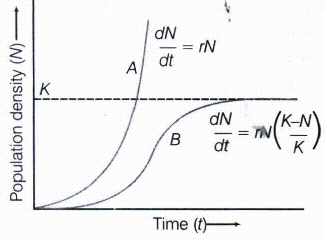
A- When resources are not limiting the growth, plot is exponential.
B- When resources are limiting the growth, plot is logistic, K is the carrying capacity.
6.
(i) A - Exponential growth curve
B- Logistic growth curve
(ii) Logistic growth B is considered more realistic one because the resources are finite and become limited sooner or later.
(iii) K stands for carrying capacity which refers to the maximum number of individuals of a population that the given environment can sustain at a given time.
(iv) N symbolise population density, i.e. the number of individuals of a species in a given population per unit area.
7.
8.
(i) An individual has birth; a population has birth rate, i.e. the number of individuals added to a population by birth/hatching per capita in a given period of time.
(ii) An individual has death; a population has death rate, i.e. the number of individuals removed from a population due to death per capita in a given period of time.
(iii) An individual is either male or female, but a population has sex ratio, i.e. the number of males: .the number of females at a given time.
9.
(a) Arctic tern
(b) Tiger/Lion
(c) Aphid
(d) Chameleon
(e) Glycosides (in Calotropis).

12th Standard CBSE Syllabus & Materials
12th Standard CBSE
CBSE 12th Computer Science Python Revision Tour I - New Previous year Question Papers Study Material - QB365 Set A
NEW12th Standard CBSE
CBSE 12th Business Studies Planning Important Questions And Answers Study Material - QB365 Set A
NEW12th Standard CBSE
CBSE 12th Business Studies Business Environment Important Questions And Answers Study Material - QB365 Set A
NEW12th Standard CBSE
CBSE 12th Business Studies Principles of Management Important Questions And Answers Study Material - QB365 Set A



NCERT Books

Syllabus

Exam Pattern

Sample Question Papers

Previous year Question Papers

Important Notes

MCQ Practice test

NCERT Exemplers

Case study Questions

Image Based Questions

Passage based Questions

HOT Questions

Value Based Questions

Model Questions Papers
NCERT ( Book Back ) Questions

Assertion and Reason
Important Questions And Answers

CBSE 12th Standard CBSE Subjects
CBSE Standards









