
 100% FREE ACCESS
12th Standard CBSE Syllabus & Materials
12th Standard CBSE
CBSE 12th Economics Government Budget and the Economy Previous year Question Papers Study Material - QB365 Set A
NEW12th Standard CBSE
CBSE 12th Computer Science Interface Python with MySQL - New Previous year Question Papers Study Material - QB365 Set A
NEW12th Standard CBSE
CBSE 12th Computer Science Database Concept - New Previous year Question Papers Study Material - QB365 Set A
NEW12th Standard CBSE
CBSE 12th Computer Science Data Communication - New Previous year Question Papers Study Material - QB365 Set A
NEW12th Standard CBSE
CBSE 12th Computer Science Data Structures - New Previous year Question Papers Study Material - QB365 Set A
NEW12th Standard CBSE
CBSE 12th Computer Science Functions - New Previous year Question Papers Study Material - QB365 Set A

Published on: 25/05/2021
QB365 Provides the updated NCERT Examplar Questions for Class 12 Biology, and also provide the detail solution for each and every ncert examplar questions , QB365 will give all kind of study materials will help to get more marks
Download CBSE Class 12th Standard CBSE Biology question papers, sample papers, important questions, and previous year solved papers in PDF format. Get free study materials, NCERT solutions, and exam preparation resources for Class 12th Standard CBSE Biology
Questions + Answers key
Take MCQ Biology Test1.
In Lake Tanganyika in Africa, there are six species of fish of the genus Tropheus and a much larger number of distinctly coloured subspecies of each of the six species. Tropheus species are small fishes that are confined to isolated rocky habitats around the shores of Lake Tanganyika.

Recent research has compared DNA sequence data from these various species and subspecies and linked this with geological data on the lake. This suggests that some 1.25 million years ago, when the lake first filled, the six species evolved during the primary radiation phase. They arose from river dwelling ancestors and then filled all available niches. Secondary radiations into the many subspecies occurred during the last 2,00,000 years.
Sometime during this period, the water level in the lake fell, resulting in the formation of three separate lake basins. These basins persisted for level rose again.
Figure shown above is an outline map of the lake and the location of the three temporary basins caused by lowering of lake levels.
(i) Define the terms
(a) species
(b) niche
(ii) Explain how natural selection could have caused the evolution of the six closely related species in the primary radiation.
2.
What is 'predation'? Explain with the help of suitable examples why is it required in a community with rich biodiversity.
3.
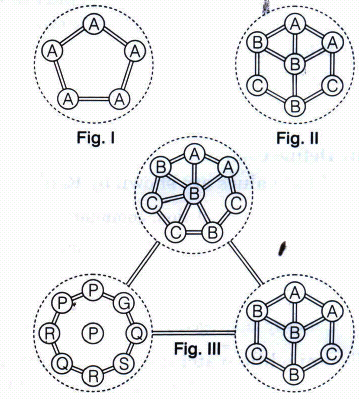
Comment on the following figures: I, II and III. In these, A,B,C,D,G,P,Q,R,S are different species.
4.
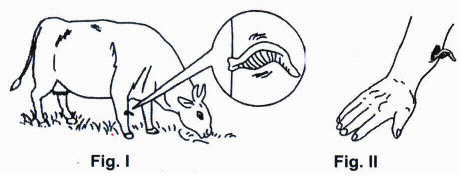
In nature, leeches attach themselves to the cow grazing in the field (shown in figure I). In some medical treatments, doctors attach leeches onto accumulation of blood (shown in figure II).
(i) State the type of interaction in figure I and II.
(ii) Under what conditions the doctors advice leech therapy?
(iii) Why are leeches used for treating patients?
5.
Why do all the fresh water organisms have contractile vacuoles whereas majority of marine organisms lack them?
6.
Why are coral reefs not found in the regions from West Bengal to Andhra Pradesh but are found in Tamil Nadu and on the East coast of India?
7.
Explain the S-shaped pattern of population growth. How is J-shaped pattern different from it and why?
8.
Give one example for each of the following:
(a) Migratory animal
(b) Predator animal
(c) Phytophagous animals
(d) Camouflaged animal
(e) Chemical defense agent.
1.
(i) (a) Species A group of specific organisms with similar characteristics which are capable of compatible interbreeding to produce fertile offsprings
(b) Niche The way in which an organism functions in relation to the biotic and abiotic factors within its habitat that serves a purpose in its environment.
(ii) Increased selection pressure due to climatic or habitat change cause organisms to become specialised and have the optimum phenotype that is suited to the prevailing environment condition.
In the primary radiation, the six closely related species evolved as a result of the increasing water levels when the lake first filled. This change in the environment exerted a selection pressure on their river dwelling ancestors to adapt by developing different characteristics for survival, thus giving rise to the six species that could occupy more niches.
2.
Predation is an interaction where one organism (predator) kills and eats the other weaker organisms called prey. Predation is a natural way of transferring the energy fixed by plants, to higher trophic levels.
Examples of predation include snake eating a frog, tiger killing and eating a deer, Predators keep prey population under control which otherwise could achieve very high population densities and cause instability in ecosystem.
They also help in maintaining a species diversity in a community by reducing the intensity of competition among competing prey species.
3.
Figure I It is single population and all individuals are of the same species, i.e. all individuals interact among themselves and their environment in an intraspecific interaction.
Figure II It is a community and it contains three populations of species A,B and C. They interact with each other and their environment in as interspecific interaction.
Figure III It is a biome. It contains three communities of which one is in climax and other two are in different stages of development. All three communities are in the same environment and they interact with each other and their environment.
4.
(i) The interaction in figure I parasitism (one organism is benefitted and other is harmed) and in figure II, the interaction is mutualism (both organisms are benefitted).
(ii) The doctors often use leech therapy after a microsurgery (attaching tissues and connecting thin arteries and veins). If the veins are not connected properly, excess blood can pool-blocking the entry of oxygenated blood and eventually leading to death of reattached tissue.
(iii) Leeches are used to treat such a condition due to the presence of hirudin in their saliva. Hirudin is an anticoagulant factor which prevents the blood from pooling in the reattached tissues.
5.
Contractile nacuole helps in osmoregulation. Because of hypertonic, the water diffuses inside the cell constantly and gets collected in the contractile vacuole, which squeeze the extra water out of the cell periodically. Thus, keeping the internal environmental constant. In case marine organisms, this does not occur due to hogh salinity, therefore, there is no need of contractile vacuole.
6.
Coral reefs are found in zone with salt concentration (salinity), optimal temperature and with a less siltation condition which fairly facilitate to colonise corals. Hence, are found in Talil Nadu and east coast of India. In case of high siltation and water flow, coral reef do not colonise.
7.
S-shaped pattern of population growth from shows an initial gradual increase, followed by an exponential increase and then a gradual decline to a near constant level. It is different from J-shaped curve because J-shaped pattern shows exponential population growth and its abrupt crash after attaining the peak value.
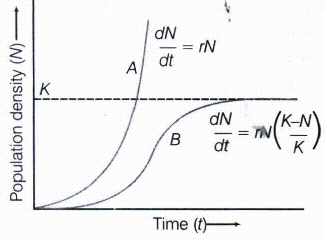
A- When resources are not limiting the growth, plot is exponential.
B- When resources are limiting the growth, plot is logistic, K is the carrying capacity.
8.
(a) Arctic tern
(b) Tiger/Lion
(c) Aphid
(d) Chameleon
(e) Glycosides (in Calotropis).

12th Standard CBSE Syllabus & Materials
12th Standard CBSE
CBSE 12th Computer Science Python Revision Tour I - New Previous year Question Papers Study Material - QB365 Set A
NEW12th Standard CBSE
CBSE 12th Business Studies Planning Important Questions And Answers Study Material - QB365 Set A
NEW12th Standard CBSE
CBSE 12th Business Studies Business Environment Important Questions And Answers Study Material - QB365 Set A
NEW12th Standard CBSE
CBSE 12th Business Studies Principles of Management Important Questions And Answers Study Material - QB365 Set A



NCERT Books

Syllabus

Exam Pattern

Sample Question Papers

Previous year Question Papers

Important Notes

MCQ Practice test

NCERT Exemplers

Case study Questions

Image Based Questions

Passage based Questions

HOT Questions

Value Based Questions

Model Questions Papers
NCERT ( Book Back ) Questions

Assertion and Reason
Important Questions And Answers

CBSE 12th Standard CBSE Subjects
CBSE Standards









