
 100% FREE ACCESS
12th Standard CBSE Syllabus & Materials
12th Standard CBSE
CBSE 12th Economics Government Budget and the Economy Previous year Question Papers Study Material - QB365 Set A
NEW12th Standard CBSE
CBSE 12th Computer Science Interface Python with MySQL - New Previous year Question Papers Study Material - QB365 Set A
NEW12th Standard CBSE
CBSE 12th Computer Science Database Concept - New Previous year Question Papers Study Material - QB365 Set A
NEW12th Standard CBSE
CBSE 12th Computer Science Data Communication - New Previous year Question Papers Study Material - QB365 Set A
NEW12th Standard CBSE
CBSE 12th Computer Science Data Structures - New Previous year Question Papers Study Material - QB365 Set A
NEW12th Standard CBSE
CBSE 12th Computer Science Functions - New Previous year Question Papers Study Material - QB365 Set A

Published on: 28/05/2021
QB365 Provides the HOT Question Papers for Class 12 Biology, and also provide the detail solution for each and every HOT Questions. HOT Questions will help to get more idea about question pattern in every exams and also will help to get more marks in Exams
Download CBSE Class 12th Standard CBSE Biology question papers, sample papers, important questions, and previous year solved papers in PDF format. Get free study materials, NCERT solutions, and exam preparation resources for Class 12th Standard CBSE Biology
Questions + Answers key
Take MCQ Biology Test1.
A relevant portion of \(\beta\)-chain of haemoglobin of a normal human is given below:
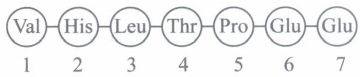
The codon for the sixth amino acid is GAG. The sixth codon GAG mutates to GAA as a result of mutation 'A' and to GUG as a result of mutation 'B'. Haemoglobin structure did not change as a result of mutation' A', whereas haemoglobin structure changed because of mutation 'B', leading to sickle-shaped RBCs. Explain giving reasons how could mutation 'B' change the haemoglobin structure or bring down mutation and not mutation 'A'.
2.
When a tall pea plant was selfed, it produced onefourth of its progeny as dwarf. Explain with the help of a cross.
3.
What is the method of finding the genotype of an organism exhibiting a dominant phenotype trait ? Explain.
4.
The distance between the two strands of DNA is maintained constant ? How it is maintained ?
5.
How do biologists use cross over frequencies to map genes on chromosomes?
6.
The pedigree chart given below shows a particular trait which is absent in parents but present in the next generation irrespective of sexes.
Draw your conclusion on the basis of the pedigree.

7.
Why does the son of a carrier mother and a normal father suffer from haemophilia, whereas the son of a haemophilic father and a normal mother would not?
8.
Not all characters show true dominance what are the two other possible types of dominance? Give an example of each type.
9.
Inheritance is particulate in nature. Justify.
10.
In a cross between two tall pea plants, some of the offspring produced were dwarf. Show with the help of a Punnet square, how this is possible.
1.
1. In mutation A, the change in the codon GAG to GAA does not change the amino acid coded, i.e. both GAG and GAA code for amino acid glutamic acid; hence, there is no change in the haemoglobin structure.
2.In mutation B, the codon GAG is changed to GUG, where GUG codes for valine, while the original codon GAG codes for glutamic acid; hence, there is a change in the haemoglobin structure and it leads to sickle-cell anaemia.
2.
Since dwarfness (recessive trait) has appeared in the progeny, the tall pea plant must be heterozygous for tallness, i.e. its genotype is Tt
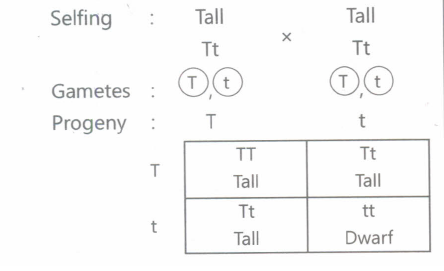
1.The phenotypic ratio is 3 Tall : 1 dwarf.
2.Since tallness is dominant over dwarfness, the homozygotes (TT) as well as the heterozygotes (Tt) are tall.
3.The recessive trait is expressed only under homozygous condition (tt) and hence appears only in one-fourth of the progeny.
3.
Test cross.In the cross ,if the individual is homozygous dominant, all terozygous, the progeny the individuals in the progeny will be dominant. If the individual is will show both he and recessive trait in the ratio of 1:1dominant.
4.
By base pairing between the two strands that is adenine with thymine with two hydrogen bond and guanine with cytosine with 3 hydrogen bond.
5.
The father genes are on a chromosome, the more frequently they will cross over. By comparison, the more frequently they will cross over.By comparison, genes that are close together on a chromosome, are less likely to be separated. The analysis of how often the traits appear together helps to establish linkage map, which shows the relative positions of genes on chromosomes.
6.
It is an autosomal recessive trait that is not found in the parents, but has appeared irrespective of sex in the offspring. It this case, both the parents are heterozygous for the trait.
7.
1.The gene for haemophilia is present in the X-chromosome.
2.The son receives the X-chromosome from his mother; so a carrier-mother passeson the disease to 50% of her sons.
3. When the mother is normal, the sons .have no chance of getting the disease, even if the father is haemophilic, because father passes on the Y-chromosome to his sons.
8.
The other possible types of dominance are:
(i) Incomplete dominace.
e.g. Flower colour in snapdragon.
(ii) Codominance.
e.g. Blood group AB.
9.
1. The characters are controlled by 'Factors' which are stably passed down without any change from the parents to the offspring, through the gametes.
2. The allels do not show any blending.
10.
Since dwarfness (recessive trait) has appeared in the progeny, the tall pea plant must be heterozygous for tallness, i.e. its genotype is Tt
The phenotypic ratio is 3 Tall : 1 dwarf.
Since tallness is dominant over dwarfness, the homozygotes (TT) as well as the heterozygotes (Tt) are tall.
The recessive trait is expressed only under homozygous condition (tt) and hence appears only in one-fourth of the progeny.

12th Standard CBSE Syllabus & Materials
12th Standard CBSE
CBSE 12th Computer Science Python Revision Tour I - New Previous year Question Papers Study Material - QB365 Set A
NEW12th Standard CBSE
CBSE 12th Business Studies Planning Important Questions And Answers Study Material - QB365 Set A
NEW12th Standard CBSE
CBSE 12th Business Studies Business Environment Important Questions And Answers Study Material - QB365 Set A
NEW12th Standard CBSE
CBSE 12th Business Studies Principles of Management Important Questions And Answers Study Material - QB365 Set A



NCERT Books

Syllabus

Exam Pattern

Sample Question Papers

Previous year Question Papers

Important Notes

MCQ Practice test

NCERT Exemplers

Case study Questions

Image Based Questions

Passage based Questions

HOT Questions

Value Based Questions

Model Questions Papers
NCERT ( Book Back ) Questions

Assertion and Reason
Important Questions And Answers

CBSE 12th Standard CBSE Subjects
CBSE Standards









