
 100% FREE ACCESS
12th Standard CBSE Syllabus & Materials
12th Standard CBSE
CBSE 12th Economics Government Budget and the Economy Previous year Question Papers Study Material - QB365 Set A
NEW12th Standard CBSE
CBSE 12th Computer Science Interface Python with MySQL - New Previous year Question Papers Study Material - QB365 Set A
NEW12th Standard CBSE
CBSE 12th Computer Science Database Concept - New Previous year Question Papers Study Material - QB365 Set A
NEW12th Standard CBSE
CBSE 12th Computer Science Data Communication - New Previous year Question Papers Study Material - QB365 Set A
NEW12th Standard CBSE
CBSE 12th Computer Science Data Structures - New Previous year Question Papers Study Material - QB365 Set A
NEW12th Standard CBSE
CBSE 12th Computer Science Functions - New Previous year Question Papers Study Material - QB365 Set A

Published on: 28/05/2021
QB365 Provides the HOT Question Papers for Class 12 Biology, and also provide the detail solution for each and every HOT Questions. HOT Questions will help to get more idea about question pattern in every exams and also will help to get more marks in Exams
Download CBSE Class 12th Standard CBSE Biology question papers, sample papers, important questions, and previous year solved papers in PDF format. Get free study materials, NCERT solutions, and exam preparation resources for Class 12th Standard CBSE Biology
Questions + Answers key
Take MCQ Biology Test1.
It is observed that gametes of both haploid and diploid parents are haploid thousand times the number of female gametes. What is the reason behind it?
2.
In angiosperms, the pollen germinates to produce pollen tube that carries two gametes.What is the purpose if carrying two gametes when single gamete can fertilize the egg?
3.
What will you do to convert a bisexual flower into a female flower so that it is cross-pollinated artificially by the pollens of some other plant?
4.
Which one is advance- external fertilization or internal fertilization? Give reasons in support of your answer.
5.
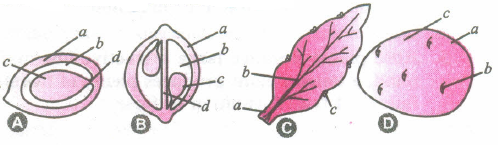
In the following figures label the parts responsible for production of new plants
6.
Ramesh tried to propagate sugarcane vegetatively by sowing a segment of stem having internodal region only. Suresh tried the same by sowing a segment having an internode. Who chose the correct segment and why?
7.
Select out any four animals to demonstrate examples of bisexual organism:
Frog, Earthworm, Cockroach, Spider, Sponge, tapeworm, leech, honey, bee, Rat, Rabbit, House fly.
8.
A gardener grafted a scion of "Dashahari" mango twig to the stock of Zea mays. He took all precautions during the grafting process but failed to get positive results as the grafting was not successful. Give the possible reason.
9.
In an experiment, Mr. Jhon dissected a large potato tuber into serval small pieces and then placed each piece in a separate pot for germination. After few days, he observed that a few pieces germinated and developed new plants. The others did not germinate at all. Give the possible reasons.
10.
Although potato tuber is an underground plant part, it is considered as a stem. Give two reasons.
1.
The type of cell division during gamete formation in haploid parents is mitotic and that in diploid parents is meiosis
2.
Angiosperms perform double fertilization in which one male gamete fuses with the egg to form zygote and the other gamete fuses with diploid secondary nucleus to form the triploid primary endosperm nucleus.
3.
Bisexual flower possesses both stamens and the pistil. The stamens are the male reproductive organs which must be removed in order to get the flower converted into female. Stamens are removed one after the other with the help of a pair of foreceps. This is done in the bud condition of a flower and then the pistil is protected till maturity for pollination with desired pollen grains.
4.
External fertilization is primitive and internal fertilization is advance. External fertilization is not advanced because it occurs outside the body of the organisms, mostly in water in most aquatic organisms so that a large number of gametes are wasted. Moreover, the offsprings are not protected from predators and their survival threatened.
5.
(A) c is a seed that produces new plant.
(B) c is a seed that produces new plant.
(C) c is an adventitious bud that produces a new plant.
(D) b is an eye that has a bud.
6.
Suresh has chosen the correct of sugarcane stem. It is because the bud formation takes place at the node of the stem.
7.
Earthworm, Sponge, Tapeworm, Leech.
8.
Gardener did a mistake by selecting a monocotyledonous stock for grafting a dicotyledonous scion. Usually grafting is between two dicotyledonous plants where cambium develops at the place of grafting.
9.
Potato tubers eyes which are infact dormant buds protected by small bracts. These buds germinate to give new plants. In the experiment performed by Mr. Jhon, the pieces which possessed eyes germinated and those without eyes did not germinate.
10.
(i) The tuber has nodes and internodes.
(ii) Leafy shoots appear from the nodes.

12th Standard CBSE Syllabus & Materials
12th Standard CBSE
CBSE 12th Computer Science Python Revision Tour I - New Previous year Question Papers Study Material - QB365 Set A
NEW12th Standard CBSE
CBSE 12th Business Studies Planning Important Questions And Answers Study Material - QB365 Set A
NEW12th Standard CBSE
CBSE 12th Business Studies Business Environment Important Questions And Answers Study Material - QB365 Set A
NEW12th Standard CBSE
CBSE 12th Business Studies Principles of Management Important Questions And Answers Study Material - QB365 Set A



NCERT Books

Syllabus

Exam Pattern

Sample Question Papers

Previous year Question Papers

Important Notes

MCQ Practice test

NCERT Exemplers

Case study Questions

Image Based Questions

Passage based Questions

HOT Questions

Value Based Questions

Model Questions Papers
NCERT ( Book Back ) Questions

Assertion and Reason
Important Questions And Answers

CBSE 12th Standard CBSE Subjects
CBSE Standards









