
 100% FREE ACCESS
12th Standard CBSE Syllabus & Materials
12th Standard CBSE
CBSE 12th Economics Government Budget and the Economy Previous year Question Papers Study Material - QB365 Set A
NEW12th Standard CBSE
CBSE 12th Computer Science Interface Python with MySQL - New Previous year Question Papers Study Material - QB365 Set A
NEW12th Standard CBSE
CBSE 12th Computer Science Database Concept - New Previous year Question Papers Study Material - QB365 Set A
NEW12th Standard CBSE
CBSE 12th Computer Science Data Communication - New Previous year Question Papers Study Material - QB365 Set A
NEW12th Standard CBSE
CBSE 12th Computer Science Data Structures - New Previous year Question Papers Study Material - QB365 Set A
NEW12th Standard CBSE
CBSE 12th Computer Science Functions - New Previous year Question Papers Study Material - QB365 Set A

Published on: 21/05/2021
QB365 Provides the updated CASE Study Questions for Class 12 Biology, and also provide the detail solution for each and every case study questions . Case study questions are latest updated question pattern from NCERT, QB365 will helps to get more marks in Exams
Download CBSE Class 12th Standard CBSE Biology question papers, sample papers, important questions, and previous year solved papers in PDF format. Get free study materials, NCERT solutions, and exam preparation resources for Class 12th Standard CBSE Biology
Questions + Answers key
Take MCQ Biology Test
1.
Read the following and answer any four questions from (i) to (v) given below:
A woman unable to conceive after many years of regular unprotected coitus went to specialised infertility clinic. On complete examination, woman was found to be normal while male partner was diagnosed with infertility. Male partner is unable to copulate the female. Couple was advised to opt for assisted reproductive technology (ART).
(i) Which ART could have been useful for this couple?
| (a) ZIFT | (b) IUT | (c) AI | (d) GIFT |
(ii) In which of the following infertility issues could this technique be used?
| (a) Anovulation | (b) Oligospermia | (c) Low fructose content in seminal fluid | (d) All of these |
(iii) Which among the following techniques is useful to conceive when there is very low sperm count?
| (a) GIFT | (b) Test-tube baby | (c) IUT | (d) ICSI |
(iv) Assertion: Artificial insemination (AI) is intra-uterine insemination.
Reason: In AI, sperms collected from donor are introduced into the uterus.
| (a) Both assertion and reason are true and reason is the correct explanation of assertion | (b) Both assertion and reason are true but reason is not the correct explanation of assertion |
| (c) Assertion is true but reason is false | (d) Both assertion and reason are false |
(v) Success rate of artificial insemination technique is
| (a) 20-40% | (b) 60-70% | (c) 40-50% | (d) 5-7%. |
2.
Read the following and answer any four questions from (i) to (v) given below:
Population is defined as the total number of individuals of a species present in a particular area at a given time. The scientific study of human population is called demography. The rapid increase in population over a relatively short period is called population explosion. Four basic processes are involved in increase or decrease in the population size. Population shows two types of growth; exponential and logistic.
(i) Which of the following factors are responsible for population explosion?
A. Decrease in number of people of reproducible age
B. Decline in infant mortality rate
C. Increase in maternal mortality rate
D. Rapid decline in death rate
| (a) A and B | (b) Band C | (c) B and D | (d) A and D |
(ii) What is the shape of curve showing logistic growth?
| (a) Sigmoid | (b) J-shape | (c) Linear | (d) Hyperbola |
(iii) What is immigration?
| (a) Number of individuals of the population who left the habitat. | (b) Number of individuals that have come into the habitat. |
| (c) Number of individuals of a species per unit area at given time. | (d) Number of births per 1000 individuals. |
(iv) Equation of Verhulst-Pearl logistic growth is
| (a) \(\frac{d N}{d t}=r N\) | (b) \(\frac{d N}{d t}=\frac{K-N}{k}\) | (c) \(\frac{d N}{d t}=r N\left(\frac{K-N}{K}\right)\) | (d) \(\frac{d N}{d t}=\left(1-\frac{N}{K}\right) r\) |
(v) Which of the following contributes to decrease in population?
| (a) Fertility | (b) Natality | (c) Social mobility | (d) Emigration |
3.
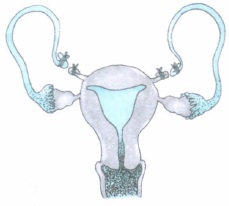
The surgical method of contraception in human females is shown above.
Answer the following questions.
(a) Give the technical term for the process shown above.
(b) How is the process carried out?
(c) What is the principle behind it as a method of contraception?
4.
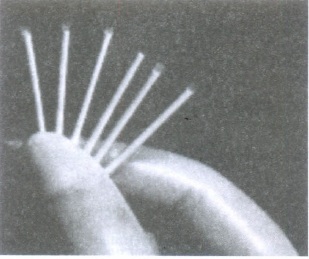
(a) Identify the contraceptive device shown in the picture.
(b) What does it contain and how is it used?
(c) How does it function as a contraceptive?
5.
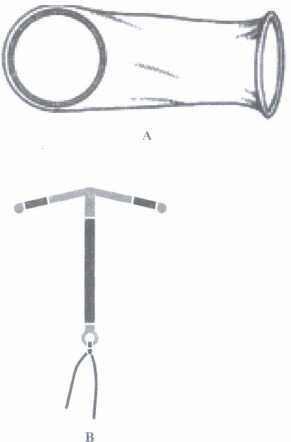
The picture shows two different contraceptive devices, used by human females.
(a) Identify A and B.
(b) Mention how each ofthem prevents fertilisation and conception.
1.
(i) (c) : Artificial Insemination (AI) is done in infertility cases either due to inability of male partner to copulate the female or due to very low sperm count in the semen of male partner.
(ii) (b) : Oligospermia is very low sperm count.
(iii) (d): ICSI is intra cytoplasmic sperm injection.
(iv) (a)
(v) (a)
2.
(i) (c) : A rapid decline in death rate, maternal mortality rate, infant mortality rate and an increase in number of of people in reproducible age are reasons for population explosion.
(ii) (a) : Logistic growth shows S-shaped or sigmoid growth curve.
(iii) (b) :
(iv) (c) :
(v) (d) : Emigration is the number of individuals of the population who left the habitat.
3.
(a) It is tubectomy.
(b) In this method, a small part of the fallopian tube is removed or tied up through a small incision in the abdomen or through the vagina.
(c) The surgical intervention blocks the transport of gametes and thus prevents fertilisation.
4.
(a) Implants.
(b) (i) It contains progestogens or a combination of estrogens and progestogens.
(ii) It is placed under the skin (implant).
(c) It functions as a contraceptive by
(i) inhibiting ovulation and implantation.
(ii) altering the quality of cervical mucus to prevent or retard the entry of sperms.
5.
(a) A - Condom; B - Copper T
(b) (i) A is a barrier that prevents the entry of sperms (semen) into the reproductive tract and prevents meeting of sperm and ovum for fertilisation.
(ii) The Cu2+ released by B suppress sperm motility and thereby the fertilising capacity of sperms.

12th Standard CBSE Syllabus & Materials
12th Standard CBSE
CBSE 12th Computer Science Python Revision Tour I - New Previous year Question Papers Study Material - QB365 Set A
NEW12th Standard CBSE
CBSE 12th Business Studies Planning Important Questions And Answers Study Material - QB365 Set A
NEW12th Standard CBSE
CBSE 12th Business Studies Business Environment Important Questions And Answers Study Material - QB365 Set A
NEW12th Standard CBSE
CBSE 12th Business Studies Principles of Management Important Questions And Answers Study Material - QB365 Set A



NCERT Books

Syllabus

Exam Pattern

Sample Question Papers

Previous year Question Papers

Important Notes

MCQ Practice test

NCERT Exemplers

Case study Questions

Image Based Questions

Passage based Questions

HOT Questions

Value Based Questions

Model Questions Papers
NCERT ( Book Back ) Questions

Assertion and Reason
Important Questions And Answers

CBSE 12th Standard CBSE Subjects
CBSE Standards








