
 100% FREE ACCESS
12th Standard CBSE Syllabus & Materials
12th Standard CBSE
CBSE 12th Economics Government Budget and the Economy Previous year Question Papers Study Material - QB365 Set A
NEW12th Standard CBSE
CBSE 12th Computer Science Interface Python with MySQL - New Previous year Question Papers Study Material - QB365 Set A
NEW12th Standard CBSE
CBSE 12th Computer Science Database Concept - New Previous year Question Papers Study Material - QB365 Set A
NEW12th Standard CBSE
CBSE 12th Computer Science Data Communication - New Previous year Question Papers Study Material - QB365 Set A
NEW12th Standard CBSE
CBSE 12th Computer Science Data Structures - New Previous year Question Papers Study Material - QB365 Set A
NEW12th Standard CBSE
CBSE 12th Computer Science Functions - New Previous year Question Papers Study Material - QB365 Set A

Published on: 21/05/2021
QB365 Provides the updated CASE Study Questions for Class 12 Biology, and also provide the detail solution for each and every case study questions . Case study questions are latest updated question pattern from NCERT, QB365 will helps to get more marks in Exams
Download CBSE Class 12th Standard CBSE Biology question papers, sample papers, important questions, and previous year solved papers in PDF format. Get free study materials, NCERT solutions, and exam preparation resources for Class 12th Standard CBSE Biology
Questions + Answers key
Take MCQ Biology Test
1.
Read the following and answer any four questions from (v) to (v) given below:
A typical angiospermic ovule is a small structure attached to the placenta by means of a stalk called funicle. The body of the ovule fuses with funicle in the region called hilum. Each ovule has one or two protective envelopes called integuments. Integuments encircle the nucellus except at the tip where a small opening called the micropyle is formed. Mature ovules are classified on the basis of funiculus. It can be orthotropous, anatropous, hemitropous, campylotropous, etc.
(i) The body of the ovule consists of a mass of parenchymatous cells called
| (a) integuments | (b) nucellus | (c) hilum | (d) funiculus |
(ii) Refer to the given figure and select the correct statement regarding it.
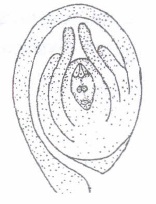
(a) This type of ovule is found in cactus.
(b) The micropyle comes to lie close to the funiculus due to unilateral growth of ovule.
(c) It is most common type of ovule found in the members of Chenopodiaceae
(d) It is half inverted ovule.
(iii) Identify the parts labelled as A, B, Cand D in the given figure and select the correct option
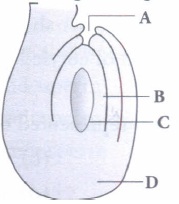
| A | B | C | D |
| (a) Chalaza | Female gametophyte | Embryo sac | Micropyle |
| (b) Chalaza | Nucellus | Embryo sac | Micropyle |
| (c) Micropyle | Egg | Embryo sac | Chalaza |
| (d) Micropyle | Nucellus | Embryo sac | Chalaza |
(iv) Mature ovules are classified on the basis of funiculus. If micropyle lie close to the funiculus, the ovule is termed as
| (a) orthotropous | (b) anatropous | (c) hemitropous | (d) campylotropous |
(v) In Asphodelus, ovule is
| (a) unitegmic | (b) tritegmic | (c) bitegmic | (d) ategmic |
2.
Read the following and answer any four questions from (i) to (v) given below:
Apomixis is a mode of reproduction which does not involve formation of zygote through gametic fusion. In plants, apomixis commonly mimics sexual reproduction but produces seeds without fertilisation. There are several methods of apomictic development in seeds. The two common ones are recurrent agamospermy and adventive embryony.
(i) Apomixis is a type of reproduction in plants in which
(a) fertilisation does not take place
(b) male nucleus takes part in fertilisation
(c) pollen fusion takes place
(d) generative nucleus takes part in fertilisation
(ii) Which of the following statements is incorrect regarding recurrent agamospermy?
(a) It is the formation of seed that has an embryo formed without meiosis and syngamy
(b) All the cells of embryo sac are diploid.
(c) An embryo develops directly from a diploid cell other than egg like that of nucleus and integument
(d) None of these
(iii) Adventive embryony is found in
| (a) Citrus | (b) Opuntia | (c) Apple | (d) Both (a) and (b). |
(iv) Formation of embryo directly from diploid egg without fertilisation is called
| (a) apospory | (b) diplospory | (c) polyembryony | (d) diploid parthenogenesis |
(v) If any somatic cell of sporophyte produces gametophyte without reduction division, it is called
| (a) parthenogenesis | (b) apogamy | (c) apospory | (d) amphimixis |
3.
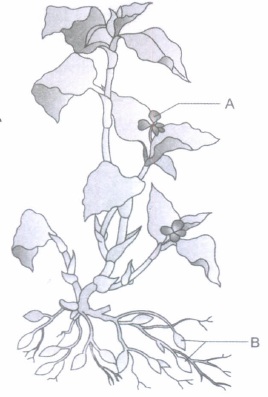
Identify the types of flowers A and B on the Commelina plant shown above.
(b) Mention the type(s) of pollination that can occur in each of them.
4.
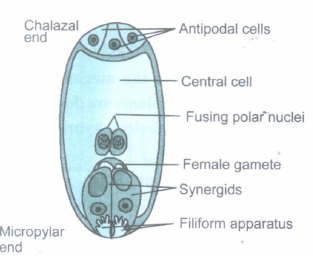
A fully developed embryo sac
A fully-developed and mature embryo sac is shown above.
(a) Name the cell from which it has developed.
(b) What is the ploidy level of its nuclei?
(c) What is filiform apparatus? Mention its significance.
5.
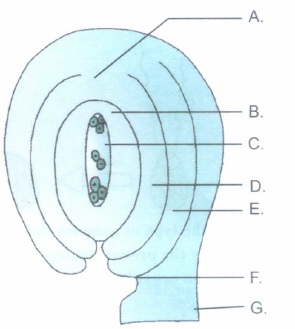
The diagram of an anatropous ovule is presented above.
(a) Give the technical term for ovule.
(b) Identify and name the part that
(i) attaches the ovule to the placenta
(ii) remains as perisperm in some seeds.
(iii) forms the testa of seed.
(iv) represents the basal part of the ovule.
(v) represents the female gametophyte.
1.
(i) (b)
(ii) (a) : The given figure is of circinotropous ovule where funiculus coiled around the ovule. It is found in the Family Cactaceae.
(iii) (d) : Given figure represents an anatropous ovule where· A, B, C and D represent micropyle, nucellus, embryo sac and chalaza respectively.
(iv) (b) : Depending upon the configuration and orientation of the body of ovule in relation to funiculus, there are six types of ovule - orthotropous (atropous, erect), anatropous (inverted), hemitropous (half inverted), campylotropous (body curved), amphitropous (both body and embryo sac curved) and circinotropous (funiculus coiled around the ovule). Anatropous or inverted ovule is the most common type of ovule found in angiosperms (in 80% of angiosperm families). Here, body of the ovule gets inverted and micropyle is on lower side. Further micropyle and funiculus lie side by side and micropyle is close to hilum.
(v) (b)
2.
(i) (a)
(ii) (c) : In recurrent agamospermy all the cells of embryo sac are diploid as it is formed directly either from a nuclear cell or diploid megaspore mother cell.
(iii) (d) : In adventive embryony, an embryo develops directly from a diploid cell other than egg like that of nucleus and integument, e.g., Citrus, Opuntia.
(iv) (d) : Formation of embryo directly from diploid egg without fertilisation is called diploid parthenogenesis. It is found in Rubus, apple, Poa.
(v) (c)
3.
(a) A - Chasmogamous flower
B - Cleistogamous flower
(b) A - Autogamy, geitonogamy and xenogamy
B - Autogamy only.
4.
(a) Megaspore
(b) Haploid
(c) (i) Filiform apparatus refers to the special cellular thickenings in the synergids, towards micropylar tip.
(ii) They play an important role in guiding the pollen tube to enter one of the synergids.
5.
(a) Megasporangium
(b) (i) G. Funicle
(ii) B. Nucellus
(iii) E. Outer integument
(iv) A. Chalaza
(v) C. Embryo sac.

12th Standard CBSE Syllabus & Materials
12th Standard CBSE
CBSE 12th Computer Science Python Revision Tour I - New Previous year Question Papers Study Material - QB365 Set A
NEW12th Standard CBSE
CBSE 12th Business Studies Planning Important Questions And Answers Study Material - QB365 Set A
NEW12th Standard CBSE
CBSE 12th Business Studies Business Environment Important Questions And Answers Study Material - QB365 Set A
NEW12th Standard CBSE
CBSE 12th Business Studies Principles of Management Important Questions And Answers Study Material - QB365 Set A



NCERT Books

Syllabus

Exam Pattern

Sample Question Papers

Previous year Question Papers

Important Notes

MCQ Practice test

NCERT Exemplers

Case study Questions

Image Based Questions

Passage based Questions

HOT Questions

Value Based Questions

Model Questions Papers
NCERT ( Book Back ) Questions

Assertion and Reason
Important Questions And Answers

CBSE 12th Standard CBSE Subjects
CBSE Standards








