
 100% FREE ACCESS
12th Standard CBSE Syllabus & Materials
12th Standard CBSE
CBSE 12th Economics Government Budget and the Economy Previous year Question Papers Study Material - QB365 Set A
NEW12th Standard CBSE
CBSE 12th Computer Science Interface Python with MySQL - New Previous year Question Papers Study Material - QB365 Set A
NEW12th Standard CBSE
CBSE 12th Computer Science Database Concept - New Previous year Question Papers Study Material - QB365 Set A
NEW12th Standard CBSE
CBSE 12th Computer Science Data Communication - New Previous year Question Papers Study Material - QB365 Set A
NEW12th Standard CBSE
CBSE 12th Computer Science Data Structures - New Previous year Question Papers Study Material - QB365 Set A
NEW12th Standard CBSE
CBSE 12th Computer Science Functions - New Previous year Question Papers Study Material - QB365 Set A

Published on: 28/05/2021
QB365 Provides the HOT Question Papers for Class 12 Biology, and also provide the detail solution for each and every HOT Questions. HOT Questions will help to get more idea about question pattern in every exams and also will help to get more marks in Exams
Download CBSE Class 12th Standard CBSE Biology question papers, sample papers, important questions, and previous year solved papers in PDF format. Get free study materials, NCERT solutions, and exam preparation resources for Class 12th Standard CBSE Biology
Questions + Answers key
Take MCQ Biology Test1.
If the meiocyte of a maize plant contains 20 chromosomes, write the number of chromosomes in the endosperm and embryo of the maize grain and give reasons in support of your answer.
2.
Vivipary automatically limits the number of offsprings in a litter. How?
3.
Given below are the events that are observed in an artificial hybridisation programme. Selection of parents \(\rightarrow\) Emasculation \(\rightarrow\)Bagging \(\rightarrow\) Collection of pollen from other male plant \(\rightarrow\) Dusting of pollen on stigma \(\rightarrow\) Rebagging. While, planning for crop improvement involving dioecious plants, which of the above mentioned steps would not be relevant?
4.
(i) Can a plant flowering in Mumbai be pollinated by pollen grains of the same species growing in New Delhi? Provide explanation to your answer.
(ii) Draw the diagram of a pistil where pollination has successfully occurred. Label the parts involved in reaching the male gametes to its desired destination.
5.
On the basis of relative position of funicle, chalaza and micropyle, the ovules can be classified into following six types. Identify the type of ovule from the diagrams given below and name them.
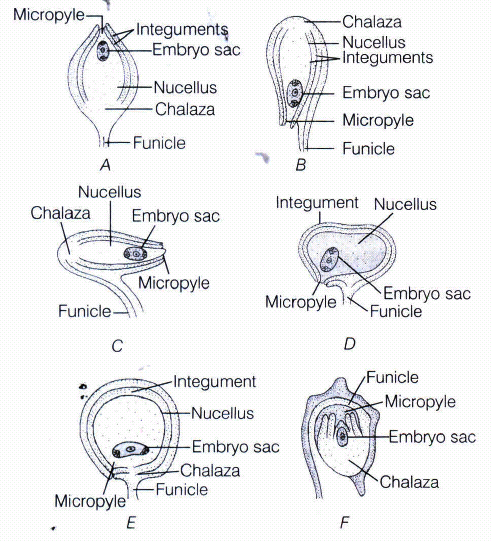
1.
1. The endosperm will have 30 chromosomes and the embryo will have 20 chromosomes.
2. The meiocyte is a diploid cell (with 20 chromosomes) and it undergoes meiosis; hence, the haploid cells of maize will have 10 chromosomes.
3. The endosperm develops from the primary endosperm cell, where the primary endosperm nucleus (PEN) is formed by triple fusion, i.e., fusion of three haploid nuclei-two polar nuclei (fuse to form a diploid secondary nucleus) and a haploid male gamete.
4. So the endosperm cells are triploid with 30 chromosomes.
5. The embryo develops from the zygote, which is formed by the fusion of a female gamete with a male gamete; so it is diploid with 20 chromosomes.
2.
Vivipary is defined as the seed germination, while the fruit is still attached to the mother plant. Plants which grow in marshy places are called mangroves. In these plants when seeds fall on marshy places, they cannot germinate because of high salinity and more water conditions.
So, in those plants, seeds germinate when they are still attached to the mother plant. Litter is the offspring at one birth of animal usually 3-8 in number. Vivipary automatically limits the number of offspring in litter due to the reason that limited number of egg or ovum are produced and fertilised during reproductive cycle of female.
3.
While planning for an artificial hybridisation programme for crop improvement involving dioecious plants, there is no need of emasculation. Dioecious plants have both the male and female reproductive organs borne on separate individuals of the same species.
If the female parent produces unisexual flowers, emasculation is not required. The female flower buds are bagged before the flowers open. When the stigma becomes receptive, pollination is carried out using the desired pollen and the flower is rebagged. This protects them from contamination by unwanted pollen grains.
4.
i) Yes, a plant flowering in Mumbai can be pollinated by pollen grains of the same species growing in New Delhi. It is mainly possible due to artificial hybridisation. In this the pollens are collected from the source plant in Mumbai and dusted on the emasculated flower growing in New Delhi.
(i) The parts involved in transferring the male gametes to their desired destination are stigma, style, micropyle, filiform apparatus and synergids. For LS of post-pollinated pistil
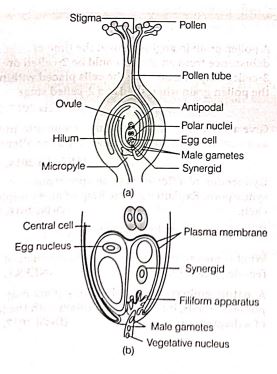
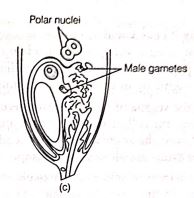
5.
A-Orthotropous ovule
B-Anatropous ovule
C-Hemianatropous
D-Campylotropous ovule
E-Amphitropous ovule
F-Circinotropous ovule

12th Standard CBSE Syllabus & Materials
12th Standard CBSE
CBSE 12th Computer Science Python Revision Tour I - New Previous year Question Papers Study Material - QB365 Set A
NEW12th Standard CBSE
CBSE 12th Business Studies Planning Important Questions And Answers Study Material - QB365 Set A
NEW12th Standard CBSE
CBSE 12th Business Studies Business Environment Important Questions And Answers Study Material - QB365 Set A
NEW12th Standard CBSE
CBSE 12th Business Studies Principles of Management Important Questions And Answers Study Material - QB365 Set A



NCERT Books

Syllabus

Exam Pattern

Sample Question Papers

Previous year Question Papers

Important Notes

MCQ Practice test

NCERT Exemplers

Case study Questions

Image Based Questions

Passage based Questions

HOT Questions

Value Based Questions

Model Questions Papers
NCERT ( Book Back ) Questions

Assertion and Reason
Important Questions And Answers

CBSE 12th Standard CBSE Subjects
CBSE Standards









