
 100% FREE ACCESS
12th Standard CBSE Syllabus & Materials
12th Standard CBSE
CBSE 12th Economics Government Budget and the Economy Previous year Question Papers Study Material - QB365 Set A
NEW12th Standard CBSE
CBSE 12th Computer Science Interface Python with MySQL - New Previous year Question Papers Study Material - QB365 Set A
NEW12th Standard CBSE
CBSE 12th Computer Science Database Concept - New Previous year Question Papers Study Material - QB365 Set A
NEW12th Standard CBSE
CBSE 12th Computer Science Data Communication - New Previous year Question Papers Study Material - QB365 Set A
NEW12th Standard CBSE
CBSE 12th Computer Science Data Structures - New Previous year Question Papers Study Material - QB365 Set A
NEW12th Standard CBSE
CBSE 12th Computer Science Functions - New Previous year Question Papers Study Material - QB365 Set A

Published on: 28/05/2021
QB365 Provides the HOT Question Papers for Class 12 Biology, and also provide the detail solution for each and every HOT Questions. HOT Questions will help to get more idea about question pattern in every exams and also will help to get more marks in Exams
Download CBSE Class 12th Standard CBSE Biology question papers, sample papers, important questions, and previous year solved papers in PDF format. Get free study materials, NCERT solutions, and exam preparation resources for Class 12th Standard CBSE Biology
Questions + Answers key
Take MCQ Biology Test1.
Give reasons why:
(i) most zygotes in angiosperms divide only after certain amount of endosperm is formed.
(ii) groundnut seeds are exalbuminous and castor seeds 'are albuminous.
(iii) micropyle remains as a small pore in the seed coat of a seed.
(iv) integuments of an ovule harden and the water content is highly reduced, as the seed matures.
(v) apple and cashew are not called true fruits.
2.
During a biology lecture in class the teacher called apple seeds as seeds but maize seeds as grains. On hearing this Amit got confused and asks her teacher the reason behind this. The teacher appreciated Amit and cleared all his doubts.
(i) What is the difference between seed and grain?
(ii) How are maize grains formed?
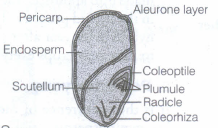
(iii) Explain along with a labelled diagram of the vertical section of a maize grain.
(iv) What values are shown by Amit.
3.
Ram saw a farmer spraying some chemicals on flowers. On asking farmer, he came to know that this act will lead to the formation of fruits without fertilisation. Ram thought that fruits developed in this way are not good to eat as chemicals are sprayed on it.
Next day, he asked his biology teacher about it, who explained him everything.
(i) What chemicals were sprayed by the farmer?
(ii) Give difference between such a spray and usual pesticide spray?
(iii) What is parthenocarpy? Give its types.
(iv) What values are shown by Ram?
4.
In case of polyembryony, if one embryo develops from the synergid and another from the nucellus, which one is haploid and which is diploid? Describe polyembryony and also mention how can it be commercially exploited.
5.
Embryo sacs of some apomictic species appear normal, but contain diploid cells. Suggest a suitable explanation for the condition.
1.
(i) The zygote starts dividing only after a certain amount of endosperm is formed as an adaptation to provide assured nutrition to the developing embryo; hence we can say it remains dormant for sometime.
(ii) In groundnut, the developing embryo utilises the endosperm completely; there is no residual endosperm in the seed and so the seed is exalbuminous.
In castor, the endosperm is not completely used up by the developing embryo; there is some amount of endosperm left in the seeds and hence the seeds are albuminous.
(iii) The integuments encircle the nucellus except at the tip, leaving a small opening, called micropyle.
a. As the integuments harden as the seed coat the micropyle remains as a small opening or pore in the seed coat.
b. The micropyle facilitates the entry of water and oxygen into the seed during germination.
(iv) The integuments harden as seed coat to protect the embryo. The moisture content is reduced and the seed become dry (with only 10-15% of moisture by mass), so that the general metabolic activity of the seed decreases and the seed can enter a state of inactivity, called dormancy, to tide over the unfavourable conditions.
(v) Since, the thalamus (a part other than the ovary) also contributes to fruit formation, these fruits are not true fruits; they are cal\ed false fruits.
2.
(i) A seed is defined as an embryonic plant covered in a seed coat containing some food.On the other hand, a grain is a small edible fruit, usually hard on the outside, harvested from grassy crops.
(ii) Maize grains are formed from female flowers after the fertilisation.
(iii)VS of maize grain
(iv) Amit is attentive, inquisitive and wants to gain knowledge.
3.
(i) The farmer was spraying auxins or gibberellins in low concentration which have been found to induce parthenocarpy in several plants, e.g. tomato, cucurbits, strawberry, fig, etc.
(ii) This is called chemicallyinduced parthenocarpy, which is not harmful for the consumers. However, pesticide sprays are harmful for our health.
(iii) In parthenocarpy, fruit formation occurs without fertilisation. It can be of three types, i.e. genetical, environmental and chemically induced (as done by the farmer).
(iv) Ram is an intelligent, observant, inquisitive boy who is concerned about the day-to-day activities that happen around him.
4.
1.Embryo developed from the synergid is haploid as the ploidy level of the synergid is haploid.
2.Embryo developed from the nucellus is diploid as the ploidy of the nucellus is diploid.
3.Presence of more than one embryo in a seed is called polyembryony, e.g. lemon, groundnut, etc.
4.Polyembryony plays an important role in plant breeding and horticulture. The plantlets obtained from these embryos are virus-free and have more vigour. Hybrid varieties of several food and vegetable crops are being extensively cultivated and these hybrid cultivars possess high productivity.
5.
Replacement of the normal sexual reproduction by asexual reproduction without fertilisation is called apomixis, e.g. replacement of the flower by bulbils and replacement of the seed by a plant. Apomictically produced offsprings are genetically identical to the parent plant. In flowering plants, apomixis is used in a restricted sense to mean angiosperm, i.e. asexual reproduction through seeds. In some plant species, it is common, e.g. Asteraceae and Poaceae. In some species, the diploid egg cell is formed without reduction division and develops into embryo without fertilisation. It is an asexual reproduction in the absence of pollinators such as in extreme environments.
In some species like Citrus, some of the nucellar cells surrounding the embryo sac start dividing and develop into embryo. It occurs in the megaspore mother cell and does not undergo meiosis, thus produces diploid embryo sac through mitotic divisions. Thus, it explains that, embryo sacs of some apomictic species appear normal but produce diploid cells.

12th Standard CBSE Syllabus & Materials
12th Standard CBSE
CBSE 12th Computer Science Python Revision Tour I - New Previous year Question Papers Study Material - QB365 Set A
NEW12th Standard CBSE
CBSE 12th Business Studies Planning Important Questions And Answers Study Material - QB365 Set A
NEW12th Standard CBSE
CBSE 12th Business Studies Business Environment Important Questions And Answers Study Material - QB365 Set A
NEW12th Standard CBSE
CBSE 12th Business Studies Principles of Management Important Questions And Answers Study Material - QB365 Set A



NCERT Books

Syllabus

Exam Pattern

Sample Question Papers

Previous year Question Papers

Important Notes

MCQ Practice test

NCERT Exemplers

Case study Questions

Image Based Questions

Passage based Questions

HOT Questions

Value Based Questions

Model Questions Papers
NCERT ( Book Back ) Questions

Assertion and Reason
Important Questions And Answers

CBSE 12th Standard CBSE Subjects
CBSE Standards









