
 100% FREE ACCESS
12th Standard CBSE Syllabus & Materials
12th Standard CBSE
CBSE 12th Economics Government Budget and the Economy Previous year Question Papers Study Material - QB365 Set A
NEW12th Standard CBSE
CBSE 12th Computer Science Interface Python with MySQL - New Previous year Question Papers Study Material - QB365 Set A
NEW12th Standard CBSE
CBSE 12th Computer Science Database Concept - New Previous year Question Papers Study Material - QB365 Set A
NEW12th Standard CBSE
CBSE 12th Computer Science Data Communication - New Previous year Question Papers Study Material - QB365 Set A
NEW12th Standard CBSE
CBSE 12th Computer Science Data Structures - New Previous year Question Papers Study Material - QB365 Set A
NEW12th Standard CBSE
CBSE 12th Computer Science Functions - New Previous year Question Papers Study Material - QB365 Set A

Published on: 24/05/2021
QB365 Provides the updated NCERT Examplar Questions for Class 12 Biology, and also provide the detail solution for each and every ncert examplar questions , QB365 will give all kind of study materials will help to get more marks
Download CBSE Class 12th Standard CBSE Biology question papers, sample papers, important questions, and previous year solved papers in PDF format. Get free study materials, NCERT solutions, and exam preparation resources for Class 12th Standard CBSE Biology
Questions + Answers key
Take MCQ Biology Test1.
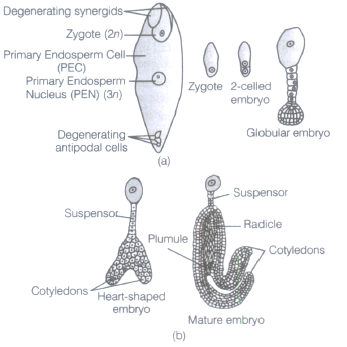
Starting with the zygote, draw the diagrams of the different stages of embryo development in a dicot.
2.
From the recent studies, it was found that one of the common fruit banana is one the verge of extinction, as a new fungal disease is plaguing banana plants.
(i) State what could be the possible reasons against this condition
(ii) Describe the phenomenon reasons against this condition
(iii) Suggest a technique to overcome this forthcoming problem.
3.
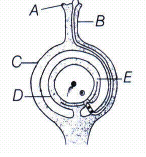
In the diagram given below, identify the parts of the flower and mention the post-fertilisation changes shown in the parts
4.
Do you think microspores and pollen grains are the same structures. If they are different then what is the basic difference between them?
5.
Observe the figure carefully and the answer of the following question:
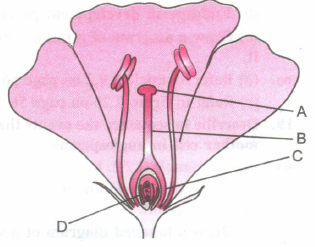
(a) Write whether ovary is superior or inferior?
(b) What is the type of flower - hypogynous, perigynous or epigynous?
(c) What type of ovule is shown the figure?
(d) What changes occur in C after fertilization?
(e) What does A, B, C, D represent in the figure.
1.
2.
(i) Banana appear to have been around as long ago as 10,000 years but because of human controlled asexual reproduction, bananas have very low genetic variety. Their gene pool is becoming have very stringent. As bananas produce no seeds,there is no way for them to diversity their do not have genetic makeup. As a result, they do not have the genetic capability to defend themselves against the funal pathogen. That's why, they are speculated on the verge of extinction within few (approximately 10 years.
(ii) The phenomenon by which fruits develop without fertilisation is called parthenocarpy
(iii) Genetic engineering might be the suggested possible technique to overcome the above-mentioned problem. Though this technique, fungal-resistant genes can be introduced in bananas to protect them from becoming extinct.
3.
| Parts | Post-fertilisation change |
| A-Stigma B-Style |
Both degenerate |
| C-Ovary | Fruit |
| D-Ovule | Seed |
| E-Integuments | Seed coat |
4.
Microspores and pollen grains are not the same structures. Initially, the diploid microspore mother cell divides by meiosis to form four haploid microspores which are arranged in tetrads. Each microspore has single haploid nucleus. Then the nucleus of microspores divides mitotically so that the two haploid nuclei are formed inside the spore. The entire cell becomes bicellular by developing a separating wall. Now the spore is two-celled ----- one large tube cell and other smaller generative cell. This structure is regarded as young male gametophyte and called as pollen grain. Pollination takes Place at this two-celled stage.
5.
(a) Ovary is superior
(b) Flower is hypogynous because all the floral arise from thalamus below the level of ovary
(c) Ovule is anatropous because it is completely inverted. The micropyle is near the hilum and faces down towards the placenta.The embryo sac is straight.
(d) The ovary of the flower gets converted into fruit after fertilization.
(e) A = Stigma, B = Style, C = Ovary and D = Ovule

12th Standard CBSE Syllabus & Materials
12th Standard CBSE
CBSE 12th Computer Science Python Revision Tour I - New Previous year Question Papers Study Material - QB365 Set A
NEW12th Standard CBSE
CBSE 12th Business Studies Planning Important Questions And Answers Study Material - QB365 Set A
NEW12th Standard CBSE
CBSE 12th Business Studies Business Environment Important Questions And Answers Study Material - QB365 Set A
NEW12th Standard CBSE
CBSE 12th Business Studies Principles of Management Important Questions And Answers Study Material - QB365 Set A



NCERT Books

Syllabus

Exam Pattern

Sample Question Papers

Previous year Question Papers

Important Notes

MCQ Practice test

NCERT Exemplers

Case study Questions

Image Based Questions

Passage based Questions

HOT Questions

Value Based Questions

Model Questions Papers
NCERT ( Book Back ) Questions

Assertion and Reason
Important Questions And Answers

CBSE 12th Standard CBSE Subjects
CBSE Standards









