
 100% FREE ACCESS
12th Standard CBSE Syllabus & Materials
12th Standard CBSE
CBSE 12th Economics Government Budget and the Economy Previous year Question Papers Study Material - QB365 Set A
NEW12th Standard CBSE
CBSE 12th Computer Science Interface Python with MySQL - New Previous year Question Papers Study Material - QB365 Set A
NEW12th Standard CBSE
CBSE 12th Computer Science Database Concept - New Previous year Question Papers Study Material - QB365 Set A
NEW12th Standard CBSE
CBSE 12th Computer Science Data Communication - New Previous year Question Papers Study Material - QB365 Set A
NEW12th Standard CBSE
CBSE 12th Computer Science Data Structures - New Previous year Question Papers Study Material - QB365 Set A
NEW12th Standard CBSE
CBSE 12th Computer Science Functions - New Previous year Question Papers Study Material - QB365 Set A

Published on: 31/05/2021
QB365 Provides the Value Based Question Papers for Class 12 Biology, and also provide the detail solution for each and every Value Based Questions. Value Based Questions will help to get more idea about question pattern in every exams and also will help to get more marks in Exams
Download CBSE Class 12th Standard CBSE Biology question papers, sample papers, important questions, and previous year solved papers in PDF format. Get free study materials, NCERT solutions, and exam preparation resources for Class 12th Standard CBSE Biology
Questions + Answers key
Take MCQ Biology Test
1.
Naman entered into a quarrel with some farmers who were spraying DOT in their field. Many people gathered at the spot to see and enjoy the incident. The angry mob demanded that Naman should not interfere in the farmer's job. Naman tried to explain his point and finally succeeded in explaining the harmful effects of DOT.
(i) What is biomagnification? Explain with an example.
(ii) Is biomagnification related with DDT only? Comment.
(iii) What is the effect of DDT on birds?
(iv) What values did Naman promote?
2.
Waste disposal and waste management poses a major problem in present times. Generation of garbage and its disposal is a major threat and consequently leads to severe environmental issues. The problem is not with biodegradable and recycled wastes. We realise that'the need is to reduce non-biodegradable wastes.
(i) Why is there a great concern of managing non-biodegradable waste in comparison to biodegradable waste? Explain.
(ii) As a member of eco-club of your school, suggest any two ways that you will discuss with your fellow members to organise for a 'Zero garbage day' once in a month in the school.
3.
Public all over India is very much concerned about the deteriorating air quality in large parts of North India. Alarmed by this situation the Resident's Welfare Association of your locality organised an awareness programme entitled 'Bury not burn'. They invited you, being a biology student to participate.
(i) How would you justify your arguments that promote burying and discourage burning? (Give two reasons)
(ii) With the help of flowcharts, one for each practice, depict the chain of events that follow.
4.
On his visit to a national park; Harshendra was very angry as the forest authorities did not allow him to enter a specified area. On returning back, he discussed the matter with his friend, who explained him the reason.
(i) Which category of conservation strategy does national park belong?
(ii) Name India's first national park.
(iii) At present, there are how many national parks in India?
(iv) Whatvalues are shownby Harshendra's friend?
5.
During an excursion to a botanical garden, the teacher shows an old tree, which was on the verge of extinction. As soon as the teacher advanced with the students, some enthusiastic students climbed up the tree and started cutting the branches, collecting its leaves as precious collection. Rajesh instead took photographs of the tree from various angles. The boys mocked at Rajesh while the teacher appreciated him.
(i) Why should we conserve biodiversity?
(ii) Howcan biodiversity be conserved?
(iii) What international initiatives were taken to conserve biodiversity?
(iv) What values did Rajesh possess?
6.
Seeing a crowd of students in one corner of the school: the principal rushed to see the matter and found some children beating and chasing a small lizard. On seeing the principal, all the children fled to their classes except Alok who requested the principal to arrange for some medical assistance for the injured animal. The principal rewarded Alok for his attitude to save guard our biodiversity.
(i) What do you understand by biodiversity?
(ii) Mention the factors resulting in loss of biodiversity.
(iii) Was Alokan indisciplined boy,who did not run to the class on seeing the principal? What values does the act promote?
7.
During her tour to a renowned forest, Sakshi saw a highway being constructed, which passes through the middle of the forest. She was unhappy seeing that and on return, she I contacted the local eco-club and approached the concerned department to stop the work.
(i) What would be the effect on biodiversity, if the highway is constructed?
(ii) Howforests are useful to mankind?
(iii) What values of Sakshi reflect here?
8.
Ankit attended a blood donation camp to donate blood and came to know that he was HIV positive. He lost interest in studies knowing that. He remained absent from school for a long time. The biology teacher visited his house and talked to him. Ankit started coming to school again and showed interest in studies.
(i) Aperson detected to be HIV positive should be isolated by the society. Do you agree? Why/why not?
(ii) Write the processes through which, AIDS does not spread.
(iii) Who are at higher risk of encountering AIDS?
(iv) What sense of responsibility did the biology teacher exhibit?
9.
Rohan and his friends emptied all the overhead tanks, which were not in use for last few months. Some people did not like this. Rohan and his friends explained and convinced them about the hygienic benefits of their act.
(i) What was the objective behind their act?
(ii) Explain in brief the stages of life cycle of a malarial parasite in human body.
(iii) Which pathogen is responsible for malaria?
(iv) What values did Rahul and his friends promote?
10.
Vicky's mother was using the same mosquito repellent cream from last six years. She was regularly complaining that this cream has no effects on mosquitoes now, Hearing this, Vicky advised his mother to change the cream as regular usage has led the mosquitoes to develop resistance against it. His mother changed the cream and could notice its effect on mosquitoes.
(i) Explain how mosquitoes were not affected by the previous cream?
(ii) On what factors, Darwin's theory was based?
(iii) Can you relate this incident to Darwin's concept? How?
(iv) Identify the values shown by Vicky.
11.
While going to Nainital during summer vacations, Amitabh saw a board indicating the direction to Jim Corbett National Park. He asked his uncle, who happened to be a forest Officer, about national parks. He explained that national parks are maintained by government solely for the welfare of entire wild life in it
read the above passage and answer the following questions:
(i) How is wild life maintained in a national park?
(ii) name two other national parks.
(iii) What value is displayed by Amitabh's uncle?
12.
Satish heard about red data book in a TV programme on conservation of natural resources. He wanted to know in detail about this book so he discussed it with biology teacher who explained to him about this.
Read the above passage and answer the following questions:
(i) What is Red Data Book?
(ii) What is the utility of this document?
(iii) Who publishes this book?
13.
While visiting a national park, Ravi noticed a board with warning that hunting and killing of wild animals is a punishable crime. He failed to understand why killing a wild animal who may harm human beings, is a crime? He discussed it with his biology teacher who made him realise the importance of wild life for human survival.
Read the above passage and answer the following questions:
(i) How is our survival linked with the existence of wild animals?
(ii) How can we protect these animals?
(iii) What value is displayed by Ravi's teacher ?
14.
One day, Hari asked his uncle why can not he clear various types of wild plants in the vicinity of his village and use the land for cultivation of crops? Uncle replied that it will not be a wise step as plants other than crops are also essential for our survival.
Read the above passage and answer the following question :
(i) As a student of biology, in your opinion who is right Hari or His uncle and why ?
(ii) What is the term used to denote the diversity among living things?
(iii) What are the benefits of biodiversity?
15.
"To reduce or check the global warming is the biggest challenge. Scientist belive that this rise in temperature is leading to deletrious changes in environment and resulting in odd climates".
(i) Write one difference between E1-nino and La-nino affect.
(ii) Name any two agents which cause global warming.
16.
Pollution is an undesirable change in physical, chemical and biological characteristics of environment, air, water, soil and land that has potential to adversely affect human life, the lives of the desirable species, natural resources, industrial processes and cultural assets.
Given below are the sources of pollution and their effects. Using this information fill the spaces in the given box. Each pollutant may have more than one source and may show more than one effect.
Pollutant source: Automobile exhaust, burning of fossils, refrigerant, agricultural field, fire extinguisher, paint solvents, deforestation, plastic foam.
Effect: Photochemical smog, acid deposition, global warming, depletion of ozone.
| Name of pollutant | Source | Effect |
| Chlorofluoro carbon (CFC) | \(a\) | \(p\) |
| Suspended particulate matter (SPM) | \(b\) | \(q\) |
| Oxides of nitrogen \(({ NO }_{ 2 })\) | \(c\) | \(r\) |
| Sulphur dioxide \(({ SO }_{ 2 })\) | \(d\) | \(s\) |
| Methane \(({ CH }_{ 4 })\) | \(e\) | t |
17.
A mother is ready to feed her newborn baby just after parturition by nature.
(i) Name the cells which secrete milk.
(ii) Name the process of producing during the first few days, after parturition.
(iv) Name the hormone meant for release of milk.
(v) Why the doctors recommend breastfeeding during the initial period of infant growth?
18.
A little child girl, Ruchika of five years had curiosity, asked her mother.Why did not she possess the moustaches and beard like her daddy.
(i) Name the hormone responsible for the development of moustaches and beard.
(ii) Name the cells and their location which secrete this hormone.
(iii) Name the cells and their location which secrete the hormone responsible for the development of female characteristics in a female.Are there additional structures in the female reproductive system which secrete hormones? Name them.
19.
Expand MOET. Explain the procedure of this technology in cattle improvement.
20.
Differentiate between inbreeding and out breeding in cattle. State on eadvantage and on edisadvantage for each one of them.
1.
(iv) Health awareness, eco-friendly nature and boldness for the right cause.
2.
(i) The management of non-biodegradable waste is of great concern as comparison to biodegradable waste because non-biodegradable waste cannot be degraded by microbes and get accumulated in the environment. Biodegradable waste can be degraded by microbes into simpler form in which it can be used in ecosystem.
(ii) Two ways to organise 'zero garbage day' is as follows
Tell them about 'zero garbageday'.
Remind them rules to organise the day and also telling them important of this day.
3.
(i) Following arguments can be put forward to promote burying and discourage burning
(a) When we burn wastes, pollutants such as carbon dioxide, NO2 SO2 etc., are released in the atmosphere. These pollutants damage the environment. Due to burning, smoke is released into atmosphere which causes problems like asthma, emphysema,etc.
(b) Burying the waste does not have any harmful effect in fact when we bury organic wastes, the soil becomes enriched with nutrients.
(ii) The solid wastes are of two types
(a) Biodegradable wastes These can be degraded by the microbes,e.g. organic waster paper, etc.
(b) Non-biodegradable wastes These cannot be degraded by the microbes and can remain as such for long periods, e.g. plastic. Flowcharts depicting effects of burying and burning are
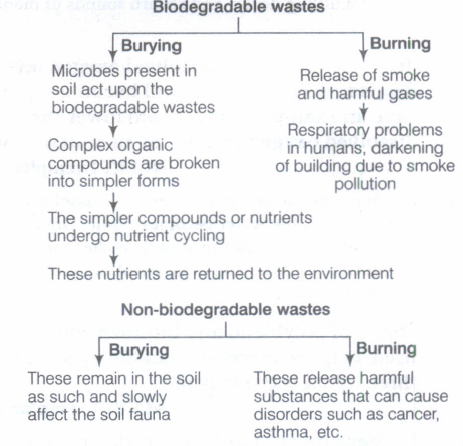
4.
(i) National Park belongs to in situ conservation methodrt
(ii) First national park of India is Haileys National Park which is now called as Jim Corbett National Park.
(iii) According to National Wildlife Database Cell, Wildlife Institute of India, there are 103 national parks till now.
(iv) His friend is calm and has knowledge about biodiversity.
5.
(ii) Biodiversity can be conserved in the following two ways In situ conservation Sacred groves, biosphere reserves (terrestrial and marine), national parks and wildlife sanctuaries, etc. Ex situ conservation Sacred plants, home gardens, seed banks, gene bank, cryopreservations, botanical garden, zoological garden and aquariums.
(iii) For conserving biodiversity, the Earth Summit was held in 1992 and World Summit was held in 2002.
(iv) The values possessed by Rajesh are respect for nature, scientific attitude with a vision of the tuture.
6.
(ii) There are four major factors that results in loss of bidiversity and these are
(a) Habitat loss and fragmentation
(b) Over-exploitation.
(c) Alien species invasion
(d) Co-extinction
(iii) No, Alok was a brave and courteous boy. He expressed his love for animals, commitment towards natural resources and their conservation.
7.
(i) Continuity of the habitat (i.e. forest) would be disrupted. Animals get confined to smaller area. Fragmentation characteristically reduces species richness and taxon diversity and may reduce the efficacy of ecosystem functioning. Fragmentation not only reduces the amount of functional habitat, but also it may isolate a species population into sub-populations. It may be sufficiently near the minimum viable population size, to risk the , local extinction from successive demographic processes or catastrophic events.
(ii) Forests are important for mankind due to following reasons
(a) They are source of firewood, fibre, construction material, industrial products and products of medicinal importance.
(b) They proxide us with fresh air (oxygen) and also help in bringing down rain.
(c) Acts as a habitat of a wide variety of flora and fauna.
(d) They also help in keeping environment healthy and beautiful.
(iii) Love for nature and environmental consciousness. She was brave, focussed, and foresighted (had vision to see the disaster in the future).
8.
(i) No, HIV positive person should not be isolated from the society as AIDS is not a contagious disease and does not spread until a blood / body fluid contact is established.
(ii) AIDS does not spread by body contact in crowded place, hand shaking, sharing telephone, sharing meal, utensil or clothing, kissing, sharing same toilet seat or even swimming pool. It is not transmitted by blood sucking vectors or by coughing and sneezing.
9.
(i) Water in the tanks is stagnant and can become a breeding ground for mosquitoes. So their objective was to prevent mosquito borne diseases.
(iii) Malaria is caused by protozoan, Plasmodium.
(iv) Social responsibility, commitment towards community health and respect towards elders.
10.
(i) Mosquitoes were not affected by the previous cream because they got adapted to the cream and became resistant.
(ii) Darwin's theory was based on the fact the organisms which adapt well will survive more in nature and gets selected by nature through the mode of natural selection.
(iii) Yes, the excess use of the cream leads to selection of mosquitoes in a short duration of time.
(iv) Vicky is knowledegble, scientific and observant.
11.
(i) In a national park, a track of land (core zone) is reserved and maintained solely for wild life conservation, and operations such as plantations, cultivation, grazing are not allowed. Private ownership rights and habitat manipulation are also not permitted in this zone.
(ii) Kazipranga National Park and Kanha National Park.
(iii) Amitabh's uncle maintained his nephew's curiosity to know about surroundings, wildlife and their importance in our life.
12.
(i) It is a document in which the taxa which are facing threats of extinction and grouped into various categories, are published.
(ii) This document creates awareness about the importance of threatened biodiversity. It also highlights conservation priorities.
(iii) The IUCN now called WCU (World conservation Union).
13.
(i) Wild animals are components of various food chains and webs their elimination will cause disturbance in ecosystem and will result in natural calamities threatening our survival.
(ii) We can protect these animals by prohibiting hunting, poaching and establishing national parks, sanctuaries and biosphere reserves.
(iii) As a biology teacher, he explained the importance of wildlife to Ravi and the necessity of its conservation.
14.
(i) Uncle is right as he is aware of the importance of biodiversity on our planet.
(ii) Biodiversity.
(iii) Biodiversity provides us food, fiber, medicine in addition to other indirect benefits like ecosystem services.
15.
(i) Both the terms refer to large scale changes in sea-surface temperature across the central and eastern tropical Pacific. Usually, sea-surface temperature, off South America's west coast, ranges from \({ 60 }^{ 0 }F\) to \({ 70 }^{ 0 }F\) , while it exceeds \({ 80 }^{ 0 }F\) inthe "warmpool" located in the central and western Pacific. This warm pool expands to cover the tropics during E1-Nine but shrinks to the west during La-Nino.
(ii) Increase in release of green house gases (CO2 and methane) are responsible for increase in temperature. Thus leads to global warming.
16.
(\(a\)) Refrigerant, fire extinguisher (\(p\)) Global warming and ozone depletion.
(\(b\)) Automobile exhaust (\(q\)) Smog
(\(c\)) Burning of fossil fuel (\(r\)) Photochemical smog
(\(d\)) Burning of fossils (\(s\)) Acid deposition
(\(e\)) Industrial/agricultural fuels (\(t\)) Ozone depletion and global warming.
17.
(i) Lactiferous cells of alveoli of mammary glands.They are present in breast.
(ii) Lactation
(iii) Colostrum.
(iv) Oxytocin hormone released by posterior lobe of pituitary body.
(v) Mother's milk is low in fat but rich in proteins such as lactalbumin and lactoprotein. Colostrum also contains major immunoglobin IgA. It provides passive immunity to the newborn baby.
18.
(i) Androgens, mainly testosterone, secreted by testes and adrenal gland.
(ii) Interstitial cells or Leydig cells, present in the interstitial spaces between the seminiferous tubules.
(iii) Estrogens secreted by ovary.Progesterone hormone is secreted by corpus luteum of ovary and placenta during pregnancy.
19.
(a) Multiple ovulation Embryo Transfer , (MOET) technology
(b) Steps in MOET technology:
A cow is administered hormones with FSH-like activity to induce follicular maturation and superovulation, i.e. instead of one egg, 6-8 eggs are produced per cycle.
The animal is either mated with an elite bull or artificially inseminated.
The fertilised eggs are recovered at the 8-32 celled stages, nonsurgically.
They are then transferred to surrogate mothers.
The genetic mother is available for and her round of superovulation.
20.
| Inbreeding | Outbreeding |
|---|---|
| Inbreeding refers to the mating of more closely related individuals within the same breed for 4-6 generations. | Outbreeding refers to the breeding of unrelated animals of the same breed with no common ancestors, or between two different breeds or different species |
Advantages:
Inbreeding: It is used to evolve purelines in animals.
Outbreeding: These methods are used for improving the yield of animals and also to produce new breeds.
Disadvantages:
Inbreeding: Continuous inbreeding leads to inbreeding depression and reduction in productivity.
Outbreeding: The success rate may below and the desired combinations of characters may appear in low frequency.

12th Standard CBSE Syllabus & Materials
12th Standard CBSE
CBSE 12th Computer Science Python Revision Tour I - New Previous year Question Papers Study Material - QB365 Set A
NEW12th Standard CBSE
CBSE 12th Business Studies Planning Important Questions And Answers Study Material - QB365 Set A
NEW12th Standard CBSE
CBSE 12th Business Studies Business Environment Important Questions And Answers Study Material - QB365 Set A
NEW12th Standard CBSE
CBSE 12th Business Studies Principles of Management Important Questions And Answers Study Material - QB365 Set A



NCERT Books

Syllabus

Exam Pattern

Sample Question Papers

Previous year Question Papers

Important Notes

MCQ Practice test

NCERT Exemplers

Case study Questions

Image Based Questions

Passage based Questions

HOT Questions

Value Based Questions

Model Questions Papers
NCERT ( Book Back ) Questions

Assertion and Reason
Important Questions And Answers

CBSE 12th Standard CBSE Subjects
CBSE Standards








