
 100% FREE ACCESS
12th Standard CBSE Syllabus & Materials
12th Standard CBSE
CBSE 12th Economics Government Budget and the Economy Previous year Question Papers Study Material - QB365 Set A
NEW12th Standard CBSE
CBSE 12th Computer Science Interface Python with MySQL - New Previous year Question Papers Study Material - QB365 Set A
NEW12th Standard CBSE
CBSE 12th Computer Science Database Concept - New Previous year Question Papers Study Material - QB365 Set A
NEW12th Standard CBSE
CBSE 12th Computer Science Data Communication - New Previous year Question Papers Study Material - QB365 Set A
NEW12th Standard CBSE
CBSE 12th Computer Science Data Structures - New Previous year Question Papers Study Material - QB365 Set A
NEW12th Standard CBSE
CBSE 12th Computer Science Functions - New Previous year Question Papers Study Material - QB365 Set A

Published on: 01/08/2018
From the chapter Aldehydes, Ketones and Carboxylic Acids, some of the important questions are covered in this question paper. The questions are covers from the book back and the previous year questions.
Download CBSE Class 12th Standard CBSE Chemistry question papers, sample papers, important questions, and previous year solved papers in PDF format. Get free study materials, NCERT solutions, and exam preparation resources for Class 12th Standard CBSE Chemistry
Questions + Answers key
Take MCQ Chemistry Test
1.
Benzaldehyde can be obtained from benzal chloride Write reactions for obtaining benzal chloride and then benzaldehyde from it.
2.
Write the formula of the following :
(i) 4 - Methylpent - 3 - en - 2 - one
(ii) 2 - Ethoxy - 4 - methoxypentan - 3 - one
3.
What products will be formed on reaction of propanal with 2-methylpropanal in the presence of NaOH ?Write the name of reaction also.
4.
Explain why dialkylcadmium is considered superior to Grignard reagent for the preparation of a ketone from an acid chloride ?
5.
Write the structural formula of 1-phenylpentan-1-one.
6.
What is Tollen's reagent? Write one usefulness of this reagent.
7.
Write the structure of the following compound: 3 - oxo pentanal.
8.
How will you bring about the following conversions:
(i) Propanone to propane
(ii) Benzoyl chloride to benzaldehyde.
(iii) Ethanal to but-2-enal.
9.
Suggest the reagents to bring about the following conversion:
(i) Hexan -l- ol to hexanal
(ii) Cyclohexanol to cyclohexanone
(iii) 4-Fluorotoluene to 4-fluorobenzaldehyde
(iv) Ethanenitrile to ethanal
(v) Allyl alcohol to propenal
(vi) But-2-ene to ethanal
10.
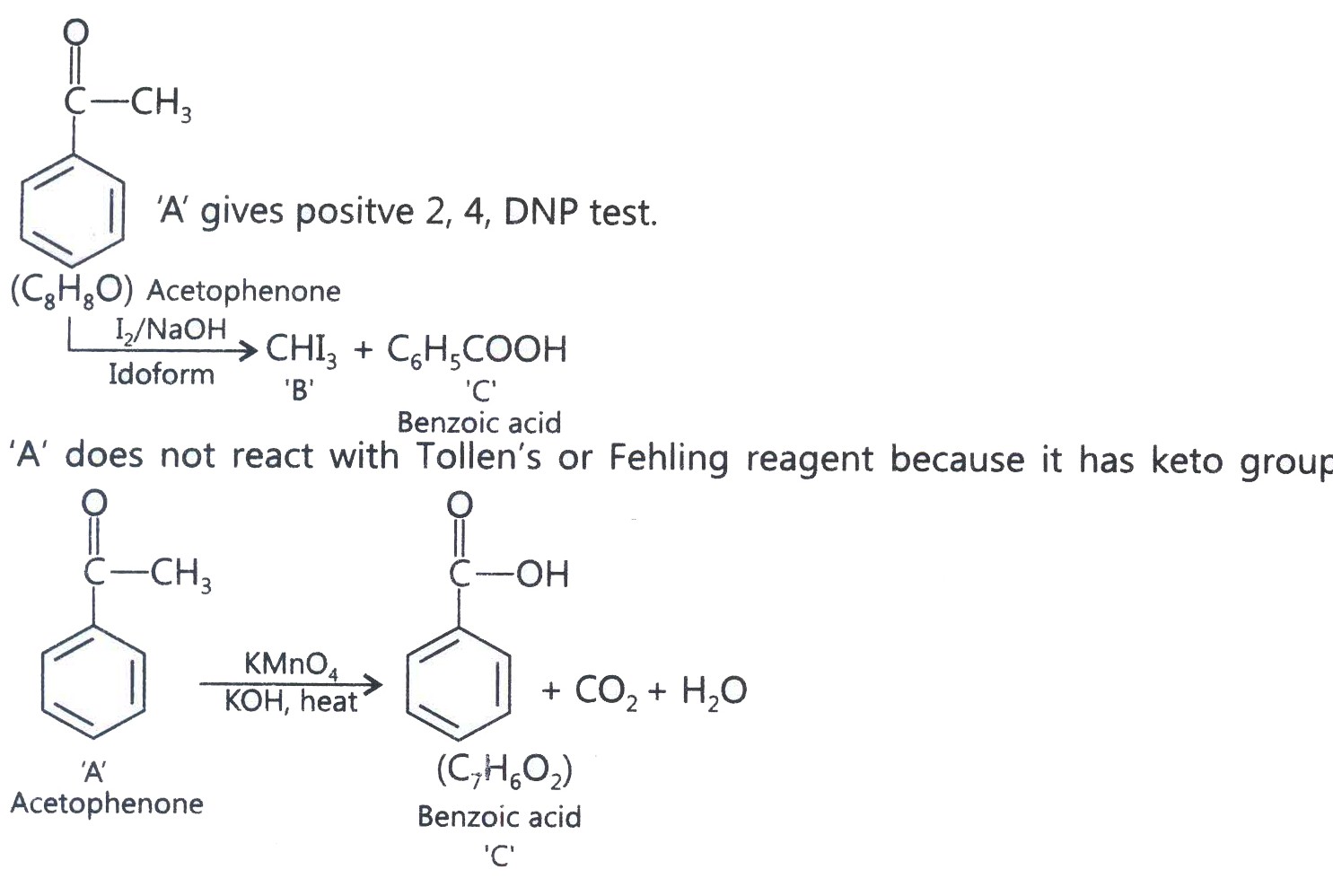
An aromatic compound 'A' (Molecular formula C8H8O) gives positive 2, 4-DNP test. It gives a yellow precipitates of compound 'B' on treatments with iodine and sodium hydroxide solution. Compound 'A' does not give Tollen's or Fehling's test. On drastic oxidation with potassium permanganate it forms a carboxylic acid 'C' (Molecular formula C7HO)6O2), which is also formed along with the yellow compound in the above reaction. Identify A, B and C write all the reacitons involved.
11.
What happens when:
(i) An aqueous solution of sodium acetate is electrolysed?
(ii) Calcium acetate is dry distilled?
(iii) Sodium benzoate is heated with soda lime?
12.
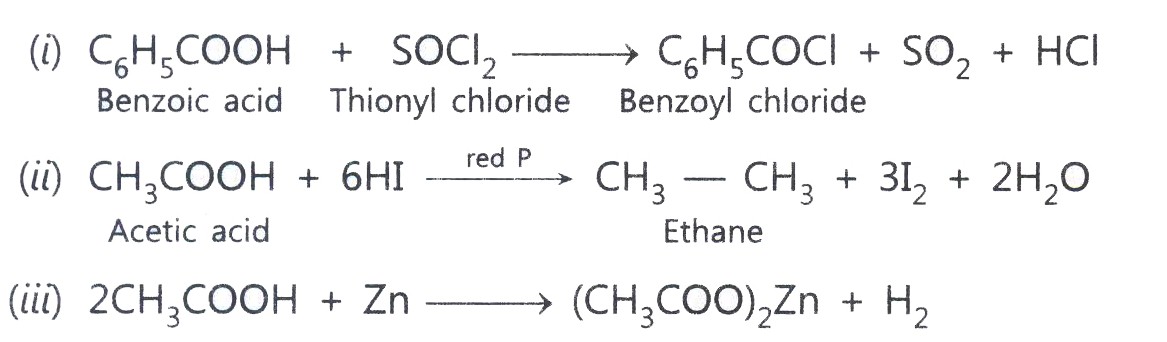
Write balanced chemical equations for the following reactions:
(i) Thionyl chloride reacts with benzoic acid
(ii) Acetic acid is reacted with red phosphorus and HI
(iii) Acetic acid is treated with Zn metal.
13.
Methyl benzoate can ve prepared by
C6H5COOH + CH3OH \(\xrightarrow {H^{+}}\)
C6H5COCI+ CH3OH \(\xrightarrow {Pyridine}\)
C6H5COOH + CH3N2 \(\longrightarrow \)
All the above methods
14.
Which of the following presents the correct order of the activity in the given compounds?
FCH2COOH > CICH2COOH > BrCH2COOH > CH3COOH
CH3COOH > BrCH2COOH > CICH2COOH > FCH2COOH
FCH2COOH > CICH2COOH > BrCH2COOH > CICH2COOH
BrCH2COOH > CICH2COOH > FCH2COOH > CH3COOH
15.
Which of the following reagents converts C6H5COCHO to C6H5CHOHCOOH ?
Aq. NaOH
Acidic Na2SO3
Na2CrO4/H2SO4
NaNO2/HCI
16.
Identify the combination of compounds that undergo Aldol condensation followed by dehydration to produce but-2-enal.
methanal and ethanal
two moles of ethanal
methanal and propanone
two moles of ethanol
17.
For making distination between 2-pentanone and 3-pentanone, the reagent employed is
K2Cr2O7/H2SO4
Zn-Hg/HCI
SeO2
Iodine/NaOH
18.
Which the following will react with water
CHCI3
CI3CCHO
CCI4
CICH2CH2CI
19.
The IUPAC name of the compound is
4-methoxy-2-nitrobenzaldehyde
4-formyl-3-nitroanisole
4-methoxy-6-nitrobenzaldehyde
2-formy-5-methoxynitrobenzene
20.
The product formed in Aldol condensation is
an alpha, beta unsaturated ester
a beta hydroxy acid
a beta hydroxyaldehyde or ketone
an alpha hydroxy aldehyde or ketone
21.
Which of the following organic compounds answers both iodoform test and Fehling's test?
Ethanal
Propanone
Ethanol
Methanol
22.
The formation of cyanohydrin from acetone is which type of reaction ?
Electrophilic substitution
Electrophilic addition
Nucleophilic addition
Nucleophilic substitution
23.
Benzoin is formed when benzaldehyde is treated with --------
24.
A compound with molecular formula, C4H10O3 on acetylation with acetic anhydride gives a compound with molecular weight 190. Find out the number of hydroxyl groups present in the compound.
25.
Give reasons for the following:
(i) Oximes are more acidic than hydroxylamine.
(ii) Iodoform is obtained by the reaction of acetone with hypoiodite but with iodide ion.
(iii) Oxidation of tolune to benzaldehyde with CrO3 is carried out presence of acetic anhydride and not in presence of H2SO4.
1.
It is the commercial method for preparing benzaldehyde. Benzal chloride can be obtained by photochlorination of toluene i.e., chlorination of toluene in presence of sunlight.
Then, benzal chloride on heating with boiling water produces benzaldehyde as shown below.

2.
\((i)\ ({ { CH }_{ 3 }) }_{ 2 }{ C }{ = }{ CHCOCH }_{ 3 } \)
\((ii){ \quad CH }_{ 3 }{ - }{ CH(OCH }_{ 3 }){ - }{ CO }{ - }{ CH(OCH }_{ 2 }{ CH }_{ 3 }){ CH }_{ 3 }\)
3.
Propanal and 2-methylpropanal both have a-hydrogens and hence can undergo cross aldol condensation in which each one of them can act either an electrophile or a nucleophile thereby giving two cross aldol products. Thus,
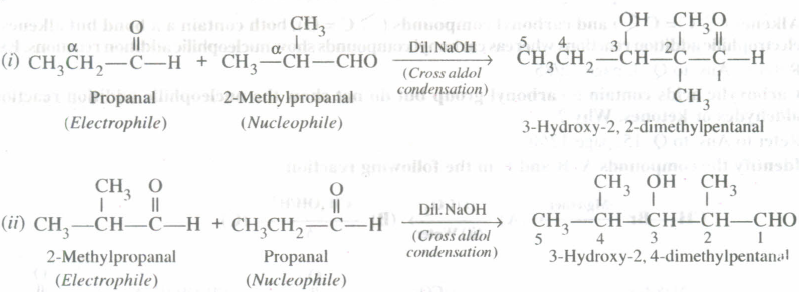
Besides, cross aldol condensation each aldehyde can also undergo selfot simple aldol condensation giving two self or simple aldol products.
.png)
4.
Since Cd (E.N. = 1.7) is less electropositive than Mg (E.N. = 1.2), therefore, dialkyl cadmium's are less reactive than Grignard reagents towards nucleophilic addition reactions. As such, dialkyl cadmium's react with the more reactive acid chlorides to give ketones but do not react further with the less reactive ketones thus formed to give tert-alcohols. In contrast, Grignard reagents being more reactive not only react with the acid chlorides but also with the ketones so formed to give tert-alcohols. \(\underset { Ketone }{ { { R }^{ ' } }{ - }\overset { O\\ || }{ C } { - }{ R } } \overset { { R }_{ 2 }Cd }{ \underset { -RCdCl }{ \longleftarrow } }\underset { Acid\quad chloride }{ { R }^{ ' }{ - }\overset { O\\ || }{ C } { - }{ Cl } } \quad \overset { { R }MgX }{ \underset { -Mg(Cl)X }{ \longleftarrow } }\underset { Ketone }{ { R }^{ ' }{ - }\overset { O\\ || }{ C } { - }{ R } } \quad \overset { { (i)R }MgX }{ \underset { (ii){ H }^{ + }/{ H }_{ 2 }O }{ \longleftarrow } }\underset { 3°Alcohol }{ { R }^{ ' }{ - }\overset { OH\\ | }{ \underset { |\\ R }{ C } } { - }{ R } } \)
5.

6.
It is ammoniacal silver nitrate (agNO3 + NH4OH) solution. It is used as mild oxidising agent to test the presence of aldehyde group.
7.

8.
(i) Conversion of Propanone to Propane:
.JPG)
(ii) Conversion of Benzoyl chloride to benzaldehyde:
.JPG)
(iii) On treatment with dilute alkali, ethanol produces 3-hydroxybutanal gives But-2-enal on hheating.
.JPG)
9.
\((i)\ { C }_{ 5 }{ H }_{ 5 }{ NH }^{ + }{ CrO }_{ 3 }{ Cl }^{ - }(pcc)\ in\ { CH }_{ 2 }{ Cl }_{ 2 }\)
\( (ii)\ { K }_{ 2 }{ Cr }_{ 2 }{ O }_{ 7 }\ in\ acidic\ medium\)
\((iii)\ Cr{ O }_{ 2 }\ in\ the\ presence\ of\ acetic\ anhydride\ (273-283K)\ or\ Cr{ O }_{ 2 }{ Cl }_{ 2 }, { H }_{ 2 }O\)
\((iv)\ DIBALH\:\ (Diisobutyl)\ aluminium\ hydride, 78°C,{ H }_{ 2 }O\)
\((v)\ PCC\ in\ { CH }_{ 2 }{ Cl }_{ 2 }\)
\((vi)\ { O }_{ 3 }/{ H }_{ 2 }O-Zn\ dust\)
10.
11.
(i) \(2CH_{ 3 }COONa\overset { Electrolysis }{ \longrightarrow } 2CH_{ 3 }COO^{ - }+2Na^{ + }\)
At anode : \(2CH_{ 3 }COO^{ - }\longrightarrow \overset { CH_{ 3 } }{ \underset { CH_{ 3 } }{ | } } +2CO_{ 2 }+2e^{ - }\)
At Cathode : \(2H^++2e^-\rightarrow H_2(g)\)
(ii) \(_{ CH_{ 3 }COO }^{ CH_{ 3 }COO }{ _{ \diagup }^{ \diagdown }{ Ca } }\quad \overset { Dry }{ \underset { distillation }{ \longrightarrow } } \underset { Acetone }{ CH_{ 3 }COCH_{ 3 } } +CaCO_{ 3 }\)
(iii) \(\underset { Sodium\quad benzoate }{ C_{ 6 }H_{ 5 }COONa } +\underset { Soda\quad lime }{ NaOH(CaO) } \overset { \triangle }{ \longrightarrow } \underset { Benzene }{ C_{ 6 }H_{ 6 } } +\underset { sodium\\ carbonate }{ Na_{ 2 }CO_{ 3 } } \)
12.
13.
(d)
All the above methods
14.
(a)
FCH2COOH > CICH2COOH > BrCH2COOH > CH3COOH
15.
(a)
Aq. NaOH
16.
(b)
two moles of ethanal
17.
(d)
Iodine/NaOH
18.
(b)
CI3CCHO
19.
(a)
4-methoxy-2-nitrobenzaldehyde
20.
(c)
a beta hydroxyaldehyde or ketone
21.
(a)
Ethanal
22.
(c)
Nucleophilic addition
23.
()
alcoholic KCN
24.
During acetylation, one H-atom (at. mass = Iamu) of the OH group is replaced by an acetyl group, i.e., CH3CO (mol. mass = 43 amu). .
-OH + (CH3CO)2O ⇾ -O-COCH3 + CH3COOH
In other words, acetylation of each OH group increases the mass by 43 - I = 42 amu. Now the mol. mass of C4H10O = 106 amu while that of the acetylated product is 190 amu, therefore, the number of OH groups III the compound\(={190-106\over 42}=2\)
25.
(i) Loss of a proton from an oxime gives a conjugate base which is stabilized by resonance but the conjugate base of NH2OH is not.
(ii) To prepare iodoform from acetone, I+ is required which is supplied by IO- ion but not by I- ion as shown below:
(iii) During oxidation of toluene with CrO/H2SO4, the intermediate benzaldehyde formed readily undergoes oxidation to form benzoic acid due to the presence of H2O in H2SO4,
\(\underset{Toluene}{C_6H_5-CH_3}\xrightarrow[\Delta]{CrO_3/H_2SO_4}\underset{Benzaldehyde}{C_6H_5-CHO}\xrightarrow{H_2O}\underset{Benzaldehyde\ hydrate}{C_6H_5CH(OH)_2}\xrightarrow{CrO_3/H_2SO_4}\underset{Benzalde\ acid}{C_6H_5COOH}\)
However, with CrO 33 in (CH3CO)2O, due to the absence of H2O as soon as benzaldehyde is formed, it reacts with acetic anhydride to form benzylidene diacetate which does not undergo further oxidation. In this way, oxidation of benzaldehyde to benzoic acid is prevented. The gem-diacetate thus formed upon subsequent hydrolysis with alkali or acid gives benzaldehyde
\(\underset{Toluene}{C_6H_5CH_3}\xrightarrow[273-283K]{CrO_3/H_2SO_4}\underset{Benzylidene diacetate\\ (gem-diacelate)}{C_6H_5CH(OOH_3)_2}\xrightarrow[(Hydrolysis)]{H_3O^+}\underset{Benzaldehyde}{C_6H_5CHO}+\underset{Acetic\ acid}{2CH_3COOH}\)

12th Standard CBSE Syllabus & Materials
12th Standard CBSE
CBSE 12th Computer Science Python Revision Tour I - New Previous year Question Papers Study Material - QB365 Set A
NEW12th Standard CBSE
CBSE 12th Business Studies Planning Important Questions And Answers Study Material - QB365 Set A
NEW12th Standard CBSE
CBSE 12th Business Studies Business Environment Important Questions And Answers Study Material - QB365 Set A
NEW12th Standard CBSE
CBSE 12th Business Studies Principles of Management Important Questions And Answers Study Material - QB365 Set A



CBSE 12th Standard CBSE Subjects
CBSE Standards










