
 100% FREE ACCESS
12th Standard CBSE Syllabus & Materials
12th Standard CBSE
CBSE 12th Economics Government Budget and the Economy Previous year Question Papers Study Material - QB365 Set A
NEW12th Standard CBSE
CBSE 12th Computer Science Interface Python with MySQL - New Previous year Question Papers Study Material - QB365 Set A
NEW12th Standard CBSE
CBSE 12th Computer Science Database Concept - New Previous year Question Papers Study Material - QB365 Set A
NEW12th Standard CBSE
CBSE 12th Computer Science Data Communication - New Previous year Question Papers Study Material - QB365 Set A
NEW12th Standard CBSE
CBSE 12th Computer Science Data Structures - New Previous year Question Papers Study Material - QB365 Set A
NEW12th Standard CBSE
CBSE 12th Computer Science Functions - New Previous year Question Papers Study Material - QB365 Set A

Published on: 28/05/2021
QB365 Provides the HOT Question Papers for Class 12 Chemistry, and also provide the detail solution for each and every HOT Questions. HOT Questions will help to get more idea about question pattern in every exams and also will help to get more marks in Exams
Download CBSE Class 12th Standard CBSE Chemistry question papers, sample papers, important questions, and previous year solved papers in PDF format. Get free study materials, NCERT solutions, and exam preparation resources for Class 12th Standard CBSE Chemistry
Questions + Answers key
Take MCQ Chemistry Test1.
Write the structure of alanine at pH = 2 and pH = 10.
2.
The Ka and Kb values of \(\alpha\) - amino acids are very low. Explain.
3.
What forces are responsible for the stability of \(\alpha\) - helix ? Why is it named as 3.613 helix?
4.
Glucose and fructose give the same osazone ? Explain.
5.
How do expimers differ from anomers ?
1.
Alanine exists as a zwitterion (I) in aqueous solution. In presence of acid (pH = 2), the basic - COO- group accepts a proton to give cation (II) but in presence of a base (pH = 10), the acidic - \({ NH }_{ 3 }\) group donates a proton to the base and thus exists as an anion (III).
\(\quad \quad \quad { CH }_{ 3 }\quad \quad \quad \quad \quad \quad \quad \quad \quad \quad \quad \quad { CH }_{ 3 }\\ \quad \quad \quad \quad |\quad \quad \quad \quad \quad \quad \quad \quad \quad \quad \quad \quad \quad |\\ \overset { + }{ { NH }_{ 3 } } -CH-{ COO }^{ - }\quad \overset { { H }^{ + } }{ \longrightarrow } \overset { + }{ { NH }_{ 3 } } -CH-{ COO }H\\ \quad \quad Alanine\quad (I)\quad \quad \quad \quad \quad \quad \quad \quad II\)
\(\\ \quad \quad \quad { CH }_{ 3 }\quad \quad \quad \quad \quad \quad \quad \quad \quad \quad \quad \quad { CH }_{ 3 }\\ \quad \quad \quad \quad |\quad \quad \quad \quad \quad \quad \quad \quad \quad \quad \quad \quad \quad |\\ \overset { + }{ { NH }_{ 3 } } -CH-{ COO }^{ - }\quad \overset { { OH }^{ - } }{ \longrightarrow } \overset { + }{ { NH }_{ 3 } } -CH-{ { COO }^{ - } }\\ \quad \quad Alanine\quad (I)\quad \quad \quad \quad \quad \quad \quad \quad III\\ \)
2.
The Ka and Kb values of a-amino acids are very low because, in a-amino acids, the acidic group is \({ NH }_{ 3 }\) instead of -COOH in carboxylic acids and basic group is -\({ COO }^{ - }\) instead of -\({ NH }_{ 2 }\) group in aliphatic amines. For example, the Ka and Kb values of glycine are \(1.6\times { 10 }^{ -10 }\) and \(2.5\times { 10 }^{ -12 }\) respectively.
3.
The stability of \(\alpha \) -helix structure is due to intramolecular H-bonding between -NH- and -CO- groups of the same polypeptide chain. The \(\alpha \) -helix is termed as \({ 3.6 }_{ 13 }\) helix since each turn of the helix has approximately 3·6 amino acids and the hydrogen bonding leads to the formation of a 13-membered ring.
4.
During osazone formation, the reaction occurs only at CI and C2 while rest of the molecule remains intact. Since glucose and fructose differ from each other only in the arrangement of atoms at CI and C2, therefore, they. give the same osazone.
5.
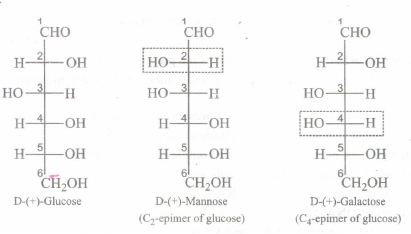
Carbohydrates which differ in configuration at the glycosidic carbon (i.e. \({ C }_{ 1 }\) in aldoses and \({ C }_{ 2 }\) in ketoses) are called anomers while those which differ in configuration at any carbon other than glycosidic carbon are called epimers. For example, \(\alpha \)-D-glucose and \(\beta \)-D-glucose are anomers since they differ in configuration at \({ C }_{ 1 }\) (glycosidic carbon) while glucose and mannose are called epimers since they differ in configuration at \({ C }_{ 2 }\)(other than the glycosidic carbon \({ C }_{ 1 }\) ). In other words, glucose and mannose are Cr epimers. Similarly, we can show that glucose and galactose are \({ C }_{ 4 }\) -epimers since they differ in configuration only at \({ C }_{ 4 }\).

12th Standard CBSE Syllabus & Materials
12th Standard CBSE
CBSE 12th Computer Science Python Revision Tour I - New Previous year Question Papers Study Material - QB365 Set A
NEW12th Standard CBSE
CBSE 12th Business Studies Planning Important Questions And Answers Study Material - QB365 Set A
NEW12th Standard CBSE
CBSE 12th Business Studies Business Environment Important Questions And Answers Study Material - QB365 Set A
NEW12th Standard CBSE
CBSE 12th Business Studies Principles of Management Important Questions And Answers Study Material - QB365 Set A



NCERT Books

Syllabus

Exam Pattern

Sample Question Papers

Previous year Question Papers

Important Notes

MCQ Practice test

NCERT Exemplers

Case study Questions

Image Based Questions

Passage based Questions

HOT Questions

Value Based Questions

Model Questions Papers
NCERT ( Book Back ) Questions

Assertion and Reason
Important Questions And Answers

CBSE 12th Standard CBSE Subjects
CBSE Standards









