
 100% FREE ACCESS
12th Standard CBSE Syllabus & Materials
12th Standard CBSE
CBSE 12th Economics Government Budget and the Economy Previous year Question Papers Study Material - QB365 Set A
NEW12th Standard CBSE
CBSE 12th Computer Science Interface Python with MySQL - New Previous year Question Papers Study Material - QB365 Set A
NEW12th Standard CBSE
CBSE 12th Computer Science Database Concept - New Previous year Question Papers Study Material - QB365 Set A
NEW12th Standard CBSE
CBSE 12th Computer Science Data Communication - New Previous year Question Papers Study Material - QB365 Set A
NEW12th Standard CBSE
CBSE 12th Computer Science Data Structures - New Previous year Question Papers Study Material - QB365 Set A
NEW12th Standard CBSE
CBSE 12th Computer Science Functions - New Previous year Question Papers Study Material - QB365 Set A

Published on: 21/05/2021
QB365 Provides the updated CASE Study Questions for Class 12 , and also provide the detail solution for each and every case study questions . Case study questions are latest updated question pattern from NCERT, QB365 will helps to get more marks in Exams
Download CBSE Class 12th Standard CBSE Chemistry question papers, sample papers, important questions, and previous year solved papers in PDF format. Get free study materials, NCERT solutions, and exam preparation resources for Class 12th Standard CBSE Chemistry
Questions + Answers key
Take MCQ Chemistry Test
1.
Read the passage given below and answer the following questions:
Glucose is known as dextrose because it occurs in nature as the optically active dextrorotatory isomer. It is essential constituent of human blood. The blood normally contains 65 to 110 mg of glucose per 100 mL (hence named Blood sugar). The level may be much higher in diabetic persons. The urine of diabetic persons also contain considerable amount of glucose. In combined form, it occurs in cane sugar and polysaccharides such as starch and cellulose.
Glucose has an aldehyde group (-CHO), one primary alcoholic group (-CH2OH) and four secondary alcoholic groups (-CHOH) in their structure. Due to the presence five hydroxyl groups (-OH), glucose acetylation. Glucose also undergoes oxidation with mild oxidising agents like bromine water as well as with strong oxidising agents like nitric acid. Since glucose is readily oxidised, it acts as a strong reducing agent and reduces Tollen's reagent and Fehling solution. Glucose exists in two crystalline forms: \(\alpha \) -D-glucose and \(\beta \) -Dglucose undergoes If either of the two forms is dissolved in water and allowed to stand, the specific rotation of the solution changes gradually, until a constant value is obtained. This change is called mutarotation.
In these questions (i-iv), a statement of assertion followed by a statement of reason is given. Choose the correct answer out of the following choices.
(a) Assertion and reason both are correct statements and reason is correct explanation for assertion.
(b) Assertion and reason both are correct statements but reason is not correct explanation for assertion.
(c) Assertion is correct statement but reason is wrong statement.
(d) Assertion is wrong statement but reason is correct statement.
(i) Assertion: A diabetic person carries a packet of glucose with him always.
Reason: Glucose increases the blood sugar level almost instantaneously.
(ii) Assertion: On oxidation with nitric acid, glucose as well as gluconic acid both yield saccharic acid.
Reason: The pentaacetate of glucose does not react with hydroxylamine indicating the absence of free -CHO group.
(iii) Assertion: Glucose reacts with acetyl chloride to form pentaacetyl glucose.
Reason: The formation of pentaacetyl derivative confirms the presence of five -OH groups in glucose.
(iv) Assertion: A certain compound gives negative test with ninhydrin and positive test with Benedict's solution, the compound is an amino acid.
Reason: Glucose is a monosaccharide.
2.
Read the passage given below and answer the following questions:
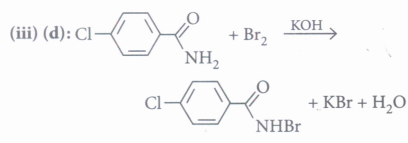
RCONH2 is converted into RNH2 by means of Hoffmann bromamide degradation. During the reaction amide is treated with Br2 and alkali to get amine. This reaction is used to descend the series in which carbon atom is removed as carbonate ion (CO32-). Hoffmann bromide degradation reaction can be written as :
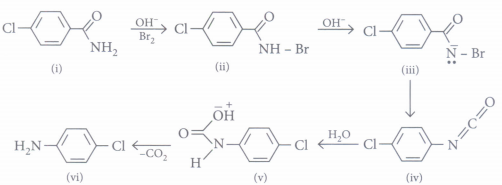
The following questions are multiple choice questions. Choose the most appropriate answer:
(i) Hoffmann bromamide degradation is used for the preparation of
| (a) primary amines | (b) secondary amines | (c) tertiary amines | (d) secondary aromatic amines. |
(ii) Which is the rate determining step in Hoffmann bromamide degradation?
| (a) Formation of (i) | (b) Formation of (ii) | (c) Formation of (iii) | (d) Formation of (iv). |
(iii) Which of the following are used for the conversion of (i) to (ii)?
| (a) KBr | (b) KBr + CH3ONa | (c) KBr + KOH | (d) Br2 + KOH |
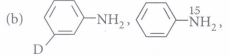
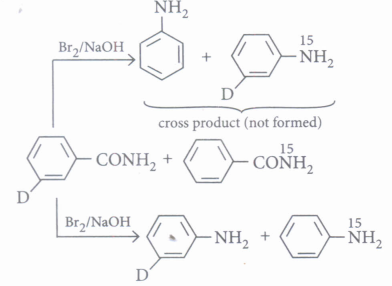
(iv) What are the constituent amines formed when the mixture of (i) and (ii) undergoes Hoffmann bromamide degradation?
 |
 |
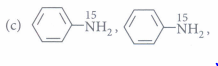 |
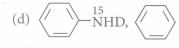 |
3.
Read the passage given below and answer the following questions:
All the elements of group 16 have ns2 np4 configuration in their outermost shell. Therefore, the atoms of these elements try to gain or share two electrons to achieve noble gas configuration. Sulphur and other elements of group 16 are less electronegative than oxygen, so, they cannot accept electrons easily. By sharing of two electrons with other elements, these elements acquire ns2 np6 configuration and exhibit +2 oxidation state. Except oxygen, group 16 elements have vacant d-orbitals in their valence shell to which electrons can be promoted from p- and s-orbitals of the same shell. As a result, they can show +4 and +6 oxidation states also.
The following questions are multiple choice questions. Choose the most appropriate answer:
(i) Oxygen shows +2 oxidation state in
| (a) OF2 | (b) H2O | (c) Cl2O | (d) H2O2 |
(ii) Like sulphur, oxygen is not able to show +4 and +6 oxidation states because
| (a) oxygen is a gas while sulphur is a solid |
| (b) sulphur has high ionisation enthalpy as compared to oxygen |
| (c) oxygen has no d-orbitals in its valence shell |
| (d) oxygen has high electron affinity as compared to sulphur. |
(iii) Oxidation state of sulphur in Na2S4O6
| (a) 7/2 | (b) 5/2 | (c) 1/2 | (d) 3/2 |
(iv) The oxidation states of sulphur in S8' SO3 and H2S are respectively
| (a) 0, +6 and -2 | (b) +6,0 and -2 | (c) -2,0 and +6 | (d) +2, +6 and -2 |
4.
Read the passage given below and answer the following questions:
When a solution of an \(\alpha \) -amino acid is placed in an electric field depending on the pH of the medium, following three cases may happen.

(i) In alkaline solution,\(\alpha \) -amino acids exist as anion II, and there is a net migration of amino acid towards the anode.
(ii) In acidic solution, \(\alpha \) -amino acids exist as cation III, and there is a net migration of amino acid towards the cathode.
(iii) If II and III are exactly balanced there is no net migration; under such conditions anyone molecule exists as a positive ion and as a negative ion for exactly the same amount of time, and any small movement in the direction of one electrode is subsequently cancelled by an equal movement back toward the other electrode. The pH of the solution in which a particular amino acid does not migrate under the influence of an electric field is called the isoelectric point of that amino acid.
The following questions are multiple choice questions. Choose the most appropriate answer:
(i) 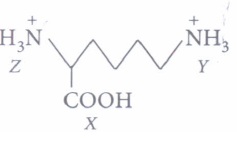
Arrange in order of increasing acid strengths.
| (a) X>Z>Y | (b) Z |
(c) X>Y>Z | (d) Z>X>Y |
(ii) In aqueous solutions, amino acids mostly exist as
| \(\text { (a) } \mathrm{NH}_{2}-\mathrm{CH} R-\mathrm{COOH}\) | \(\text { (b) } \mathrm{NH}_{2}-\mathrm{CH} R-\mathrm{COO}^{-}\) |
| \(\text { (c) } \mathrm{NH}_{3} \mathrm{CH} R \mathrm{COOH}\) | \(\text { (d) } \mathrm{H}_{3} \mathrm{NCH} R \mathrm{COO}^{-}\) |
(iii) Amino acids are least soluble
| (a) at pH 1 | (b) at pH 7 |
| (c) at their isoelectric points | (d) none of these. |
(iv) The \(pK_{a_{1}}\)and \(pK_{a_{2}}\) of an amino acid are 2.3 and 9.7 respectively. The isoelectric point of the amino acid is
| (a) 12.0 | (b) 7.4 | (c) 6.0 | (d) 3.7 |
5.
Read the passage given below and answer the following questions:
Carboxylic acids having an a-hydrogen atom when treated with chlorine or bromine in the presence of small amount of red phosphorus gives a-halo carboxylic acids. The reaction is known as Hell- Volhard-Zelinsky reaction.
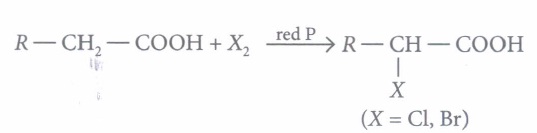
When sodium salt of carboxylic acid is heated with soda lime it loses carbon dioxide and gives hydrocarbon with less number of C-atoms.

In these questions (i - iv), a statement of assertion followed by a statement of reason is given. Choose the correct answer out of the following choices.
(a) Assertion and reason both are correct statements and reason is correct explanation for assertion.
(b) Assertion and reason both are correct statements but reason is not correct explanation for assertion.
(c) Assertion is correct statement but reason is wrong statement.
(d) Assertion is wrong statement but reason is correct statement.
(i) Assertion: (CH3)3CCOOH does not give H.V.Z reaction.
Reason: (CH3)3CCOOH does not have \(\alpha\)-hydrogen atom.
(ii) Assertion: H.V.Z. reaction involves the treatment of carboxylic acids having \(\alpha\)-hydrogens with Cl2 or Br2 in presence of small amount of redphosphorus.
Reason : Phosphorus reacts with halogens to form phosphorus trihalides.
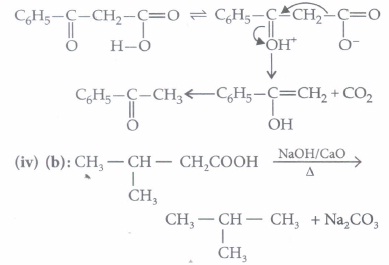
(iii) Assertion: C6H5COCH2COOH undergoes decarboxylation easily than C6H5COCOOH.
Reason : C6H5COCH2COOH is a 13-ketoacid.
(iv) Assertion: On heating 3-methylbutanoic acid with soda lime, isobutane is obtained.
Reason: Soda lime is a mixture of NaOH + CaO in the ratio 3 : 1.
6.
Read the passage given below and answer the following questions:
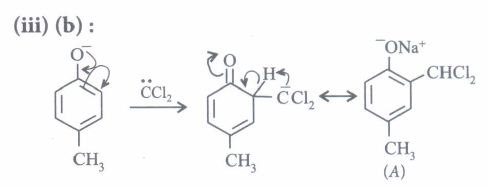
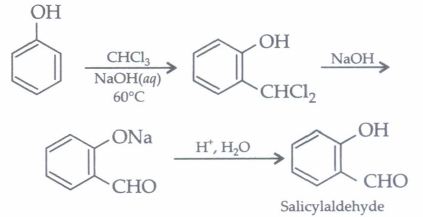
Reimer- Tiemann reaction introduces an aldehyde group, on aromatic ring of phenol, ortho to the hydroxyl group. This is a general method for the synthesis of substituted salicylaldehydes as depicted below.
The following questions are multiple choice questions. Choose the most appropriate answer:
(i) Reimer-Tiemann reaction is an example of
| (a) nucleophilic substitution reaction | (b) electrophilic substitution reaction |
| (c) nucleophilic addition reaction | (d) electrophilic addition reaction |
(ii) Which of the following reagents is used in the given reaction in steps I?
| (a) aq. NaOH + CH3CI | (b) aq. NaOH + CH2Cl2 | (c) aq. NaOH + CHCl3 | (d) aq. NaOH + CCl4 |
(iii) The structure of the intermediate [A] is
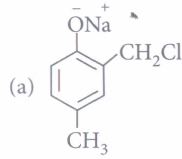 |
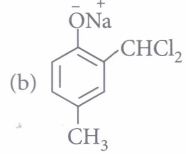 |
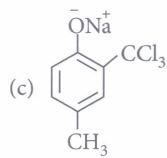 |
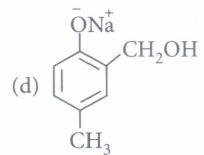 |
(iv) When phenol reacts with chloroform in presence of KOH, the product formed is
| (a) salicylic acid | (b) salicylaldehyde | (c) both (a) and (b) | (d) none of these. |
7.
Read the passage given below and answer the following questions :
Hardy Schulze rule states that the precipitating effect of an ion on dispersed phase of opposite charge increases with the valency of the ion. The higher the valency of the flocculating ion, the greater is its precipitating power. Thus, for the precipitation of AS2 S3 sol (-ve sol) the precipitating power of Al3+, Ba2+ and Na+ ions is of the order, Al3+> Ba2+ > Na+. Similarly, for precipitating Fe(OH)3 sol (-ve sol) the precipitating power of \(\left[\mathrm{Fe}(\mathrm{CN})_{6}\right]^{3-}\)\(\mathrm{SO}_{4}^{2-}\) and Cl- is of the order,\(\left[\mathrm{Fe}(\mathrm{CN})_{6}\right]^{3-}>\mathrm{SO}_{4}^{2-}>\mathrm{Cl}^{-}\) . The minimum concentration of an electrolyte in millimoles per litre required to cause precipitation of a sol in 2 hours is called flocculation value. The smaller the flocculation value, the higher will be the coagulating power of the ion. The minimum mass of the protective colloid (lyophilic colloid) in milligrams that must be added to 10 mL of a standard red gold sol so that no coagulation occurs when 1 mL of 10% NaCl solution is rapidly added to it is called the gold number of the protective colloid.
The following questions are multiple choice questions. Choose the most appropriate answer:
(i) The gold number of four protective colloids A, B, C and Dare 0.03, 0.003, 10 and 30 respectively. Protective power of these colloids will be of the order:
| (a) B > A > C > D | (b) A > B > C > D | (c) C >B> D > A | (d) D > A > C > |
(ii) Which of the following has least flocculating value for positive sol?
| (a) Cl- | (b) \(\mathrm{SO}_{4}^{2-}\) | (c) \(\mathrm{PO}_{4}^{3-}\) | (d) [Fe(CN6)4- |
(iii) Which of the following colloidal solutions is positively charged?
| (a) TiO2 | (b) AS2 S3 | (c) Blood | (d) Gold sol |
(iv) The coagulation value in millimoles per litre of electrolytes used for the coagulation of As2 S3 are as below:
| I. NaCl = 52 | II. KCl = 50 | III. BaCl2 = 0.69 | IV. MgSO4 = 0.72 |
The correct order of their flocculating power is
| (a) I > II > III > IV | (b) I > II > IV > III | (c) I < II < IV <III | (d) IV < I < II < III |
8.
Read the passage given below and answer the following questions:
The aryl halides are relatively less reactive towards nucleophilic substitution reactions as compared to alkyl halides. This low reactivity can be attributed to the following factors:
1. The C - X bond in halobenzene has a partial double bond character due to involvement of halogen electrons in resonance with benzene ring.
2. The C - X bond in aryl halides is less polar as compared to that in alkyl halides as sp2 hyridised carbon is more electronegative than sp3 hybridised carbon.
In these questions ( i-iv), a statement of assertion followed by a statement of reason is given. Choose the correct answer out of the following choices.
(a) Assertion and reason both are correct statements and reason is correct explanation for assertion.
(b) Assertion and reason both are correct statements but reason is not correct explanation for assertion.
(c) Assertion is correct statement but reason is wrong statement.
(d) Assertion is wrong statement but reason is correct statement.
(i) Assertion: Primary benzylic halides are more reactive than primary alkyl halides towards SN1 reactions.
Reason: Reactivity depends upon the nature of the nucleophile and the solvent.
(ii) Assertion : 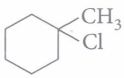 is more reactive than
 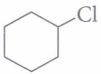 towards nucleophilic substitution reactions.
Reason: Tertiary alkyl halides react predominantly by SN1 mechanism.
(iii) Assertion: Chlorobenzene is more reactive than p-chloroanisole to nucleophilic substitution reactions.
Reason: Greater the stability of'carbanion, greater is its ease of formation and hence, more reactive is the aryl halide.
(iv) Assertion: Chlorobenzene is less reactive than benzene towards the electrophilic substitution reaction.
Reason: Resonance destabilises the carbo cation.
9.
Read the passage given below and answer the following questions:
Consider the given sequence of reactions:
The following questions are multiple choice questions. Choose the most appropriate answer:
(i) Identify w.
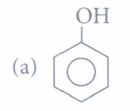 |
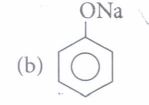 |
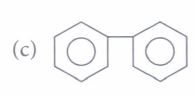 |
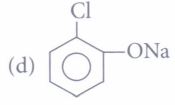 |
(ii) When X reacts with CH3COCI in presence of anhy. AICI3, the reaction is known as
| (a) Fittig reaction | (b) Ullmann reaction | (c) Wurtz-Fittig reaction | (d) Friedel-Crafts acylation reaction. |
(iii) When X is treated Ni-Al / NaOH the product obtained is
| (a) benzene | (b) phenol | (c) p-chlorophenol | (d) triphenyl. |
(iv) Compound Z is
| (a) phenol | (b) p-chlorophenol | (c) p-nitrophenol | (d) nitrobenzene |
10.
Read the passage given below and answer the following questions:
Few colligative properties are:
(a) relative lowering of vapour pressure: depends only on molar concentration of solute (mole fraction) and independent of its nature.
(b) depression in freezing point: it is proportional to the molal concentration of solution.
(c) elevation of boiling point: it is proportional to the molal concentration of solute.
(d) osmotic pressure: it is proportional to the molar concentration of solute.
A solution of glucose is prepared with 0.052 g at glucose in 80.2 g of water. (Kf = 1.86 K kg mol-1 and Kb = 5.2 K kg mol-1)
The following questions are multiple choice questions. Choose the most appropriate answer:
(i) Molality of the given solution is
| (a) 0.0052 m | (b) 0.0036 m | (c) 0.0006 m | (d) 1.29 m |
(ii) Boiling point for the solution will be
| (a) 373.05 K | (b) 373.15 K | (c) 373.02 K | (d) 372.98 K |
(iii) The depression in freezing point of solution will be
| (a) 0.0187 K | (b) 0.035 K | (c) 0.082 K | (d) 0.067 K |
(iv) Mole fraction of glucose in the given solution is
| (a) 6.28 x 10⁻⁵ | (b) 1.23 x 10⁻⁴ | (c) 0.00625 | (b) 0.00028 |
11.
Read the passage given below and answer the following questions :
Decrease in concentration of reactant or increase in concentration of product per unit time is called rate of reaction. It is of two types:
(i) Instantaneous rate of reaction : Rate of change of concentration of reactant or product at a particular time is called instantaneous rate of reaction.
\(r_{\text {inst. }}=\frac{d C}{d t}\)
where, dC = infinitely small change in concentration
dt = infinitely small change in time.
(ii) Average rate of reaction: Ratio of change in concentration and time required for the change is average rate of reaction.
\(r_{a v}=\frac{\Delta x}{\Delta t}=\frac{\text { Change in concentration }}{\text { Time required for the change }}\)
For a reaction of the type, \(m_{1} A+m_{2} B \rightarrow n_{1} C+n_{2} D\)
Rate of reaction is given as
\(-\frac{1}{m_{1}} \frac{d[A]}{d t}=-\frac{1}{m_{2}} \frac{d[B]}{d t}=+\frac{1}{n_{1}} \frac{d[C]}{d t}=+\frac{1}{n_{2}} \frac{d[D]}{d t}\)
In these questions (i-iv), a statement of assertion followed by a statement of reason is given. Choose the correct answer out of the following choices.
| (a) Assertion and reason both are correct statements and reason is correct explanation for assertion |
| (b) Assertion and reason both are correct statements but reason is not correct explanation for assertion |
| (c) Assertion is correct statement but reason is wrong statement. |
| (d) Assertion is wrong statement but reason is correct statement. |
(i) Assertion : The kinetics of the reaction,\(m A+n B+p C \rightarrow m^{\prime} X+n^{\prime} Y+p^{\prime} Z\) obey the rate expression as \(\frac{d x}{d t}=k[A]^{m}[B]^{n}\) .
Reason : The rate of the reaction does not depend upon the concentration of C.
(ii) Assertion: Instantaneous rate of reaction is equal to dx/ dt.
Reason : It is the rate of reaction at any particular instant of time.
(iii) Assertion : For the reaction,\(R \mathrm{Cl}+\mathrm{NaOH} \rightarrow \mathrm{ROH}+\mathrm{NaCl}\) the rate of reaction is reduced to half on reducing the concentration of RCl to half.
Reason : The sate of reaction is represented by k[RCl].
(iv) Assertion : In rate law, unlike in the expression for equilibrium constants, the exponents for concentrations do not necessarily match the stoichiometric coefficients.
Reason: It is the mechanism and not the balanced chemical equation for the overall change that governs the reaction rate.
12.
Read the passage given below and answer the following questions :
Number of molecules which must collide simultaneously to give product is called molecularity. It is equal to sum of coefficients of reactants present in stoichiometric chemical equation. For reaction, \(m_{1} A+m_{2} B \rightarrow \text { Product }\)
Molecularity = [m1 + m2 ]
In complex reaction each step has its own molecularity which is equal to the sum of coefficients of reactants present in a particular step. Molecularity is a theoretical property. Its value is any whole number. Number of concentration terms on which rate of reaction depends is called order of reaction or sum of powers of concentration terms present in the rate equation is called order of reaction.
If rate equation of reaction is : Rate = \(k \cdot C_{A}^{m_{1}} \cdot C_{B}^{m_{2}}\)
Then order of reaction = m1 + m2
In simple reaction, order and molecularity are same. In complex reaction, order of slowest step is the order of over all reaction. This step is known as rate determining step. Order is an experimental property. Its value may be zero, fractional or negative.
The following questions are multiple choice questions. Choose the most appropriate answer:
(i) Higher order (> 3) reactions are rare due to
| (a) shifting of equilibrium towards reactants due to elastic collisions |
| (b) loss of active species on collision |
| (c) low probability of simultaneous collision of all the reacting species |
| (d) increase in entropy and activation energy as more molecules are involved |
(ii) The molecularity of the reaction:
\(6 \mathrm{FeSO}_{4}+3 \mathrm{H}_{2} \mathrm{SO}_{4}+\mathrm{KClO}_{3} \rightarrow \mathrm{KCl}+3 \mathrm{Fe}_{2}\left(\mathrm{SO}_{4}\right)_{3}+3 \mathrm{H}_{2} \mathrm{O} \text { is }\)
| (a) 6 | (b) 3 | (c) 10 | (d) 7 |
(iii) Which of the following statements is false in the following?
| (a) Order of a reaction may be even zero |
| (b) Molecularity of a reaction is always a whole number. |
| (c) Molecularity and order always have same values for a reaction. |
| (d) Order of a reaction depends upon the mechanism of the reaction. |
(iv) The rate of the reaction \(A+B+C \rightarrow \text { products }\) , is given by \(r=-\frac{d[A]}{d t}=k[A]^{1 / 2}[B]^{1 / 3}[C]^{1 / 4}\) ,The order of the reaction is
| (a) \(\frac{1}{3}\) | (b) \(\frac{1}{4}\) | (c) \(\frac{1}{2}\) | (d) \(\frac{13}{12}\) |
13.
Read the passage given below and answer the following questions:
Most important crystal lattices are the simple cubic, body centred cubic and face centred cubic. In simple cubic lattice, all the atoms are present at all the corners of the cube. In body-centred cubic lattice, atoms are present at all the corners and at the body-centre. In face-centred cubic lattice, atoms are present at the corners and at the centers of all' six faces.
In the formation of crystals, the constituent particles get closely packed together. The closely packed arrangement is that in which maximum available space is occupied leaving minimum vacant space. The most efficient close packing, can be achieved in two ways, one which is called hexagonal close packing (hcp) and the other, cubic close packing (ccp or fcc).
In these questions (i-iv), a statement of assertion followed by a statement of reason is given. Choose the correct answer out of the following choices.
(a) Assertion and reason both are correct statements and reason is correct explanation for assertion.
(b) Assertion and reason both are correct statements but reason is not correct explanation for assertion.
(c) Assertion is correct statement but reason is wrong statement.
(d) Assertion is wrong statement but reason is correct statement.
(i) Assertion: Face centred cubic cell has 4 atoms per unit cell.
Reason: In fcc unit cell, there are 8 atoms at the corners and 6 atoms at face centres.
(ii) Assertion: fee and hep have same packing efficiency.
Reason: bee and fee both have same number of atoms per unit cell and same arrangement.
(iii) Assertion: The total number of atoms present in a simple cubic unit cell is one.
Reason: Simple cubic unit cell has atoms at its corners, each of which is shared between eight adjacent unit cells.
(iv) Assertion: The packing efficiency is maximum for the fccstructure.
Reason: The coordination number is 12 in fcc structures.
14.
Read the passage given below and answer the following questions:
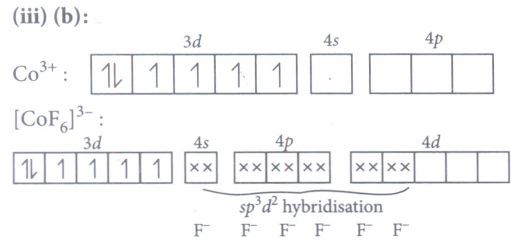
To explain bonding in coordination compounds various theories were proposed. One of the important theory was valence bond theory. According to that, the central metal ion in the complex makes available a number of empty orbitals for the formation ofcoordination bonds with suitable ligands. The appropriate atomic orbitals of the metal hybridise to give a set of equivalent orbitals of definite geometry. The d-orbitals involved in the hybridisation may be either inner d-orbitals i.e., (n - 1) d or outer d-orbitals i.e., nd. For example, CO3+ forms both inner orbital and outer orbital complexes, with ammonia it forms [Co(NH3)6]3+ and with fluorine it forms [CoF6]3- complex ion.
The following questions are multiple choice questions. Choose the most appropriate answer:
(i) Which of the following is not true for [CoF6]3- ?
| (a) It is paramagnetic. | (b) It has coordination number of 6. |
| (c) It is outer orbital complex. | (d) It involves d2sp3 hybridisation. |
Which of the following is true for [Co(NH3)6]3+ ?
| (a) It is an octahedral, dimagnetic and outer orbital complex. |
| (b) It is an octahedral, paramagnetic and outer orbital complex. |
| (c) It is an octahedral, paramagnetic and inner orbital complex. |
| (d) It is an octahedral, dimagnetic and inner orbital complex. |
(iii) The paramagnetism of [CoF6]3- is due to
| (a) 3 electrons | (b) 4 electrons | (c) 2 electrons | (d) 2 electrons |
(iv) Which of the following is an inner orbital or low spin complex?
| (a) \(\left[\mathrm{Ni}\left(\mathrm{H}_{2} \mathrm{O}\right)_{6}\right]^{3+}\) | (b)\(\left[\mathrm{FeF}_{6}\right]^{3-}\) | (c) \(\left[\mathrm{Co}(\mathrm{CN})_{6}\right]^{3-}\) | (d) \(\left[\mathrm{NiCl}_{4}\right]^{2-}\) |
15.
Read the passage given below and answer the following questions:
Electrical work done in unit time is equal to electrical potential multiplied by total charge passed. In order to obtain maximum work from a cell, the charge has to be passed reversibly. The reversible work done by a cell is equal to decrease in its Gibb's energy. Hence, Gibb's energy of reaction is given by
\(\Delta G=-n F E_{\text {cell }}\)
Hence, E is the emf of the cell and nF is the amount of energy.
In these questions (i-iv), a statement of assertion followed by a statement of reason is given. Choose the correct answer out of the following choices
(i) Assertion : \(\Delta G^{\circ}=-n F E^{\circ}\)
Reason : Eo should be positive for a spontaneous reaction
| (a) Assertion and reason both are correct statements and reason is correct explanation for assertion |
| (b) Assertion and reason both are correct statements but reason is not correct explanation for assertion. |
| (c) Assertion is correct statement but reason is wrong statement. |
| (d) Assertion is wrong statement but reason is correct statement. |
(ii) Assertion : An electrochemical cell can be set up only if the redox reaction is spontaneous.
Reason : A reaction is spontaneous if free energy change is negative.
| (a) Assertion and reason both are correct statements and reason is correct explanation for assertion |
| (b) Assertion and reason both are correct statements but reason is not correct explanation for assertion. |
| (c) Assertion is correct statement but reason is wrong statement. |
| (d) Assertion is wrong statement but reason is correct statement. |
(iii) Assertion : Current stops flowing when Ecell = 0.
Reason : Equilibrium of the cell reaction is attained.
| (a) Assertion and reason both are correct statements and reason is correct explanation for assertion |
| (b) Assertion and reason both are correct statements but reason is not correct explanation for assertion. |
| (c) Assertion is correct statement but reason is wrong statement. |
| (d) Assertion is wrong statement but reason is correct statement. |
(iv) Assertion: Ecell should have a positive value for the cell to function.
Reason : Ecell = Ecathode - Eanode
| (a) Assertion and reason both are correct statements and reason is correct explanation for assertion |
| (b) Assertion and reason both are correct statements but reason is not correct explanation for assertion. |
| (c) Assertion is correct statement but reason is wrong statement. |
| (d) Assertion is wrong statement but reason is correct statement. |
1.
(i) (a)
(ii) (b): 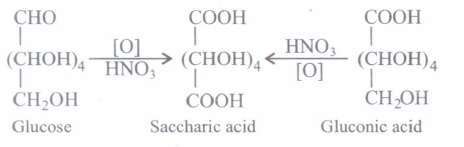
Strong oxidising agents like nitric acid oxidises both the terminal -CHO and -CH2OH groups of glucose to give the dibasic acid, saccharic acid.
(iii) (b)
(iv) (d): If a certain compound gives negative test with ninhydrin and positive test with Benedict's solution then the compound should be a monosaccharide.
2.
(i) (a)
(ii) (d): The rate determining step is probably loss of Br- to form isocyanate as this is the slowest step.
(iv) (b): Since, the overall reaction is intermolecular, hence there will be no effect on product formation.
3.
(i) (a) : As fluorine is more electronegative than oxygen, so, oxygen exhibits +2 oxidation state in OF2.
(c) : In SO2 sulphur having +4 oxidation state, so it can lose its two more electrons to attain +6 oxidation state. It can gain electrons to attain its lowest oxidation state of -2. Therefore, it can behave as both reducing and oxidising agent.
(iii) (b) : \(\mathrm{Na}_{2} \mathrm{~S}_{4} \mathrm{O}_{6} \Rightarrow 2(+1)+4 x+6(-2)=0 \Rightarrow x=5 / 2\)
(iv) (a)
4.
(i) (a): Carboxylic acids are stronger acids than - +NH3, therefore X is the strongest acid. Since -COOH has -I effect which decreases with distance therefore, effect is more pronounced on Z than on Y. As a result Z is more acidic than Y, therefore, overall order of increasing acid strength is X > Z > Y.
(ii) (d): In aqueous solutions, amino acids mostly exist as zwitter ion or dipolar ion
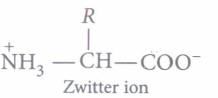
(iii) (c) : Amino acids are least soluble at their isoelectric points. At a specific pH, called isoelectric point, the positive and negative charges balance each other and the net charge becomes zero. If there is a charge, the amino acid prefers to interact with water, rather than other amino acid molecules, this charge makes it more soluble.
(iv) (c) : Isoelectric point = \(\frac{2.3+9.7}{2}=6\)
5.
(i) (a)
(ii) (c): Phosphorus converts a little .of the acid into acid chloride which is more reactive than the parent carboxylic acid. Thus, it is the acid chloride, not the acid itself, that undergoes chlorination at the \(\alpha\)-carbon.
(iii) (a): \(\beta\)-ketoacids are unstable acids. They readily undergo decarboxylation through a cyclic transition state.
(i) (b): All aliphatic aldehydes give red ppt. with
Fehling's solution, but ketones do not reduce Fehling's
solution.
(ii) (e): Aliphatic aldehydes reduce Fehling's solution,
but aromatic aldehydes do not.
6.
(i) (b): It is an electrophilic substitution reaction.
(ii) (c)
(iv) (b): It is known as Reimer-Tiemann reaction.
7.
(i) (a) : Lesser is the gold number, greater is the protective power.
(ii) (d) : Charge of [Fe(CN)6]4- is highest, hence, it will be most effective for the coagulation of positive colloids. More is the coagulating power lesser will be the flocculating value.
(iii) (a)
(iv) (c) : Coagulation value is inversely proportional to their flocculating power.
8.
(i) (b): Primary benzylic halides show higher reactivity in SN1reactions than primary alkyl halides. This is due to the greater stabilisation of the benzylic carbocation intermediates by resonance.
(ii) (a)
(iii) (a) : On comparing the relative stabilities of carbanion of chlorobenzene and p-chloroanisole.
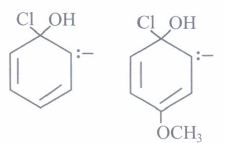
the electron donating group (OCH3) in anisole tends to intensify the negative charge relative to carbanion in chlorobenzene. Thus, p-chloroanisole is less reactive than chlorobenzene.
(iv) (c): Chlorobenzene is less reactive than benzene towards the electrophilic substitution reactions due to -I effect.
9.
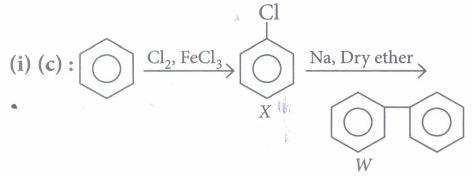
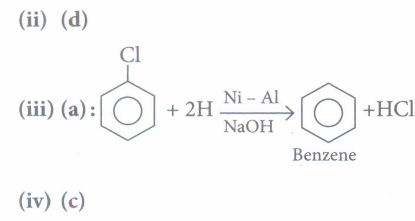
10.
(i) (b): m \(=\frac{0.052}{180} \times \frac{1000}{80.2}=0.0036\)
(ii) (c): \(\Delta T_{b}=K_{b} \times m=5.2 \times 0.0036=0.0187 \mathrm{~K}\)
\(T_{b}=373+0.0187=373.0187 \mathrm{~K} \approx 373.02 \mathrm{~K}\)
(iii) (d): \(\Delta T_{f}=K_{f} \times m=1.86 \times 0.0036=0.067 \mathrm{~K}\)
(iv) (a): Moles of glucose \(=\frac{0.052}{180}=0.00028\)
Moles 0f water = \(\frac{80.2}{18}=4.455\)
Mole fraction of glucose = \(\frac{0.00028}{4.45+0.00028}=6.28 \times 10^{-5}\)
11.
(i) (a) : Rate expression \(\frac{d x}{d t}=k[A]^{m}[B]^{n}\)
shows that the total order of reactions is m + n + 0 = m + n, as the rate of reaction is independent of concentration of C, i.e., the order with respect to C is zero. This is the reason that C does not figure in the rate expression.
(ii) (b) : Instantaneous rate of a reaction is equal to small change in concentration (dx) during a small interval of time (dt) at that particular instant of time divided by the time interval.
(iii) (a) : For the given reaction, rate of reaction (r) = k[RCl] (where k is rate constant). Therefore if the concentration of [RCl] is reduced to half, then new rate \(\left(r^{\prime}\right)=\frac{k}{2}[R \mathrm{Cl}]\)
(iv) (a)
12.
(i) (c) : The reactions of higher order are very rare because of the less chances of the molecules to come together simultaneously and collide.
(ii) (c) : The total number of reactant molecules participating in a chemical reaction is known as its rnolecularity, hence the molecularity = 6 + 3 + 1 = 10.
(iii) (c) : Molecularity mayor may not be equal to the order of a reaction.
(iv) (d) : Order of reaction \(=\frac{1}{2}+\frac{1}{3}+\frac{1}{4}=\frac{6+4+3}{12}=\frac{13}{12}\)
13.
(i) (a)
(ii) (c): fcc and hep both have 74% packing efficiency. In bcc there are 2 atoms per unit cell while in fcc there are 4 atoms per unit cell and both have different arrangements.
(iii) (a)
(iv) (b): The no. of atoms in fcc structure is 4 per unit cell which provides a maximum efficiency as 74%.
14.
(i) (d): It involves sp3 d2 hybridisation and not d2sp3.
(ii) (d) : [Co(NH3)6]3+ is d2sp3 hybridised with all electrons paired hence, it is diamagnetic and inner
orbital complex.
(iv) (c): Inner orbital complexes are formed with strong ligands as they force electrons to pair up and hence the complex will be either diamagnetic or will have less number of unpaired electrons.
15.
(i) (b)
(ii) (b): If redox reaction is spontaneous, \(\Delta G\) is -ve and hence, Eo is positive.
\(-\Delta G^{\mathrm{o}}=n F E^{\circ} \mathrm{cell}\)
(iii) (a)
(iv) (b)

12th Standard CBSE Syllabus & Materials
12th Standard CBSE
CBSE 12th Computer Science Python Revision Tour I - New Previous year Question Papers Study Material - QB365 Set A
NEW12th Standard CBSE
CBSE 12th Business Studies Planning Important Questions And Answers Study Material - QB365 Set A
NEW12th Standard CBSE
CBSE 12th Business Studies Business Environment Important Questions And Answers Study Material - QB365 Set A
NEW12th Standard CBSE
CBSE 12th Business Studies Principles of Management Important Questions And Answers Study Material - QB365 Set A



NCERT Books

Syllabus

Exam Pattern

Sample Question Papers

Previous year Question Papers

Important Notes

MCQ Practice test

NCERT Exemplers

Case study Questions

Image Based Questions

Passage based Questions

HOT Questions

Value Based Questions

Model Questions Papers
NCERT ( Book Back ) Questions

Assertion and Reason
Important Questions And Answers

CBSE 12th Standard CBSE Subjects
CBSE Standards








