
 100% FREE ACCESS
12th Standard CBSE Syllabus & Materials
12th Standard CBSE
CBSE 12th Economics Government Budget and the Economy Previous year Question Papers Study Material - QB365 Set A
NEW12th Standard CBSE
CBSE 12th Computer Science Interface Python with MySQL - New Previous year Question Papers Study Material - QB365 Set A
NEW12th Standard CBSE
CBSE 12th Computer Science Database Concept - New Previous year Question Papers Study Material - QB365 Set A
NEW12th Standard CBSE
CBSE 12th Computer Science Data Communication - New Previous year Question Papers Study Material - QB365 Set A
NEW12th Standard CBSE
CBSE 12th Computer Science Data Structures - New Previous year Question Papers Study Material - QB365 Set A
NEW12th Standard CBSE
CBSE 12th Computer Science Functions - New Previous year Question Papers Study Material - QB365 Set A

Published on: 21/05/2021
QB365 Provides the updated CASE Study Questions for Class 12 , and also provide the detail solution for each and every case study questions . Case study questions are latest updated question pattern from NCERT, QB365 will helps to get more marks in Exams
Download CBSE Class 12th Standard CBSE Chemistry question papers, sample papers, important questions, and previous year solved papers in PDF format. Get free study materials, NCERT solutions, and exam preparation resources for Class 12th Standard CBSE Chemistry
Questions + Answers key
Take MCQ Chemistry Test
1.
Read the passage given below and answer the following questions :
Noble gases are inert gases with general electronic configuration of ns2np6. These are mono atomic, colourless, odourless and tasteless gases. The first compound of noble gases was obtained by the reaction of Xe with PtF6. A large number of compounds of Xe and fluorine have been prepared till now. The structure of these compounds can be explained on the basis of VSEPR theory as well as concept of hybridisation. The compounds of krypton are fewer. Only the difluoride of krypton (KrF2) has been studied in detail. Compounds of radon have not isolated but only identified by radio tracer technique. However, no true compounds of helium, neon or argon are yet known.
The following questions are multiple choice questions. Choose the most appropriate answer:
(i) The formula of the compound when Xe and PtF6 are mixed, is
| (a) XeF6 | (b) XeF4 | (c) Xe2PtF6 | (d) Xe+[PtF6]- |
(ii) Which of the following is not formed by Xe?
| (a) XeFs | (b) XeF | (c) XeF3 | (d) All of these |
(iii) The number of lone pairs and bond pairs of electrons around Xe in XeOF4 respectively are
| (a) O and 5 | (b) 1 and 5 | (c) 1 and 4 | (d) 2 and 3 |
(iv) Which of the following compounds has more than one lone pair of electrons around central atom?
| (a) XeO3 | (b) XeF2 | (c) XeOF4 | (d) XeO2F2 |
2.
Read the passage given below and answer the following questions:
Lucas test is a test to differentiate between primary, secondary and tertiary alcohols. This test consists of treating an alcohol with Lucas reagent, and turbidity, due to the formation of insoluble alkyl chloride, is observed. Lucas test is based on the difference in reacting of three classes of alcohols with hydrogen chloride via SN1 reaction. The different reactivity reflects the differing ease of formation of the corresponding carbocations.
In these questions (i-iv), a statement of assertion followed by a statement of reason is given. Choose the correct answer out of the following choices.
(a) Assertion and reason both are correct statements and reason is correct explanation for assertion.
(b) Assertion and reason both are correct statements but reason is not correct explanation for assertion.
(c) Assertion is correct statement but reason is wrong statement.
(d) Assertion is wrong statement but reason is correct statement.
(i) Assertion: Equimolar mixture of conc. HCI and anhydrous ZnCl2 is called Lucas' reagent.
Reason : Lucas' reagent can be used to distinguish between methanol and ethanol.
(ii) Assertion: 2-Methyl-2-butanol gives no turbidity with Lucas' reagent at room temperature.
Reason: It is a 3° alcohol
(iii) Assertion: Amongst the compounds, H2C =CHCH2OH (I), C6H5OH (II), CH3CH2CH2OH (III) and (CH3)3COH (IV), only (IV) reacts with Lucas' reagent at room temperature.
Reason : Tertiary alcohol gives turbidity immediately with Lucas' reagent.
(iv) Assertion: Lucas test can be used to distinguish between 1-propanol and 2-propanol.
Reason : Lucas test is based upon the difference in reactivity of primary, secondary and tertiary alcohols with conc. HCI and anhyd. ZnCI2.
3.
Read the passage given below and answer the following questions :
Carboxylic acids dissociate in water to give carboxylate ion and hydronium ion.
RCOOH + H2O \(\longrightarrow\) RCOO- + H3O+
The acidity of carboxyl group is due to the presence of positive charge on oxygen which liberates proton. The carboxylate ion formed is resonance stabilised.

Carboxylic acids are stronger acids than phenols. Electron withdrawing groups (EWG) increase the acidity of carboxylic acids by stabilising the conjugate base through delocalisation of negative charge by inductive and/ or resonance effects. Electron donating group (EDG) decrease the acidity by destabilising the conjugate base.
The following questions are multiple choice questions. Choose the most appropriate answer :
(i) Which of the following reactions is showing the acidic property of carboxylic acid?

(ii) Which one of the following is the correct order of acidic strength?
| (a) CF3COOH > CHCl2COOH > HCOOH > C6H5CH2COOH > CH3COOH |
| (b) CH3COOH > HCOOH > CF3COOH > CHCl2COOH > C6H5CH2COOH |
| (c) HCOOH > C6H5CH2COOH > CF3COOH > CHCl2COOH > CH3COOH |
| (d) CF3COOH > CH3COOH > HCOOH > CHCl2COOH > C6H5CH2COOH |
(iii) Which of the following acids has the smallest dissociation constant?
| (a) CH3CHFCOOH | (b) FCH2CH2COOH |
| (c) BrCH2CH2COOH | (d) CH3CHBrCOOH |
(iv) The correct order of acidity for the following compounds is
| (a) I > II > III > IV | (b) III > I > II > IV |
| (c) III> IV > II> I | (d) I > III > IV > II |
4.
Read the passage given below and answer the following questions:
A compound (X) containing C, Hand O is unreactive towards sodium. It also does not react with Schiff's reagent. On refluxing with an excess ofhydroiodic acid, (X) yields only one organic product (Y). On hydrolysis, (Y) yields a new compound (Z) which can be converted into (Y) by reaction with red phosphorus and iodine. The compound (Z) on oxidation with potassium permanganate gives a carboxylic acid. The equivalent weight of this acid is 60.
The following questions are multiple choice questions. Choose the most appropriate answer:
(i) The compound (X) is an
| (a) acid | (b) aldehyde | (c) alcohol | (d) ether |
(ii) The IUPAC name of the acid formed is
| (a) methanoic acid | (b) ethanoic acid | (c) propanoic acid | (d) butanoic acid. |
(iii) Compound (Y) is
| (a) ethyl iodide | (b) methyl iodide | (c) propyl iodide | (d) mixture of (a) and (b). |
(iv) Compound (X) on treatment with excess of Cl2 in presence of light gives
| (a) \(\alpha\) - chlorodiethyl ether | (b) \(\alpha\), \(\alpha\)' -dichlorodiethyl ether | (c) perchlorodiethyl ether | (d) none of these. |
5.
Read the passage given below and answer the following questions :
Adsorption is a spontaneous process and involves unequal distribution of the molecules of the gaseous substance on the surface of solid or liquid. Adsorption is an exothermic process. The attractive forces between adsorbate and adsorbent are either van der Waals' forces or chemical bonds. Adsorption of gases on solids is generally controlled by the factors like temperature, pressure and nature of adsorbate and adsorbent.
The following questions are multiple choice questions.Choose the most appropriate answer:
(i) In physisorption process, the attractive forces between adsorbate and adsorbent are
| (a) covalent bonds | (b) ionic bonds |
| (c) van der Waals' force | (d) H-bonds |
(ii) Which of the following graph represents the variation of physical adsorption with temperature?

(iii) Which one of the following processes does not use adsorption?
| (a) Froth floatation process | (b) Chromatography |
| (c) Decolourisation of sugar liquors | (d) Dissolution of sugar in water |
(iv) Which of the following statements is true?
| (a) Chemisorption forms unimolecular layer |
| (b) Chemisorption is a reversible process. |
| (c) Chemisorption is independent of pressure. |
| (d) Chemisorption has low enthalpy change. |
6.
Read the passage given below and answer the following questions:
When a chemical reaction involves bond cleavage or bond formation at an asymmetric carbon atom, three different products may be formed. For example, during the substitution of a group X by Y in the following reaction, the three possible products may be shown below:
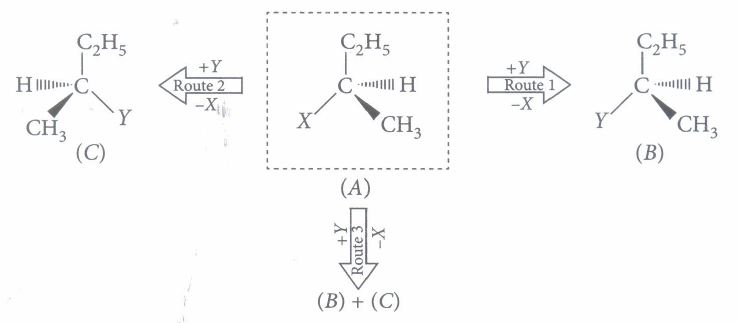
(i) If B is the only product, the process is called retention of configuration because B has the same configuration as the starting reactant (A).
(ii) If C is the only product, the process is called inversion of configuration because C has the configuration opposite to the starting reactant (A).
(iii) If an equimolar mixture of B and C (i.e., a 50 : 50 mixture) is formed, then the process is called racemisation and the product is optically inactive because one isomer will rotate the light in the direction opposite to another.
In these questions ( i-iv), a statement of assertion followed by a statement of reason is given. Choose the correct answer out of the following choices.
(a) Assertion and reason both are correct statements and reason is correct explanation for assertion.
(b) Assertion and reason both are correctstatements but reason is not correct explanation for assertion.
(c) Assertion is correct statement but reason is wrong statement.
(d) Assertion is wrong statement but reason is correct statement.
(i) Assertion: A reaction is said to be stereospecific if a particular stereoisomer of the reactant produces a specific stereoisomer of the product.
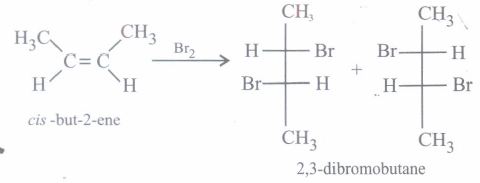
Reason: Bromination of cis-2-butene gives meso-2, 3-dibromobutane which is stereospecific
(ii) Assertion: Addition of Br2 to cis-but-2-ene is stereoselective.
Reason: SN2 reactions are stereospecific as well as stereoselective.
(iii) Assertion: Optically active 2-iodobutane on treatment with NaI in acetone undergoes recemization.
Reason: Repeated Walden inversions on the reactant and its product eventually gives a racemic mixture.
(iv) Assertion: SN2 reaction of an optically active alkyl halide with an aqueous solution of KOH always gives an alcohol with opposite sign of rotation.
Reason: SN2 reactions always proceed with inversion of configuration.
7.
Read the passage given below and answer the following questions:
When haloalkanes with \(\beta\)-hydrogen atom are boiled with alcoholic solution of KOH, they undergo elimination of hydrogen halide resulting in the formation of alkenes. These reactions are called \(\beta\)-elimination reactions or dehydrohalogenation reactions. These reactions follow Saytzeff's rule. Substitution and elimination reactions often compete with each other. Mostly bases behave as nucleophiles and therefore can engage in substitution or elimination reactions depending upon the alkyl halide and the reaction conditions.
The following questions are multiple choice questions. Choose the most appropriate answer:
(i) Among the following the most reactive towards alcoholic KOH is
|
(a) \(\mathrm{CH}_{2}=\mathrm{CHBr}\) |
(b) \(\mathrm{CH}_{3} \mathrm{COCH}_{2} \mathrm{CH}_{2} \mathrm{Br}\) |
(c) \(\mathrm{CH}_{3} \mathrm{CH}_{2} \mathrm{Br}\) |
(d) \(\mathrm{CH}_{3} \mathrm{CH}_{2} \mathrm{CH}_{2} \mathrm{Br}\) |
(ii) The general reaction, \(R-X \stackrel{\text { aq. } \mathrm{OH}^{-}}{\longrightarrow} R \mathrm{OH}+X^{-}\) is expected to follow decreasing order of reactivity as in (t- Bu = tertiary Butyl group)
| (a) t-BuI> t-BuBr > t-BuCI > t-BuF | (b) t-BuF> t-BuCI > t-BuBr > t-BuI |
| (c) t-Bu'Br> t-BuCI > t-BuI > t-BuF | (d) t-BuF> t-BuCI > t-BuI > t-BuBr |
(iii) Reaction of t-butyl bromide with sodium methoxide produces
| (a) sodium t-butoxide | (b) t-butyl methyl ether |
| (c) iso-butane | (d) iso-butylene. |
(iv) In the elimination reactions, the reactivity of alkyl halides follows the sequence
| (a) R - F > R - Cl > R - Br > R - I | (b) R - I > R - Br > R - Cl > R - F |
| (c) R - I > R - F > R - Br > R - Cl | (d) R - F > R-I > R-Br > R-CI |
8.
Read the passage given below and answer the following questions:
The properties of the solutions which depend only on the number of solute particles but not on the nature of the solute are called colligative properties. Relative lowering in vapour pressure is also an example of colligative properties.
For an experiment, sugar solution is prepared for which lowering in vapour pressure was found to be 0.061 mm of Hg. (Vapour pressure of water at 20°C is 17.5 mm of Hg.)
The following questions are multiple choice questions. Choose the most appropriate answer:
(i) Relative lowering of vapour pressure for the given solution is
| (a) 0.00348 | (b) 0.061 | (c) 0.122 | (d) 1.75 |
(ii) The vapour pressure (mm of Hg) of solution will be
| (a) 17.5 | (b) 0.61 | (c) 17.439 | (d) 0.00348 |
(iii) Mole fraction of sugar in the solution is
| (a) 0.00348 | (b) 0.9965 | (c) 0.061 | (d) 1.75 |
(iv) The vapour pressure (mm of Hg) of water at 293 K when 25 g of glucose is dissolved in 450 g of water is
| (a) 17.2 | (b) 17.4 | (c) 17.120 | (d) 17.02 |
9.
Read the passage given below and answer the following questions:
A reaction in which rate of reaction is independent of concentration of the reactants is called zero order reaction. Photochemical combination of hydrogen and chlorine to give hydrogen chloride is an example of zero order reaction. The rate constant of a zero order reaction is equal to the rate of reaction. The half life period of a zero order reaction is directly proportional to initial concentration of the reactant. For a zero order reaction, \(k=\frac{1}{t}\left\{[A]_{0}-[A]\right\}\)
In these questions (i-iv), a statement of assertion followed by a statement of reason is given. Choose the correct answer out of the following choices.
| (a) Assertion and reason both are correct statements and reason is correct explanation for assertion |
| (b) Assertion and reason both are correct statements but reason is not correct explanation for assertion. |
| (c) Assertion is correct statement but reason is wrong statement. |
| (d) Assertion is wrong statement but reason is correct statement |
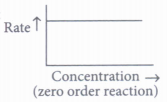
(i) Assertion : For a zero order reaction, plot of rate vs concentration will be a straight line parallel to concentration axis.
Reason : For a zero order reaction, rate is independent of concentration.
(ii) Assertion : Photochemical combination of hydrogen and chlorine to give hydrogen chloride is an example of zero order reaction.
Reason : The rate of reaction depends on the concentration of hydrogen and independent of concentration of chlorine.
(iii) Assertion : If in a zero order reaction, the concentration of the reactant is doubled, the half-life period is also doubled.
Reason : For a zero order reaction, the rate of reaction is independent of initial concentration
(iv) Assertion : In a reaction A -7 products, the concentration of the reactant is reduced to zero after a finite time.
Reason : The order of reaction is zero.
10.
Read the passage given below and answer the following questions:
For understanding the structure and bonding in transition metal complexes, the magnetic properties are very helpful. Low spin complexes are generally diamagnetic because of pairing of electrons, whereas high spin complexes are usually paramagnetic because of presence of unpaired electrons. Larger the number of unpaired electrons, stronger will be the paramagnetism. However magnetic behaviour of a complex can be confirmed from magnetic moment measurement. Magnetic moment \(\mu=\sqrt{n(n+2)} \text { B.M. }\)where n = number of unpaired electrons. Greater the number of unpaired electrons, more will be the magnetic moment.
In these questions ( i-iv), a statement of assertion followed by a statement of reason is given. Choose the correct answer out of the following choices.
(a) Assertion and reason both are correct statements and reason is correct explanation for assertion.
(b) Assertion and reason both are correct statements but reason is not correct explanation for assertion.
(c) Assertion is correct statement but reason is wrong statement.
(d) Assertion is wrong statement but reason is correct statement.
(i) Assertion: Both [Cr(H2O)6]2+ and [FeH2O)6]2+ have same magnetic moment.
Reason: Number of unpaired electrons in Cr2+ and Fe2+ are same.
(ii) Assertion: [Fe(H2O)5NO]SO4 is paramagnetic.
Reason: The Fe in [Fe(H2O)5NO]SO4 has three unpaired electrons.
(iii) Assertion: [Co(en)3]3+ is paramagnetic.
Reason: It is an inner orbital complex.
(iv) Assertion: [Ni(CN)4]2- is diamagnetic complex.
Reason: It involves dsl hybridisation and there is no unpaired electron.
11.
Read the passage given below and answer the following questions:
Nernst equation relates the reduction potential of an electrochemical reaction to the standard potential and activities of the chemical species undergoing oxidation and reduction. Let us consider the reaction, \(M_{(a q)}^{n+} \longrightarrow n M_{(s)}\)
For this reaction, the electrode potential measured with respect to standard hydrogen electrode can be given as
\(E_{\left(M^{n+} / M\right)}=E_{\left(M^{n+} / M\right)}^{\circ}-\frac{R T}{n F} \ln \frac{[M]}{\left[M^{n+}\right]}\)
In these questions ( i-iv), a statement of assertion followed by a statement of reason is given. Choose the correct answer out of the following choices.
| (a) Assertion and reason both are correct statements and reason is correct explanation for assertion. |
| (b) Assertion and reason both are correct statements but reason is not correct explanation for assertion |
| (c) Assertion is correct statement but reason is wrong statement |
| (d) Assertion is wrong statement but reason is correct statement. |
(i) Assertion : For concentration cell, \(\begin{array}{c} \mathrm{Zn}_{(s)}\left|\mathrm{Zn}^{2+}{ }_{(a q)} \| \mathrm{Zn}^{2+}{ }_{(a q)}\right| \mathrm{Zn} \\ \mathrm{C}_{1} \quad \mathrm{C}_{2} \end{array}\)
For spontaneous cell reaction, C1 < C2.
Reason : For concentration cell \(E_{\text {cell }}=\frac{R T}{n F} \log \frac{C_{2}}{C_{1}}\)
For spontaneous reaction, \(E_{\text {cell }}=+\mathrm{ve} \Rightarrow C_{2}>C_{1}\)
(ii) Assertion : For the cell reaction, \(\mathrm{Zn}_{(s)}+\mathrm{Cu}_{(a q)}^{2+} \longrightarrow \mathrm{Zn}_{(a q)}^{2+}+\mathrm{Cu}_{(s)}\) voltmeter gives zero reading at equilibrium.
Reason : At the equilibrium, there is no change in concentration of Cu2+ and Zn2+ ions.
(iii) Assertion : The Nernst equation gives the concentration dependence of emf of the cell.
Reason : In a cell, current flows from cathode to anode
(iv) Assertion : Increase in the concentration of copper half cell in a cell, increases the emf of the cell
Reason : \(E_{\text {cell }}=E_{\text {cell }}^{\circ}+\frac{0.059}{2} \log \frac{\left[\mathrm{Cu}^{2+}\right]}{\left[\mathrm{Zn}^{2+}\right]}\)
12.
Read the passage given below and answer the following questions:
To explain bonding in coordination compounds various theories were proposed. One of the important theory was valence bond theory. According to that, the central metal ion in the complex makes available a number of empty orbitals for the formation ofcoordination bonds with suitable ligands. The appropriate atomic orbitals of the metal hybridise to give a set of equivalent orbitals of definite geometry. The d-orbitals involved in the hybridisation may be either inner d-orbitals i.e., (n - 1) d or outer d-orbitals i.e., nd. For example, CO3+ forms both inner orbital and outer orbital complexes, with ammonia it forms [Co(NH3)6]3+ and with fluorine it forms [CoF6]3- complex ion.
The following questions are multiple choice questions. Choose the most appropriate answer:
(i) Which of the following is not true for [CoF6]3- ?
| (a) It is paramagnetic. | (b) It has coordination number of 6. |
| (c) It is outer orbital complex. | (d) It involves d2sp3 hybridisation. |
Which of the following is true for [Co(NH3)6]3+ ?
| (a) It is an octahedral, dimagnetic and outer orbital complex. |
| (b) It is an octahedral, paramagnetic and outer orbital complex. |
| (c) It is an octahedral, paramagnetic and inner orbital complex. |
| (d) It is an octahedral, dimagnetic and inner orbital complex. |
(iii) The paramagnetism of [CoF6]3- is due to
| (a) 3 electrons | (b) 4 electrons | (c) 2 electrons | (d) 2 electrons |
(iv) Which of the following is an inner orbital or low spin complex?
| (a) \(\left[\mathrm{Ni}\left(\mathrm{H}_{2} \mathrm{O}\right)_{6}\right]^{3+}\) | (b)\(\left[\mathrm{FeF}_{6}\right]^{3-}\) | (c) \(\left[\mathrm{Co}(\mathrm{CN})_{6}\right]^{3-}\) | (d) \(\left[\mathrm{NiCl}_{4}\right]^{2-}\) |
13.
Read the passage given below and answer the following questions:
The idealized ionic solid consists of two interpenetrating lattices of oppositely-charged point charges that are held in place by a balance of coulombic force of long range. But real ions occupy space, no such "perfect" ionic solid exists in nature. Chemists usually apply the term "ionic solid" to binary compounds of the metallic elements of groups 1 - 2 with one of the halogen elements or oxygen. The most well known ionic solid is sodium chloride, also known by its geological names as rock-salt or halite. Structurally, each ion in sodium chloride is surrounded and held in tension by six neighbouring ions of opposite charge; this is known as (6, 6) coordination. The resulting crystal lattice is of a type known as simple cubic. There are many other fundamental ionic structures (not all cubic) and these are:
Zinc blende structure (ZnS) : having ccp arrangement of S2- and Zn2+ in alternate tetrahedral voids; Wurtzite structure (ZnS) : having hcp arrangement of S2- and Zn2+ in alternate tetrahedral voids; Fluorite structure (CaF2) : having ccp arrangement of Ca2+ and F- in all tetrahedral voids; Antifluorite structure (Na2O): having ccp arrangement of O2- and Na+ in all tetrahedral voids. These solids tend to be quite hard and have high melting points.
The following questions are multiple choice questions. Choose the most appropriate answer:
(i) In NaCl crystal, each Cl- ion is surrounded by
| (a) 4 Na+ ions | (b) 6 Na+ ions | (c) 1Na+ ion | (d) 2 Na+ ions. |
(ii) In an antifluorite structure, cations occupy
| (a) tetrahedral voids | (b) centre of cube | (c) octahedral voids | (d) corners of cube |
(iii) Antifluorite structure is derived from fluorite structure by
| (a) heating fluorite crystal lattice |
| (b) subjecting fluorite structure to high pressure |
| (c) interchanging the positions of positive and negative ions in the lattice |
| (d) none of these. |
(iv) Ionic solid BaF2 has which kind of structure?
| (a) Fluorite | (b) Antifluorite | (c) Wurtzite | (d) Rock-salt |
14.
Read the passage given below and answer the following questions:
Standard electrode potentials are used for various processes:
(i) It is used to measure relative strengths of various oxidants and reductants.
(ii) It is used to calculate standard cell potential.
(iii) It is used to predict possible reactions.
A set of half-reactions (in acidic medium) along with their standard reduction potential, Eo (in volt) values are given below
\(\mathrm{I}_{2}+2 e^{-} \rightarrow 2 \mathrm{I}^{-} ; \quad E^{\circ}=0.54 \mathrm{~V}\)
\(\mathrm{Cl}_{2}+2 e^{-} \rightarrow 2 \mathrm{Cl}^{-} ; \quad E^{\circ}=1.36 \mathrm{~V}\)
\(\mathrm{Mn}^{3+}+e^{-} \rightarrow \mathrm{Mn}^{2+} ; \quad E^{\circ}=1.50 \mathrm{~V}\)
\(\mathrm{Fe}^{3+}+e^{-} \longrightarrow \mathrm{Fe}^{2+} ; \quad E^{\circ}=0.77 \mathrm{~V}\)
\(\mathrm{O}_{2}+4 \mathrm{H}^{+}+4 e^{-} \longrightarrow 2 \mathrm{H}_{2} \mathrm{O} ; E^{\circ}=1.23 \mathrm{~V}\)
The following questions are multiple choice questions. Choose the most appropriate answer:
(i) Which of the following statements is correct?
| (a) CI- is oxidised by O2 | (b) Fe2+ is oxidised by iodine |
| (c) I- is oxidised by chlorine. | (d) Mn2+ is oxidised by chlorine |
(ii) Mn3+ is not stable in acidic medium, while Fe3+is stable because
| (a) O2 oxidises Mn2+ to Mn3+ |
| (b) O2 oxidises both Mn2+ to Mn3+ and Fe2+ to Fe3+ |
| (c) Fe3-oxidises H2O to O2 |
| (d) Mn3+ oxidises H2O to O2 |
(iii) The strongest reducing agent in the aqueous solution is
| (a) I- | (b) Cl- | (c) Mn2+ | (d) Fe2+ |
(iv) The emf for the following reaction is
\(\mathrm{I}_{2}+\mathrm{KCl} \rightleftharpoons 2 \mathrm{KI}+\mathrm{Cl}_{2}\)
| (a) -0.82 V | (b) +0.82 V | (c) -0.73 V | (d) +0.73 V |
15.
Read the passage given below and answer the following questions:
Transition metal oxides are compounds formed by the reaction of metals with oxygen at high temperature. The highest oxidation number in the oxides coincides with the group number. In vanadium, there is a gradual change from the basic V2O3 to less basic V2O4 and to amphoteric V2O5・V2O4 dissolves in acids to give VO2+ salts. Transition metal oxides are commonly utilized for their catalytic activity and semiconductive properties. Transition metal oxides are also frequently used as pigments in paints and plastic. Most notably titatnium dioxide. One of the earliest application of transition metal oxides to chemical industry involved the use of vanadium oxide for catalytic oxidation of sulfur dioxide to sulphuric acid. Since then, many other applications have emerged, which include benzene oxidation to maleic anhydride on vandium oxides; cyclohexane oxidation to adipic acid on cobalt oxides. An important property of the catalyst material used in these processes is the ability of transition metals to change their oxidation state under a given chemical potential of reductants and oxidants.
The following questions are multiple choice questions. Choose the most appropriate answer:
(i) Which oxide of vanadium is most likely to be basic and ionic ?
| (a) VO | (b) V2O3 | (c) VO2 | (d) V2O5 |
(ii) Vanadyl ion is
| (a) VO2+ | (b) VO2+ | (c) V2O+ | (d) VO43- |
(iii) The oxidation state of vanadium in V2O5 is
| (a) +5/2 | (b) +7 | (c) +5 | (d) +6 |
(iv) Identify the oxidising agent in the following reaction.
| (a) V2O5 | (b)Ca | (c) V | (d) None of these |
1.
(i) (d)
(d) : XeF6 has sp3d3 hybridisation and distorted octahedral shape
(ii) (d) : Xe has completely filled 5p -orbital. As a result, when it undergoes bonding with an odd number (1, 3 or 5) of fluorine atoms, it leaves behind one unpaired electron. This causes the molecule to become unstable. As a result, XeF, XeF3 and XeF5 do not exist.
(iii) (b):
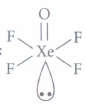
(iv) (b) : XeF2 has 3 lone pairs on Xe atom.
2.
(i) (c): Both methanol and ethanol are 1° alcohols and hence, cannot be distinguished by Lucas' reagent.
(ii) (d): Tertiary alcohols immediately react with Lucas' reagent.
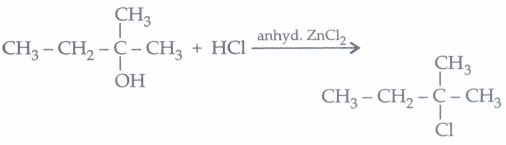
(iii) (d): The order of reactivity of alcohols towards Lucas' reagent is 3° alcohol > 2° alcohol > 1° alcohol. 1° alcohols do not react with Lucas' reagent at room temperature. It requires high temperature. The benzyl and allyl alcohols react as rapidly as 3° alcohols with Lucas' reagent because their cations are resonance stabilised.
(iv) (b) : When Lucas' reagent (conc. HCl + ZnCI2) is added to 2-propanol (2° alcohol) turibitity appears within five minutes whereas with 1-propanol no turbidity appears and solution remains dear at room temperature.
3.
(i) (d): All the reactions are showing the acidic properties of carboxylic acid. Carboxylic acid forms the sodium salts with all i.e., alkali metals, NaOH and Na2CO3 etc. and removes the acidic proton from the carboxylic acid.
(ii) (a): In general, greater the +I effect of the group attached to the carboxyl group, lesser will be the acidic strength and greater the -I effect ofthe group, greater will be acidic strength. As number of halogen atoms and electronegativity of halogen atom increases, acidic strength increases. Thus, correct order of acidic strength is
CF3COOH> CHCl2COOH > HCOOH > C6H5CH2COOH > CH3COOH
(iii) (c) : Stronger -I group attached closer to - COOH makes the acid stronger, i.e., acid has the larger dissociation constant. - Br shows poor (-I) effect and also far away from -COOH group i.e., option (c) has smallest dissociation constant.
(iv) (a): Due to ortho-effect, (I) and (II) are stronger acids than (III) and (IV). Due to two ortho-hydroxyl groups in (I), it is stronger acid than (II). (III) is a stronger acid than (IV) because at m-position, -OH group cannot exert its +R effect but can only exert its -I effect while at p-position, -OH group exerts its strong +R effect. Thus, the correct order of acidity is : I > II > III > IV.
4.
(i) (d): Since the compound X is unreactive towards sodium so it is neither an acid nor an alcohol. Since the compound X is unreactive towards Schiff's base so it is not an aldehyde.
The compound X forms only one product on reaction with excess HI, indicates that the compound X may be ether.
(ii) (b): The reactions can be written as :
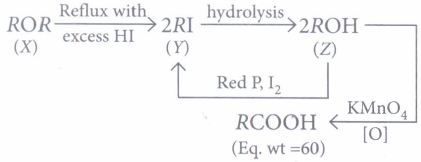
Since the equivalent weight of carboxylic acid is 60. So, it must be CH3COOH i.e., ethanoic acid.
(iii) (a) : The alcohol Z in that case should be C2H5OH and the compound Y should be ethyl iodide.
X is therefore diethyl ether (C2H5 - O -C2H5)
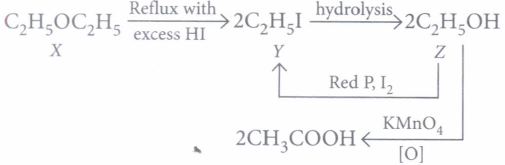
(iv) (C): In the presence of light and excess of chlorine, all the hydrogen atoms of diethyl ether are substituted to give perchlorodiethyl ether.
\(
\mathrm{CH}_{3} \mathrm{CH}_{2}-\mathrm{O}-\mathrm{CH}_{2} \mathrm{CH}_{3}+10 \mathrm{Cl}_{2} \stackrel{\mathrm{h} \mathrm{v}}{\longrightarrow}\\
\quad\quad\quad \quad \quad \quad \quad \quad \quad \quad \quad { (excess) }
\) \(
\mathrm{CCl}_{3} \mathrm{CCl}_{2}-\mathrm{O}-\mathrm{CCl}_{2}-\mathrm{CCl}_{3}+10 \mathrm{HCl}\\
\text { Perchlorodiethyl ether }
\)
5.
(i) (c) : In physisorption process, the attractive forces between adsorbate and adsorbent are van der Waals' forces.
(ii) (a)
(iii) (d)
(iv) (a)
6.
(i) (c): Bromination of cis-2-butene give (±) 2,3-dibromobutane.
(ii) (b)
(iii) (a)
(iv) (a)
7.
(i) (d): In alkyl halides, polarity of C - Br bond increases with increase in chain length.
(ii) (a): The order of reactivity of alkyl halides: iodide > bromide > chloride (nature of the halogen atom)
tertiary> secondary> primary (type of halogen atom).
(iii) (d) : Iso-butylene is obtained.
(iv) (b): The order of bond dissociation energy: R - F > R - CI > R - Br > R - I. During dehydrohalogenation C - I bond breaks more easily than C - F bond. So reactivity order of halides R - I > R - Br > R - CI > R - F
8.
(i) (a) : Vapour pressure of water \(\left(p_{A}^{\circ}\right)\) = 17.5 mm of Hg
Lowering of vapour pressure \(\left(p_{A}^{\circ}-p_{A}\right)\)= 0.061
Relative lowering of vapour pressure
\(=\frac{p_{A}^{\circ}-p_{A}}{p_{A}^{\circ}}=\frac{0.061}{17.5}=0.00348\)
(ii) (c): P = Vapour pressure of solvent - lowering in vapour pressure = 17.5 - 0.061 = 17.439 mm of Hg
(iii) (a): \(\frac{p_{A}^{\circ}-p_{A}}{p_{A}^{\circ}}=x_{B}=0.00348\)
Hence, mole fraction of sugar = 0.00348
(iv) (b): \(\frac{p_{A}^{\circ}-p_{A}}{p_{A}^{\circ}}=x_{B}=\frac{w_{B} \times M_{A}}{M_{B} \times w_{A}}\)
\(\frac{17.5-p_{A}}{17.5}=\frac{25 \times 18}{450 \times 180}=5.56 \times 10^{-3}\)
\(17.5-p_{A}=17.5 \times 5.56 \times 10^{-3}\)
\(17.5-p_{A}=0.0973\)
P = 17.40 mm Hg
9.
(i) (a) :
(ii) (c) : The reaction proceeds with a constant rate which is independent of concentration of hydrogen and chlorine. That is why, this reaction is a zero order reaction.
(iii) (b) : For a zero order reaction t1/2 = [a]/2k. .
(iv) (a) :
10.
(i) (a): Spin only magnetic moment, \(\mu=\sqrt{n(n+2)} \text { B.M. }\) where n = number of unpaired electrons.
As the number of unpaired electrons in Cr2+ ([Ar ]3d4) and Fe2+([Ar]3d6) are same, hence [Cr(H2O)6]2+ and [Fe(H2O)6]2+ will have same magnetic moment.
(ii) (a): Fe+ : [Ar] 3d6 4s1
When the weak field ligand H2O and strong field ligand NO+ attack, the configuration changes as follows: Fe+ : [Ar] 3d7 4s°
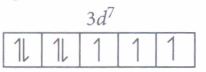
ஃ Fe+ has 3 unpaired electrons.

In presence of strong ethylenediamine ligand the electrons get paired.
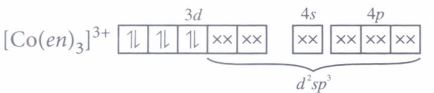
Thus inner orbital complex with no unpaired electrons.
(iv) (a)
11.
(i) (a) : \(\log \left(\frac{C_{1}}{C_{2}}\right)<0\) for spontaneity.
∴ C1 < C2
(ii) (a)
(iii) (b)
(iv) (a)
12.
(i) (d): It involves sp3 d2 hybridisation and not d2sp3.
(ii) (d) : [Co(NH3)6]3+ is d2sp3 hybridised with all electrons paired hence, it is diamagnetic and inner
orbital complex.
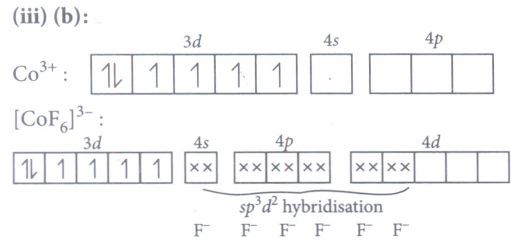
(iv) (c): Inner orbital complexes are formed with strong ligands as they force electrons to pair up and hence the complex will be either diamagnetic or will have less number of unpaired electrons.
13.
(i) (b): In NaCl crystal, each Cl- ion is surrounded by 6 Na+ ions.
(ii) (a): Anti-fluorite structure (NaCl) have eep arrangement of O2- and Na+ in all tetrahedral voids.
(iii) (c) : Antifluorite structure is derived from fluorite structure by interchanging the positions of positive and negative ions.
(iv) (a) : BaF2 has fluorite structure.
14.
(i) (c) : The half cell having the higher reduction potential will undergo reduction process.
(ii) (d) : Electrode potential of Mn3+ is higher than O2.
(iii) (a) : Due to least electrode potential value.
(iv) (a) : Half reactions :
| \(\mathrm{I}_{2}+2 e^{-} \rightarrow 2 \mathrm{I}^{-}\) | Reduction Eo = 0.54 V |
| \(2 \mathrm{Cl}^{-} \longrightarrow \mathrm{Cl}_{2}+2 e^{-}\) | Oxidation Eo = -1.36 V |
| ------------------------------- | |
| e.m.f = -0.82 V |
15.
(i) (a): Oxide of V in lowest oxidation state, i.e., VO is basic and ionic in character.
(ii) (a): Vanadyl ion is VO2+ where V is in +4 oxidation state.
(iii) (c)
(iv) (a)

12th Standard CBSE Syllabus & Materials
12th Standard CBSE
CBSE 12th Computer Science Python Revision Tour I - New Previous year Question Papers Study Material - QB365 Set A
NEW12th Standard CBSE
CBSE 12th Business Studies Planning Important Questions And Answers Study Material - QB365 Set A
NEW12th Standard CBSE
CBSE 12th Business Studies Business Environment Important Questions And Answers Study Material - QB365 Set A
NEW12th Standard CBSE
CBSE 12th Business Studies Principles of Management Important Questions And Answers Study Material - QB365 Set A



NCERT Books

Syllabus

Exam Pattern

Sample Question Papers

Previous year Question Papers

Important Notes

MCQ Practice test

NCERT Exemplers

Case study Questions

Image Based Questions

Passage based Questions

HOT Questions

Value Based Questions

Model Questions Papers
NCERT ( Book Back ) Questions

Assertion and Reason
Important Questions And Answers

CBSE 12th Standard CBSE Subjects
CBSE Standards








