
 100% FREE ACCESS
12th Standard CBSE Syllabus & Materials
12th Standard CBSE
CBSE 12th Economics Government Budget and the Economy Previous year Question Papers Study Material - QB365 Set A
NEW12th Standard CBSE
CBSE 12th Computer Science Interface Python with MySQL - New Previous year Question Papers Study Material - QB365 Set A
NEW12th Standard CBSE
CBSE 12th Computer Science Database Concept - New Previous year Question Papers Study Material - QB365 Set A
NEW12th Standard CBSE
CBSE 12th Computer Science Data Communication - New Previous year Question Papers Study Material - QB365 Set A
NEW12th Standard CBSE
CBSE 12th Computer Science Data Structures - New Previous year Question Papers Study Material - QB365 Set A
NEW12th Standard CBSE
CBSE 12th Computer Science Functions - New Previous year Question Papers Study Material - QB365 Set A

Published on: 21/05/2021
QB365 Provides the updated CASE Study Questions for Class 12 , and also provide the detail solution for each and every case study questions . Case study questions are latest updated question pattern from NCERT, QB365 will helps to get more marks in Exams
Download CBSE Class 12th Standard CBSE Chemistry question papers, sample papers, important questions, and previous year solved papers in PDF format. Get free study materials, NCERT solutions, and exam preparation resources for Class 12th Standard CBSE Chemistry
Questions + Answers key
Take MCQ Chemistry Test
1.
Read the passage given below and answer the following questions :
In a reaction, the rates of disappearance of different reactants or rates of formation of different products may not be equal but rate of reaction at any instant of time has the same value expressed in terms of any reactant or product. Further, the rate of reaction may not depend upon the stoichiometric coefficients of the balanced chemical equation. The exact powers of molar concentrations of reactants on which rate depends are found experimentally and expressed in terms of 'order of reaction'. Each reaction has a characteristic rate constant depends upon temperature. The units of the rate constant depend upon the order of reaction.
The following questions are multiple choice questions. Choose the most appropriate answer :
(i) The rate constant of a reaction is found to be 3 x 10⁻³ mol-2 L 2 sec-1.The order of the reaction is
| (a) 0.5 | (b) 2 | (c) 3 | (d) 1 |
(ii) In the reaction \(A+3 B \rightarrow 2 C\) ,the rate of formation of C is
| (a) the same as rate of consumption of A | (b) the same as the rate of consumption of B |
| (c) twice the rate of consumption of A | (d) 3/2 times the rate of consumption of B. |
(iii) Rate of a reaction can be expressed by following rate expression, Rate = k[A]2 [B], if concentration of A is increased by 3 times and concentration of B is increased by 2 times, how many times rate of reaction increases?
| (a) 9 times | (b) 27 times | (c) 18 times | (d) 8 times |
(iv) The rate of a certain reaction is given by,rate = k[H+]n . The rate increases 100 times when the pH changes from 3 to 1. The order (n) of the reaction is
| (a) 2 | (b) 0 | (c) 1 | (d) 1.5 |
2.
Read the passage given below and answer the following questions :
Number of molecules which must collide simultaneously to give product is called molecularity. It is equal to sum of coefficients of reactants present in stoichiometric chemical equation. For reaction, \(m_{1} A+m_{2} B \rightarrow \text { Product }\)
Molecularity = [m1 + m2 ]
In complex reaction each step has its own molecularity which is equal to the sum of coefficients of reactants present in a particular step. Molecularity is a theoretical property. Its value is any whole number. Number of concentration terms on which rate of reaction depends is called order of reaction or sum of powers of concentration terms present in the rate equation is called order of reaction.
If rate equation of reaction is : Rate = \(k \cdot C_{A}^{m_{1}} \cdot C_{B}^{m_{2}}\)
Then order of reaction = m1 + m2
In simple reaction, order and molecularity are same. In complex reaction, order of slowest step is the order of over all reaction. This step is known as rate determining step. Order is an experimental property. Its value may be zero, fractional or negative.
The following questions are multiple choice questions. Choose the most appropriate answer:
(i) Higher order (> 3) reactions are rare due to
| (a) shifting of equilibrium towards reactants due to elastic collisions |
| (b) loss of active species on collision |
| (c) low probability of simultaneous collision of all the reacting species |
| (d) increase in entropy and activation energy as more molecules are involved |
(ii) The molecularity of the reaction:
\(6 \mathrm{FeSO}_{4}+3 \mathrm{H}_{2} \mathrm{SO}_{4}+\mathrm{KClO}_{3} \rightarrow \mathrm{KCl}+3 \mathrm{Fe}_{2}\left(\mathrm{SO}_{4}\right)_{3}+3 \mathrm{H}_{2} \mathrm{O} \text { is }\)
| (a) 6 | (b) 3 | (c) 10 | (d) 7 |
(iii) Which of the following statements is false in the following?
| (a) Order of a reaction may be even zero |
| (b) Molecularity of a reaction is always a whole number. |
| (c) Molecularity and order always have same values for a reaction. |
| (d) Order of a reaction depends upon the mechanism of the reaction. |
(iv) The rate of the reaction \(A+B+C \rightarrow \text { products }\) , is given by \(r=-\frac{d[A]}{d t}=k[A]^{1 / 2}[B]^{1 / 3}[C]^{1 / 4}\) ,The order of the reaction is
| (a) \(\frac{1}{3}\) | (b) \(\frac{1}{4}\) | (c) \(\frac{1}{2}\) | (d) \(\frac{13}{12}\) |
3.
Read the passage given below and answer the following questions:
A reaction is said to be of the first order if the rate of the reaction depends upon one concentration term only. For a first order reaction of the type A \(\rightarrow\) Products, the rate of the reaction is given as : rate = k[A]. The differential rate law is given as \(\frac{d A}{d t}=-k[A]\) .The integrated rate law : In \(\frac{[A]}{[A]_{0}}=-k t\) where [A] is the concentration of reactant left at time t and [A]o is the initial concentration of the reactant, k is the rate constant.
The following questions are multiple choice questions. Choose the most appropriate answer :
(i) The unit of rate constant for a first order reaction is
| (a) s-1 | (b) mol L-1 s-1 | (c) L mol-1 s-1 | (d) L2 mol-2 s-1 |
(ii) Half-life period of a first order reaction is 10 min. Starting with initial concentration 12 M, the rate after 20 min is
| (a) 0.693 x 3 M min-1 | (b) 0.0693 x 4 M min-1 | (c) 0.0693 M min-1 | (d) 0.0693 x 3 M min-1 |
(iii) For a first order reaction, (A) \(\rightarrow\) products, the concentration of A changes from 0.1 M to 0.025 M in 40 minutes. The rate of reaction when the concentration of A is 0.01 M, is
| (a) 3.47 x 10⁻⁴ M/min | (b) 3.47 x 10⁻⁵ M/min | (c) 1.73 x 10⁻⁴ M/min | (d) 1.73 x 10⁻⁵ M/min |
(iv) The half-life period of a 1st order reaction is 60 minutes. What percentage will be left over after 240 minutes?
| (a) 6.25% | (b) 4.25% | (c) 5% | (d) 6% |
4.
Read the passage given below and answer the following questions:
For the reaction: \(2 \mathrm{NO}_{(g)}+\mathrm{Cl}_{2(g)} \rightarrow 2 \mathrm{NOCl}_{(g)}\), the following data were collected. All the measurements were taken at 263 K.
| Experiment No. |
Initial [NO] (M) | Initial [Cl2] (M) | Initial rate of disapp. of Cl2 (M/min) |
| 1. | 0.15 | 0.15 | 0.60 |
| 2.` | 0.15 | 0.30 | 1.20 |
| 3. | 0.30` | 0.15 | 2.40 |
| 4 | 0.25 | 0.25 | ? |
The following questions are multiple choice questions. Choose the most appropriate answer:
(i) The molecularity of the reaction is
| (a) 1 | (b) 2 | (c) 3 | (d) 4 |
(ii) The expression for rate law is
| (a) r = k[NO][Cl2] | (b) r = k[NO]2[Cl2 ] | (c) ) r = k[NO][Cl2]2 | (d) r = k[NO]2[Cl2]2 |
(iii) The overall order of the reaction is
| (a) 2 | (b) 0 | (c) 1 | (d) 3 |
(iv) The value of rate constant is
| (a) 150.32 M-2 min-1 | (b) 200.08 M-1 min-1 | (c) 177.77 M-2 min-1 | (d) 155.75 M-1 min-1 |
5.
Read the passage given below and answer the following questions :
The progress of the reaction, \(A \rightleftharpoons n B\) with time is represented in the following figure.
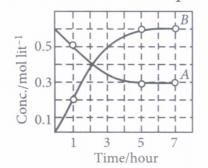
The following questions are multiple choice questions. Choose the most appropriate answer:
(i) What is the value of n?
| (a) 1 | (b) 2 | (c) 3 | (d) 4 |
(ii) Find the-value of the equilibrium constant
| (a) 0.6 M | (b) 1.2M | (c) 0.3M | (d) 2.4M |
(iii) The initial rate of conversion of A will be
| (a) 0.1 mol L-1 hr-1 | (b) 0.2 mol L-1 hr-1 | (c) 0.4 mol L-1 hr-1 | (d) 0.8 mol L-1 hr-1 |
(iv) For the reaction, if \(\frac{d[B]}{d t}=2 \times 10^{-4}\) , value of \(-\frac{d[A]}{d t}\) will be
| (a) 2 x 10- 4 | (b) 10-4 | (c) 4 x 10- 4 | (d) 0.5 x 10- 4 |
1.
(i) (c) : Unit of k for nth order = (mol L-1 )1-n sec-1.
Here,k = 3 x 10⁻³ mol-2 L2 sec-1 ...(i)
Unit of \(k=m o l^{-2} L^{2} \sec ^{-1} \Rightarrow\left(m o l L^{-1}\right)^{-2} \sec ^{-1}\) ...(ii)
Comparing (i) and (ii) we get, \(1-n=-2 \Rightarrow n=3\)
(ii) (c) : \(\text { Rate }=-\frac{d[A]}{d t}=-\frac{1}{3} \frac{d[B]}{d t}=\frac{1}{2} \frac{d[C]}{d t}\)
(iii) (c) : Given R1 = k[A]2 [B]
According to question R2 = k[3A]2 [2B]
= k x 9 [A]2 x 2 [B] = 18 x k [A]2 [B] = 18 R1
(iv) (c) : Rate (r) = k[H+]n
When pH = 3 ; [H+] = 10-3 and when pH = 1 ; [H+] = 10-1.
\(\therefore \quad \frac{r_{1}}{r_{2}}=\frac{k\left(10^{-3}\right)^{n}}{k\left(10^{-1}\right)^{n}} \Rightarrow \frac{1}{100}=\left(\frac{10^{-3}}{10^{-1}}\right)^{n}\left(\because r_{2}=100 r_{1}\right)\)
\(\Rightarrow \quad\left(10^{-2}\right)^{1}=\left(10^{-2}\right)^{n} \Rightarrow n=1\)
2.
(i) (c) : The reactions of higher order are very rare because of the less chances of the molecules to come together simultaneously and collide.
(ii) (c) : The total number of reactant molecules participating in a chemical reaction is known as its rnolecularity, hence the molecularity = 6 + 3 + 1 = 10.
(iii) (c) : Molecularity mayor may not be equal to the order of a reaction.
(iv) (d) : Order of reaction \(=\frac{1}{2}+\frac{1}{3}+\frac{1}{4}=\frac{6+4+3}{12}=\frac{13}{12}\)
3.
(i) (a) : Unit of rate constant for a reaction of nth order = (conc.)1-n time-1
For a first order reaction, n = 1
Unit of rate constant = (mol L-1)1 - 1 s-1= s-1
(ii) (d) : \(\underset{\text { Initial conc. }}{12 \mathrm{M} \stackrel{t_{1 / 2}}{\longrightarrow}} 6 \mathrm{M} \stackrel{t_{1 / 2}}{\longrightarrow} 3 \mathrm{M}\)
t1/2 = 10 min
\(k=\frac{0.693}{10}=0.0693 \mathrm{~min}^{-1}\)
As t1/2 is 10 min, after 20 minutes the concentration will be 3 M.
Hence, Rate = 0.0693 x 3 M min-1
(iii) (a) : For the first order reaction,
\(k=\frac{2.303}{t} \log \frac{a}{a-x}\)
a = 0.1 M, a - x = 0.025 M, t = 40 min
\(k=\frac{2.303}{40} \log \frac{0.1}{0.025}=\frac{2.303}{40} \log 4=0.0347 \mathrm{~min}^{-1}\)
\([A] \rightarrow \text { product }\)
Thus, rate = k[A]
rate = 0.0347 x 0.01 M min-1= 3.47 x 10⁻⁴ M min-1
(iv) (a) : \(t_{1 / 2}=\frac{0.693}{k} \Rightarrow \frac{0.693}{t_{1 / 2}}=k \Rightarrow \frac{0.693}{60}=k\)
k = 0.01155 min-1
\(k=\frac{2.303}{t} \log \left(\frac{a}{a-x}\right)\)
Let the initial amount (a) be 100
\(0.01155 \mathrm{~min}^{-1}=\frac{2.303}{240 \mathrm{~min}} \log \left(\frac{100}{a-x}\right)\)
1.204 = log100 - log(a-x)
1.204 = 2 - log(a-x)
log (a - x) = 2 - 1.204 = 0.796
(a - x) = 6.25%
4.
(i) (c) : \(2 \mathrm{NO}_{(g)}+\mathrm{Cl}_{2(g)} \rightarrow 2 \mathrm{NOCl}_{(g)}\)
Molecularity = 3
(ii) (b) : Let rate of this reaction, r = k[NO]m[CI2 ]n then \(\frac{r_{1}}{r_{2}}=\frac{0.60}{1.20}=\frac{k(0.15)^{m}(0.15)^{n}}{k(0.15)^{m}(0.30)^{n}}\)
or \(\frac{1}{2}=\left(\frac{1}{2}\right)^{n} \Rightarrow n=1\)
Again from \(\frac{r_{2}}{r_{3}}=\frac{1.20}{2.40}=\frac{k(0.15)^{m}(0.30)^{n}}{k(0.30)^{m}(0.15)^{n}}\)
or \(\frac{1}{2}=\left(\frac{1}{2}\right)^{m} \cdot \frac{2}{1} \text { or } \frac{1}{4}=\left(\frac{1}{2}\right)^{m} \Rightarrow m=2\)
Hence, expression for rate law is
r = k[NO] 2[Cl2 ]1
(iii) (d) : As the order W.r.t. NO is 2 and order W.r.t. Cl2 is 1, hence the overall order is 3.
(iv) (c) : Substituting the values of experiment 1 in rate law expression
0.60 M min-1 = k(0.15 M)2 (0.15 M)1
or \(k=\frac{0.60 \mathrm{Mmin}^{-1}}{0.0225 \times 0.15 \mathrm{M}^{3}}=177.77 \mathrm{M}^{-2} \mathrm{~min}^{-1}\)
5.
(i) (b) : According to the figure, in the given time of 4 hours (1 to 5) concentration of A falls from 0.5 to 0.3 M, while in the same time concentration of B increases from 0.2 to 0.6 M.
Decrease in concentration of A in 4 hours
= 0.5 - 0.3 = 0.2 M
Increase in concentration of B in 4 hours
= 0.6 - 0.2 = 0.4 M
Thus, increase in concentration of B in a given time is twice the decrease in concentration of A. Thus, n = 2
(ii) (b) : \(K=\frac{[B]^{2}}{[A]}=\frac{(0.6)^{2}}{0.3}=1.2 \mathrm{M}\)
(iii) (a) : From t = 0 to t = 1 hr,
For A, dx = 0.6 - 0.5 = 0.1 mol L-1
\(\therefore\) Initial rate of conversion of \(A=\frac{d x}{d t}\)
\(=\frac{0.1 \mathrm{~mol} \mathrm{~L}^{-1}}{1 \mathrm{hr}}=0.1 \mathrm{~mol} \mathrm{~L}^{-1} \mathrm{hr}^{-1}\)
(iv) (b) : \(A \rightleftharpoons 2 B\)
\(-\frac{d[A]}{d t}=+\frac{1}{2} \frac{d[B]}{d t}=\frac{1}{2} \times 2 \times 10^{-4}=10^{-4}\)

12th Standard CBSE Syllabus & Materials
12th Standard CBSE
CBSE 12th Computer Science Python Revision Tour I - New Previous year Question Papers Study Material - QB365 Set A
NEW12th Standard CBSE
CBSE 12th Business Studies Planning Important Questions And Answers Study Material - QB365 Set A
NEW12th Standard CBSE
CBSE 12th Business Studies Business Environment Important Questions And Answers Study Material - QB365 Set A
NEW12th Standard CBSE
CBSE 12th Business Studies Principles of Management Important Questions And Answers Study Material - QB365 Set A



NCERT Books

Syllabus

Exam Pattern

Sample Question Papers

Previous year Question Papers

Important Notes

MCQ Practice test

NCERT Exemplers

Case study Questions

Image Based Questions

Passage based Questions

HOT Questions

Value Based Questions

Model Questions Papers
NCERT ( Book Back ) Questions

Assertion and Reason
Important Questions And Answers

CBSE 12th Standard CBSE Subjects
CBSE Standards








