
 100% FREE ACCESS
12th Standard CBSE Syllabus & Materials
12th Standard CBSE
CBSE 12th Economics Government Budget and the Economy Previous year Question Papers Study Material - QB365 Set A
NEW12th Standard CBSE
CBSE 12th Computer Science Interface Python with MySQL - New Previous year Question Papers Study Material - QB365 Set A
NEW12th Standard CBSE
CBSE 12th Computer Science Database Concept - New Previous year Question Papers Study Material - QB365 Set A
NEW12th Standard CBSE
CBSE 12th Computer Science Data Communication - New Previous year Question Papers Study Material - QB365 Set A
NEW12th Standard CBSE
CBSE 12th Computer Science Data Structures - New Previous year Question Papers Study Material - QB365 Set A
NEW12th Standard CBSE
CBSE 12th Computer Science Functions - New Previous year Question Papers Study Material - QB365 Set A

Published on: 21/05/2021
QB365 Provides the updated CASE Study Questions for Class 12 , and also provide the detail solution for each and every case study questions . Case study questions are latest updated question pattern from NCERT, QB365 will helps to get more marks in Exams
Download CBSE Class 12th Standard CBSE Chemistry question papers, sample papers, important questions, and previous year solved papers in PDF format. Get free study materials, NCERT solutions, and exam preparation resources for Class 12th Standard CBSE Chemistry
Questions + Answers key
Take MCQ Chemistry Test
1.
Read the passage given below and answer the following questions:
Valence bond theory considers the bonding between the metal ion and the ligands as purely covalent. On the other hand, crystal field theory considers the metal-ligand bond to be ionic arising from electrostatic interaction between the metal ion and the ligands. In coordination compounds, the interaction between the ligand and the metal ion causes the five d-orbitals to split-up. This is called crystal field splitting and the energy difference between the two sets of energy level is called crystal field splitting energy. The crystal field splitting energy (Δo) depends upon the nature of the ligand. The actual configuration of complexes is divided by the relative values of Δo and P (pairing energy)
If Δo < P, then complex will be high spin.
If Δo > P, then complex will be low spin.
The following questions are multiple choice questions. Choose the most appropriate answer :
(i) Which of the following ligand has lowest Δo value?
| (a) CN- | (b) CO | (c) F- | (d) NH3 |
(ii) The crystal field splitting energy for octahedral (Δo) and tetrahedral (Δt) complex is related as
| (a) \( \Delta_{t}=\frac{1}{2} \Delta_{o}\) | (b) \(\Delta_{t}=\frac{4}{9} \Delta_{o}\) |
| (c) \(\Delta_{t}=\frac{3}{5} \Delta_{o}\) | (d) \(\Delta_{t}=\frac{2}{5} \Delta_{o}\) |
(iii) On the basis of crystal field theory, the electronic configuration of d4 in two situations: (i) Δo > P and (ii) Δo< P are
| (i) | (ii) |
| (a) \(t_{2 g}^{4} e_{g}^{0}\) | \(t_{2 g}^{3} e_{g}^{1}\) |
| (b) \(t_{2 g}^{3} e_{g}^{1}\) | \(t_{2 g}^{4} e_{g}^{0}\) |
| (c) \(t_{2 g}^{3} e_{g}^{1}\) | \(t_{2 g}^{3} e_{g}^{1}\) |
|
(d) \(t_{2 g}^{4} e_{g}^{0}\) |
\(t_{2 g}^{4} e_{g}^{0}\) |
(iv) Using crystal field theory, calculate magnetic moment of central metal ion of [FeF6]4-.
| (a) 1.79 B.M. | (b) 2.83 B.M. | (c) 3.85 B.M. | (d) 4.9 B.M. |
2.
Read the passage given below and answer the following questions:
To explain bonding in coordination compounds various theories were proposed. One of the important theory was valence bond theory. According to that, the central metal ion in the complex makes available a number of empty orbitals for the formation ofcoordination bonds with suitable ligands. The appropriate atomic orbitals of the metal hybridise to give a set of equivalent orbitals of definite geometry. The d-orbitals involved in the hybridisation may be either inner d-orbitals i.e., (n - 1) d or outer d-orbitals i.e., nd. For example, CO3+ forms both inner orbital and outer orbital complexes, with ammonia it forms [Co(NH3)6]3+ and with fluorine it forms [CoF6]3- complex ion.
The following questions are multiple choice questions. Choose the most appropriate answer:
(i) Which of the following is not true for [CoF6]3- ?
| (a) It is paramagnetic. | (b) It has coordination number of 6. |
| (c) It is outer orbital complex. | (d) It involves d2sp3 hybridisation. |
Which of the following is true for [Co(NH3)6]3+ ?
| (a) It is an octahedral, dimagnetic and outer orbital complex. |
| (b) It is an octahedral, paramagnetic and outer orbital complex. |
| (c) It is an octahedral, paramagnetic and inner orbital complex. |
| (d) It is an octahedral, dimagnetic and inner orbital complex. |
(iii) The paramagnetism of [CoF6]3- is due to
| (a) 3 electrons | (b) 4 electrons | (c) 2 electrons | (d) 2 electrons |
(iv) Which of the following is an inner orbital or low spin complex?
| (a) \(\left[\mathrm{Ni}\left(\mathrm{H}_{2} \mathrm{O}\right)_{6}\right]^{3+}\) | (b)\(\left[\mathrm{FeF}_{6}\right]^{3-}\) | (c) \(\left[\mathrm{Co}(\mathrm{CN})_{6}\right]^{3-}\) | (d) \(\left[\mathrm{NiCl}_{4}\right]^{2-}\) |
3.
Read the passage given below and answer the following questions:
Iron forms many complexes in its +2 and +3 oxidation states such as \(\left[\mathrm{Fe}\left(\mathrm{H}_{2} \mathrm{O}\right)_{6}\right]^{2+}(A) ;\left[\mathrm{Fe}(\mathrm{CN})_{6}\right]^{4-}(B)\) \(\left[\mathrm{Fe}\left(\mathrm{H}_{2} \mathrm{O}\right)_{6}\right]^{3+}(C) ;\left[\mathrm{Fe}(\mathrm{CN})_{6}\right]^{3-}(D)\) ,etc., They exhibit, different magnetic properties and undergo different hybridisation of iron.
The following questions are multiple choice questions. Choose the most appropriate answer:
(i) Which of the following statements is correct?
| (a) (B) is paramagnetic while (C) is diamagnetic. |
| (b) Both (B) and (D) are outer orbital complexes. |
| (c) Both (A) and (C) are paramagnetic. |
| (d) (A) is outer orbital complex and (C) is inner orbital complex. |
(ii) The complex having maximum magnetic moment is
| (a) (A) | (b) (B) | (c) (C) | (d) (D) |
(iii) The spin only magnetic moment of complexes (A), (B), (C) and (D) are respectively (in BM)
| (a) \(2 \sqrt{6}, 0, \sqrt{35}, \sqrt{3}\) | (b) \(0,2 \sqrt{6}, \sqrt{35}, \sqrt{3}\) | (c) \(\sqrt{15}, 2 \sqrt{6}, \sqrt{3}, 0\) | (d) \(\sqrt{3}, \sqrt{8}, 0, \sqrt{15}\) |
(iv) Which of the given complexes are outer orbital complexes?
| (a) (A) and (B) only | (b) (B) and (C) only | (c) (A) and (C) only | (d) (B) and (D) only |
4.
Read the passage given below and answer the following questions:
Coordination compounds are formulated and named according to the IUPAC system.
Few rules for naming coordination compounds are:
(I) In ionic complex, the cation is named first and then the anion.
(II) In the coordination entity, the ligands are named first and then the central metal ion.
(III) When more than one type of ligands are present, they are named in alphabetical order of preference without any consideration of charge.
The following questions are multiple choice questions. Choose the most appropriate answer:
(i) The IUPAC name of the complex \(\left[\mathrm{Pt}\left(\mathrm{NH}_{3}\right)_{3} \mathrm{Br}\left(\mathrm{NO}_{2}\right) \mathrm{Cl}\right] \mathrm{Cl}\) is
| (a) triamminechlorobromonitroplatinum (IV) chloride |
| (b) triamminebromonitrochloroplatinum (IV) chloride |
| (c) triamminebromidochloridonitroplatinum (IV) chloride |
| (d) triamminenitrochlorobromoplatinum (IV) chloride |
(ii) The lUPAC name of [Ni(CO)4] is
| (a) tetracarbonylnickel (II) | (b) tetracarbonylnickel (0) |
| (c) tetracarbonylnickelate (II) | (d) tetracarbonylnickelate (0). |
(iii) As per IUPAC nomenclature, the name of the complex \(\left[\mathrm{Co}\left(\mathrm{H}_{2} \mathrm{O}\right)_{4}\left(\mathrm{NH}_{3}\right)_{2}\right] \mathrm{Cl}_{3}\) is
| (a) tetraaquadiamminecobalt (II) chloride | (b) tetraaquadiamminecobalt (III) chloride |
| (c) diamminetetraaquacobalt (II) chloride | (d) diamminetetraaquacobalt (III) chloride |
(iv) Which of the following represents correct formula of dichloridobis( ethane-1, 2-diamine ) cobalt (III) ion?
| (a) [CoCl2(en)]2+ | (b) [Co(ONO)(NH3)5]SO4 | (c) [Co(NO2)(NH3)4] (SO4)2 | (d) [Co(NO)(NH3)4] (SO4)2 |
5.
Read the passage given below and answer the following questions:
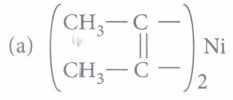
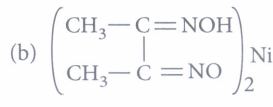
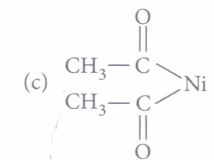
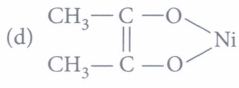
The molecular compounds which are formed from the combination of two or more simple stable compounds and retain their identity in the solid as well as in the dissolved state are called coordination compounds. Their properties are completely different from the constituents. In coordination compounds, the central metal atom or ion is linked to a number of ions or neutral molecules, called ligands, by coordinate bonds. For example, Dimethyl glyoxime (dmg) is a bidendate ligand chelating large amounts of metals. When dimethyl glyoxime is added to alcoholic solution of NiCl2 and ammonium hydroxide is slowly added to it, a rosy red precipitate of a complex is formed.
The following questions are multiple choice questions. Choose the most appropriate answer:
(i) The structure of the complex is
 |
 |
 |
 |
(ii) Oxidation number of Ni in the given complex is
| (a) +3 | (b) +1 | (c) +2 | (d) zero. |
(iii) Which of the following is true about this complex?
| (a) It is paramagnetic, containing 2 unpaired electrons. |
| (b) It is paramagnetic, containing 1 unpaired electron. |
| (c) It is paramagnetic, containing 4 unpaired electrons. |
| (d) It is diamagnetic with no unpaired electron |
(iv) Which one will give test for Fe3+ ions in the solution?
| (a) [Fe(CN)6]3- | (b) [Fe(CN)6]2- |
| (c) (NH4)2SO4· FeSO4· 6H2O | (d) Fe2(SO4)3 |
1.
(i) (c): Spectrochemical series:
\((\mathrm{I}^{-}<\mathrm{Br}^{-}<\mathrm{SCN}^{-}<\mathrm{Cl}^{-}<\mathrm{S}^{2-}<\mathrm{F}^{-}<\mathrm{OH}^{-}<\mathrm{C}_{2} \mathrm{O}_{4}^{2-}<\mathrm{O}^{2-}< \mathrm{H}_{2} \mathrm{O}<\mathrm{NCS}^{-}<\mathrm{EDTA}^{4-}<\mathrm{NH}_{3}\)(ii) (b)
(iii) (a) : When Δo > P, the electrons paired up in the t2g level rather than going to the eg level, so
when Δo> P : \(t_{2 g}^{4} e_{g}^{0}\)
and Δo < P : \(t_{2 g}^{3} e_{g}^{1}\)
(iv) (d): Fe2+: 3d6 ⇒\(t_{2 g}^{4} e_{g}^{2}\)
(Since, F- is a weak field ligand)
Hence four unpaired electrons are present.
Magnetic moment (μ)\(=\sqrt{n(n+2)}=\sqrt{4(4+2)}=4.9 \mathrm{~B} \cdot \mathrm{M}\)
2.
(i) (d): It involves sp3 d2 hybridisation and not d2sp3.
(ii) (d) : [Co(NH3)6]3+ is d2sp3 hybridised with all electrons paired hence, it is diamagnetic and inner
orbital complex.
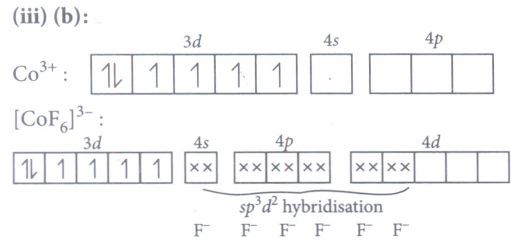
(iv) (c): Inner orbital complexes are formed with strong ligands as they force electrons to pair up and hence the complex will be either diamagnetic or will have less number of unpaired electrons.
3.
(i) (c): (A) : sp3d2 hybridisation (outer orbital)
No. of unpaired electrons = 4
(B) : d2sp3 hybridisation (inner orbital)
No. of unpaired electrons = 0
(C) : sp3 d2 hybridisation (outer orbital)
No. of unpaired electrons = 5
(D) : d2sp3 hybridisation (inner orbital)
No. of unpaired electron = 1
(ii) (c): It has 5 unpaired electrons.
(iii) (a): Magnetic moments of (A), (B), (C) and (D) are respectively.
\(\sqrt{4(4+2)}, 0, \sqrt{5(5+2)}, \sqrt{1(1+2)}\)
(iv) (c)
4.
(i) (c): Ligands are named in alphabetical order irrespective of their charge.
(ii) (b)
(iii) (d)
(iv) (d)
5.
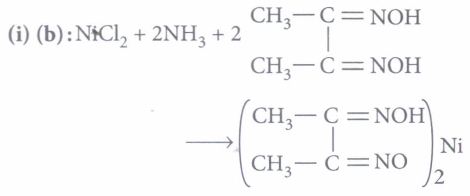
(ii) (c)
(iii) (d) : It has no unpaired electrons hence, it is diamagnetic.
(iv) (d): (a) and (b) are coordination compounds hence cannot give free Fe2+ or, Fe3+ ions in solution. (c) and (d) represent simple compounds hence are free to give ions in solution, but only Fe2(SO4)3 contains Fe3+ ions.(NH4)2SO4・FeSO4・ 6H2O contains Fe2+ ions not Fe3+ ions.

12th Standard CBSE Syllabus & Materials
12th Standard CBSE
CBSE 12th Computer Science Python Revision Tour I - New Previous year Question Papers Study Material - QB365 Set A
NEW12th Standard CBSE
CBSE 12th Business Studies Planning Important Questions And Answers Study Material - QB365 Set A
NEW12th Standard CBSE
CBSE 12th Business Studies Business Environment Important Questions And Answers Study Material - QB365 Set A
NEW12th Standard CBSE
CBSE 12th Business Studies Principles of Management Important Questions And Answers Study Material - QB365 Set A



NCERT Books

Syllabus

Exam Pattern

Sample Question Papers

Previous year Question Papers

Important Notes

MCQ Practice test

NCERT Exemplers

Case study Questions

Image Based Questions

Passage based Questions

HOT Questions

Value Based Questions

Model Questions Papers
NCERT ( Book Back ) Questions

Assertion and Reason
Important Questions And Answers

CBSE 12th Standard CBSE Subjects
CBSE Standards








