
 100% FREE ACCESS
12th Standard CBSE Syllabus & Materials
12th Standard CBSE
CBSE 12th Economics Government Budget and the Economy Previous year Question Papers Study Material - QB365 Set A
NEW12th Standard CBSE
CBSE 12th Computer Science Interface Python with MySQL - New Previous year Question Papers Study Material - QB365 Set A
NEW12th Standard CBSE
CBSE 12th Computer Science Database Concept - New Previous year Question Papers Study Material - QB365 Set A
NEW12th Standard CBSE
CBSE 12th Computer Science Data Communication - New Previous year Question Papers Study Material - QB365 Set A
NEW12th Standard CBSE
CBSE 12th Computer Science Data Structures - New Previous year Question Papers Study Material - QB365 Set A
NEW12th Standard CBSE
CBSE 12th Computer Science Functions - New Previous year Question Papers Study Material - QB365 Set A

Published on: 21/05/2021
QB365 Provides the updated CASE Study Questions for Class 12 , and also provide the detail solution for each and every case study questions . Case study questions are latest updated question pattern from NCERT, QB365 will helps to get more marks in Exams
Download CBSE Class 12th Standard CBSE Chemistry question papers, sample papers, important questions, and previous year solved papers in PDF format. Get free study materials, NCERT solutions, and exam preparation resources for Class 12th Standard CBSE Chemistry
Questions + Answers key
Take MCQ Chemistry Test
1.
Read the passage given below and answer the following questions:
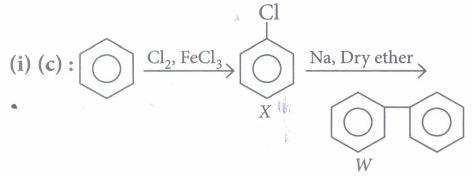
Consider the given sequence of reactions:
The following questions are multiple choice questions. Choose the most appropriate answer:
(i) Identify w.
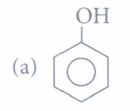 |
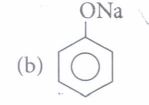 |
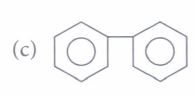 |
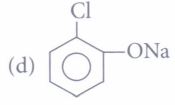 |
(ii) When X reacts with CH3COCI in presence of anhy. AICI3, the reaction is known as
| (a) Fittig reaction | (b) Ullmann reaction | (c) Wurtz-Fittig reaction | (d) Friedel-Crafts acylation reaction. |
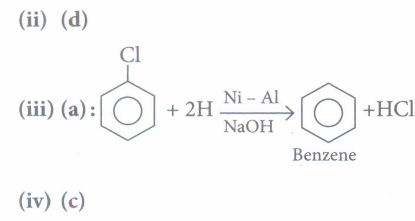
(iii) When X is treated Ni-Al / NaOH the product obtained is
| (a) benzene | (b) phenol | (c) p-chlorophenol | (d) triphenyl. |
(iv) Compound Z is
| (a) phenol | (b) p-chlorophenol | (c) p-nitrophenol | (d) nitrobenzene |
2.
Read the passage given below and answer the following questions:
When haloalkanes with \(\beta\)-hydrogen atom are boiled with alcoholic solution of KOH, they undergo elimination of hydrogen halide resulting in the formation of alkenes. These reactions are called \(\beta\)-elimination reactions or dehydrohalogenation reactions. These reactions follow Saytzeff's rule. Substitution and elimination reactions often compete with each other. Mostly bases behave as nucleophiles and therefore can engage in substitution or elimination reactions depending upon the alkyl halide and the reaction conditions.
The following questions are multiple choice questions. Choose the most appropriate answer:
(i) Among the following the most reactive towards alcoholic KOH is
|
(a) \(\mathrm{CH}_{2}=\mathrm{CHBr}\) |
(b) \(\mathrm{CH}_{3} \mathrm{COCH}_{2} \mathrm{CH}_{2} \mathrm{Br}\) |
(c) \(\mathrm{CH}_{3} \mathrm{CH}_{2} \mathrm{Br}\) |
(d) \(\mathrm{CH}_{3} \mathrm{CH}_{2} \mathrm{CH}_{2} \mathrm{Br}\) |
(ii) The general reaction, \(R-X \stackrel{\text { aq. } \mathrm{OH}^{-}}{\longrightarrow} R \mathrm{OH}+X^{-}\) is expected to follow decreasing order of reactivity as in (t- Bu = tertiary Butyl group)
| (a) t-BuI> t-BuBr > t-BuCI > t-BuF | (b) t-BuF> t-BuCI > t-BuBr > t-BuI |
| (c) t-Bu'Br> t-BuCI > t-BuI > t-BuF | (d) t-BuF> t-BuCI > t-BuI > t-BuBr |
(iii) Reaction of t-butyl bromide with sodium methoxide produces
| (a) sodium t-butoxide | (b) t-butyl methyl ether |
| (c) iso-butane | (d) iso-butylene. |
(iv) In the elimination reactions, the reactivity of alkyl halides follows the sequence
| (a) R - F > R - Cl > R - Br > R - I | (b) R - I > R - Br > R - Cl > R - F |
| (c) R - I > R - F > R - Br > R - Cl | (d) R - F > R-I > R-Br > R-CI |
3.
Read the passage given below and a.9swer the following questions:
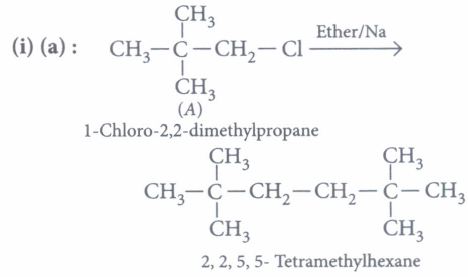
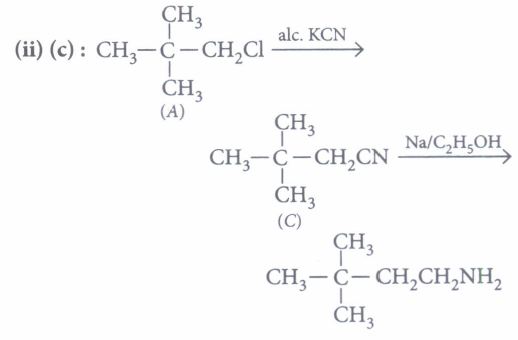
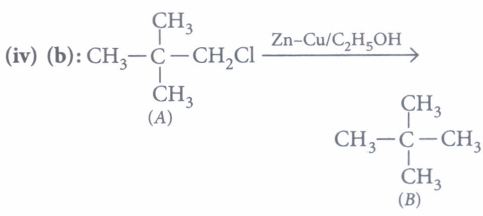
A chlorocompound (A) on reduction with Zn-Cu and ethanol gives the hydrocarbon (B) with five carbon atoms. When (A) is dissolved in dry ether and treated with sodium metal it gave 2,2,5,5 tetramethylhexane. The treatment of (A) with alcoholic KCN gives compound (C).
The following questions are multiple choice questions. Choose the most appropriate answer:
(i) The compound (A) is
| (a) 1-chloro- 2, 2-dimethylpropane | (b) 1-chloro- 2, 2-dimethyl butane |
| (c) 1-chloro-2-methyl butane | (d) 2-chloro-2-methyl butane. |
(ii) The reaction of (C) with Na, C2H5OH gives
| (a) (CH3)3C CH2CONH2 | (b) (CH3)3C NH2 |
| (c) (CH)3C CH2CH2NH2 | (d) (CH3)2CHCH2NH2 |
(iii) The reaction of (C) with Na, C2H5OH is called
| (a) Gilman reaction | (b) Mendius reaction |
| (c) Grooves process | (d) Swart's reaction. |
(iv) Compound (B) is
| (a) n-pentane | (b) 2, 2-dimethylpropane |
| (c) 2-methylbutane | (d) none of these. |
4.
Read the passage given below and answer the following questions:
Nucleophilic substitution reactions are of two types; substitution nucleophilic bimolecular (SN2) and substitution nucleophilic unimolecular (SN1) depending on molecules taking part in determining the rate of reaction. Reactivity of alkyl halide towards SN1 and SN2 reactions depends on various factors such as steric hindrance, stability of intermediate or transition state and polarity of solvent. SN2 reaction mechanism is favoured mostly by primary alkyl halide then secondary and then tertiary. This order is reversed in case of SN1 reactions.
The following questions are multiple choice questions. Choose the most appropriate answer:
(i) Which of the following is most reactive towards nucleophilic substitution reaction?
| (a) \(\mathrm{C}_{6} \mathrm{H}_{5} \mathrm{Cl}\) | (b) \(\mathrm{CH}_{2}=\mathrm{CHCl}\) | (c) \(\mathrm{ClCH}_{2} \mathrm{CH}=\mathrm{CH}_{2}\) | (d) \(\mathrm{CH}_{3} \mathrm{CH}=\mathrm{CHCl}\) |
(ii) Isopropyl chloride undergoes hydrolysis by
| (a) SN1mechanism | (b) SN2mechanism | (c) SN1 and SN2mechanism | (d) neither SN1 and SN2mechanism |
(iii) The most reactive nucleophile among the following is
| (a) CH3O- | (b) C6H5O- | (c) (CH3)2CHO- | (d) (CH3)3CO- |
(iv) Tertiary alkyl halides are practically inert to substitution by SN2mechanism because of
| (a) insolubility | (b) instability | (c) inductive effect | (d) stearic hindrance. |
5.
Read the passage given below and answer the following questions:
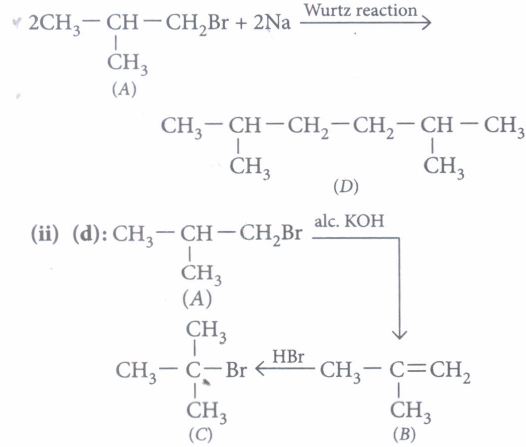
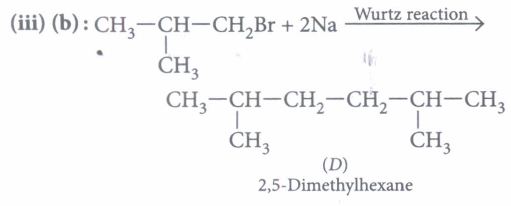
A primary alkyl halide (A) C4H9Br reacted with alcoholic KOH to give compound (B). Compound (B) is reacted with HBr to give compound (C) which is an isomer of (A). When (A) reacted with sodium metal, it gave a compound (D) C8H18 that is different than the compound obtained when n-butyl bromide reacted with sodium metal
The following questions are multiple choice questions. Choose the most ap appropriate answer:
(i) Compound (A) is
| (a) \(\mathrm{CH}_{3} \mathrm{CH}_{2} \mathrm{CH}_{2} \mathrm{CH}_{2} \mathrm{Br}\) | (b) 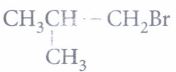 |
(c) 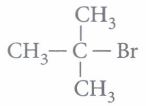 |
(d) \(\mathrm{CH}_{3} \mathrm{CH}_{2} \mathrm{CH}_{2} \mathrm{Br}\) |
(ii) Which type of isomerism is present in compound (A) and (C)?
| (a) Positional | (b) Functional | (c) Chain | (d) Both (a) and (c) |
(iii) IUPAC name of compound (D) is
| (a) n-octane | (b) 2,5-dimethylhexane | (c) 2-methylheptane | (d) 3,4-dimethyl hexane. |
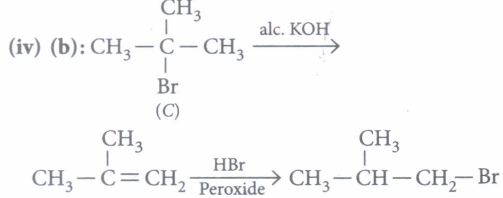
(iv) When compoound (C) is treated with alc. KOH and then treated with HBr in presence of peroxide, the compound obtained is
| a) |
(b) 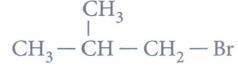 |
| (c) \(\mathrm{CH}_{3} \mathrm{CH}_{2} \mathrm{CH}_{2} \mathrm{CH}_{2} \mathrm{Br}\) | (d) 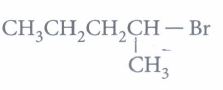 |
1.
2.
(i) (d): In alkyl halides, polarity of C - Br bond increases with increase in chain length.
(ii) (a): The order of reactivity of alkyl halides: iodide > bromide > chloride (nature of the halogen atom)
tertiary> secondary> primary (type of halogen atom).
(iii) (d) : Iso-butylene is obtained.
(iv) (b): The order of bond dissociation energy: R - F > R - CI > R - Br > R - I. During dehydrohalogenation C - I bond breaks more easily than C - F bond. So reactivity order of halides R - I > R - Br > R - CI > R - F
3.
(iii) (b)
4.
(i) (c) : Allylic chlorides are most reactive.
(ii) (c): 20 - alkyl halides undergo hydrolysis by SN1 or SN2 mechanism.
(iii) (a): Smaller the size of the nucleophile (i.e., CH3O-), more reactive it is.
(iv) (d): Stearic hindrance due to bulky alkyl groups prevents the attack of the nucleophile in SN2 mechanism.
5.
(i) (b): When compound (A) reacted with Na-metal, it gave a compound D(C8H18) which is different from the compound obtained when n-butyl bromide reacted with Na metal and hence the
compound (A) must be isobutyl bromide.
\(2 \mathrm{CH}_{3} \mathrm{CH}_{2} \mathrm{CH}_{2} \mathrm{CH}_{2} \mathrm{Br}+2 \mathrm{Na}\) \(\overset{Wurtz reaction}\rightarrow\) \(\mathrm{CH}_{3} \mathrm{CH}_{2} \mathrm{CH}_{2} \mathrm{CH}_{2} \mathrm{CH}_{2} \mathrm{CH}_{2} \mathrm{CH}_{2} \mathrm{CH}_{3}\)

12th Standard CBSE Syllabus & Materials
12th Standard CBSE
CBSE 12th Computer Science Python Revision Tour I - New Previous year Question Papers Study Material - QB365 Set A
NEW12th Standard CBSE
CBSE 12th Business Studies Planning Important Questions And Answers Study Material - QB365 Set A
NEW12th Standard CBSE
CBSE 12th Business Studies Business Environment Important Questions And Answers Study Material - QB365 Set A
NEW12th Standard CBSE
CBSE 12th Business Studies Principles of Management Important Questions And Answers Study Material - QB365 Set A



NCERT Books

Syllabus

Exam Pattern

Sample Question Papers

Previous year Question Papers

Important Notes

MCQ Practice test

NCERT Exemplers

Case study Questions

Image Based Questions

Passage based Questions

HOT Questions

Value Based Questions

Model Questions Papers
NCERT ( Book Back ) Questions

Assertion and Reason
Important Questions And Answers

CBSE 12th Standard CBSE Subjects
CBSE Standards








