
 100% FREE ACCESS
12th Standard CBSE Syllabus & Materials
12th Standard CBSE
CBSE 12th Economics Government Budget and the Economy Previous year Question Papers Study Material - QB365 Set A
NEW12th Standard CBSE
CBSE 12th Computer Science Interface Python with MySQL - New Previous year Question Papers Study Material - QB365 Set A
NEW12th Standard CBSE
CBSE 12th Computer Science Database Concept - New Previous year Question Papers Study Material - QB365 Set A
NEW12th Standard CBSE
CBSE 12th Computer Science Data Communication - New Previous year Question Papers Study Material - QB365 Set A
NEW12th Standard CBSE
CBSE 12th Computer Science Data Structures - New Previous year Question Papers Study Material - QB365 Set A
NEW12th Standard CBSE
CBSE 12th Computer Science Functions - New Previous year Question Papers Study Material - QB365 Set A

Published on: 25/05/2021
QB365 Provides the updated NCERT Exemplar Questions for Class 12, and also provide the detail solution for each and every NCERT Exemplar questions. NCERT Exemplar questions are latest updated question pattern from NCERT, QB365 will helps to get more marks in Exams
Download CBSE Class 12th Standard CBSE Chemistry question papers, sample papers, important questions, and previous year solved papers in PDF format. Get free study materials, NCERT solutions, and exam preparation resources for Class 12th Standard CBSE Chemistry
Questions + Answers key
Take MCQ Chemistry Test
1.
Why it is necessary to avoid even traces of moisture during the use of a Grignard reagent?
2.
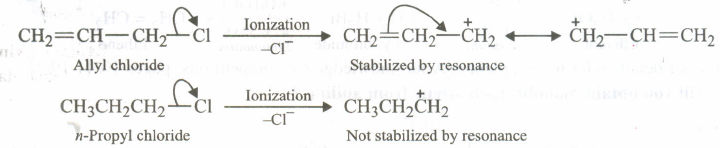
Allyl chloride is hydrolysed more readily than n-propyl chloride. Why?
3.
What are the IUPAC names of the insecticide DDT and benzene hexachloride? Why is their use banned in india and other countries?
1.
Grignard reagents react with water to give the corresponding hydrocarbons.
\(\underset { Grignard\ reagent }{ RMgX } \ +\ HOH\longrightarrow \underset { Hydrocarbon }{ RH } \ +\ Mg(OH)X\)
2.
In S N1 reactions, carbocations are the intermediates. Obviously more stable the carbocation, more reactive is the alkyl halide. Since allyl chloride upon ionization gives allyl cation which is stabilized by resonance but the carbocation obtained from n-propyl chloride is not, therefore, allyl chloride It undergoes hydrolysis much faster than n-propyl chloride.
3.
The IUPAC name of DDT is 2, 2-bis (4-chlorophenyl)-I, I, l-trichloroethane and that of benzene hexachloride is 1, 2, 3, 4, 5, 6-hexachlorocyclohexane. Their use in India and other countries has been banned because they are not biodegradable. As a result, these insecticides enter the food chain of animals and get deposited in their fatty tissues over a period of time and affect their reproductive systems.

12th Standard CBSE Syllabus & Materials
12th Standard CBSE
CBSE 12th Computer Science Python Revision Tour I - New Previous year Question Papers Study Material - QB365 Set A
NEW12th Standard CBSE
CBSE 12th Business Studies Planning Important Questions And Answers Study Material - QB365 Set A
NEW12th Standard CBSE
CBSE 12th Business Studies Business Environment Important Questions And Answers Study Material - QB365 Set A
NEW12th Standard CBSE
CBSE 12th Business Studies Principles of Management Important Questions And Answers Study Material - QB365 Set A



NCERT Books

Syllabus

Exam Pattern

Sample Question Papers

Previous year Question Papers

Important Notes

MCQ Practice test

NCERT Exemplers

Case study Questions

Image Based Questions

Passage based Questions

HOT Questions

Value Based Questions

Model Questions Papers
NCERT ( Book Back ) Questions

Assertion and Reason
Important Questions And Answers

CBSE 12th Standard CBSE Subjects
CBSE Standards








