
 100% FREE ACCESS
12th Standard CBSE Syllabus & Materials
12th Standard CBSE
CBSE 12th Economics Government Budget and the Economy Previous year Question Papers Study Material - QB365 Set A
NEW12th Standard CBSE
CBSE 12th Computer Science Interface Python with MySQL - New Previous year Question Papers Study Material - QB365 Set A
NEW12th Standard CBSE
CBSE 12th Computer Science Database Concept - New Previous year Question Papers Study Material - QB365 Set A
NEW12th Standard CBSE
CBSE 12th Computer Science Data Communication - New Previous year Question Papers Study Material - QB365 Set A
NEW12th Standard CBSE
CBSE 12th Computer Science Data Structures - New Previous year Question Papers Study Material - QB365 Set A
NEW12th Standard CBSE
CBSE 12th Computer Science Functions - New Previous year Question Papers Study Material - QB365 Set A

Published on: 28/05/2021
QB365 Provides the HOT Question Papers for Class 12 Chemistry, and also provide the detail solution for each and every HOT Questions. HOT Questions will help to get more idea about question pattern in every exams and also will help to get more marks in Exams
Download CBSE Class 12th Standard CBSE Chemistry question papers, sample papers, important questions, and previous year solved papers in PDF format. Get free study materials, NCERT solutions, and exam preparation resources for Class 12th Standard CBSE Chemistry
Questions + Answers key
Take MCQ Chemistry Test1.
Why is the reduction of a metal oxide easier if the metal formed is in liquid state at the temperature of reduction?
2.
A heterogenous reaction is carried out at 500 K. If the same reaction is carried out in the presence of catalyst at the same rate, the temperature requires is 400 K, calculate the activation energy of the reaction if the catalyst lowers the activation barrier by 20 KJ/mol.
3.
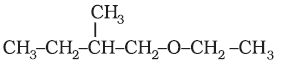
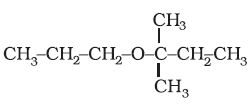
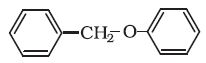
Give tha major products that are formed by heating each of following ethers with HI.
(i)
(ii)
(iii)
4.
Which of the two \(Na^{ + }\) or \(Ag^{ + }\) is stronger Lewis acid and why?
5.
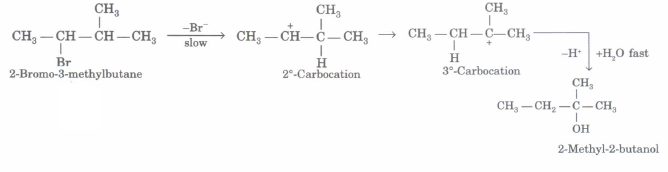
Hydrolysis of 2-bromo-3-methylbutane \(\left( 2° \right) \) gives only 2-methyl1-2-butanol \(\left( 3° \right) \).Explain.
6.
The standard reduction potential for \({ Cu }^{ 2+ }|Cu\) \(+0.34V\) . Calculate the reduction potential at \( pH=14\) for the above couple.\({ K }_{ sp }\) of \(Cu{ (OH) }_{ 2 }\) is \(1.0\times { 10 }^{ -19 }\).
7.
Why water cannot be separated completely from ethanol by fractional distillation?
1.
The entropy is higher if the metal is in liquid state than when it is in solid state. The value of entropy change (DS) of the reduction process is more on positive side when the metal formed is in liquid state and the metal oxide being reduced is in solid state. Thus the value of DrG V becomes more on negative side and the reduction becomes easier.
2.
K = Ae-Ea/RT
Ea, absence of catalyst = x KJ/mol
Ea, presence of catalyst = (x-20)KJ/mol
At 500K K = Ae-x/R.500
At 400
K = Ae-(x-20)/R.400
Divide 1 by 2, we get
X = 100KJ/mol
Ea = 100KJ/mol.
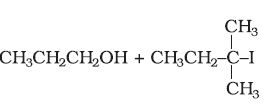
3.
(i)

(ii)
(iii)
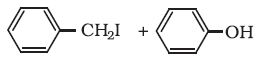
4.
Ag+ ion is stronger Lewis acid than Na+. Ag+ has 18-electron shell configuration (known as pseudo inert gas configuration) and causes greater polarization than Na+, an ion with 8-electron shell configuration. This is due to the fact that in the case of 18-electrons shell ion there are 10 d-electrons in addition to 88-and p-electrons. The d-electrons do not shield the nuclear charge effectively and therefore, they have increased the effective nuclear charge. Hence they cause greater polarization and therefore, Ag+ is a stronger Lewis acid than Na+ ion.
5.
During SNIreaction, the ionization gives 2° carbocation which rearranges by a hydride shift to a more stable 3"-carbocation to form 3°-alcohol as:
6.
For pH = 14, [H+]= 10-14
\([OH^-]={K_w\over [H^+]}={10^{-14}\over 10^{-14}}=1M\)
Cu(OH)2 ⇌ Cu2++ 2OH-
Ksp= [Cu2+] [OH-]2
1.0 x 10-19 = [Cu2+](1)2
[Cu2+] = 1.0 X 10⁻¹⁹
For the cell reaction,
Cu2++ 2e- ⟶ Cu
\(E=E^0{0.059\over 2}log{1\over [Cu^{2+}]}\)
\(=0.34-{0.059\over 2}log{1\over 1.0\times 10^{-19}}\)
\(=0.34-{0.059\over 2}\times19=-0.22V\)
7.
Ethanol and water (95.4% ethanol and 4.6% \({ H }_{ 2 }O\)) from a constant boiling mixture (azeotrope) boiling at 351.5 K. Hence, further water cannot be removed by fractional distillation.

12th Standard CBSE Syllabus & Materials
12th Standard CBSE
CBSE 12th Computer Science Python Revision Tour I - New Previous year Question Papers Study Material - QB365 Set A
NEW12th Standard CBSE
CBSE 12th Business Studies Planning Important Questions And Answers Study Material - QB365 Set A
NEW12th Standard CBSE
CBSE 12th Business Studies Business Environment Important Questions And Answers Study Material - QB365 Set A
NEW12th Standard CBSE
CBSE 12th Business Studies Principles of Management Important Questions And Answers Study Material - QB365 Set A



NCERT Books

Syllabus

Exam Pattern

Sample Question Papers

Previous year Question Papers

Important Notes

MCQ Practice test

NCERT Exemplers

Case study Questions

Image Based Questions

Passage based Questions

HOT Questions

Value Based Questions

Model Questions Papers
NCERT ( Book Back ) Questions

Assertion and Reason
Important Questions And Answers

CBSE 12th Standard CBSE Subjects
CBSE Standards









