
 100% FREE ACCESS
12th Standard CBSE Syllabus & Materials
12th Standard CBSE
CBSE 12th Economics Government Budget and the Economy Previous year Question Papers Study Material - QB365 Set A
NEW12th Standard CBSE
CBSE 12th Computer Science Interface Python with MySQL - New Previous year Question Papers Study Material - QB365 Set A
NEW12th Standard CBSE
CBSE 12th Computer Science Database Concept - New Previous year Question Papers Study Material - QB365 Set A
NEW12th Standard CBSE
CBSE 12th Computer Science Data Communication - New Previous year Question Papers Study Material - QB365 Set A
NEW12th Standard CBSE
CBSE 12th Computer Science Data Structures - New Previous year Question Papers Study Material - QB365 Set A
NEW12th Standard CBSE
CBSE 12th Computer Science Functions - New Previous year Question Papers Study Material - QB365 Set A

Published on: 24/05/2021
QB365 Provides the updated NCERT Exemplar Questions for Class 12, and also provide the detail solution for each and every NCERT Exemplar questions. NCERT Exemplar questions are latest updated question pattern from NCERT, QB365 will helps to get more marks in Exams
Download CBSE Class 12th Standard CBSE Chemistry question papers, sample papers, important questions, and previous year solved papers in PDF format. Get free study materials, NCERT solutions, and exam preparation resources for Class 12th Standard CBSE Chemistry
Questions + Answers key
Take MCQ Chemistry Test
1.
Explain, why on addition of mole of NaCI to 1L of water, the boiling point of water increases, while addition of 1mole of methyl alcohol to 1L of water decreases its boiling point?
2.
Define the following and give an example of each
(a) Coagulation
(b) Tyndall effect.
3.
Why do physisorption and chemisorption behave differently with rise in temperature?
4.
What happens when electric field is applied to colloidal solution?
5.
What should be the consideration during extraction of metals by electrochemical method?
6.
Write two basic requirements for refining of a metal by Mond process and by Van Arkel Method.
7.
Why does the rate of any reaction generally decreases during the course of the reaction ?
8.
For a zero order reaction, will be molecularity be equal to zero ? Explain.
9.
Write the Nernst equation for the cell reaction in the Daniel cell. How will the Ecell be affected when concentration of Zn2+ ions is increased ?
10.
Solutions of two electrolytes 'A' and 'B' are diluted. The \({ \wedge }_{ m }\) of 'B' increases 1.5 times while that of A increases 25 times. Which of the two is a strong electrolyte? Justify your answer.
11.
Aqueous copper sulphate solution and aqueous silver nitrate solution are electrolysed by 1 ampere current for 10 minutes in separate electrolytic cells. Will the mass of copper and silver deposited on the cathode be same or different ? Explain your answer.
12.
Why does table salt, NaCl, sometimes appear yellow in colour?
13.
What is ''semi-permeable'' membrane?
14.
What is the significance of Henry's Law constant KH?
1.
NaCl is a non-volatile solute. So, its addition to water lowers the vapour pressure of water. Hence, boiling point of water (solution) increases. Whereas methyl alcohol is more volatile than water. So, its addition to water increases the total vapour pressure of the solution. It results in decrease of boiling point of water.
2.
(a) Electrophoresis. The phenomenon of movement of colloidal particles under an applied the electric field is called electrophoresis. This helps to know the presence of charge on the sol particles and its nature whether positive or negative. In' this experiment, the colloidal particles move towards positive or negative electrodes depending upon their charge under the influence of electrical field. If the particles accumulate near the negative electrode, the charge on the particles is positive. On the other hand, if the sol particles accumulate near the positive electrode, the charge on the particles is negative. The apparatus consists of U tube with two platinum electrodes in each limb. Take a sol of AS2S3 in the U-tube. The intensity of the color of the sol in both the arms is same. Now, pass the current through the sol After some time, it
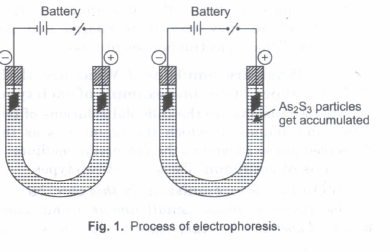
electrode became intense than the initial color. This indicates that the AS2S3particles have accumulated near the positive electrode. Therefore, the particles of AS2S3 are negatively charged and they move towards oppositely charged (positive) electrode and get accumulated there. Similarly, when an electric current is passed through positively charged Fe(OH)3sol, it is observed that they move towards negatively charged electrode and get accumulated there. Thus, by observing the direction of movement of the colloidal particles, the sign of the charge carried by the particles can be determined.
(ii) Coagulation. The phenomenon of ."precipitation of a colloidal solution by the addition of an excess of an electrolyte is called coagulation or Occultation. The coagulation capacity of different electrolytes depends upon the valency of the active ion or called flocculating ion. It is the ion carrying a charge opposite to the charge on the colloidal particles.According to Hardy Schulz law, greater the valency of the active ion or flocculating ion, greater will be its coagulating power. Thus, to coagulate negative sol of AS2S3, the coagulating power of different actions has been found to decrease in the order as:Al3+> Mg2+>Na+
Similarly, to coagulate a positive sol., such as Fe(OH)3 the coagulating power of different anions has been found to decrease in the order:[Fe (CN)]4--> PO:- > SO- > CI-
(iii) Dialysis. The method used to separate the impurities from the colloidal solution is called
dialysis. Its principle is based on the fact that colloidal particles cannot pass through a parchment or cellophane membrane while the ions of the electrolyte can pass through it. The colloidal solution is taken in It bag made of cellophane or parchment. The bag is suspended in fresh water. The impurities slowly diffuse out of the bag leaving behind the pure colloidal solution. Dialysis can be used for removing HCI from the ferric hydroxide sol
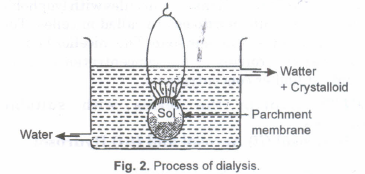
The ordinary process of dialysis is slow. To increase the process of purification, the dialysis is carried out by applying an electric field. This process is called electrodialysis.
(iv) 'Tyndall effect. When a strong beam of light is passed through a true solution placed in a beaker, in a dark room, the path of the light does not become visible as shown in However, if the light is passed through a sol, placed in the same room, the path of the light becomes visible when viewed from a direction at right angle to that of the incident beam.
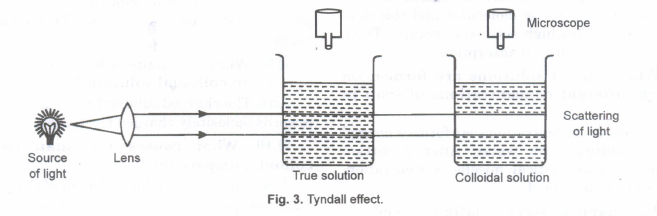
This phenomenon was studied for the first time by Tyndall and therefore it is called Tyndall effect. The cause to Tyndall effect is the scattering of light by colloidal particles i.e., these particles first absorb the incident ligand then a part of it gets scattered by them. Since the intensity of the scattered light is at a right angle to the plane of the incident light, the path becomes visible only when seen in that direction. The particles in true solution are too small
in size to cause any scattering i.e., the Tyndall effect is not noticed in true solutions.
3.
Physisorption is due to weak van der Waals forces. These weaken with rising in temperature. Hence, physisorption decreases. Chemisorption involves the formation of chemical bond which requires activation energy like any other chemical reaction. The rise in temperature provides the required activation energy and hence initially it increases with the increase of temperature and then decreases due to exothermic nature of adsorption equilibrium.
4.
The charged colloidal particles start moving towards the oppositely charged electrode.
5.
During extraction of metals by electrochemical method, the following are considered so the at proper precautions can be taken:
(i) reactivity of metal produced.
(ii) suitability of electrodes
6.
Basic requirements for both processes are:
(i) The metal should form volatile compound with a reagent, whereas impurities should not react.
(ii) The volatile compound should be easily decomposable, so that metal can be recovered easily.
7.
The rate of reaction depends upon concentrations of reactants proceeds, reactants are consumed, Hence, their concentration decreases and so the rate reaction decreases.
8.
No because molecularity can never be zero or fractional.
9.
\(Zn+{ Cu }^{ 2+ }\longrightarrow { Zn }^{ 2+ }+Cu,\)
\(\\ { E }_{ cell }={ E }_{ cell }^{ 0 }-\frac { 0.059 }{ 2 } \log { \frac { \left[ { Zn }^{ 2+ } \right] }{ \left[ { Cu }^{ 2+ } \right] } } \)
When \(\left[ { Zn }^{ 2+ } \right] \) is increased, Ecell will decrease.
10.
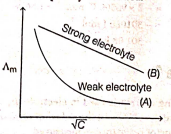
The \({ \wedge }_{ m }\) of 'B' increases 1.5 times while that of A increases 25 times. This shows that B is a strong electrolyte. The molar conductivity increases slowly with dilution as there is no increase in number of ions on dilution as strong electrolyte are completely dissociated.
11.
Masses of Cu and Ag deposited will be different because by the same quantity of electricity, masses deposited are in the ratio of their equivalent weights (Faraday's second law).
12.
Yellow colour of NaCl is due to metal excess defect as some Cl- ions (anions) leave their lattice sites and occupied by unpaired electrons. These sites are called F-centres. These electrons absorb energy from visible region for excitation so that complementry colour is yellow.
13.
A semipermeable membrane is a continuous sheet or film of suitable material (natural or synthetic) which has pores such that solvent molecules can pass through but big molecules of the solute cannot.
14.
Higher the value of Henry's law constant, KH . lower is the solubility of gas in the liquid.

12th Standard CBSE Syllabus & Materials
12th Standard CBSE
CBSE 12th Computer Science Python Revision Tour I - New Previous year Question Papers Study Material - QB365 Set A
NEW12th Standard CBSE
CBSE 12th Business Studies Planning Important Questions And Answers Study Material - QB365 Set A
NEW12th Standard CBSE
CBSE 12th Business Studies Business Environment Important Questions And Answers Study Material - QB365 Set A
NEW12th Standard CBSE
CBSE 12th Business Studies Principles of Management Important Questions And Answers Study Material - QB365 Set A



NCERT Books

Syllabus

Exam Pattern

Sample Question Papers

Previous year Question Papers

Important Notes

MCQ Practice test

NCERT Exemplers

Case study Questions

Image Based Questions

Passage based Questions

HOT Questions

Value Based Questions

Model Questions Papers
NCERT ( Book Back ) Questions

Assertion and Reason
Important Questions And Answers

CBSE 12th Standard CBSE Subjects
CBSE Standards








