
 100% FREE ACCESS
12th Standard CBSE Syllabus & Materials
12th Standard CBSE
CBSE 12th Economics Government Budget and the Economy Previous year Question Papers Study Material - QB365 Set A
NEW12th Standard CBSE
CBSE 12th Computer Science Interface Python with MySQL - New Previous year Question Papers Study Material - QB365 Set A
NEW12th Standard CBSE
CBSE 12th Computer Science Database Concept - New Previous year Question Papers Study Material - QB365 Set A
NEW12th Standard CBSE
CBSE 12th Computer Science Data Communication - New Previous year Question Papers Study Material - QB365 Set A
NEW12th Standard CBSE
CBSE 12th Computer Science Data Structures - New Previous year Question Papers Study Material - QB365 Set A
NEW12th Standard CBSE
CBSE 12th Computer Science Functions - New Previous year Question Papers Study Material - QB365 Set A

Published on: 24/05/2021
QB365 Provides the updated NCERT Exemplar Questions for Class 12, and also provide the detail solution for each and every NCERT Exemplar questions. NCERT Exemplar questions are latest updated question pattern from NCERT, QB365 will helps to get more marks in Exams
Download CBSE Class 12th Standard CBSE Chemistry question papers, sample papers, important questions, and previous year solved papers in PDF format. Get free study materials, NCERT solutions, and exam preparation resources for Class 12th Standard CBSE Chemistry
Questions + Answers key
Take MCQ Chemistry Test
1.
Predict the major product formed when HCl is added to isobutylene. Explain the mechanism involved.
2.
Arrange water, ethanol and phenol in increasing order of acidity and give reason for your answer.
3.
Suggest a reagent for conversion of ethanol to ethanoic acid.
4.
Explain the following observations:
(a) A lyophilic colloid is more stable than lyophobic colloid.
(b) Coagulation takes place when sodium chloride solution is added to a colloidal solution of ferric hydroxide.
(c) The sky appears blue in color.
5.
PH3 forms bubbles when passed slowly in water but NH3 dissolves. Explain Why?
6.
Why does leather get hardened after tanning?
7.
Why are sulphide ores converted to oxide before reduction?
8.
For a general reaction A \(\longrightarrow\) B, plot of concentration of A vs time is given in Fig. Answer the following questions on the basis of this graph.
(i) What is the order of the reaction ?
(ii) What is the slope of the curve ?
(iii) What are the units of rate constant
9.
Consider the cell :Cu | Cu2+ || Cl- | Cl2 , Pt
Write the reactions that occur at anode and cathode.
10.
Can \({ E }_{ cell }^{ 0 }\) and \({ \Delta }_{ r }{ G }^{ 0 }\) for cell reaction ever be equal to zero ?
11.
Why does white ZnO (s) become yellow upon heating?
12.
Why is the vapour pressure of an aqueous solution of glucose lower than that of water?
1.
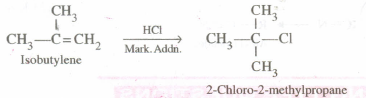
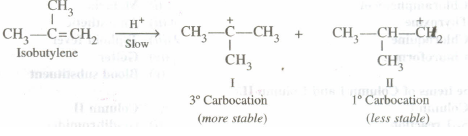
Mechanism. This reaction is an example of electrophilic addition reaction and occurs in two steps: Step I. In the first step, a proton adds to form two possible carbocations (I and II). Since carbocation (I) is 3°, therefore, it is much more stable than carbocation (II) which is 1°,
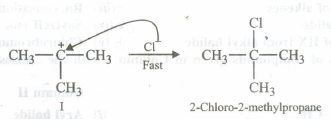
Step II. In the second step, the Cl- ion readily attacks the 3° carboation (I) forming 2-chloro-2-methylpropane as the major product.
2.
Increasing order of acidity is: ethanol < water < phenol. The phenoxide ion obtained after the removal of a proton is stabilised by resonance whereas the ethoxide ion obtained after the removal of a proton is destabilised by '+I' effect of C2H5 group. Therefore phenol is stronger acid than ethanol.
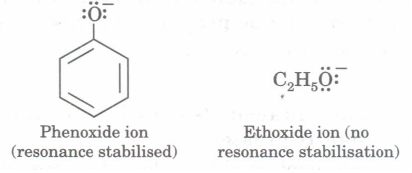
On the other hand ethanol is weaker acid than water because electron releasing -C2H5 group in ethanol increases the electron density on oxygen and hence the polarity of O-H bond in ethanol decreases. This results in the decreasing acidic strength. Hence acidic strength increases in the order given above.
3.
Any strong oxidising agent such as acidified KMnO4 or K2Cr2O7.
\(\underset { Ethanol }{ CH_{ 3 }CH_{ 2 }OH\ } \overset { KMn{ O }_{ 4 }/\ { H }_{ 2 }{ SO }_{ 4 } }{ \underset { orK_{ 2 }{ Cr }_{ 2 }{ O }_{ 7 }\ /{ H }_{ 2 }{ SO }_{ 4 } }{ \longrightarrow }} \underset { EthanoIC\ acid }{ CH_{ 3 }COHH } \)
4.
(a) It is due to more force of attraction between dispersed phase and a dispersion medium in lyophilic colloid than lyophobic colloid.
(b) Fe(OH) sol is positively charged which is /coagulated by negatively charged CI- ions present in sodium chloride solution.
(c) The sky appears blue in color due to scattering of light by colloidal particles. It is called Tyndall effect.
5.
Due to high electronegativity (3·0) and small size of N, NH3 forms H-bonds with water and hence it is water soluble. On the other hand, due to its lower electronegativity (2.1) of P and its bigger size than N, PH3 does not form H-bonds with \({ H }_{ 2 }O\) . As a result, it does not dissolve \({ H }_{ 2 }O\) in and hence escapes as bubbles.
6.
Animal hides are colloidal in nature and contain positively charged particles. Tannin contain negative charged colloidal particles. When hide is soaked in tannin, their mutual coagulation takes place and leather becomes hard.
7.
Sulphides are not reduced easily but oxides are easily reduced.
8.
(i) Order of reaction is zero.
(ii) Slope = -k
(iii) \(mol \ { L }^{ -1 }{ s }^{ -1 }\)
9.
Anode : \(Cu\longrightarrow { Cu }^{ 2+ }+2{ e }^{ - }\) (Oxidation)
Cathode : \({ Cl }_{ 2 }+2{ e }^{ - }\longrightarrow 2{ Cl }^{ - }\) (Reduction)
10.
No (Ecell can be zero but not \({ E }_{ cell }^{ 0 }\) ). Further, \({ \Delta G }^{ 0 }=-nF{ E }_{ cell }^{ 0 }\) . As \({ E }_{ cell }^{ 0 }\neq 0\) ,therefore, \({ \Delta }_{ r }{ G }^{ 0 }\) also cannot be zero.
11.
ZnO loses oxygen on heating and vacant sites of anions are occupied by electrons which absorb light fro the visible region and radiate complementary color, i.e. yellow.
12.
In pure water, the entire surface is occupied by water are volatile. On adding glucose, some water molecules on the surface are replaced by glucose molecules which are non - volatile. Hence, vapour pressure is lowered.

12th Standard CBSE Syllabus & Materials
12th Standard CBSE
CBSE 12th Computer Science Python Revision Tour I - New Previous year Question Papers Study Material - QB365 Set A
NEW12th Standard CBSE
CBSE 12th Business Studies Planning Important Questions And Answers Study Material - QB365 Set A
NEW12th Standard CBSE
CBSE 12th Business Studies Business Environment Important Questions And Answers Study Material - QB365 Set A
NEW12th Standard CBSE
CBSE 12th Business Studies Principles of Management Important Questions And Answers Study Material - QB365 Set A



NCERT Books

Syllabus

Exam Pattern

Sample Question Papers

Previous year Question Papers

Important Notes

MCQ Practice test

NCERT Exemplers

Case study Questions

Image Based Questions

Passage based Questions

HOT Questions

Value Based Questions

Model Questions Papers
NCERT ( Book Back ) Questions

Assertion and Reason
Important Questions And Answers

CBSE 12th Standard CBSE Subjects
CBSE Standards








