
 100% FREE ACCESS
12th Standard CBSE Syllabus & Materials
12th Standard CBSE
CBSE 12th Economics Government Budget and the Economy Previous year Question Papers Study Material - QB365 Set A
NEW12th Standard CBSE
CBSE 12th Computer Science Interface Python with MySQL - New Previous year Question Papers Study Material - QB365 Set A
NEW12th Standard CBSE
CBSE 12th Computer Science Database Concept - New Previous year Question Papers Study Material - QB365 Set A
NEW12th Standard CBSE
CBSE 12th Computer Science Data Communication - New Previous year Question Papers Study Material - QB365 Set A
NEW12th Standard CBSE
CBSE 12th Computer Science Data Structures - New Previous year Question Papers Study Material - QB365 Set A
NEW12th Standard CBSE
CBSE 12th Computer Science Functions - New Previous year Question Papers Study Material - QB365 Set A

Published on: 24/05/2021
QB365 Provides the updated NCERT Exemplar Questions for Class 12, and also provide the detail solution for each and every NCERT Exemplar questions. NCERT Exemplar questions are latest updated question pattern from NCERT, QB365 will helps to get more marks in Exams
Download CBSE Class 12th Standard CBSE Chemistry question papers, sample papers, important questions, and previous year solved papers in PDF format. Get free study materials, NCERT solutions, and exam preparation resources for Class 12th Standard CBSE Chemistry
Questions + Answers key
Take MCQ Chemistry Test
1.
Why is the vapour pressure of a solution of glucose in water lower than that of water?
2.
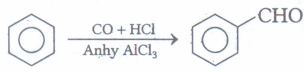
Can Gattermann-Koch reaction be considered simular to Friedel-Crafts acylation? Discuss
3.
Arrange the following is increasing order of their solubility in water
C6H5NH2, (C2H5)2NH, C2H5NH2
4.
Amino acids behave like salts rather than simple amines or carboxylic acids. Explain.
5.
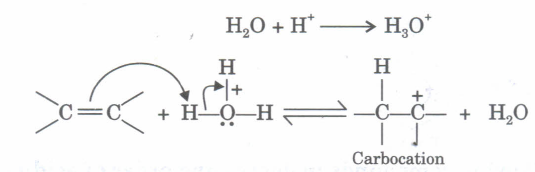
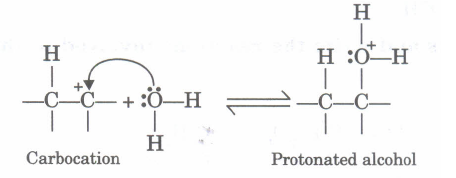
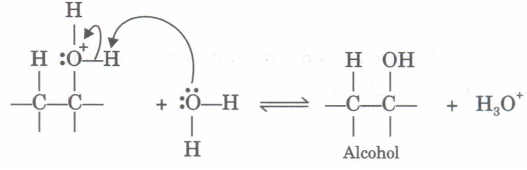
Preparation of alcohols from alkenes involves the electrophilic attack on alkene carbon atom. Explain its mechanism.
6.
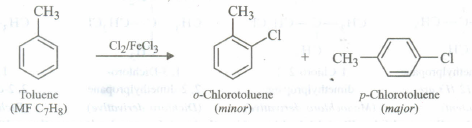
Write the structures and names of the compounds formed when compound 'A' with molecular formula, C7H8 is treated with Cl2 in the presence of FeCl3
7.
\(CuSO_4.5\ H_2O\) is blue in colour while \(CuSO_4\) is Colourless. Why ?
8.
Define the following and give an example of each
(a) Coagulation
(b) Tyndall effect.
9.
Explain why the acidity oxoacids of chlorine increases in the order given below:
HCIO < HCIO2 < HCIO3
10.
How are metals used as semiconductors refined?What is the principle of the method used?
11.
Why in the redox titration of \({ KMnO }_{ 4 }\) vs oxalic acid, we heat oxalic acid, we heat oxalic acid solution before starting the titration?
12.
What advantage do the fuel cells have over primary and secondary batteries ?
13.
Depict the galvanic cell in which the cell reaction is Cu(s) + 2Ag+ (aq) \(\longrightarrow\) 2Ag(s) + Cu2+ (aq)
14.
Inspite of long range order in the arrangement of particles why are the crystals usually not perfect?
15.
Why are aquatic species more comfortable in cold water in comparison to warm water ?
1.
In the solution, the surface has both solute and solvent molecules, so the fraction of the surface covered by solvent molecules gets reduced. Thus, the number of solvent molecules escaping from the surface is reduced, resulting in lowering the vapour pressure. So, the vapour pressure of the solution of glucose in water is lower than that of pure water.
2.
In Gattermann-Koch reaction, benzene or its derivative is treated with CO and HCI in the presence of anhydrous aluminium chloride to produce benzaldehyde. In this reaction, CO and HCI combine to form HCOCI, i.e. formyl chloride which gets substituted on benzene by the replacement of l-l-atom.
3.
The extent of H-bonding and hence solubility in water decreases as the steric hindrance due to the size of alkyl/aryl groups increases. Thus, solubility increases in the order:
C6H5NH2<(C2H5)2NH
4.
In aqueous solution, the carboxyl group loses a proton and the amino group accepts a proton. In other words, the carboxyl and amino groups neutralize each other to form zwitterion.
\(R-CH-COOH\quad \rightleftharpoons R-CH-{ COO }^{ - }\\ \quad \quad \quad |\quad \quad \quad \quad \quad \quad \quad \quad \quad \quad |\\ \quad \quad { NH }_{ 2 }\quad \quad \quad \quad \quad \quad \quad ^{ + }{ { NH }_{ 3 } }\quad \\ \alpha -Amino\quad acid\quad \quad \quad Zwitterion\\ \)
5.
(a) Alkenes get protonated by the electrophilic attack of H3O+
(b) Nucleophile (H2O) attacks the carbocation forming protonated alcohol.
(c) Loss of H+from oxygen (deprotonation) to form alcohol.
6.
Compound with MF C7H8 is toluene. Since CH3 group is O, p-directing, therefore, chlorination of toluene with Cl2 in presence of FeCl3 gives a mixture of o-chlorotoluene and p-chlorotoluene, in which the p-isomer predominates.
7.
In \(CuSO_4.5\ H_2O, \ 4\ H_2O\) molecules are present as ligand. Crystal field splitting occurs and hence d-d transition occurs which gives it blue colour. In CuSO4, there are no H2O molecules present as ligand. No crystal field splitting occurs and hence it has no colour.
8.
(a) Electrophoresis. The phenomenon of movement of colloidal particles under an applied the electric field is called electrophoresis. This helps to know the presence of charge on the sol particles and its nature whether positive or negative. In' this experiment, the colloidal particles move towards positive or negative electrodes depending upon their charge under the influence of electrical field. If the particles accumulate near the negative electrode, the charge on the particles is positive. On the other hand, if the sol particles accumulate near the positive electrode, the charge on the particles is negative. The apparatus consists of U tube with two platinum electrodes in each limb. Take a sol of AS2S3 in the U-tube. The intensity of the color of the sol in both the arms is same. Now, pass the current through the sol After some time, it
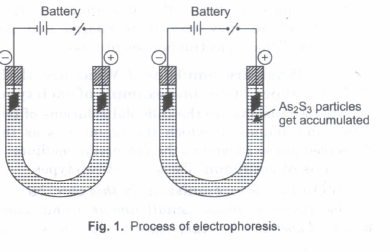
electrode became intense than the initial color. This indicates that the AS2S3particles have accumulated near the positive electrode. Therefore, the particles of AS2S3 are negatively charged and they move towards oppositely charged (positive) electrode and get accumulated there. Similarly, when an electric current is passed through positively charged Fe(OH)3sol, it is observed that they move towards negatively charged electrode and get accumulated there. Thus, by observing the direction of movement of the colloidal particles, the sign of the charge carried by the particles can be determined.
(ii) Coagulation. The phenomenon of ."precipitation of a colloidal solution by the addition of an excess of an electrolyte is called coagulation or Occultation. The coagulation capacity of different electrolytes depends upon the valency of the active ion or called flocculating ion. It is the ion carrying a charge opposite to the charge on the colloidal particles.According to Hardy Schulz law, greater the valency of the active ion or flocculating ion, greater will be its coagulating power. Thus, to coagulate negative sol of AS2S3, the coagulating power of different actions has been found to decrease in the order as:Al3+> Mg2+>Na+
Similarly, to coagulate a positive sol., such as Fe(OH)3 the coagulating power of different anions has been found to decrease in the order:[Fe (CN)]4--> PO:- > SO- > CI-
(iii) Dialysis. The method used to separate the impurities from the colloidal solution is called
dialysis. Its principle is based on the fact that colloidal particles cannot pass through a parchment or cellophane membrane while the ions of the electrolyte can pass through it. The colloidal solution is taken in It bag made of cellophane or parchment. The bag is suspended in fresh water. The impurities slowly diffuse out of the bag leaving behind the pure colloidal solution. Dialysis can be used for removing HCI from the ferric hydroxide sol
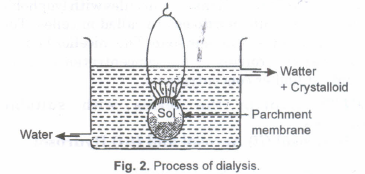
The ordinary process of dialysis is slow. To increase the process of purification, the dialysis is carried out by applying an electric field. This process is called electrodialysis.
(iv) 'Tyndall effect. When a strong beam of light is passed through a true solution placed in a beaker, in a dark room, the path of the light does not become visible as shown in However, if the light is passed through a sol, placed in the same room, the path of the light becomes visible when viewed from a direction at right angle to that of the incident beam.
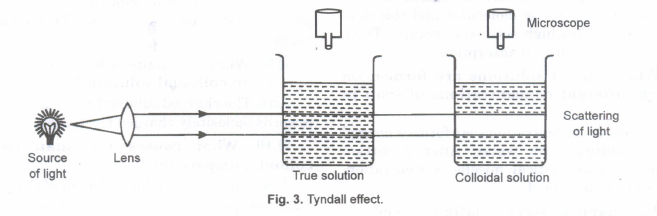
This phenomenon was studied for the first time by Tyndall and therefore it is called Tyndall effect. The cause to Tyndall effect is the scattering of light by colloidal particles i.e., these particles first absorb the incident ligand then a part of it gets scattered by them. Since the intensity of the scattered light is at a right angle to the plane of the incident light, the path becomes visible only when seen in that direction. The particles in true solution are too small
in size to cause any scattering i.e., the Tyndall effect is not noticed in true solutions.
9.
Reason: All these acids on losing a proton give their corresponding conjugate bases, i.e.,\(Cl{ O }^{ - },\ Cl{ O }_{ 2 }^{ - },\ Cl{ O }_{ 3 }^{ - }\ and\ Cl{ O }_{ 4 }^{ - }.\) Their structures are :

Since oxygen is more electronegative than chlorine, therefore, the dispersal of the -ve charge present on oxygen atom (singly bonded to CI)increases as the number of oxygen atoms attached by a double bond to chlorine increases due to \(d\pi -p\pi \) back bonding. In other words, stability of the conjugate bases increases in the order: \({ ClO }^{ - }<{ ClO }_{ 2 }^{ - }<{ ClO }_{ 3 }^{ - }<{ ClO }_{ 4 }^{ - }.\)
Thus, due to increase in stability of the conjugate base, acidic strength increases in the same order :\( \ (HClO\) )
10.
Semiconducting metal is produced by zone refining method which is based on the principle that th~ impurities are more soluble in melt than in the solid state of metals
11.
The reaction between \({ KMnO }_{ 4 }\) and oxalic acid is very slow. By raising the temperature we can increase the rate of reaction.
12.
Primary batteries contain limited amounts of reactants. These cells become dead when the reactants are consumed. Secondary batteries can be recharged but take a long time for recharging. Fuel cells can be run continuously so long as the reactants are supplied and the products are removed continuously.
13.
Cu(s) | Cu2+ (aq) || Ag+(aq) | Ag(s)
14.
This is because when crystallisation occurs at a fast or moderate rate, the constituent particles may not get sufficient time to arrange themselves in a perfect order.
15.
At a given pressure the solubility of oxygen in water increases with decrease in temperature. Therefore, the concentration of oxygen in sea is more in cold water and thus presence of more oxygen at lower temperature makes the aquatic species more comfortable in cold water.

12th Standard CBSE Syllabus & Materials
12th Standard CBSE
CBSE 12th Computer Science Python Revision Tour I - New Previous year Question Papers Study Material - QB365 Set A
NEW12th Standard CBSE
CBSE 12th Business Studies Planning Important Questions And Answers Study Material - QB365 Set A
NEW12th Standard CBSE
CBSE 12th Business Studies Business Environment Important Questions And Answers Study Material - QB365 Set A
NEW12th Standard CBSE
CBSE 12th Business Studies Principles of Management Important Questions And Answers Study Material - QB365 Set A



NCERT Books

Syllabus

Exam Pattern

Sample Question Papers

Previous year Question Papers

Important Notes

MCQ Practice test

NCERT Exemplers

Case study Questions

Image Based Questions

Passage based Questions

HOT Questions

Value Based Questions

Model Questions Papers
NCERT ( Book Back ) Questions

Assertion and Reason
Important Questions And Answers

CBSE 12th Standard CBSE Subjects
CBSE Standards








