
 100% FREE ACCESS
12th Standard CBSE Syllabus & Materials
12th Standard CBSE
CBSE 12th Economics Government Budget and the Economy Previous year Question Papers Study Material - QB365 Set A
NEW12th Standard CBSE
CBSE 12th Computer Science Interface Python with MySQL - New Previous year Question Papers Study Material - QB365 Set A
NEW12th Standard CBSE
CBSE 12th Computer Science Database Concept - New Previous year Question Papers Study Material - QB365 Set A
NEW12th Standard CBSE
CBSE 12th Computer Science Data Communication - New Previous year Question Papers Study Material - QB365 Set A
NEW12th Standard CBSE
CBSE 12th Computer Science Data Structures - New Previous year Question Papers Study Material - QB365 Set A
NEW12th Standard CBSE
CBSE 12th Computer Science Functions - New Previous year Question Papers Study Material - QB365 Set A

Published on: 24/05/2021
QB365 Provides the updated NCERT Exemplar Questions for Class 12, and also provide the detail solution for each and every NCERT Exemplar questions. NCERT Exemplar questions are latest updated question pattern from NCERT, QB365 will helps to get more marks in Exams
Download CBSE Class 12th Standard CBSE Chemistry question papers, sample papers, important questions, and previous year solved papers in PDF format. Get free study materials, NCERT solutions, and exam preparation resources for Class 12th Standard CBSE Chemistry
Questions + Answers key
Take MCQ Chemistry Test
1.
An amorphous solid A burns in air to form a gas B which turns lime water milky. The gas is also produced as a byproduct during roasting of sulphide ore. This gas decolourises acidified aqueous KMnO4 solution and reduces Fe 3+ to Fe2+. Identify the solid 'A' and the gas 'B ' and write the reactions involved.
2.
On heating compound (A)gives a gas (B)which is a constituent of air.This gas when treated with 3 mol of hydrogen (H2) in the presence of a catalyst gives another gas (C) which is basic in nature. Gas C on further oxidation in moist condition gives gives a compound (D) which is a part of acid rain. Identify compounds (A) to D and also give necessary equations of all the steps involved.
3.
(a) Out of Ag2SO4, CuF2, MgF2 and CuCI, which compound will be coloured and why?
(b) Explain :
(i) \({ CrO }_{ 4 }^{ 2- }\) is a strong oxidizing agent while \({ MnO }_{ 4 }^{ 2- }\) is not.
(ii) Zr and Hf have identical sizes.
(iii) The lowest oxidation state of manganese is basic while the highest is acidic.
(iv) Mn (II) shows maximum paramagnetic character amongst the divalent ions of the first transition series.
4.
Why are different colours observed in octahedral and tetrahedral complexes for the same metal and same ligands ?
5.
What is the relationship between observed colour of the complex and the wavelength of light absorbed by the complex ?
6.
CoSO4Cl.5 NH3 exists in two isomeric forms 'A' and 'B' gives white precipitate with BaCl2 but does not react with AgNO3. Answer the following questions.
(i) Identify 'A' and 'B' and write their structure formulas.
(ii) Name the type of isomerism involved
(iii) Give the IUPAC name of 'A' and 'B'.
7.
Using valence bond theory, explain the following in relation to the complexes given below :
\([Mn(CN)_6]^{3-}, [Co(NH_3)_6]^{3+}, [Cr(H_2O)_6]^{3+}, [FeCl_6]^{4-}\)
(i) Type of hybridisation
(ii) Inner or outer orbital complex.
(iii) Magnetic behaviour.
(iv) Spin only magnetic moment value.
8.
Using crystal field theory, draw energy level diagram, write electronic configuration of the central metal atom/ion and determine the magnetic moment value in the following :
(i) \([CoF_6]^{3-}, [Co(H_2O)_6]^{2+},[Co(CN)_6]^{3-}\)
(ii) \([FeF_6]^{3-}, \ [Fe(H_2O)_6]^{2+}, [Fe(CN)_6]^{4-}\).
9.
On heating compound(A) gives a gas (B) which is a constituent of air. This gas when treated with 3 mol of hydrogen (H2) in the presence of a catalyst gives another gas (C) which is basic in nature. Gas C on further oxidation in moist condition gives a compound (D) which is a part of acid rain. Identify compounds (A) to (D) and also give necessary equations of all the steps involved.
10.
On heating, lead (II) nitrate gives a brown gas 'A'. The gas 'A' on cooling changes to colourless solid 'B'. Solid 'B' on heating with NO changes to a blue solid 'C'. Identiy 'A', 'B' and 'C' and also write reactions involved and draw the structures of 'B' and 'C'.
11.
An amorphous solid 'A' burns in air to form a gas 'B' which turns lime water milky. The gas is also produced as a by-product during roasting of sulphide ore. This gas decolourises acidified aqueous KMnO4 solution and reduces Fe3+ to Fe2+ Identify the solid "A" and the gas "B" and write the reactions involved.
12.
What are the applications of adsorption in chemical analysis?
13.
(a) what is meant by rate of a reaction.
(b) In a pseudo first order hydrolysis of ester in water, the following results are obtained:
| t in seconds | 0 | 30 | 60 | 90 |
| [Ester] M | 0.55 | 0.31 | 0.17 | 0.085 |
(i) Calculate the average rate of reaction between the time interval 30 to 60 seconds.
(ii) Calculate the pseudo first order rate constant for the hydrolysis of ester.
14.
Write down the reactions taking place in different zones in the blast furnace during the extraction of iron.
1.
(i) Since, the byproduct of roasting of sulphide ore is SO2' It also turns lime water milky. Therefore, gas 'B ' must be SO2.
(ii) As the gas B is obtained when amorphous solid 'A' burns in air therefore, amorphous solid 'A' must be sulphur, S8
\(\begin{aligned} &\mathrm{S}_{8}+8 \mathrm{O}_{2} \stackrel{\Delta}{\longrightarrow} 8 \mathrm{SO}_{2}\\ &\text { (A) }\\ &2 \mathrm{ZnS}(s)+3 \mathrm{O}_{2}(g) \longrightarrow 2 \mathrm{ZnO}(s)+2 \mathrm{SO}_{2} \end{aligned}\)
(iii) Gas B reduces acidified aqueous KMnO4 solution and reduces Fe3+ to Fe2+ salts as shown below:
\(2 \mathrm{MnO}_{4}^{-}+5 \mathrm{SO}_{2}+2 \mathrm{H}_{2} \mathrm{O} \longrightarrow 5 \mathrm{SO}_{4}^{2-}+4 \mathrm{H}^{+}+2 \mathrm{Mn}^{2+}\\ (Violet) (Colourless) \)
\(\\\underset{\text { (Yellow) }}{2 \mathrm{Fe}^{3+}}+\mathrm{SO}_{2}+2 \mathrm{H}_{2} \mathrm{O} \longrightarrow \underset{\text { (Green) }}{2 \mathrm{Fe}^{2+}}+\mathrm{SO}_{4}^{2-}+4 \mathrm{H}^{+}\)
Thus, solid A is S8 and gas B is SO2
2.
\((A)=NH_{ 4 }NO_{ 2 },\ (B)=N_{ 2 },\ (C)=NH_{ 3 },\ (D)=HNO_{ 3 }\)
\(\\ NH_{ 4 }NO_{ 2 }\overset { Heat }{ \longrightarrow } \underset { (B) }{ N_{ 2 } } +2H_{ 2 }O\)
\(\\ N_{ 2 }+3H_{ 2 }\overset { Catalyst }{ \longrightarrow } \underset { (C) }{ 2NH_{ 3 } } \)
\(\\ 4NH_{ 3 }+5O_{ 2 }\longrightarrow 4NO+6H_{ 2 }O\)
\(\\ 2NO+O_{ 2 }\longrightarrow 2NO_{ 2 }\)
\(\\ 3NO_{ 2 }+H_{ 2 }O\longrightarrow 2HNO_{ 3 }+NO\)
3.
(i) (a) CuF2 (b) (i) Cr in crO24 - is in the highest oxidation state, i.e., +6 while Mn in MnO is in oxidation state +6 and its most stable oxidation state is +7
(ii) due to lanthanoid contraction
(iii) [Mn2+ has 3d 5 configuration]
4.
\({ \triangle }_{ t }=\left( \frac { 4 }{ 9 } \right) { \triangle }_{ 0 }\). Thus, \({ \triangle }_{ t }\) is smaller than \({ \triangle }_{ 0 }\). Hence, less energy (higher wavelength) is absorbed by tetrahedral complexes than by octahedral complexes of the same metal and ligands. Therefore, the observed colour are different.
5.
When white light falls on the complex, some part of it is absorbed. Greater the CFSE, greater is the energy absorbed or shorter is the wavelength absorbed \((E={hc\over\lambda })\). The observed colour is the complementary colour of the colour absorbed.
6.
(i) As isomer A reacts with AgNO3 to give a white precipitate, CI must be present in the ionization sphere. As it does not react with BaCI2, SO42- must be present in coordination sphere.
Formula of A = [Co(NH3)5SO4] CI (coordination no. of Co = 6) As reactions are reverse for isomer B, formula of B = [Co(NH3)5CI]S04
(ii) Ionization isomerism.
(iii) A = Pentaarnminesulphatocobalt (III) chloride ; B = Pentaamminechloridocobalt (ill) sulphate
7.
\([Mn(CN)_6]^{3-}\)
d2sp3, (ii) inner orbital complex, (iii) paramagnetic, (iv) 2.87 B.M.
(i) d2sp3 (ii) Inner orbital complex, (iii) diamagnetic, (iv) \(\mu=0\)
(i) d2sp3, (ii) Inner orbital complex, (iii) paramagnetic, (iv) 3.87 B.M.
(i) sp3d2, (ii) outer orbital complex (iii) paramagnetic (iv) 4.9 B.M.
8.
(i) \([CoF_6]^{3-}\)
\( [Co(H_2O)_6]^{2+}\)
\([Co(CN)_6]^{3-}\)
(ii) \([FeF_6]^{3-}\)
\(\ [Fe(H_2O)_6]^{2+}\)
\([Fe(CN)_6]^{4-}\)
It is diamagnetic due to the absence of unpaired electrons.
9.
(i) \({ NH }_{ 4 }{ NO }_{ 2 }(s)\underrightarrow { heat } { N }_{ 2 }+{ 2H }_{ 2 }O\)
'A' 'B'
(ii) \({ N }_{ 2 }+{ 3H }_{ 2 }\longrightarrow 2{ NH }_{ 3 }(g)\)
'C' basic
(iii) \({ 4NH }_{ 3 }+{ 5O }_{ 2 }\longrightarrow 4NO+{ 6H }_{ 2 }O\)
\(\\ 2NO+{ O }_{ 2 }\longrightarrow { 2NO }_{ 2 }\)
'D' (part of acid rain)
\({ 3NO }_{ 2 }+{ H }_{ 2 }O\longrightarrow 2{ HNO }_{ 3 }+NO\)
10.
\(2Pb{ { { { (NO }_{ 3 }) } } }_{ 2 }\xrightarrow { heat } 2PbO(s)+{ NO }_{ 2 }+{ O }_{ 2 }\)
Brown (A)
\({ 2NO }_{ 2 }(g)\overset { cooling }{ \rightleftharpoons } { N }_{ 2 }{ O }_{ 4 }(s)\)
(B) Colourless
\({ N }_{ 2 }{ O }_{ 4 }+2NO\overset { heat }{ \underset { 250k }{ \rightleftharpoons } } { 2N }_{ 2 }{ O }_{ 3 }(s)\)
(C) Blue solid
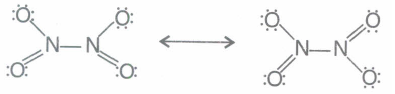
Resonating Structures of \({ N }_{ 2 }{ O }_{ 4 }\)
11.
\('A'\quad is\quad { S }_{ 8 }.\quad 'B'is{ SO }_{ 2 }(g).\)
\({ S }_{ 8 }+{ 8O }_{ 2 }\overset { heat }{ \rightarrow } { 8SO }_{ 2 }(g)\)
'B' decolorizes
'B' turns lime water milky due to formation of
'B' is obtained by roasting of sulphideores
'B' reduces in aqueous solution.
12.
(i) In TLC
(ii) As adsorption incicators
(iii) In separation of inert gases.
13.
(a) Rate of reaction is defined as change in cone. of reactants or products per unit time.Its unit is mol L-1 S-1.
Average rate: The rate of reaction measured over a long time interval is called average
rate of reaction: It is equal to Δx/Δt, e.g.
H2(g) + Cl2 (g) ⇾ 2HCI(g);
Rate of reaction = \(-{Δ[H_2]\over Δt}=-{Δ[Cl_2]\over Δt}=+{1\over 2}{Δ[HCl]\over Δt}\)
2HI (g) ⇾ H2 (g) + I2 (g)
Rate of reaction = \(-{Δ[HI]\over Δt}=+{Δ[H_2]\over Δt}=+{Δ[I_2]\over Δt}\)
Instantaneous rate: It is the rate of reaction when the average rate is taken over a very small interval of time. It is equal to dx/dt.
Instantaneous rate = Average rate as ∆t approaches zero.
(b) (t) Average rate = \(-\left(C_2-C_1\over t_2-t_1\right)=\left(0.17-0.31\over 60-30\right)=+{0.14\over 30}={10\over 100}\times{1\over 30}\)
= \({14\over 3}\) x 10-3 moI L-1 s-1
= 4.67 x 10⁻³ mol L-1 s1
(ii) \(k={2.303\over t}log{[A]_0\over [A]}={2.303\over 30}log{0.55\over 0.31}={2.303\over 30}[log 55-log 3]\)
\(={2.303\over 30}[1.7404 - 1.4914]={2.303\over 30}\times0.2490\)
= 1.91 x 10⁻² s-1
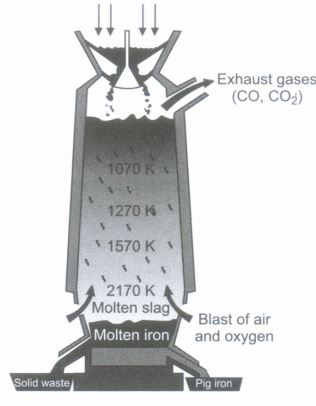
14.
At 500-800 K
\(3Fe_{ 2 }{ O }_{ 3 }+CO\rightarrow 2Fe_{ 3 }{ O }_{ 4 }+CO_{ 2 }\)
\(Fe_{3 }{ O }_{ 4}+4CO\rightarrow 3Fe_+4CO_{ 2 }\)
\(Fe_{ 2 }{ O }_{ 3 }+CO\rightarrow 2Fe_{ }{ O }_{ }+CO_{ 2 }\)
At 900-1500 K
\(C+CO_{ 2 }\rightarrow 2CO\)
\(Fe_{} { O }_{ }+CO\rightarrow Fe_{ }{ }_{ }+CO_{ 2 }\)
\(C+O_{ 2}\rightarrow { }_{ }+CO_{ 2 }\)
At above 1570 K
\(Fe_{} { O }_{ }+C\rightarrow Fe_{ }{ }_{ }+CO_{ }\)
\(Ca{ CO }_{ 3 }\overset { \Delta }{ \rightarrow } Ca{ O }+CO_{ 2 }\)
\(Ca{ O }+SiO_{ 2 }\rightarrow CaSiO_{ 3 }(slag)\)
Ore, limestone, and coke

12th Standard CBSE Syllabus & Materials
12th Standard CBSE
CBSE 12th Computer Science Python Revision Tour I - New Previous year Question Papers Study Material - QB365 Set A
NEW12th Standard CBSE
CBSE 12th Business Studies Planning Important Questions And Answers Study Material - QB365 Set A
NEW12th Standard CBSE
CBSE 12th Business Studies Business Environment Important Questions And Answers Study Material - QB365 Set A
NEW12th Standard CBSE
CBSE 12th Business Studies Principles of Management Important Questions And Answers Study Material - QB365 Set A



NCERT Books

Syllabus

Exam Pattern

Sample Question Papers

Previous year Question Papers

Important Notes

MCQ Practice test

NCERT Exemplers

Case study Questions

Image Based Questions

Passage based Questions

HOT Questions

Value Based Questions

Model Questions Papers
NCERT ( Book Back ) Questions

Assertion and Reason
Important Questions And Answers

CBSE 12th Standard CBSE Subjects
CBSE Standards








