
 100% FREE ACCESS
12th Standard CBSE Syllabus & Materials
12th Standard CBSE
CBSE 12th Economics Government Budget and the Economy Previous year Question Papers Study Material - QB365 Set A
NEW12th Standard CBSE
CBSE 12th Computer Science Interface Python with MySQL - New Previous year Question Papers Study Material - QB365 Set A
NEW12th Standard CBSE
CBSE 12th Computer Science Database Concept - New Previous year Question Papers Study Material - QB365 Set A
NEW12th Standard CBSE
CBSE 12th Computer Science Data Communication - New Previous year Question Papers Study Material - QB365 Set A
NEW12th Standard CBSE
CBSE 12th Computer Science Data Structures - New Previous year Question Papers Study Material - QB365 Set A
NEW12th Standard CBSE
CBSE 12th Computer Science Functions - New Previous year Question Papers Study Material - QB365 Set A

Published on: 25/05/2021
QB365 Provides the updated NCERT Exemplar Questions for Class 12, and also provide the detail solution for each and every NCERT Exemplar questions. NCERT Exemplar questions are latest updated question pattern from NCERT, QB365 will helps to get more marks in Exams
Download CBSE Class 12th Standard CBSE Chemistry question papers, sample papers, important questions, and previous year solved papers in PDF format. Get free study materials, NCERT solutions, and exam preparation resources for Class 12th Standard CBSE Chemistry
Questions + Answers key
Take MCQ Chemistry Test
1.
Define the following and give an example of each
(a) Coagulation
(b) Tyndall effect.
2.
Explain the following observations:
(a) A lyophilic colloid is more stable than lyophobic colloid.
(b) Coagulation takes place when sodium chloride solution is added to a colloidal solution of ferric hydroxide.
(c) The sky appears blue in color.
3.
Define each of the following terms
(i) Micelles
(ii) Peptization
(iii) Desorption.
4.
Explain the following terms giving a suitable example for each:
(i) Aerosol
(ii) Emulsion
(iii) Micelle
5.
What are lyophilic and lyophobic colloids? Give one example of each type. Which one of these two types of sols is easily coagulated and why?
1.
(a) Electrophoresis. The phenomenon of movement of colloidal particles under an applied the electric field is called electrophoresis. This helps to know the presence of charge on the sol particles and its nature whether positive or negative. In' this experiment, the colloidal particles move towards positive or negative electrodes depending upon their charge under the influence of electrical field. If the particles accumulate near the negative electrode, the charge on the particles is positive. On the other hand, if the sol particles accumulate near the positive electrode, the charge on the particles is negative. The apparatus consists of U tube with two platinum electrodes in each limb. Take a sol of AS2S3 in the U-tube. The intensity of the color of the sol in both the arms is same. Now, pass the current through the sol After some time, it
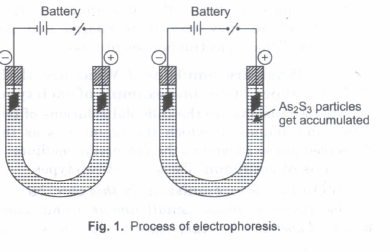
electrode became intense than the initial color. This indicates that the AS2S3particles have accumulated near the positive electrode. Therefore, the particles of AS2S3 are negatively charged and they move towards oppositely charged (positive) electrode and get accumulated there. Similarly, when an electric current is passed through positively charged Fe(OH)3sol, it is observed that they move towards negatively charged electrode and get accumulated there. Thus, by observing the direction of movement of the colloidal particles, the sign of the charge carried by the particles can be determined.
(ii) Coagulation. The phenomenon of ."precipitation of a colloidal solution by the addition of an excess of an electrolyte is called coagulation or Occultation. The coagulation capacity of different electrolytes depends upon the valency of the active ion or called flocculating ion. It is the ion carrying a charge opposite to the charge on the colloidal particles.According to Hardy Schulz law, greater the valency of the active ion or flocculating ion, greater will be its coagulating power. Thus, to coagulate negative sol of AS2S3, the coagulating power of different actions has been found to decrease in the order as:Al3+> Mg2+>Na+
Similarly, to coagulate a positive sol., such as Fe(OH)3 the coagulating power of different anions has been found to decrease in the order:[Fe (CN)]4--> PO:- > SO- > CI-
(iii) Dialysis. The method used to separate the impurities from the colloidal solution is called
dialysis. Its principle is based on the fact that colloidal particles cannot pass through a parchment or cellophane membrane while the ions of the electrolyte can pass through it. The colloidal solution is taken in It bag made of cellophane or parchment. The bag is suspended in fresh water. The impurities slowly diffuse out of the bag leaving behind the pure colloidal solution. Dialysis can be used for removing HCI from the ferric hydroxide sol
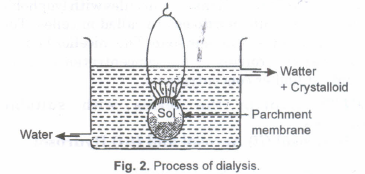
The ordinary process of dialysis is slow. To increase the process of purification, the dialysis is carried out by applying an electric field. This process is called electrodialysis.
(iv) 'Tyndall effect. When a strong beam of light is passed through a true solution placed in a beaker, in a dark room, the path of the light does not become visible as shown in However, if the light is passed through a sol, placed in the same room, the path of the light becomes visible when viewed from a direction at right angle to that of the incident beam.
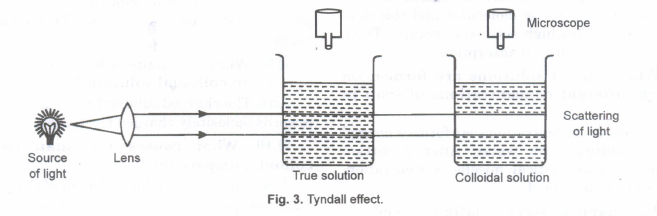
This phenomenon was studied for the first time by Tyndall and therefore it is called Tyndall effect. The cause to Tyndall effect is the scattering of light by colloidal particles i.e., these particles first absorb the incident ligand then a part of it gets scattered by them. Since the intensity of the scattered light is at a right angle to the plane of the incident light, the path becomes visible only when seen in that direction. The particles in true solution are too small
in size to cause any scattering i.e., the Tyndall effect is not noticed in true solutions.
2.
(a) It is due to more force of attraction between dispersed phase and a dispersion medium in lyophilic colloid than lyophobic colloid.
(b) Fe(OH) sol is positively charged which is /coagulated by negatively charged CI- ions present in sodium chloride solution.
(c) The sky appears blue in color due to scattering of light by colloidal particles. It is called Tyndall effect.
3.
(i) Micelles: Soaps and detergents consist of lyophilic and lyophobic parts which associate together to form micelles.
(ii) Peptization: The conversion of precipitate into colloidal solution in presence of peptizing agent is called peptization. The peptizing agent is generally an electrolyte. In this process, a dispersion medium (liquid) breaks up the precipitate into the colloidal state. Lyophilic sols are prepared by bringing into contact or warming the substance with a dispersion medium, e.g. gelatin, gum arabic, starch and soaps are easily peptized by water. Cellulose nitrate is peptized by organic solvents, such as ethyl alcohol. The product obtained is commercially known as collodion.
(iii) Desorption: The process of removing an adsorbed substance from a surface on which it is adsorbed is called desorption. Silica gel removes water, animal charcoal removes colour from surface of organic compounds.
4.
| Dispersed phase | Dispersion Medium | Name of the colloidal solution | Examples |
| Solid | Gas | Aerosol | Smoke, dust particles |
| Liquid | Liquid | Emulsion | Milk, hair cream, cod-liver oil |
(iii) When solid is dispersed in water, it is called hydrosol, e.g. starch dispersed in water.
5.
The stability of hydrophobic sol is only due to the presence of charge on the colloidal particles. If the charge is removed, e.g., by the addition of suitable electrolytes, the particles will come nearer to each other to form an aggregate, i.e.; they will coagulate and settle down. On the other hand, the stability of hydrophilic sol is due to charge as well as solvation of the colloidal particles. Both the factors have to be removed to bring about their coagulation.

12th Standard CBSE Syllabus & Materials
12th Standard CBSE
CBSE 12th Computer Science Python Revision Tour I - New Previous year Question Papers Study Material - QB365 Set A
NEW12th Standard CBSE
CBSE 12th Business Studies Planning Important Questions And Answers Study Material - QB365 Set A
NEW12th Standard CBSE
CBSE 12th Business Studies Business Environment Important Questions And Answers Study Material - QB365 Set A
NEW12th Standard CBSE
CBSE 12th Business Studies Principles of Management Important Questions And Answers Study Material - QB365 Set A



NCERT Books

Syllabus

Exam Pattern

Sample Question Papers

Previous year Question Papers

Important Notes

MCQ Practice test

NCERT Exemplers

Case study Questions

Image Based Questions

Passage based Questions

HOT Questions

Value Based Questions

Model Questions Papers
NCERT ( Book Back ) Questions

Assertion and Reason
Important Questions And Answers

CBSE 12th Standard CBSE Subjects
CBSE Standards








