
 100% FREE ACCESS
12th Standard CBSE Syllabus & Materials
12th Standard CBSE
CBSE 12th Economics Government Budget and the Economy Previous year Question Papers Study Material - QB365 Set A
NEW12th Standard CBSE
CBSE 12th Computer Science Interface Python with MySQL - New Previous year Question Papers Study Material - QB365 Set A
NEW12th Standard CBSE
CBSE 12th Computer Science Database Concept - New Previous year Question Papers Study Material - QB365 Set A
NEW12th Standard CBSE
CBSE 12th Computer Science Data Communication - New Previous year Question Papers Study Material - QB365 Set A
NEW12th Standard CBSE
CBSE 12th Computer Science Data Structures - New Previous year Question Papers Study Material - QB365 Set A
NEW12th Standard CBSE
CBSE 12th Computer Science Functions - New Previous year Question Papers Study Material - QB365 Set A

Published on: 21/05/2021
QB365 Provides the updated CASE Study Questions for Class 12 , and also provide the detail solution for each and every case study questions . Case study questions are latest updated question pattern from NCERT, QB365 will helps to get more marks in Exams
Download CBSE Class 12th Standard CBSE Chemistry question papers, sample papers, important questions, and previous year solved papers in PDF format. Get free study materials, NCERT solutions, and exam preparation resources for Class 12th Standard CBSE Chemistry
Questions + Answers key
Take MCQ Chemistry Test
1.
Read the passage given below and answer the following questions:
Nitric acid reacts with most of the metals (except noble metals like gold and platinum) and non-metals. Towards its reaction with metals, HNO3 acts as an acid as well as an oxidising agent. Like other acids, HNO3 liberate nascent hydrogen from metals which further reduces the nitric acid into number of products like NO, NO2, N2O or NH3. The different stages of reduction of nitric acid are:
\(\mathrm{HNO}_{3} \stackrel{+e^{-}}{\longrightarrow} \mathrm{NO}_{2} \stackrel{+4}{\longrightarrow} \stackrel{+2 e^{-}}{\longrightarrow} \mathrm{NO} \frac{+2^{-}}{\mathrm{NaOH}} \stackrel{+1}{\mathrm{~N}}_{2} \mathrm{O} \stackrel{+4 e^{-}}{\longrightarrow} \stackrel{-3}{\mathrm{NH}}_{3}\)
The product of the reduction of HNO3 depends upon the nature of the metal, concentration of nitric acid and temperature.
The following questions are multiple choice questions. Choose the most appropriate answer :
(i) Which of the following reactions Is used to prepare laughing gas?
| (a) \(\mathrm{Pb}+\text { dil. } \mathrm{HNO}_{3} \longrightarrow\) | (b) \(\mathrm{Hg}+\text { dil. } \mathrm{HNO}_{3} \longrightarrow\) |
| (c) \(\mathrm{Zn}+\mathrm{dil} . \mathrm{HNO}_{2} \longrightarrow\) | (d) \(\mathrm{Cu}+\text { dil. } \mathrm{HNO}_{3} \longrightarrow\) |
(ii) Gold and platinum does not dissolve in HN03 but soluble in 1 : 3 mixture of HNO3 and HCI due to the formation of respectively
| (a) Au(NO3)2' [Pt(NO3)2] | (b) H[AuCI4], H2[PtCI6] |
| (c) [AuCI6]2-, [PtCI2]2- | (d) [Au(NO3)4]+, [Pt(NO3)6]2- |
(iii) Identify B in the following reaction.
\(\mathrm{Cu}+\mathrm{HNO}_{3(\text { conc. })} \rightarrow(A)+(B)+\mathrm{H}_{2} \mathrm{O}\)
Deep blue colour Gas
| (a) NO2 | (b) N2 | (c) NO | (d) N2O |
(iv) In which of the following reactions HN03 will not act as an oxidising agent?
| (a) \(\mathrm{HNO}_{3}+\mathrm{H}_{2} \mathrm{SO}_{4} \rightarrow\) | (b) \(\mathrm{HNO}_{3}+\mathrm{FeSO}_{4}+\mathrm{H}_{2} \mathrm{SO}_{4} \rightarrow\) |
| (c) \(\mathrm{KI}+\mathrm{HNO}_{3} \rightarrow\) | (d) \(\mathrm{Au}+\mathrm{HNO}_{3} \rightarrow\) |
2.
Read the passage given below and answer the following questions:
All the elements of group 16 have ns2 np4 configuration in their outermost shell. Therefore, the atoms of these elements try to gain or share two electrons to achieve noble gas configuration. Sulphur and other elements of group 16 are less electronegative than oxygen, so, they cannot accept electrons easily. By sharing of two electrons with other elements, these elements acquire ns2 np6 configuration and exhibit +2 oxidation state. Except oxygen, group 16 elements have vacant d-orbitals in their valence shell to which electrons can be promoted from p- and s-orbitals of the same shell. As a result, they can show +4 and +6 oxidation states also.
The following questions are multiple choice questions. Choose the most appropriate answer:
(i) Oxygen shows +2 oxidation state in
| (a) OF2 | (b) H2O | (c) Cl2O | (d) H2O2 |
(ii) Like sulphur, oxygen is not able to show +4 and +6 oxidation states because
| (a) oxygen is a gas while sulphur is a solid |
| (b) sulphur has high ionisation enthalpy as compared to oxygen |
| (c) oxygen has no d-orbitals in its valence shell |
| (d) oxygen has high electron affinity as compared to sulphur. |
(iii) Oxidation state of sulphur in Na2S4O6
| (a) 7/2 | (b) 5/2 | (c) 1/2 | (d) 3/2 |
(iv) The oxidation states of sulphur in S8' SO3 and H2S are respectively
| (a) 0, +6 and -2 | (b) +6,0 and -2 | (c) -2,0 and +6 | (d) +2, +6 and -2 |
3.
Read the passage given below and answer the following questions :
Noble gases are inert gases with general electronic configuration of ns2np6. These are mono atomic, colourless, odourless and tasteless gases. The first compound of noble gases was obtained by the reaction of Xe with PtF6. A large number of compounds of Xe and fluorine have been prepared till now. The structure of these compounds can be explained on the basis of VSEPR theory as well as concept of hybridisation. The compounds of krypton are fewer. Only the difluoride of krypton (KrF2) has been studied in detail. Compounds of radon have not isolated but only identified by radio tracer technique. However, no true compounds of helium, neon or argon are yet known.
The following questions are multiple choice questions. Choose the most appropriate answer:
(i) The formula of the compound when Xe and PtF6 are mixed, is
| (a) XeF6 | (b) XeF4 | (c) Xe2PtF6 | (d) Xe+[PtF6]- |
(ii) Which of the following is not formed by Xe?
| (a) XeFs | (b) XeF | (c) XeF3 | (d) All of these |
(iii) The number of lone pairs and bond pairs of electrons around Xe in XeOF4 respectively are
| (a) O and 5 | (b) 1 and 5 | (c) 1 and 4 | (d) 2 and 3 |
(iv) Which of the following compounds has more than one lone pair of electrons around central atom?
| (a) XeO3 | (b) XeF2 | (c) XeOF4 | (d) XeO2F2 |
4.
Read the passage given below and answer the following questions :
Interhalogen compounds are formed when halogen group elements react with each other. These are the compounds which consist of two or more different elements of group - 17. A halogen with large size and low electronegativity reacts with an element of group - 17 with small size and high electronegativity. As the ratio of radius of larger and smaller halogen increases, the number of atoms in a molecule also increases.
The following questions are multiple choice questions. Choose the most appropriate answer :
(i) The stability of interhalogen compounds follows the order
| (a) IF3> BrF3 > ClF3 | (b) ClF3 > BrF3 > IF3 |
| (c) BrF3 > IF3 > ClF3 | (d) ClF3 > IF3 > BrF3 |
(ii) Identify the correct match from the following.
| (a) [ICl2]- -bent | (b) IF7 - pentagonal bipyramidal |
| (c) ClF3 - trigonal planar | (d) [BrF4r]- -square pyramidal |
(iii) In XA5, the central atom has (both X and A are halogens)
| (a) 5 bond pairs and no lone pairs | (b) 5 bond pairs and one lone pair |
| (c) 6 bond pairs and no lone pairs | (d) 4 bond pairs and one lone pair. |
(iv) In the known interhalogen compounds, the maximum number of atoms are
| (a) 4 | (b) 5 |
| (c) 8 | (d) 7 |
5.
Read the passage given below and answer the following questions:
Under the normal conditions, noble gases are monoatomic and have closed shell electronic configuration. Lighter noble gases have low boiling points due to weak dispersion forces between the atoms and the absence of other interatomic interactions. Xenon, one of the important noble gas, forms a series of compounds with fluorine with oxidation number +2, +4 and +6. All xenon fluorides are strong oxidising agents. XeF4 reacts violently with water to give XeO3. The geometry of xenon compounds can be deduced by considering the total number of electron pairs in their valence shell.
The following questions are multiple choice questions. Choose the most appropriate answer:
(i) Among noble gases (from He to Xe) only xenon reacts with fluorine to form stable xenon fluorides because xenon
| (a) has the largest size |
| (b) has the lowest ionisation enthalpy |
| (c) has the highest heat of vapourisation |
| (d) is the most readily available noble gas. |
(ii) The structure of XeO3 is
| (a) square planar | (b) pyramidal | (c) linear | (d) T-shaped. |
(iii) In the preparation of compound of xenon, Bartlett had taken \(\mathrm{O}_{2}^{+} \mathrm{PtF}_{6}^{-}\) as a base compound. This is because
| (a) both O2 and Xe have same size |
| (b) both Xe and O2 have same electron gain enthalpy |
| (c) both have almost same ionisation enthalpy |
| (d) both Xe and O2 are gases. |
(iv) The oxidation state of xenon in XeO3 is
| (a) +4 | (b) +2 | (c) +8 | (d) +6 |
1.
(i) (c) : \( 4 \mathrm{Zn}+10 \mathrm{HNO}_{3} \rightarrow\)\(4 \mathrm{Zn}\left(\mathrm{NO}_{3}\right)_{2}\) +\( 5 \mathrm{H}_{2} \mathrm{O}+\mathrm{N}_{2} \mathrm{O}\\ \text { Laughing gas } \)
(ii) (b) : \(\begin{aligned} &\mathrm{Au}+3[\mathrm{Cl}] \rightarrow \mathrm{AuCl}_{3} \stackrel{\mathrm{HCl}}{\longrightarrow} \mathrm{H}\left[\mathrm{AuCl}_{4}\right]\\ &\text { From aqua regia } \end{aligned}\)
\(\begin{aligned} &\mathrm{Pt}+4[\mathrm{Cl}] \rightarrow \mathrm{PtCl}_{4} \stackrel{\mathrm{HCl}}{\rightarrow} \mathrm{H}_{2}\left[\mathrm{PtCl}_{6}\right]\\ &\text { From aqua regia } \end{aligned}\)
(iii) (a) : \(\mathrm{Cu}+4 \mathrm{HNO}_{3(\text { conc. })} \rightarrow\) \(\mathrm{Cu}\left(\mathrm{NO}_{3}\right)_{2}+2 \mathrm{NO}_{2}+2 \mathrm{H}_{2} \mathrm{O} (A) (B)\)
(iv) (a) : \(\mathrm{HNO}_{3}+\mathrm{H}_{2} \mathrm{SO}_{4} \longrightarrow \mathrm{NO}_{2}^{+}+\mathrm{HSO}_{4}^{-}+\mathrm{H}_{2} \mathrm{O}\)
In this reaction HNO3 is acting as OH- donor and H2SO4 as H+ donor. This is not a redox reaction.
2.
(i) (a) : As fluorine is more electronegative than oxygen, so, oxygen exhibits +2 oxidation state in OF2.
(c) : In SO2 sulphur having +4 oxidation state, so it can lose its two more electrons to attain +6 oxidation state. It can gain electrons to attain its lowest oxidation state of -2. Therefore, it can behave as both reducing and oxidising agent.
(iii) (b) : \(\mathrm{Na}_{2} \mathrm{~S}_{4} \mathrm{O}_{6} \Rightarrow 2(+1)+4 x+6(-2)=0 \Rightarrow x=5 / 2\)
(iv) (a)
3.
(i) (d)
(d) : XeF6 has sp3d3 hybridisation and distorted octahedral shape
(ii) (d) : Xe has completely filled 5p -orbital. As a result, when it undergoes bonding with an odd number (1, 3 or 5) of fluorine atoms, it leaves behind one unpaired electron. This causes the molecule to become unstable. As a result, XeF, XeF3 and XeF5 do not exist.
(iii) (b):
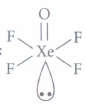
(iv) (b) : XeF2 has 3 lone pairs on Xe atom.
4.
(i) (a) : Thermal stability decreases as the size difference or the electronegativity difference between the two halogen atoms decreases.
(ii) (b) : [ICl2]- - linear, CIF3 - T-shaped, [BrF4] - - Square planar
(iii) (b): It has square pyramidal shape and has 5 bond pairs and one lone pair.
(iv) (c) : In IF7, iodine is the least electronegative halogen, so its highest oxidation number (+7) is more stable than those of the lighter member of the group.
5.
(i) (b)
(ii) (b) :
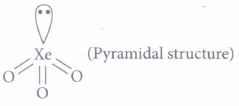
(iii) (c)
(iv) (d) : \(\mathrm{XeO}_{3} \Rightarrow x+(-2) \times 3=0 \Rightarrow x=+6\)

12th Standard CBSE Syllabus & Materials
12th Standard CBSE
CBSE 12th Computer Science Python Revision Tour I - New Previous year Question Papers Study Material - QB365 Set A
NEW12th Standard CBSE
CBSE 12th Business Studies Planning Important Questions And Answers Study Material - QB365 Set A
NEW12th Standard CBSE
CBSE 12th Business Studies Business Environment Important Questions And Answers Study Material - QB365 Set A
NEW12th Standard CBSE
CBSE 12th Business Studies Principles of Management Important Questions And Answers Study Material - QB365 Set A



NCERT Books

Syllabus

Exam Pattern

Sample Question Papers

Previous year Question Papers

Important Notes

MCQ Practice test

NCERT Exemplers

Case study Questions

Image Based Questions

Passage based Questions

HOT Questions

Value Based Questions

Model Questions Papers
NCERT ( Book Back ) Questions

Assertion and Reason
Important Questions And Answers

CBSE 12th Standard CBSE Subjects
CBSE Standards








