
 100% FREE ACCESS
12th Standard CBSE Syllabus & Materials
12th Standard CBSE
CBSE 12th Economics Government Budget and the Economy Previous year Question Papers Study Material - QB365 Set A
NEW12th Standard CBSE
CBSE 12th Computer Science Interface Python with MySQL - New Previous year Question Papers Study Material - QB365 Set A
NEW12th Standard CBSE
CBSE 12th Computer Science Database Concept - New Previous year Question Papers Study Material - QB365 Set A
NEW12th Standard CBSE
CBSE 12th Computer Science Data Communication - New Previous year Question Papers Study Material - QB365 Set A
NEW12th Standard CBSE
CBSE 12th Computer Science Data Structures - New Previous year Question Papers Study Material - QB365 Set A
NEW12th Standard CBSE
CBSE 12th Computer Science Functions - New Previous year Question Papers Study Material - QB365 Set A

Published on: 26/09/2019
Application of Derivatives
Download CBSE Class 12th Standard CBSE Maths question papers, sample papers, important questions, and previous year solved papers in PDF format. Get free study materials, NCERT solutions, and exam preparation resources for Class 12th Standard CBSE Maths
Questions + Answers key
Take MCQ Maths Test
1.
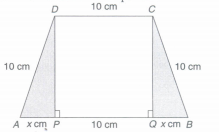
If length of three sides of a trapezium other than base are equal to 10 cm, then find the area of the trapezium when it is maximum.
2.
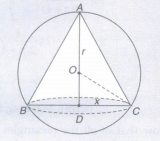
Show that the altitude of the right circular cone of maximum volume that can be inscribed in a sphere of radius r is \(\frac { 4r }{ 3 } \) Also show that the maximum volume of the cone is \(\frac { 8 }{ 27 } \) of the volume of the sphere.
3.
Show that of all the rectangles inscribed in a given fixed circle, the square has the maximum area.
4.
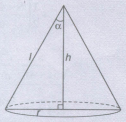
Prove that the semi-vertical angle of the right circular cone of given volume and least curved surface area is \(\cot^{-1}\sqrt2\)
5.
A metal box with a square base and vertical sides is to contain 1024 cm3. The material for the top and bottom costs Rs. 5 per cm2 and the material for the sides cost Rs. 2.50/cm2. Find the least cost of the box.
6.
A tank with rectangular base and rectangular sides open at the top is to be constructed so that its depth is 3 mand volume is 75 cm3. If building of tank costs Rs. 100 per square metre for the base and Rs. 50 per square metre for the sides, find the cost of least expensive tank.
7.
Find the intervals in which f(x) = sin3x - cos3x,0 < x < π is strictly increasing or strictly decreasing.
8.
Find the equation of the tangent line to the curve \(y=x^2-2x+7\) which is
(i) parallel to the line \(2x-y+9=0\)
(ii) perpendicular to the line \(5y-15x=13\)
1.
the required trapezium is as given in figure. Draw perpendiculars DP and CQ on AB. Let AP = x cm. Note that \(\Delta \)APD \(\cong \) \(\Delta \) BQC.
Therefore, QB = x cm. Also, by pythagoras theorem DP = QC = \(\sqrt { 100-{ x }^{ 2 } } \)
Let A be the area of the trapezium.
Then, A \(\equiv \) A(x)
\(=\frac { 1 }{ 2 } (sum\ of\ parallel\ sides)\times (height)\)
\(=\frac { 1 }{ 2 } (2x+10+10)\sqrt { 100-{ x }^{ 2 } } \)
= (x + 10)\(\sqrt { 100-{ x }^{ 2 } } \)
\(or\ A'(x)=(x+10)\frac { (-2x) }{ 2\sqrt { 100-{ x }^{ 2 } } } +(\sqrt { 100-{ x }^{ 2 }) } \)
\(=\frac { -2{ x }^{ 2 }-10x+100 }{ \sqrt { 100-{ x }^{ 2 } } } \)
Now, A'(x) = 0 gives 2x2 + 10x - 100 = 0,
i.e., x = 5 and x = -10
So, x = 5.
Now, A''(x) = \(\frac { \sqrt { 100-{ x }^{ 2 } } (-4x-10)-(-2x^{ 2 }-10x+100)\frac { (-2x) }{ 2\sqrt { 100-{ x }^{ 2 } } } }{ 100-{ x }^{ 2 } } \)
\(=\frac { { 2x }^{ 3 }-300x-1000 }{ { (100-{ x }^{ 2 }) }^{ \frac { 1 }{ 2 } } } \)
(on simplification)
or \(A''(5)=\frac { { 2(5) }^{ 3 }-300(5)-1,000 }{ (100-(5{ ) }^{ 2 })^{ \frac { 3 }{ 2 } } } \)
\(=\frac { -2,250 }{ 75\sqrt { 75 } } =\frac { -30 }{ \sqrt { 75 } } <0\)
Thus, area of trapezium is maximum at x = 5 and the maximum area is given by
A(5) = (5 + 10)\(\sqrt { 100-{ (5) }^{ 2 } } \)
= 15\(\sqrt { 75 } =75\sqrt { 3 } { cm }^{ 2 }\)
2.
Let radius of cone be x and its height be h.
\(\therefore\) OD = (h - r)
Volume of cone (V)
\(=\frac { 1 }{ 3 } \pi { x }^{ 2 }h\) ...(i)
In \(\Delta OCD,\quad { x }^{ 2 }+({ h-r) }^{ 2 }={ r }^{ 2 }or\quad { x }^{ 2 }={ r }^{ 2 }-{ (h-r) }^{ 2 }\)
\(\therefore V=\frac { 1 }{ 3 } \pi h\{ { r }^{ 2 }-(h-r{ ) }^{ 2 }\} \)
\(=\frac { 1 }{ 3 } \pi (-{ h }^{ 3 }+{ 2h }^{ 2 }r)\)
\(\Rightarrow \frac { dV }{ dh } =\frac { \pi }{ 3 } (-3{ h }^{ 2 }+4hr)\)
\(\therefore \quad \frac { dV }{ dh } =0\Rightarrow h=\frac { 4r }{ 3 } \)
\(\frac { { d }^{ 2 }V }{ { dh }^{ 2 } } =\frac { \pi }{ 3 } (-6h+4r)\)
\(=\frac { \pi }{ 3 } \left( -6\left( \frac { 4r }{ 3 } \right) +4r \right) \)
\(=-\frac { 4\pi r }{ 3 } <0\)
\(\therefore \ at\quad h=\frac { 4r }{ 3 } \), Volume is maximum
Maximum volume
\(=\frac { 1 }{ 3 } \pi .\left\{ -{ \left( \frac { 4r }{ 3 } \right) }^{ 3 }+2{ \left( \frac { 4r }{ 3 } \right) }^{ 2 }r \right\} \)
\(=\frac { 8 }{ 27 } .\left( \frac { 4 }{ 3 } \pi { r }^{ 3 } \right) \)
\(=\frac { 8 }{ 27 } \) (volume of sphere)
3.
Let ABCD be a rectangle inscribed in a given circle with centre at 0 and radius a.
Let AB = 2x and BC = 2y
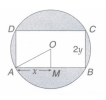
Then, OA2 = OM2 + AM2
\(\Rightarrow a^2=y^2+x^2\)
\(\Rightarrow y=\sqrt{a^2-x^2}\)
Let A be the area of the rectangle.
\(\therefore A=4xy=4x\sqrt{x^2-x^2}\)
\(\Rightarrow \ \ \frac{dA}{dx}=4\{\frac{a^2-2x^2}{\sqrt{a^2-x^2}}\}\)
For maximum or minimum value of A,
\(\frac{dA}{dx}=0\)
\(=4\{\frac{a^2-2x^2}{\sqrt{a^2-x^2}}\}=0\Rightarrow\ \ x=\frac{a}{\sqrt{2}}\)
Now, \(\frac{d^2A}{dx^2}=4\frac{d}{dx}\{(a^2-2x^2)(a^2-x^2)^{-1/2}\}\)
\(\Rightarrow \frac{d^2A}{dx^2}=4[-4x(a^2-x^2)^{-1/2}+(a^2-2x^2)\times(-1/2)(a^2-x^2)^(-3/2)(-2x)]\)
\(=[\frac{-4x}{\sqrt{a^2-x^2}}+\frac{x(a^2-2x^2)}{(a^2-x^2)^{3/2}}]\)
\(\therefore\ (\frac{d^2A}{dx^2})_{x=\frac{a}{\sqrt2}}=-16<0\)
Thus A is maximum when \(x=\frac{a}{\sqrt2}\)
putting \(x=\frac{a}{\sqrt2}\) in (i) \(y=\frac{a}{\sqrt2}\)
Therefore \(x=y=\frac{a}{\sqrt2}\)
Hence area is maximum when x = y ⇒ 2x = 2y
i.e., the rectangle is a square.
4.
let radius, height and slant height of cone be r, h and l respectively.
\(\therefore r^2+h^2=l^2\)
V(volume) \(=\frac{\pi}{3}r^2h\)
\(\Rightarrow V^2=\frac{\pi^2r^4h^2}{9}\)
\(\Rightarrow h^2=\frac{9V^2}{\pi^2r^4}\)
\(A=\pi r l,z=A^2=\pi^2r^2l^2\)
\(=\pi^2r^2(r^2+h^2)\)
\(let \ \ A^2=z\)
\(\therefore\ z=\pi^2r^2[r^2+\frac{9V^2}{\pi^2r^4}]\)
\( z=\pi^2[r^4+\frac{9V^2}{\pi^2r^2}]\)
\( \frac{dz}{dr}=\pi^2[4r^3-\frac{18V^2}{\pi^2r^3}]\)
\(\therefore \ \ \ \frac{dz}{dr}=0\)
\(\Rightarrow\ r=6\sqrt{\frac{9V^2}{2\pi^2}}\)
at \( r=6\sqrt{\frac{9V^2}{2\pi^2}}\)
\(\frac{d^2z}{dr^2}=\pi^2(12r^2+\frac{54V^2}{\pi^2r^4 })>0\)
\(\therefore\) curved surface area is minimum iff
\(2\pi^2r^6=9V^2\)
i.e., \(2\pi^2r^6=\pi^2r^4h^2\)
5.
Given, volume of the box = 1024 cm3.Let length of the side ofsquare base be x cm and height ofthe box be y cm.
= x cm,
height of box = h cm.
Volume of box = 1024 cm3
\(\Rightarrow x.x.h=1024\)
\(\therefore h=\frac{1024}{x^2}\)
C (cost of box) = 5(2x2) + 2.5(4xh)
= 10x2 + 10hx
\(=10x^2+\frac{10,240}{x}\)
\(\Rightarrow \frac{dC}{dx}=20x-\frac{10,240}{x^2}\)
Solving \(\frac{dC}{dx}=0,\) we get x3 = 512 ஃ x = 8
\(=20+\frac{1(10240)}{x^3}>0\)
Thus, cost of box is least at x = 8 and least cost of
box is:
\(C(8)=10(8)^2+\frac{10240}{8}\)
= Rs. 1,920
6.
Let l, b, h be the length, breadth and depth of the tank, respectively.
\(\therefore\ l\times b\times 3=75\)
\(\Rightarrow l\times b=25\)
Let C be the cost, then
C = 100(1x b) + 100[h(b + I)]
\(=100(l\times \frac{25}{l})+300(\frac{25}{l}+l)\)
\(=2500+300(\frac{25}{l}+l)\)
Differentiating w.r.t. l,
\(\therefore\ \frac{dC}{dl}=0+300(\frac{-25}{l^2}+1)\)
Putting \(\frac{dC}{dl}=0\)
\(\Rightarrow 300(-\frac{25}{l^2}+1)=0\)
\(\Rightarrow l^2=25 \ or\ l=5\)
Getting \(\frac{d62C}{dl^2}=300(\frac{50}{l^3})\)
\(\Rightarrow (\frac{d62C}{dl^2})_{at\ l=5}=\frac{15000}{125}>0\)
i.e., C is minimum when l = 5
\(\Rightarrow b=5\)
ஃ C = 100(25) + 300(10)
= 2,500 + 3,000
= 5,500
Hence the minimum cost is Rs. 5,500.
7.
\(\Rightarrow f'(x)=3\cos3x+3\sin3x\)
\(=3(\cos3x+\sin3x)\)
Put \(f'(x)=0\)
\(\Rightarrow \cos3x+\sin3x=0\)
\(\Rightarrow \sin3x=-\cos3x\)
\(\Rightarrow -\tan3x=1\)
\(\Rightarrow \tan3x=-1\)
As 0
ஃ tan 3x is negative for the following values:
\(3x=\frac{3\pi}{4}\)
\(\Rightarrow x=\frac{\pi}{4}\)
\(3x=\pi+\frac{3\pi}{4}=\frac{7\pi}{4}\)
\(\Rightarrow x=\frac{7\pi}{12}\)
\(3x=\frac{7\pi}{4}+\pi=\frac{11\pi}{4}\)
\(\Rightarrow x=\frac{11\pi}{12}\)
Hence we have intervals:
Hence, \(f(x)-\sin3x-\cos3x\) is strictly increasing in the intervals \((0,\frac{\pi}{4})\cup(\frac{7\pi}{12},\frac{11\pi}{12}) \) and strictly decreasing in intervals \((\frac{\pi}{4},\frac{7\pi}{12})\cup(\frac{11\pi}{12},\pi)\)
8.
Slope of tangent = \(\frac{dy}{dx}=2x-2\)
(i) Tangent parallel to \(2x-y+9=0\)
Slope of line = m1(say)
ஃ m1 = 2
ஃ They are parallel
\(\therefore \frac{dy}{dx}=m_1\)
\(\therefore\ 2x-2=2\)
\(x=2,\ y=7\)
Equation of tangent through (2, 7) and parallel to the given line is \(y-7=2(x-2)\Rightarrow y=2x+3\)
(ii) Tangent perpendicular to \(5y-15x=13\)
Slope of line = m2(say)
ஃ m2 = 3
ஃ They are perpendicular
\(\therefore \frac{dy}{dx}=-\frac{1}{m}\)
\(\therefore (2x-2)\cdot3=-1\)
\(\therefore x=\frac{5}{6},y=\frac{217}{36}\)
Equation of tangent through (\(\frac{5}{6},\frac{217}{36}\)) and perpendicular to the line is \(y=-\frac{217}{36}=-\frac{1}{3}(x-\frac{5}{6})\)
\(\Rightarrow y=\frac{-x}{3}+\frac{227}{36}\)
\(12x+36y=227\)

12th Standard CBSE Syllabus & Materials
12th Standard CBSE
CBSE 12th Computer Science Python Revision Tour I - New Previous year Question Papers Study Material - QB365 Set A
NEW12th Standard CBSE
CBSE 12th Business Studies Planning Important Questions And Answers Study Material - QB365 Set A
NEW12th Standard CBSE
CBSE 12th Business Studies Business Environment Important Questions And Answers Study Material - QB365 Set A
NEW12th Standard CBSE
CBSE 12th Business Studies Principles of Management Important Questions And Answers Study Material - QB365 Set A



CBSE 12th Standard CBSE Subjects
CBSE Standards










